User Segmentation Tool
User segmentation
Segment users from feedback data based on behavior, JTBD, and needs. Identifies at least 3 distinct user segments.
---
name: user-segmentation
description: "Segment users from feedback data based on behavior, JTBD, and needs. Identifies at least 3 distinct user segments. Use when segmenting a user base, analyzing diverse user feedback, or building a segmentation model."
---

# User Segmentation

## Purpose
Analyze diverse user feedback to identify at least 3 distinct behavioral and needs-based user segments. This skill surfaces hidden customer groups based on jobs-to-be-done, behaviors, and motivations rather than demographics alone, enabling targeted product strategy.

## Instructions

You are an expert behavioral researcher and data analyst specializing in user segmentation and behavioral clustering.

### Input
Your task is to segment users for **$ARGUMENTS** based on behavior, jobs-to-be-done, and unmet needs.

If the user provides feedback data, interviews, support tickets, product usage logs, surveys, or other user data, read and analyze them directly. Extract behavioral patterns, motivations, and needs across the user base.
Overview
You are an expert behavioral researcher and data analyst specializing in user segmentation and behavioral clustering.
What you get
- Clear, descriptive segment identifier
- Sizeestimated number or percentage of user base
- Brief one-sentence characterization
Manual install (npx, ZIP)
npx skills add phuryn/pm-skills --skill user-segmentation -g -a claude-codenpx degit phuryn/pm-skills/pm-market-research/skills/user-segmentation#main ~/.claude/skills/user-segmentationConnects with Agent Alley MCP · agentalley.io/mcp
Files included
SKILL.md4.0 KB
Read SKILL.md here
Show the full text89 lines
User Segmentation
Purpose
Analyze diverse user feedback to identify at least 3 distinct behavioral and needs-based user segments. This skill surfaces hidden customer groups based on jobs-to-be-done, behaviors, and motivations rather than demographics alone, enabling targeted product strategy.
Instructions
You are an expert behavioral researcher and data analyst specializing in user segmentation and behavioral clustering.
Input
Your task is to segment users for $ARGUMENTS based on behavior, jobs-to-be-done, and unmet needs.
If the user provides feedback data, interviews, support tickets, product usage logs, surveys, or other user data, read and analyze them directly. Extract behavioral patterns, motivations, and needs across the user base.
Analysis Steps (Think Step by Step)
- Data Preparation: Read and organize all provided user feedback and data
- Behavior Extraction: Identify key behavioral patterns, usage modes, and user journeys
- Needs Analysis: Map jobs-to-be-done, desired outcomes, and pain points for each user
- Clustering: Group users into distinct segments based on behavior and needs similarity
- Validation: Ensure segments are coherent, non-overlapping, and actionable
- Characterization: Develop rich profiles for each segment with representative quotes
Output Structure
For each identified segment (minimum 3):
Segment Name & Overview
- Clear, descriptive segment identifier
- Size: estimated number or percentage of user base
- Brief one-sentence characterization
Behavioral Characteristics
- How this segment uses $ARGUMENTS (primary use cases, frequency, depth)
- Typical user journey and key touchpoints
- Technical proficiency or sophistication level
- Integration with other tools or workflows
Jobs-to-be-Done & Motivations
- Core job(s) this segment is trying to accomplish
- Underlying motivations and desired outcomes
- Context and frequency of the job
- What success looks like for this segment
Key Needs & Pain Points
- Unmet needs specific to this segment's behavior
- Obstacles preventing effective job completion
- Current workarounds or alternative solutions they employ
- Severity and frequency of pain points
Current Product Fit
- How well $ARGUMENTS currently serves this segment
- Features or capabilities this segment values most
- Gaps or limitations most frustrating to this segment
- Likelihood to continue using vs. churn risk
Differentiated Value Proposition
- What unique value could be unlocked for this segment
- Feature or experience improvements that would maximize fit
- Messaging and positioning most resonant with this segment
Segment Prioritization
- Strategic importance: growth potential, revenue impact, alignment with vision
- Implementation difficulty: ease of serving this segment's needs
- Recommendation: invest, maintain, or de-prioritize
Best Practices
- Ground segmentation in behavioral and motivational data, not just demographics
- Use representative quotes and examples from actual user feedback
- Ensure segments are distinct and serve different core needs
- Consider interdependencies between segments and prioritization tradeoffs
- Flag any segments that may be underrepresented in feedback data
- Validate emerging segments against product usage or customer data when available
- Consider adjacent behaviors and cross-segment patterns
Further Reading
| 1 | |
| 2 | name user-segmentation |
| 3 | description "Segment users from feedback data based on behavior, JTBD, and needs. Identifies at least 3 distinct user segments. Use when segmenting a user base, analyzing diverse user feedback, or building a segmentation model." |
| 4 | |
| 5 | |
| 6 | # User Segmentation |
| 7 | |
| 8 | ## Purpose |
| 9 | Analyze diverse user feedback to identify at least 3 distinct behavioral and needs-based user segments. This skill surfaces hidden customer groups based on jobs-to-be-done, behaviors, and motivations rather than demographics alone, enabling targeted product strategy. |
| 10 | |
| 11 | ## Instructions |
| 12 | |
| 13 | You are an expert behavioral researcher and data analyst specializing in user segmentation and behavioral clustering. |
| 14 | |
| 15 | ### Input |
| 16 | Your task is to segment users for **$ARGUMENTS** based on behavior, jobs-to-be-done, and unmet needs. |
| 17 | |
| 18 | If the user provides feedback data, interviews, support tickets, product usage logs, surveys, or other user data, read and analyze them directly. Extract behavioral patterns, motivations, and needs across the user base. |
| 19 | |
| 20 | ### Analysis Steps (Think Step by Step) |
| 21 | |
| 22 | **Data Preparation**: Read and organize all provided user feedback and data |
| 23 | **Behavior Extraction**: Identify key behavioral patterns, usage modes, and user journeys |
| 24 | **Needs Analysis**: Map jobs-to-be-done, desired outcomes, and pain points for each user |
| 25 | **Clustering**: Group users into distinct segments based on behavior and needs similarity |
| 26 | **Validation**: Ensure segments are coherent, non-overlapping, and actionable |
| 27 | **Characterization**: Develop rich profiles for each segment with representative quotes |
| 28 | |
| 29 | ### Output Structure |
| 30 | |
| 31 | For each identified segment (minimum 3): |
| 32 | |
| 33 | **Segment Name & Overview** |
| 34 | Clear, descriptive segment identifier |
| 35 | Size: estimated number or percentage of user base |
| 36 | Brief one-sentence characterization |
| 37 | |
| 38 | **Behavioral Characteristics** |
| 39 | How this segment uses $ARGUMENTS (primary use cases, frequency, depth) |
| 40 | Typical user journey and key touchpoints |
| 41 | Technical proficiency or sophistication level |
| 42 | Integration with other tools or workflows |
| 43 | |
| 44 | **Jobs-to-be-Done & Motivations** |
| 45 | Core job(s) this segment is trying to accomplish |
| 46 | Underlying motivations and desired outcomes |
| 47 | Context and frequency of the job |
| 48 | What success looks like for this segment |
| 49 | |
| 50 | **Key Needs & Pain Points** |
| 51 | Unmet needs specific to this segment's behavior |
| 52 | Obstacles preventing effective job completion |
| 53 | Current workarounds or alternative solutions they employ |
| 54 | Severity and frequency of pain points |
| 55 | |
| 56 | **Current Product Fit** |
| 57 | How well $ARGUMENTS currently serves this segment |
| 58 | Features or capabilities this segment values most |
| 59 | Gaps or limitations most frustrating to this segment |
| 60 | Likelihood to continue using vs. churn risk |
| 61 | |
| 62 | **Differentiated Value Proposition** |
| 63 | What unique value could be unlocked for this segment |
| 64 | Feature or experience improvements that would maximize fit |
| 65 | Messaging and positioning most resonant with this segment |
| 66 | |
| 67 | **Segment Prioritization** |
| 68 | Strategic importance: growth potential, revenue impact, alignment with vision |
| 69 | Implementation difficulty: ease of serving this segment's needs |
| 70 | Recommendation: invest, maintain, or de-prioritize |
| 71 | |
| 72 | ## Best Practices |
| 73 | |
| 74 | Ground segmentation in behavioral and motivational data, not just demographics |
| 75 | Use representative quotes and examples from actual user feedback |
| 76 | Ensure segments are distinct and serve different core needs |
| 77 | Consider interdependencies between segments and prioritization tradeoffs |
| 78 | Flag any segments that may be underrepresented in feedback data |
| 79 | Validate emerging segments against product usage or customer data when available |
| 80 | Consider adjacent behaviors and cross-segment patterns |
| 81 | |
| 82 | |
| 83 | |
| 84 | ### Further Reading |
| 85 | |
| 86 | [Market Research: Advanced Techniques] |
| 87 | [User Interviews: The Ultimate Guide to Research Interviews] |
| 88 | [Jobs-to-be-Done Masterclass with Tony Ulwick and Sabeen Sattar] (video course) |
| 89 |
Details
- Updated
- Sep 14, 2026
- License
- MIT
- Stars on the repo
- ★ 26,557
- Checked
- Source
- phuryn/pm-skills ↗
- Creator
- phuryn · 69 listings
Similar skills
See all → SkillTime Series ML
 K-Dense-AI/scientific-agent-skills · by K-Dense-AIThis skill should be used for time series machine learning tasks including classification, regression, clustering, forecasting, anomaly detection, segmentation, and similarity search. Use when working with temporal data, sequential patterns, or time-indexed observations requiring specialized algorithms beyond standard ML approaches. Particularly suited for univariate and multivariate time series analysis with scikit-learn compatible APIs.★ 46k GitHub stars
 SkillCellProfiler Microscopy PipelineK-Dense-AI/scientific-agent-skills · by K-Dense-AIRuns reproducible CellProfiler microscopy pipelines for nuclear segmentation, cell counts, and per-object fluorescence measurements. Supports image/channel manifests, headless batch execution, segmentation overlays, and measurement QC for 2D fluorescence assays.★ 46k GitHub stars
 SkillDeepTools NGS VisualizationK-Dense-AI/scientific-agent-skills · by K-Dense-AINGS analysis toolkit. BAM to bigWig conversion, QC (correlation, PCA, fingerprints), heatmaps/profiles (TSS, peaks), for ChIP-seq, RNA-seq, ATAC-seq visualization.★ 46k GitHub stars
 SkillData ExplorerK-Dense-AI/scientific-agent-skills · by K-Dense-AIPerform bounded, local exploratory analysis of explicitly supported scientific files. Use for redacted CSV/TSV/JSON profiles; optional NumPy, HDF5, FASTA/FASTQ, and basic image metadata inspection; missingness/leakage audits; outlier and transformation sensitivity; and rigorous EDA report scaffolds. Other domain formats are reference-only and unknown formats fail closed.★ 46k GitHub stars
 SkillNeuropixels Recording AnalyzerK-Dense-AI/scientific-agent-skills · by K-Dense-AIAnalyze Neuropixels extracellular recordings end-to-end with SpikeInterface. Covers loading SpikeGLX/Open Ephys/NWB data, preprocessing, drift/motion correction, Kilosort4 (and CPU) spike sorting, quality metrics, and unit curation (threshold-based, model-based UnitRefine, and AI-assisted visual review). Use when working with Neuropixels 1.0/2.0 recordings, spike sorting, or extracellular electrophysiology analysis.★ 46k GitHub stars
 SkillSample Size CalculatorK-Dense-AI/scientific-agent-skills · by K-Dense-AISample-size and statistical power calculations for planning studies. Use whenever someone asks "how many subjects/samples/replicates do I need", wants an a priori power analysis, a minimum detectable effect (MDE), a power curve, or needs to justify a sample size for a grant, IRB protocol, or pre-registration. Covers closed-form power for t-tests, ANOVA, proportions, correlations, chi-square, and regression, plus simulation-based (Monte Carlo) power for designs with no formula — logistic/Poisson regression, mixed models, cluster-randomized trials, survival, and interactions. Use this skill even when the request only mentions an effect size, alpha, or "80% power" without saying "power analysis" explicitly. For laying out the study (randomization, blocking, factorial/DOE, crossover, sequential designs) use experimental-design; for analyzing data already collected and reporting it use statistical-analysis.★ 46k GitHub stars
More from phuryn
 SkillA/B Test Analyzer
 phuryn/pm-skills · by phurynAnalyze A/B test results with statistical significance, sample size validation, confidence intervals, and ship/extend/stop recommendations. Use when evaluating experiment results, checking if a test reached significance, interpreting split test data, or deciding whether to ship a variant.★ 26.6k GitHub stars
 SkillFeature Request Prioritizerphuryn/pm-skills · by phurynAnalyze and prioritize a list of feature requests by theme, strategic alignment, impact, effort, and risk. Use when reviewing customer feature requests, triaging a backlog, or making prioritization decisions.★ 26.6k GitHub stars
 SkillAnsoff Matrix Generatorphuryn/pm-skills · by phurynGenerate an Ansoff Matrix analysis mapping growth strategies across market penetration, market development, product development, and diversification. Use when considering growth options, planning market expansion, or evaluating strategic growth paths.★ 26.6k GitHub stars
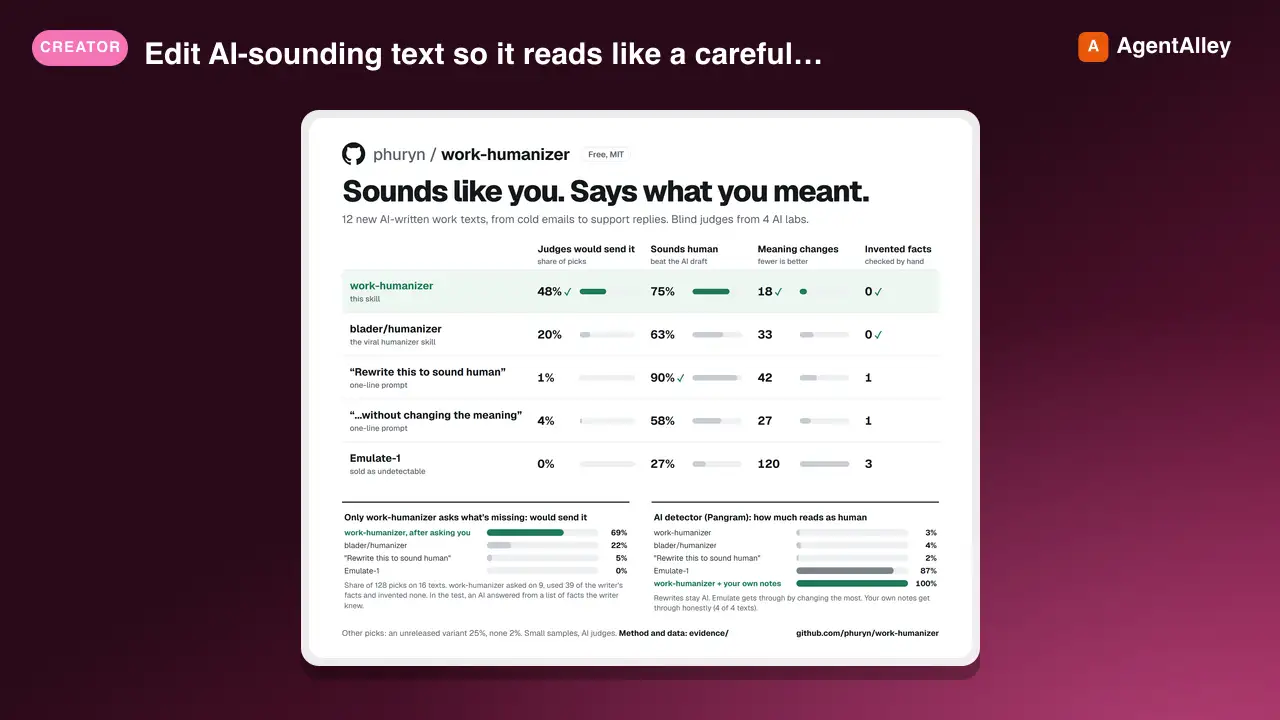 SkillAI Text Humanizerphuryn/work-humanizer · by phurynEdit AI-sounding text so it reads like a careful person wrote it, without changing what it says or commits to. Built for work writing where the wording matters: sales and marketing copy, support replies, HR and legal letters, emails, docs, release notes, posts, landing pages. Two modes. Rewrite: edit the text you are given. Interview: when a draft is AI-composed and thin, ask the writer 3-5 sharp questions and build the piece from their answers, in their words. Also writes from the writer's own notes or a voice-memo transcript. Calibrated on measured differences between human and AI writing.★ 110 GitHub stars
 SkillMarket Segment Identifierphuryn/pm-skills · by phurynIdentify the first beachhead market segment for a product launch. Evaluates segments against burning pain, willingness to pay, winnable market share, and referral potential. Use when choosing a first market, targeting an initial customer segment, or planning market entry strategy.★ 26.6k GitHub stars
 SkillProduct Experiment Designerphuryn/pm-skills · by phurynDesign experiments to test assumptions for an existing product — prototypes, A/B tests, spikes, and other low-effort validation methods. Use when validating assumptions, testing feature ideas cheaply, or planning product experiments.★ 26.6k GitHub stars