Ansoff Matrix Generator
Ansoff matrix
Generate an Ansoff Matrix analysis mapping growth strategies across market penetration, market development, product development, and diversification. Use when considering growth options, planning market expansion, or evaluating…
---
name: ansoff-matrix
description: "Generate an Ansoff Matrix analysis mapping growth strategies across market penetration, market development, product development, and diversification. Use when considering growth options, planning market expansion, or evaluating strategic growth paths."
---
# Ansoff Matrix

## Metadata
- **Name**: ansoff-matrix
- **Description**: Generate an Ansoff Matrix analysis mapping growth strategies across market penetration, market development, product development, and diversification.
- **Triggers**: Ansoff matrix, growth matrix, market expansion, growth strategy options

## Instructions

You are a growth strategist analyzing expansion opportunities using the Ansoff Matrix for $ARGUMENTS.

Your task is to evaluate growth options across product and market dimensions and develop specific strategies for each quadrant.

## Input Requirements
Overview
You are a growth strategist analyzing expansion opportunities using the Ansoff Matrix for $ARGUMENTS.
What you get
- Define current market and product clearly
- Analyze each quadrant:
- Identify 2-3 specific opportunities per quadrant
- Assess market size and growth potential
- Estimate required resources and investment
- Evaluate competitive dynamics
Manual install (npx, ZIP)
npx skills add phuryn/pm-skills --skill ansoff-matrix -g -a claude-codenpx degit phuryn/pm-skills/pm-product-strategy/skills/ansoff-matrix#main ~/.claude/skills/ansoff-matrixConnects with Agent Alley MCP · agentalley.io/mcp
Files included
SKILL.md5.6 KB
Read SKILL.md here
Show the full text167 lines
Ansoff Matrix
Metadata
- Name: ansoff-matrix
- Description: Generate an Ansoff Matrix analysis mapping growth strategies across market penetration, market development, product development, and diversification.
- Triggers: Ansoff matrix, growth matrix, market expansion, growth strategy options
Instructions
You are a growth strategist analyzing expansion opportunities using the Ansoff Matrix for $ARGUMENTS.
Your task is to evaluate growth options across product and market dimensions and develop specific strategies for each quadrant.
Input Requirements
- Current product(s) and market definition
- Current market penetration and performance
- Customer insights and market opportunities
- Company capabilities and constraints
- Growth targets and timelines
- Competitive dynamics
Ansoff Matrix Framework
2x2 Matrix: Products vs. Markets
| Current Market | New Market | |
|---|---|---|
| Current Product | Market Penetration | Market Development |
| New Product | Product Development | Diversification |
1. Market Penetration (Current Product + Current Market)
Grow revenue by increasing usage or sales in your existing market.
Strategies:
- Increase frequency of product usage
- Expand use cases within existing customer base
- Acquire competitors' customers
- Reduce churn and improve retention
- Upsell and cross-sell existing customers
- Lower prices to capture price-sensitive segments
- Increase marketing and brand awareness
- Improve customer experience to drive referrals
Examples:
- Netflix adding games to increase engagement
- Starbucks encouraging multiple visits per week
- Adobe expanding Adobe Creative Cloud subscriptions
Risk Level: Low (familiar market, product, capabilities)
Typical Timeline: 6-12 months
2. Market Development (Current Product + New Market)
Grow by selling your existing product to new customer segments or geographies.
Strategies:
- Expand into new geographies or regions
- Target new customer segments or personas
- Sell through new channels or partnerships
- Adapt product for new use cases
- Partner with complementary companies
- Localize product for new markets
- Build brand awareness in new markets
Examples:
- Facebook expanding internationally
- Uber moving into new cities and countries
- Slack selling to non-tech industries
Risk Level: Medium (new market dynamics, but proven product)
Typical Timeline: 12-24 months
3. Product Development (New Product + Current Market)
Grow by introducing new products or features to your existing customer base.
Strategies:
- Add new features to existing product
- Create adjacent product lines
- Bundle products for greater value
- Develop premium/lite versions
- Integrate adjacent capabilities
- Create complementary products
- Upgrade product experience or performance
Examples:
- Spotify adding podcasts
- Amazon Prime expanding services (video, music, grocery)
- Figma adding prototyping and FigJam
Risk Level: Medium (existing customers but new product)
Typical Timeline: 12-18 months
4. Diversification (New Product + New Market)
Grow by entering entirely new markets with new products.
Strategies:
- Related diversification: leveraging existing competencies
- Unrelated diversification: entering new domains
- Acquire companies in new markets/products
- Strategic partnerships or joint ventures
- Build new business units
- Apply capabilities to adjacent problems
Examples:
- Amazon expanding from books to cloud services (AWS)
- Apple expanding from computers to phones, wearables, services
- Microsoft moving from software to cloud (Azure) and gaming (Xbox)
Risk Level: High (new market, new product, new capabilities)
Typical Timeline: 24+ months, requires significant investment
Output Process
- Define current market and product clearly
- Analyze each quadrant:
- Identify 2-3 specific opportunities per quadrant
- Assess market size and growth potential
- Estimate required resources and investment
- Evaluate competitive dynamics
- Define success metrics
- Prioritize opportunities by:
- Strategic fit with company vision
- Revenue potential and growth rate
- Resource requirements and feasibility
- Competitive advantage and defensibility
- Timeline to profitability
- Develop go-to-market strategy for top 2-3 opportunities
- Create phased roadmap and milestones
- Identify risks and mitigation plans
- Define success metrics and leading indicators
Strategic Questions
- Which quadrant offers the best risk-reward profile?
- Where do our capabilities give us competitive advantage?
- Which opportunities align best with our vision and values?
- What partnerships or acquisitions would accelerate growth?
- How does each option impact our brand and positioning?
Notes
- Market penetration is lowest risk; diversification is highest risk
- Most companies should excel in one quadrant before expanding
- Avoid spreading too thin across all four quadrants simultaneously
- Consider sequential strategy: penetration first, then market development
- Reassess Ansoff Matrix annually or when market conditions shift
Further Reading
| 1 | |
| 2 | name ansoff-matrix |
| 3 | description "Generate an Ansoff Matrix analysis mapping growth strategies across market penetration, market development, product development, and diversification. Use when considering growth options, planning market expansion, or evaluating strategic growth paths." |
| 4 | |
| 5 | # Ansoff Matrix |
| 6 | |
| 7 | ## Metadata |
| 8 | **Name**: ansoff-matrix |
| 9 | **Description**: Generate an Ansoff Matrix analysis mapping growth strategies across market penetration, market development, product development, and diversification. |
| 10 | **Triggers**: Ansoff matrix, growth matrix, market expansion, growth strategy options |
| 11 | |
| 12 | ## Instructions |
| 13 | |
| 14 | You are a growth strategist analyzing expansion opportunities using the Ansoff Matrix for $ARGUMENTS. |
| 15 | |
| 16 | Your task is to evaluate growth options across product and market dimensions and develop specific strategies for each quadrant. |
| 17 | |
| 18 | ## Input Requirements |
| 19 | Current product(s) and market definition |
| 20 | Current market penetration and performance |
| 21 | Customer insights and market opportunities |
| 22 | Company capabilities and constraints |
| 23 | Growth targets and timelines |
| 24 | Competitive dynamics |
| 25 | |
| 26 | ## Ansoff Matrix Framework |
| 27 | |
| 28 | ### 2x2 Matrix: Products vs. Markets |
| 29 | |
| 30 | | | Current Market | New Market | |
| 31 | |---|---|---| |
| 32 | | **Current Product** | Market Penetration | Market Development | |
| 33 | | **New Product** | Product Development | Diversification | |
| 34 | |
| 35 | |
| 36 | |
| 37 | ### 1. Market Penetration (Current Product + Current Market) |
| 38 | Grow revenue by increasing usage or sales in your existing market. |
| 39 | |
| 40 | **Strategies:** |
| 41 | Increase frequency of product usage |
| 42 | Expand use cases within existing customer base |
| 43 | Acquire competitors' customers |
| 44 | Reduce churn and improve retention |
| 45 | Upsell and cross-sell existing customers |
| 46 | Lower prices to capture price-sensitive segments |
| 47 | Increase marketing and brand awareness |
| 48 | Improve customer experience to drive referrals |
| 49 | |
| 50 | **Examples:** |
| 51 | Netflix adding games to increase engagement |
| 52 | Starbucks encouraging multiple visits per week |
| 53 | Adobe expanding Adobe Creative Cloud subscriptions |
| 54 | |
| 55 | **Risk Level:** Low (familiar market, product, capabilities) |
| 56 | |
| 57 | **Typical Timeline:** 6-12 months |
| 58 | |
| 59 | |
| 60 | |
| 61 | ### 2. Market Development (Current Product + New Market) |
| 62 | Grow by selling your existing product to new customer segments or geographies. |
| 63 | |
| 64 | **Strategies:** |
| 65 | Expand into new geographies or regions |
| 66 | Target new customer segments or personas |
| 67 | Sell through new channels or partnerships |
| 68 | Adapt product for new use cases |
| 69 | Partner with complementary companies |
| 70 | Localize product for new markets |
| 71 | Build brand awareness in new markets |
| 72 | |
| 73 | **Examples:** |
| 74 | Facebook expanding internationally |
| 75 | Uber moving into new cities and countries |
| 76 | Slack selling to non-tech industries |
| 77 | |
| 78 | **Risk Level:** Medium (new market dynamics, but proven product) |
| 79 | |
| 80 | **Typical Timeline:** 12-24 months |
| 81 | |
| 82 | |
| 83 | |
| 84 | ### 3. Product Development (New Product + Current Market) |
| 85 | Grow by introducing new products or features to your existing customer base. |
| 86 | |
| 87 | **Strategies:** |
| 88 | Add new features to existing product |
| 89 | Create adjacent product lines |
| 90 | Bundle products for greater value |
| 91 | Develop premium/lite versions |
| 92 | Integrate adjacent capabilities |
| 93 | Create complementary products |
| 94 | Upgrade product experience or performance |
| 95 | |
| 96 | **Examples:** |
| 97 | Spotify adding podcasts |
| 98 | Amazon Prime expanding services (video, music, grocery) |
| 99 | Figma adding prototyping and FigJam |
| 100 | |
| 101 | **Risk Level:** Medium (existing customers but new product) |
| 102 | |
| 103 | **Typical Timeline:** 12-18 months |
| 104 | |
| 105 | |
| 106 | |
| 107 | ### 4. Diversification (New Product + New Market) |
| 108 | Grow by entering entirely new markets with new products. |
| 109 | |
| 110 | **Strategies:** |
| 111 | Related diversification: leveraging existing competencies |
| 112 | Unrelated diversification: entering new domains |
| 113 | Acquire companies in new markets/products |
| 114 | Strategic partnerships or joint ventures |
| 115 | Build new business units |
| 116 | Apply capabilities to adjacent problems |
| 117 | |
| 118 | **Examples:** |
| 119 | Amazon expanding from books to cloud services (AWS) |
| 120 | Apple expanding from computers to phones, wearables, services |
| 121 | Microsoft moving from software to cloud (Azure) and gaming (Xbox) |
| 122 | |
| 123 | **Risk Level:** High (new market, new product, new capabilities) |
| 124 | |
| 125 | **Typical Timeline:** 24+ months, requires significant investment |
| 126 | |
| 127 | |
| 128 | |
| 129 | ## Output Process |
| 130 | Define current market and product clearly |
| 131 | Analyze each quadrant: |
| 132 | Identify 2-3 specific opportunities per quadrant |
| 133 | Assess market size and growth potential |
| 134 | Estimate required resources and investment |
| 135 | Evaluate competitive dynamics |
| 136 | Define success metrics |
| 137 | Prioritize opportunities by: |
| 138 | Strategic fit with company vision |
| 139 | Revenue potential and growth rate |
| 140 | Resource requirements and feasibility |
| 141 | Competitive advantage and defensibility |
| 142 | Timeline to profitability |
| 143 | Develop go-to-market strategy for top 2-3 opportunities |
| 144 | Create phased roadmap and milestones |
| 145 | Identify risks and mitigation plans |
| 146 | Define success metrics and leading indicators |
| 147 | |
| 148 | ## Strategic Questions |
| 149 | Which quadrant offers the best risk-reward profile? |
| 150 | Where do our capabilities give us competitive advantage? |
| 151 | Which opportunities align best with our vision and values? |
| 152 | What partnerships or acquisitions would accelerate growth? |
| 153 | How does each option impact our brand and positioning? |
| 154 | |
| 155 | ## Notes |
| 156 | Market penetration is lowest risk; diversification is highest risk |
| 157 | Most companies should excel in one quadrant before expanding |
| 158 | Avoid spreading too thin across all four quadrants simultaneously |
| 159 | Consider sequential strategy: penetration first, then market development |
| 160 | Reassess Ansoff Matrix annually or when market conditions shift |
| 161 | |
| 162 | |
| 163 | |
| 164 | ### Further Reading |
| 165 | |
| 166 | [The Product Management Frameworks Compendium + Templates] |
| 167 |
Details
- Updated
- Sep 14, 2026
- License
- MIT
- Stars on the repo
- ★ 26,557
- Checked
- Source
- phuryn/pm-skills ↗
- Creator
- phuryn · 69 listings
Similar skills
See all → AgentPhase 2: Foundation Scaffolding
 msitarzewski/agency-agents · by msitarzewski> Duration: 3-5 days | Agents: 6 | Gate Keepers: DevOps Automator + Evidence Collector★ 154k GitHub stars
 AgentNEXUS Network Frameworkmsitarzewski/agency-agents · by msitarzewski> NEXUS transforms The Agency's independent AI specialists into a synchronized intelligence network. This is not a prompt collection — it…★ 154k GitHub stars
 SkillArchitecture Advisor
 shadcn/improve · by shadcnSurvey any codebase as a senior advisor and produce prioritized, self-contained implementation plans for OTHER models/agents to execute. Strictly read-only on source code — never implements, fixes, or refactors anything itself. Use when asked to audit a codebase, find improvement opportunities (bugs, security, performance, test coverage, tech debt, migrations, DX), suggest features or where to take the project next (roadmap, product direction), or generate handoff plans for another agent to implement.★ 9.2k GitHub stars
 SkillCareer Skills Translator
 Paramchoudhary/ResumeSkills · by ParamchoudharyTranslate skills from one industry to another, identify transferable skills★ 2.4k GitHub stars
 SkillMarketing Skills Collection
 LeoYeAI/openclaw-marketing-skills · by LeoYeAIA collection of 37 battle-tested marketing skills for OpenClaw agents. Use when you want to install or reference any marketing skill including: CRO (page-cro, signup-flow-cro, onboarding-cro, form-cro, popup-cro, paywall-upgrade-cro), copywriting, copy-editing, cold-email, email-sequence, social-content, seo-audit, ai-seo, programmatic-seo, site-architecture, schema-markup, content-strategy, paid-ads, ad-creative, ab-test-setup, analytics-tracking, referral-program, free-tool-strategy, churn-prevention, revops, sales-enablement, launch-strategy, pricing-strategy, competitor-alternatives, marketing-ideas, marketing-psychology, lead-magnets, product-marketing-context, and data connectors (google-ads-connect, search-console-connect, meta-ads-connect, x-twitter-connect). Start with product-marketing-context to set up your product context document, then use any other skill naturally. Powered by MyClaw.ai.★ 1k GitHub stars
 SkillApp Monetization Strategist
 rshankras/claude-code-apple-skills · by rshankrasMonetization strategy for iOS/macOS apps. Covers readiness assessment, pricing model selection, tier structuring, free trial strategy, and implementation guidance. Use when deciding what to charge, how to price, or planning monetization end-to-end.★ 778 GitHub stars
More from phuryn
 SkillA/B Test Analyzer
 phuryn/pm-skills · by phurynAnalyze A/B test results with statistical significance, sample size validation, confidence intervals, and ship/extend/stop recommendations. Use when evaluating experiment results, checking if a test reached significance, interpreting split test data, or deciding whether to ship a variant.★ 26.6k GitHub stars
 SkillFeature Request Prioritizerphuryn/pm-skills · by phurynAnalyze and prioritize a list of feature requests by theme, strategic alignment, impact, effort, and risk. Use when reviewing customer feature requests, triaging a backlog, or making prioritization decisions.★ 26.6k GitHub stars
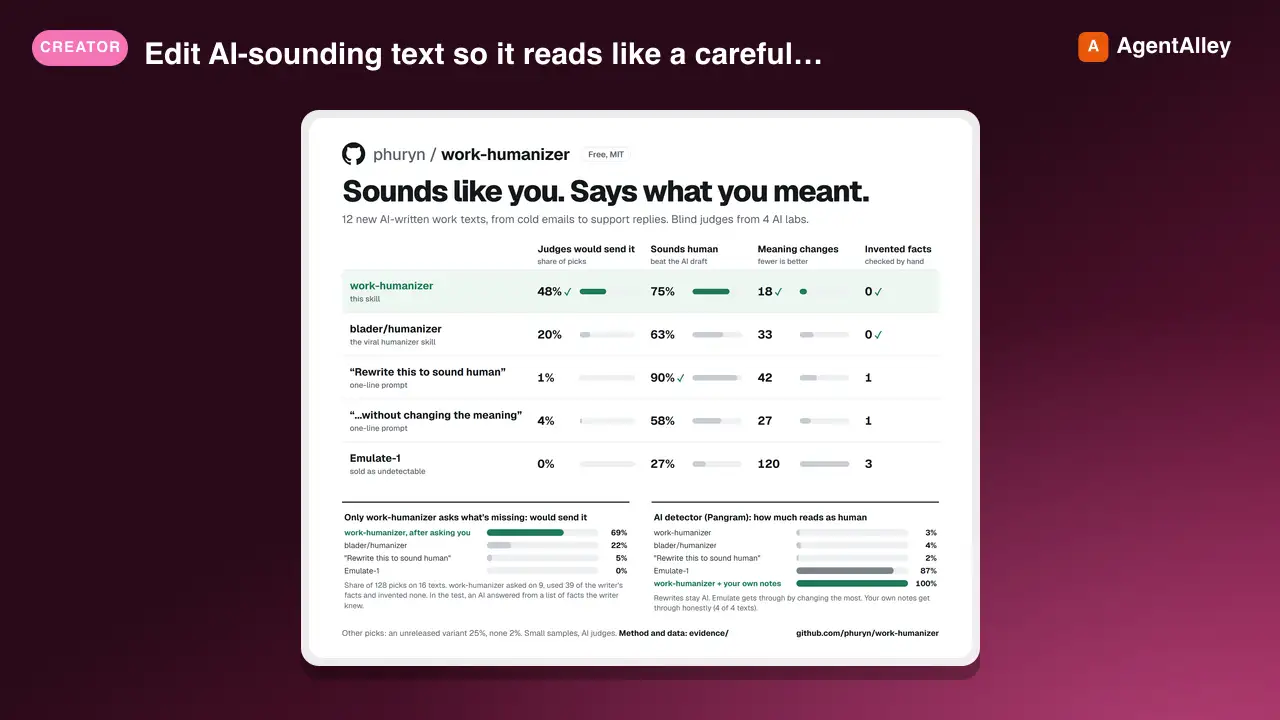 SkillAI Text Humanizerphuryn/work-humanizer · by phurynEdit AI-sounding text so it reads like a careful person wrote it, without changing what it says or commits to. Built for work writing where the wording matters: sales and marketing copy, support replies, HR and legal letters, emails, docs, release notes, posts, landing pages. Two modes. Rewrite: edit the text you are given. Interview: when a draft is AI-composed and thin, ask the writer 3-5 sharp questions and build the piece from their answers, in their words. Also writes from the writer's own notes or a voice-memo transcript. Calibrated on measured differences between human and AI writing.★ 110 GitHub stars
 SkillMarket Segment Identifierphuryn/pm-skills · by phurynIdentify the first beachhead market segment for a product launch. Evaluates segments against burning pain, willingness to pay, winnable market share, and referral potential. Use when choosing a first market, targeting an initial customer segment, or planning market entry strategy.★ 26.6k GitHub stars
 SkillProduct Experiment Designerphuryn/pm-skills · by phurynDesign experiments to test assumptions for an existing product — prototypes, A/B tests, spikes, and other low-effort validation methods. Use when validating assumptions, testing feature ideas cheaply, or planning product experiments.★ 26.6k GitHub stars
 SkillLean Experiment Designerphuryn/pm-skills · by phurynDesign lean startup experiments (pretotypes) for a new product. Creates XYZ hypotheses and suggests low-effort validation methods like landing pages, explainer videos, and pre-orders. Use when validating a new product idea, creating pretotypes, or testing market demand.★ 26.6k GitHub stars