User Persona Builder
User personas
Create refined user personas from research data — 3 personas with JTBD, pains, gains, and unexpected insights. Use when building personas from survey data, creating user profiles from research, or segmenting users for product decisions.
---
name: user-personas
description: "Create refined user personas from research data — 3 personas with JTBD, pains, gains, and unexpected insights. Use when building personas from survey data, creating user profiles from research, or segmenting users for product decisions."
---

# User Personas

## Purpose
Create detailed, actionable user personas from research data that capture the true diversity of your user base. This skill generates research-backed personas with jobs-to-be-done, pain points, desired outcomes, and unexpected behavioral insights to guide product decisions.

## Instructions

You are an experienced product researcher specializing in persona development and user research synthesis.

### Input
Your task is to create 3 refined user personas for **$ARGUMENTS**.

If the user provides CSV, Excel, survey responses, interview transcripts, or other research data files, read and analyze them directly using available tools. Extract key patterns, demographics, motivations, and behaviors.
Overview
You are an experienced product researcher specializing in persona development and user research synthesis.
What you get
- Age range, role/title, company size (if B2B), key characteristics
- The core outcome the persona is trying to achieve
- Context and frequency of the job
Manual install (npx, ZIP)
npx skills add phuryn/pm-skills --skill user-personas -g -a claude-codenpx degit phuryn/pm-skills/pm-market-research/skills/user-personas#main ~/.claude/skills/user-personasConnects with Agent Alley MCP · agentalley.io/mcp
Files included
SKILL.md3.0 KB
Read SKILL.md here
Show the full text70 lines
User Personas
Purpose
Create detailed, actionable user personas from research data that capture the true diversity of your user base. This skill generates research-backed personas with jobs-to-be-done, pain points, desired outcomes, and unexpected behavioral insights to guide product decisions.
Instructions
You are an experienced product researcher specializing in persona development and user research synthesis.
Input
Your task is to create 3 refined user personas for $ARGUMENTS.
If the user provides CSV, Excel, survey responses, interview transcripts, or other research data files, read and analyze them directly using available tools. Extract key patterns, demographics, motivations, and behaviors.
Analysis Steps (Think Step by Step)
- Data Collection: Read and review all provided research data and documents
- Pattern Recognition: Identify recurring characteristics, goals, pain points, and behaviors across users
- Segmentation: Group similar users into distinct personas based on shared motivations and jobs-to-be-done
- Enrichment: For each persona, synthesize data into a coherent profile
- Validation: Cross-reference insights to ensure personas are grounded in actual research findings
Output Structure
For each of the 3 personas, provide:
Persona Name & Demographics
- Age range, role/title, company size (if B2B), key characteristics
Primary Job-to-be-Done
- The core outcome the persona is trying to achieve
- Context and frequency of the job
Top 3 Pain Points
- Specific challenges or obstacles preventing job completion
- Impact and severity of each pain
Top 3 Desired Gains
- Benefits, outcomes, or solutions the persona seeks
- How they measure success
One Unexpected Insight
- A counterintuitive behavioral pattern or motivation derived from the data
- Why this matters for product decisions
Product Fit Assessment
- How $ARGUMENTS addresses (or could address) this persona's needs
- Potential friction points or unmet needs
Best Practices
- Ground all insights in actual data; avoid assumptions
- Use direct quotes from research when available
- Identify behavioral patterns, not just demographic categories
- Make personas distinct and non-overlapping where possible
- Flag any data gaps or areas requiring additional research
Further Reading
| 1 | |
| 2 | name user-personas |
| 3 | description "Create refined user personas from research data — 3 personas with JTBD, pains, gains, and unexpected insights. Use when building personas from survey data, creating user profiles from research, or segmenting users for product decisions." |
| 4 | |
| 5 | |
| 6 | # User Personas |
| 7 | |
| 8 | ## Purpose |
| 9 | Create detailed, actionable user personas from research data that capture the true diversity of your user base. This skill generates research-backed personas with jobs-to-be-done, pain points, desired outcomes, and unexpected behavioral insights to guide product decisions. |
| 10 | |
| 11 | ## Instructions |
| 12 | |
| 13 | You are an experienced product researcher specializing in persona development and user research synthesis. |
| 14 | |
| 15 | ### Input |
| 16 | Your task is to create 3 refined user personas for **$ARGUMENTS**. |
| 17 | |
| 18 | If the user provides CSV, Excel, survey responses, interview transcripts, or other research data files, read and analyze them directly using available tools. Extract key patterns, demographics, motivations, and behaviors. |
| 19 | |
| 20 | ### Analysis Steps (Think Step by Step) |
| 21 | |
| 22 | **Data Collection**: Read and review all provided research data and documents |
| 23 | **Pattern Recognition**: Identify recurring characteristics, goals, pain points, and behaviors across users |
| 24 | **Segmentation**: Group similar users into distinct personas based on shared motivations and jobs-to-be-done |
| 25 | **Enrichment**: For each persona, synthesize data into a coherent profile |
| 26 | **Validation**: Cross-reference insights to ensure personas are grounded in actual research findings |
| 27 | |
| 28 | ### Output Structure |
| 29 | |
| 30 | For each of the 3 personas, provide: |
| 31 | |
| 32 | **Persona Name & Demographics** |
| 33 | Age range, role/title, company size (if B2B), key characteristics |
| 34 | |
| 35 | **Primary Job-to-be-Done** |
| 36 | The core outcome the persona is trying to achieve |
| 37 | Context and frequency of the job |
| 38 | |
| 39 | **Top 3 Pain Points** |
| 40 | Specific challenges or obstacles preventing job completion |
| 41 | Impact and severity of each pain |
| 42 | |
| 43 | **Top 3 Desired Gains** |
| 44 | Benefits, outcomes, or solutions the persona seeks |
| 45 | How they measure success |
| 46 | |
| 47 | **One Unexpected Insight** |
| 48 | A counterintuitive behavioral pattern or motivation derived from the data |
| 49 | Why this matters for product decisions |
| 50 | |
| 51 | **Product Fit Assessment** |
| 52 | How $ARGUMENTS addresses (or could address) this persona's needs |
| 53 | Potential friction points or unmet needs |
| 54 | |
| 55 | ## Best Practices |
| 56 | |
| 57 | Ground all insights in actual data; avoid assumptions |
| 58 | Use direct quotes from research when available |
| 59 | Identify behavioral patterns, not just demographic categories |
| 60 | Make personas distinct and non-overlapping where possible |
| 61 | Flag any data gaps or areas requiring additional research |
| 62 | |
| 63 | |
| 64 | |
| 65 | ### Further Reading |
| 66 | |
| 67 | [User Interviews: The Ultimate Guide to Research Interviews] |
| 68 | [Market Research: Advanced Techniques] |
| 69 | [Jobs-to-be-Done Masterclass with Tony Ulwick and Sabeen Sattar] (video course) |
| 70 |
Details
- Updated
- Sep 14, 2026
- License
- MIT
- Stars on the repo
- ★ 26,557
- Checked
- Source
- phuryn/pm-skills ↗
- Creator
- phuryn · 69 listings
Similar skills
See all → Skill360 Feedback Survey
 mohitagw15856/pm-claude-skills · by mohitagw15856Design a 360-degree feedback survey or write a structured 360 feedback report. Use when asked to build a 360 feedback process, write 360 feedback for a colleague, design a feedback survey, or produce a feedback report. Produces either a complete survey instrument with rating scales and open-ended questions, or a structured narrative feedback report with themes, strengths, and development areas.★ 1.4k GitHub stars
 SkillExpert Knowledge Extractor
 inhouseseo/superseo-skills · by inhouseseoUse when extracting first-party expertise from a subject-matter expert before writing content. Produces a knowledge document of contrarian takes, specific examples, and surprising outcomes that AI can't fabricate.★ 353 GitHub stars
 SkillCreator Persona Researcher
 TheMattBerman/scrollclaw · by TheMattBermanStart of the UGC pipeline for persona research, creator profiles, format selection, and scriptwriting. Use when the user is clearly asking for messaging work rather than broad full-pipeline orchestration.★ 71 GitHub stars
 SkillQuestionnaire Generator
 mattpocock/skills · by mattpocockTell us who you need answers from and what you're missing; get back a clean form you send them to fill in.★ 267k GitHub stars
 SkillIntent Interview Assistant
 addyosmani/agent-skills · by addyosmaniExtracts what the user actually wants instead of what they think they should want. Achieves this through one-question-at-a-time interview until ~95% confidence about the underlying intent. Use when an ask is underspecified ("build me X" without "for whom" or "why now"), when the user explicitly invokes ("interview me", "grill me", "are we sure?", "stress-test my thinking"), or when you catch yourself silently filling in ambiguous requirements before any plan, spec, or code exists.★ 98.7k GitHub stars
 SkillBehavioral Science for Marketing
 coreyhaines31/marketingskills · by coreyhaines31When the user wants to apply psychological principles, mental models, or behavioral science to marketing. Also use when the user mentions 'psychology,' 'mental models,' 'cognitive bias,' 'persuasion,' 'behavioral science,' 'why people buy,' 'decision-making,' 'consumer behavior,' 'anchoring,' 'social proof,' 'scarcity,' 'loss aversion,' 'framing,' or 'nudge.' Use this whenever someone wants to understand or leverage how people think and make decisions in a marketing context. For applying psychology to specific pages, see cro; for pricing tactics, see pricing; for copy framing, see copywriting.★ 51.1k GitHub stars
More from phuryn
 SkillA/B Test Analyzer
 phuryn/pm-skills · by phurynAnalyze A/B test results with statistical significance, sample size validation, confidence intervals, and ship/extend/stop recommendations. Use when evaluating experiment results, checking if a test reached significance, interpreting split test data, or deciding whether to ship a variant.★ 26.6k GitHub stars
 SkillFeature Request Prioritizerphuryn/pm-skills · by phurynAnalyze and prioritize a list of feature requests by theme, strategic alignment, impact, effort, and risk. Use when reviewing customer feature requests, triaging a backlog, or making prioritization decisions.★ 26.6k GitHub stars
 SkillAnsoff Matrix Generatorphuryn/pm-skills · by phurynGenerate an Ansoff Matrix analysis mapping growth strategies across market penetration, market development, product development, and diversification. Use when considering growth options, planning market expansion, or evaluating strategic growth paths.★ 26.6k GitHub stars
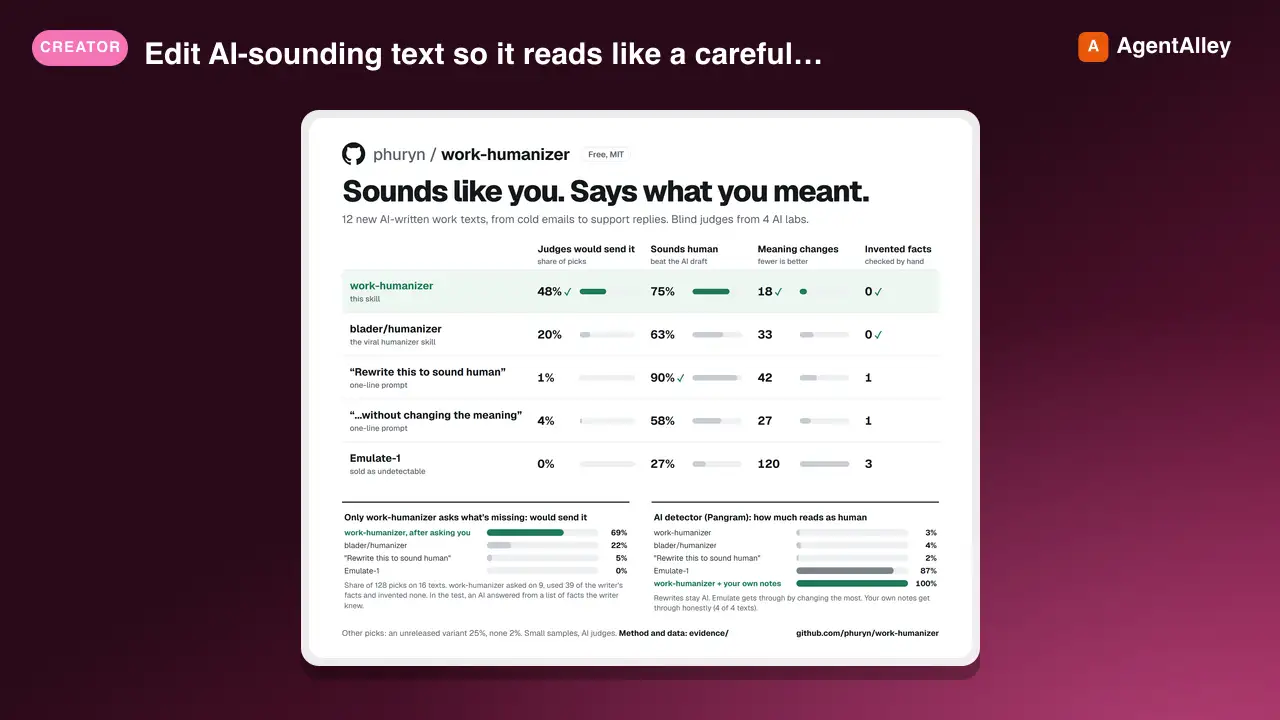 SkillAI Text Humanizerphuryn/work-humanizer · by phurynEdit AI-sounding text so it reads like a careful person wrote it, without changing what it says or commits to. Built for work writing where the wording matters: sales and marketing copy, support replies, HR and legal letters, emails, docs, release notes, posts, landing pages. Two modes. Rewrite: edit the text you are given. Interview: when a draft is AI-composed and thin, ask the writer 3-5 sharp questions and build the piece from their answers, in their words. Also writes from the writer's own notes or a voice-memo transcript. Calibrated on measured differences between human and AI writing.★ 110 GitHub stars
 SkillMarket Segment Identifierphuryn/pm-skills · by phurynIdentify the first beachhead market segment for a product launch. Evaluates segments against burning pain, willingness to pay, winnable market share, and referral potential. Use when choosing a first market, targeting an initial customer segment, or planning market entry strategy.★ 26.6k GitHub stars
 SkillProduct Experiment Designerphuryn/pm-skills · by phurynDesign experiments to test assumptions for an existing product — prototypes, A/B tests, spikes, and other low-effort validation methods. Use when validating assumptions, testing feature ideas cheaply, or planning product experiments.★ 26.6k GitHub stars