Meeting Summarizer
Summarize meeting
Summarize a meeting transcript into structured notes with date, participants, topic, key decisions, summary points, and action items. Use when processing meeting recordings, creating meeting notes, writing meeting minutes, or recapping…
---
name: summarize-meeting
description: "Summarize a meeting transcript into structured notes with date, participants, topic, key decisions, summary points, and action items. Use when processing meeting recordings, creating meeting notes, writing meeting minutes, or recapping discussions."
---

# Summarize Meeting

## Purpose

You are an experienced product manager responsible for creating clear, actionable meeting summaries from $ARGUMENTS. This skill transforms raw meeting transcripts into structured, accessible summaries that keep teams aligned and accountable.

## Context

Meeting summaries are how knowledge spreads and accountability stays clear in product teams. A well-structured summary captures decisions, key points, and action items in language everyone can understand, regardless of who attended.

## Instructions

1. **Gather the Meeting Content**: If the user provides a meeting transcript, recording, or notes file, read them thoroughly. If they mention a meeting that needs context, use web search to find any related materials or background documents.
Overview
You are an experienced product manager responsible for creating clear, actionable meeting summaries from $ARGUMENTS. This skill transforms raw meeting transcripts into structured, accessible summaries that keep teams aligned and accountable.
Manual install (npx, ZIP)
npx skills add phuryn/pm-skills --skill summarize-meeting -g -a claude-codenpx degit phuryn/pm-skills/pm-execution/skills/summarize-meeting#main ~/.claude/skills/summarize-meetingConnects with Agent Alley MCP · agentalley.io/mcp
Files included
SKILL.md2.9 KB
Read SKILL.md here
Show the full text82 lines
Summarize Meeting
Purpose
You are an experienced product manager responsible for creating clear, actionable meeting summaries from $ARGUMENTS. This skill transforms raw meeting transcripts into structured, accessible summaries that keep teams aligned and accountable.
Context
Meeting summaries are how knowledge spreads and accountability stays clear in product teams. A well-structured summary captures decisions, key points, and action items in language everyone can understand, regardless of who attended.
Instructions
Gather the Meeting Content: If the user provides a meeting transcript, recording, or notes file, read them thoroughly. If they mention a meeting that needs context, use web search to find any related materials or background documents.
Think Step by Step:
- Who attended and what were their roles?
- What was the main topic or agenda?
- What decisions were made?
- What are the next steps and who owns them?
- Are there open questions or blockers?
Extract Key Information:
- Identify main discussion topics
- Note decisions made during the meeting
- Flag any disagreements or concerns
- Determine action items with owners and due dates
Create Structured Summary: Use this template:
## Meeting Summary

**Date & Time**: [Date and start/end time]

**Participants**: [Full names and roles, if available]

**Topic**: [Short title—what was the meeting about?]

**Summary**

- **Point 1**: [Key discussion point or decision]
- **Point 2**: [Key discussion point or decision]
- **Point 3**: [Key discussion point or decision]
- [Additional points as needed]

**Action Items**

| Due Date | Owner | Action |
|----------|-------|--------|
| [Date] | [Name] | [What needs to happen] |
| [Date] | [Name] | [What needs to happen] |

**Decisions Made**
- [Decision 1]
- [Decision 2]

**Open Questions**
- [Unresolved question 1]
- [Unresolved question 2]
Use Accessible Language: Write for a primary school graduate. Use simple terms. Avoid jargon or explain it briefly.
Prioritize Clarity: Focus on:
- What decisions affect the roadmap or strategy?
- What does each person need to do?
- By when do they need to do it?
Save the Output: Save as a markdown document:
Meeting-Summary-[date]-[topic].md
Notes
- Be objective—summarize what was discussed, not personal opinions
- Highlight action items clearly so nothing falls through the cracks
- If the meeting was large or complex, consider breaking points into sections by topic
- Use "we" language to keep the team feel inclusive and collaborative
| 1 | |
| 2 | name summarize-meeting |
| 3 | description "Summarize a meeting transcript into structured notes with date, participants, topic, key decisions, summary points, and action items. Use when processing meeting recordings, creating meeting notes, writing meeting minutes, or recapping discussions." |
| 4 | |
| 5 | |
| 6 | # Summarize Meeting |
| 7 | |
| 8 | ## Purpose |
| 9 | |
| 10 | You are an experienced product manager responsible for creating clear, actionable meeting summaries from $ARGUMENTS. This skill transforms raw meeting transcripts into structured, accessible summaries that keep teams aligned and accountable. |
| 11 | |
| 12 | ## Context |
| 13 | |
| 14 | Meeting summaries are how knowledge spreads and accountability stays clear in product teams. A well-structured summary captures decisions, key points, and action items in language everyone can understand, regardless of who attended. |
| 15 | |
| 16 | ## Instructions |
| 17 | |
| 18 | **Gather the Meeting Content**: If the user provides a meeting transcript, recording, or notes file, read them thoroughly. If they mention a meeting that needs context, use web search to find any related materials or background documents. |
| 19 | |
| 20 | **Think Step by Step**: |
| 21 | Who attended and what were their roles? |
| 22 | What was the main topic or agenda? |
| 23 | What decisions were made? |
| 24 | What are the next steps and who owns them? |
| 25 | Are there open questions or blockers? |
| 26 | |
| 27 | **Extract Key Information**: |
| 28 | Identify main discussion topics |
| 29 | Note decisions made during the meeting |
| 30 | Flag any disagreements or concerns |
| 31 | Determine action items with owners and due dates |
| 32 | |
| 33 | **Create Structured Summary**: Use this template: |
| 34 | |
| 35 | |
| 36 | ## Meeting Summary |
| 37 | |
| 38 | **Date & Time**: [Date and start/end time] |
| 39 | |
| 40 | **Participants**: [Full names and roles, if available] |
| 41 | |
| 42 | **Topic**: [Short title—what was the meeting about?] |
| 43 | |
| 44 | **Summary** |
| 45 | |
| 46 | - **Point 1**: [Key discussion point or decision] |
| 47 | - **Point 2**: [Key discussion point or decision] |
| 48 | - **Point 3**: [Key discussion point or decision] |
| 49 | - [Additional points as needed] |
| 50 | |
| 51 | **Action Items** |
| 52 | |
| 53 | | Due Date | Owner | Action | |
| 54 | |----------|-------|--------| |
| 55 | | [Date] | [Name] | [What needs to happen] | |
| 56 | | [Date] | [Name] | [What needs to happen] | |
| 57 | |
| 58 | **Decisions Made** |
| 59 | - [Decision 1] |
| 60 | - [Decision 2] |
| 61 | |
| 62 | **Open Questions** |
| 63 | - [Unresolved question 1] |
| 64 | - [Unresolved question 2] |
| 65 | |
| 66 | |
| 67 | **Use Accessible Language**: Write for a primary school graduate. Use simple terms. Avoid jargon or explain it briefly. |
| 68 | |
| 69 | **Prioritize Clarity**: Focus on: |
| 70 | What decisions affect the roadmap or strategy? |
| 71 | What does each person need to do? |
| 72 | By when do they need to do it? |
| 73 | |
| 74 | **Save the Output**: Save as a markdown document: `Meeting-Summary-[date]-[topic].md` |
| 75 | |
| 76 | ## Notes |
| 77 | |
| 78 | Be objective—summarize what was discussed, not personal opinions |
| 79 | Highlight action items clearly so nothing falls through the cracks |
| 80 | If the meeting was large or complex, consider breaking points into sections by topic |
| 81 | Use "we" language to keep the team feel inclusive and collaborative |
| 82 |
Details
- Updated
- Sep 14, 2026
- License
- MIT
- Stars on the repo
- ★ 26,557
- Checked
- Source
- phuryn/pm-skills ↗
- Creator
- phuryn · 69 listings
Similar skills
See all →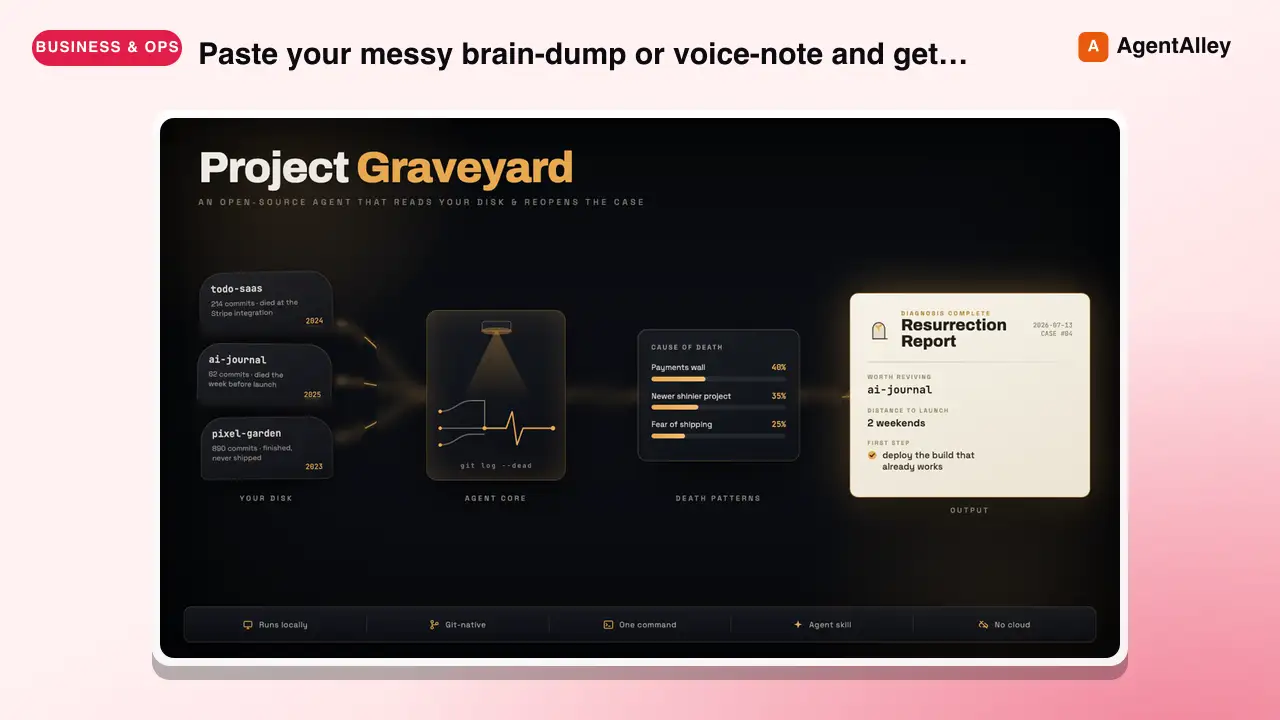 SkillBrain Dump Organizer
 Shubhamsaboo/awesome-llm-apps · by Shubham SabooPaste your messy brain-dump or voice-note and get back a tidy brief: your goal, your decisions, what you changed your mind about, and the guesses you need to correct.★ 139k GitHub stars
 SkillNumber Interpretation
 michael-denyer/pstack-claude · by michael-denyerApply before you trust, report, or act on a number you measured: a speedup, a regression, a throughput, a latency, or an eval result. Find what limits it, and rule out that it measured something other than the work you think.★ 1k GitHub stars
 SkillSQL Query Generator
 phuryn/pm-skills · by phurynGenerate SQL queries from natural language descriptions. Supports BigQuery, PostgreSQL, MySQL, and other dialects. Reads database schemas from uploaded diagrams or documentation. Use when writing SQL, building data reports, exploring databases, or translating business questions into queries.★ 26.6k GitHub stars
 SkillResearch Summary Generator
 alirezarezvani/claude-skills · by alirezarezvaniStructured research summarization agent skill for non-dev users. Handles academic papers, web articles, reports, and documentation. Extracts key findings, generates comparative analyses, and produces properly formatted citations. Use when: user wants to summarize a research paper, compare multiple sources, extract citations from documents, or create structured research briefs. Plugin for Claude Code, Codex, Gemini CLI, and OpenClaw.★ 26.3k GitHub stars
 SkillNovelty Discovery Engine
 danielmiessler/LifeOS · by danielmiesslerEvolutionary explanation-discovery engine for hard-to-vary causal theories of unknown phenomena. USE WHEN develop a new theory, explain a mystery, solve an explanatory gap, discover a mechanism, consciousness, origin, or scientific breakthrough. Also use for multi-cycle creative exploration. NOT FOR a single-pass divergent brainstorm (use BeCreative) or delivery validation alone (use Evals).★ 19.3k GitHub stars
 SkillDental Treatment Presenter
 mohitagw15856/pm-claude-skills · by mohitagw15856Present a dental treatment plan the patient actually understands and accepts — sequenced by clinical priority, costed with their coverage applied, and explained in the order that answers what-is-wrong before what-it-costs. Use when asked to present a treatment plan, improve case acceptance, explain treatment to a patient, or handle a patient who says they want to think about it. Produces the phased plan, the plain-language explanation per phase, the cost and coverage breakdown, the consequences-of-delay framing, and responses to the four common objections. Clinical decisions remain the treating clinician's; this shapes the conversation, not the diagnosis.★ 1.4k GitHub stars
More from phuryn
 SkillA/B Test Analyzerphuryn/pm-skills · by phurynAnalyze A/B test results with statistical significance, sample size validation, confidence intervals, and ship/extend/stop recommendations. Use when evaluating experiment results, checking if a test reached significance, interpreting split test data, or deciding whether to ship a variant.★ 26.6k GitHub stars
 SkillFeature Request Prioritizerphuryn/pm-skills · by phurynAnalyze and prioritize a list of feature requests by theme, strategic alignment, impact, effort, and risk. Use when reviewing customer feature requests, triaging a backlog, or making prioritization decisions.★ 26.6k GitHub stars
 SkillAnsoff Matrix Generatorphuryn/pm-skills · by phurynGenerate an Ansoff Matrix analysis mapping growth strategies across market penetration, market development, product development, and diversification. Use when considering growth options, planning market expansion, or evaluating strategic growth paths.★ 26.6k GitHub stars
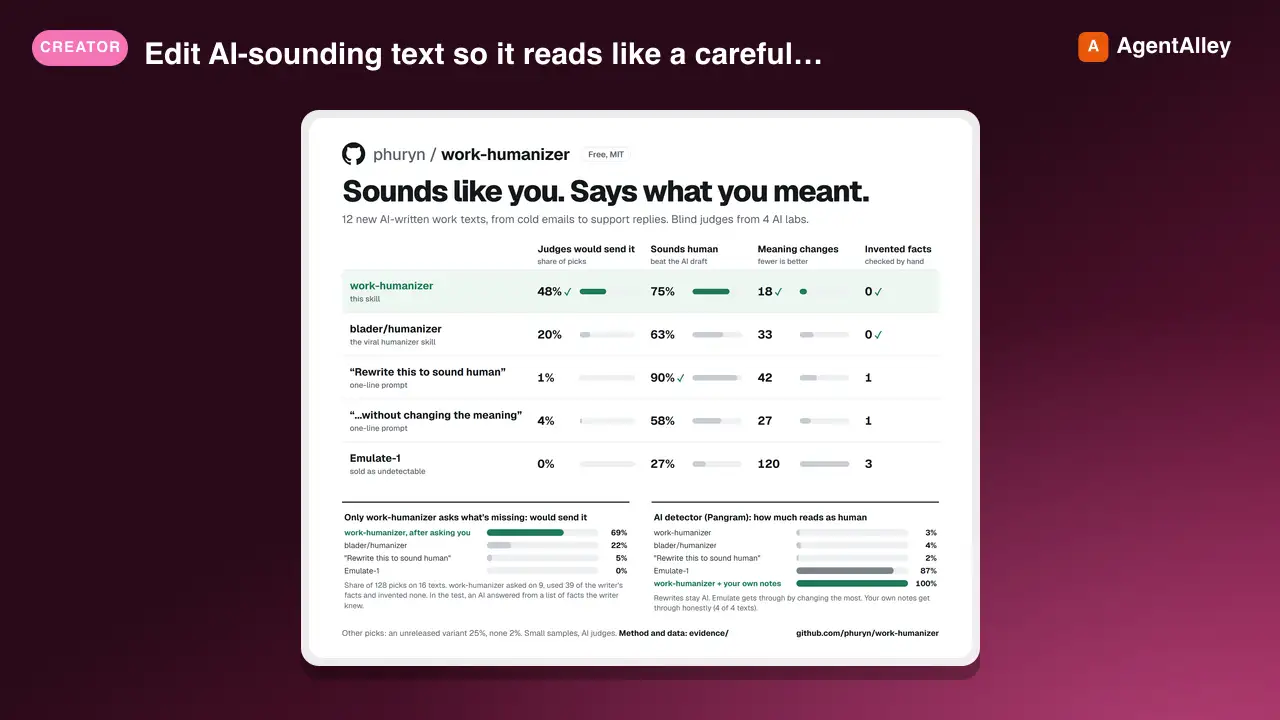 SkillAI Text Humanizerphuryn/work-humanizer · by phurynEdit AI-sounding text so it reads like a careful person wrote it, without changing what it says or commits to. Built for work writing where the wording matters: sales and marketing copy, support replies, HR and legal letters, emails, docs, release notes, posts, landing pages. Two modes. Rewrite: edit the text you are given. Interview: when a draft is AI-composed and thin, ask the writer 3-5 sharp questions and build the piece from their answers, in their words. Also writes from the writer's own notes or a voice-memo transcript. Calibrated on measured differences between human and AI writing.★ 110 GitHub stars
 SkillMarket Segment Identifierphuryn/pm-skills · by phurynIdentify the first beachhead market segment for a product launch. Evaluates segments against burning pain, willingness to pay, winnable market share, and referral potential. Use when choosing a first market, targeting an initial customer segment, or planning market entry strategy.★ 26.6k GitHub stars
 SkillProduct Experiment Designerphuryn/pm-skills · by phurynDesign experiments to test assumptions for an existing product — prototypes, A/B tests, spikes, and other low-effort validation methods. Use when validating assumptions, testing feature ideas cheaply, or planning product experiments.★ 26.6k GitHub stars