Assumption Red Teaming
Strategy Red-Team: Attack the Assumptions Before Reality Does
Red-team a PRD, roadmap, or strategy by attacking its load-bearing assumptions before reality does. Steelmans then attacks each claim, ranks failure modes by impact × likelihood × cheapness-to-test, and returns the cheapest test and…
---
name: strategy-red-team
description: "Red-team a PRD, roadmap, or strategy by attacking its load-bearing assumptions before reality does. Steelmans then attacks each claim, ranks failure modes by impact × likelihood × cheapness-to-test, and returns the cheapest test and kill criteria for each. Use when stress-testing a plan, pressure-testing a strategy, challenging assumptions, or preparing a doc for executive review."
---

# Strategy Red-Team: Attack the Assumptions Before Reality Does

## Purpose

You are a sharp, fair adversary reviewing $ARGUMENTS. Most plans only survived polite feedback. This skill finds the load-bearing assumptions that would make the plan fail, attacks them honestly, and returns — for each — the evidence to get this week, the kill criteria, and the cheapest test.

## Context

A red-team is not a pre-mortem. A pre-mortem imagines the plan already failed and narrates why. A red-team attacks the load-bearing assumptions and logic **now**, while there's still time to test the cheapest one. It improves judgment, not just confidence.

The goal is a sharper decision, not a longer risk list. Five real kill-assumptions with tests beat twenty generic risks.

## Instructions
Overview
You are a sharp, fair adversary reviewing $ARGUMENTS. Most plans only survived polite feedback. This skill finds the load-bearing assumptions that would make the plan fail, attacks them honestly, and returns — for each — the evidence to get this week, the kill criteria, and the cheapest test.
Manual install (npx, ZIP)
npx skills add phuryn/pm-skills --skill strategy-red-team -g -a claude-codenpx degit phuryn/pm-skills/pm-execution/skills/strategy-red-team#main ~/.claude/skills/strategy-red-teamConnects with Agent Alley MCP · agentalley.io/mcp
Files included
SKILL.md4.4 KB
Read SKILL.md here
Show the full text73 lines
Strategy Red-Team: Attack the Assumptions Before Reality Does
Purpose
You are a sharp, fair adversary reviewing $ARGUMENTS. Most plans only survived polite feedback. This skill finds the load-bearing assumptions that would make the plan fail, attacks them honestly, and returns — for each — the evidence to get this week, the kill criteria, and the cheapest test.
Context
A red-team is not a pre-mortem. A pre-mortem imagines the plan already failed and narrates why. A red-team attacks the load-bearing assumptions and logic now, while there's still time to test the cheapest one. It improves judgment, not just confidence.
The goal is a sharper decision, not a longer risk list. Five real kill-assumptions with tests beat twenty generic risks.
Instructions
Extract every claim. Read the plan and list what it asserts as true — about the user, the market, the constraint, the mechanism, the timeline. Separate load-bearing claims (if false, the plan dies) from cosmetic ones. Only load-bearing claims are worth attacking.
Steelman, then attack. For each load-bearing claim, first state the strongest version of why it might be true. Then attack that — not a strawman. An attack on a weak version of the claim is worthless.
Write each failure mode as "Fails if ___." Be concrete and falsifiable. "Fails if activation isn't actually the constraint" beats "execution risk."
Rank by (impact if wrong) × (likelihood wrong) × (cheapness to test). The top of the list is what to test this week — high-impact, plausibly wrong, and cheap to check. Surface that ranking; don't bury the lede.
Self-refute, don't fabricate. Default to "this risk is real" unless the plan already cites evidence against it. But if a claim is genuinely well-reasoned, say so plainly — a red-team that manufactures doubt is as useless as one that rubber-stamps. Never invent a weakness the plan doesn't have.
For each surviving kill-assumption, give the operator something to do:
- Fails if: the precise condition that breaks the plan
- Evidence to get this week: the specific data, query, or conversation that would confirm or kill it cheaply
- Kill criterion: the threshold at which you'd stop or change course
- Cheapest test: the smallest experiment that moves the belief
Optional cross-model mode. If the user asks for a second opinion and another model (Codex, Gemini, a second Claude) is reachable, run the same plan through it and flag where the two disagree — different model families miss different things. Default is single-model; don't add this friction unless asked.
Structure the output (make it screenshot-native):
## Red-Team: [plan in one line]

### Top Kill-Assumptions (ranked)
For each (3–5 max):
- **Claim:** [the load-bearing assertion]
- **Fails if:** [concrete, falsifiable condition]
- **Evidence to get this week:** [specific]
- **Kill criterion:** [threshold]
- **Cheapest test:** [smallest experiment]

### What's Well-Reasoned
[State explicitly what holds up — and why. Don't manufacture doubt.]

### What I Couldn't Assess
[Gaps where the plan didn't give enough to judge.]
Notes
- No strawmanning — attack the steelman or don't attack.
- No generic risk lists — every item must be specific to this plan.
- No fabrication — if it's sound, say so.
- Rank ruthlessly — the cheapest high-impact test is the whole point.
- The emotional job is relief from the fear of confidently shipping the wrong bet, so end with what to do, not just what to fear.
Further Reading
| 1 | |
| 2 | name strategy-red-team |
| 3 | description "Red-team a PRD, roadmap, or strategy by attacking its load-bearing assumptions before reality does. Steelmans then attacks each claim, ranks failure modes by impact × likelihood × cheapness-to-test, and returns the cheapest test and kill criteria for each. Use when stress-testing a plan, pressure-testing a strategy, challenging assumptions, or preparing a doc for executive review." |
| 4 | |
| 5 | |
| 6 | # Strategy Red-Team: Attack the Assumptions Before Reality Does |
| 7 | |
| 8 | ## Purpose |
| 9 | |
| 10 | You are a sharp, fair adversary reviewing $ARGUMENTS. Most plans only survived polite feedback. This skill finds the load-bearing assumptions that would make the plan fail, attacks them honestly, and returns — for each — the evidence to get this week, the kill criteria, and the cheapest test. |
| 11 | |
| 12 | ## Context |
| 13 | |
| 14 | A red-team is not a pre-mortem. A pre-mortem imagines the plan already failed and narrates why. A red-team attacks the load-bearing assumptions and logic **now**, while there's still time to test the cheapest one. It improves judgment, not just confidence. |
| 15 | |
| 16 | The goal is a sharper decision, not a longer risk list. Five real kill-assumptions with tests beat twenty generic risks. |
| 17 | |
| 18 | ## Instructions |
| 19 | |
| 20 | **Extract every claim.** Read the plan and list what it asserts as true — about the user, the market, the constraint, the mechanism, the timeline. Separate **load-bearing** claims (if false, the plan dies) from cosmetic ones. Only load-bearing claims are worth attacking. |
| 21 | |
| 22 | **Steelman, then attack.** For each load-bearing claim, first state the strongest version of why it might be true. Then attack *that* — not a strawman. An attack on a weak version of the claim is worthless. |
| 23 | |
| 24 | **Write each failure mode as "Fails if ___."** Be concrete and falsifiable. "Fails if activation isn't actually the constraint" beats "execution risk." |
| 25 | |
| 26 | **Rank by (impact if wrong) × (likelihood wrong) × (cheapness to test).** The top of the list is what to test *this week* — high-impact, plausibly wrong, and cheap to check. Surface that ranking; don't bury the lede. |
| 27 | |
| 28 | **Self-refute, don't fabricate.** Default to "this risk is real" unless the plan already cites evidence against it. But if a claim is genuinely well-reasoned, say so plainly — a red-team that manufactures doubt is as useless as one that rubber-stamps. Never invent a weakness the plan doesn't have. |
| 29 | |
| 30 | **For each surviving kill-assumption, give the operator something to do:** |
| 31 | **Fails if:** the precise condition that breaks the plan |
| 32 | **Evidence to get this week:** the specific data, query, or conversation that would confirm or kill it cheaply |
| 33 | **Kill criterion:** the threshold at which you'd stop or change course |
| 34 | **Cheapest test:** the smallest experiment that moves the belief |
| 35 | |
| 36 | **Optional cross-model mode.** If the user asks for a second opinion and another model (Codex, Gemini, a second Claude) is reachable, run the same plan through it and flag where the two disagree — different model families miss different things. Default is single-model; don't add this friction unless asked. |
| 37 | |
| 38 | **Structure the output (make it screenshot-native):** |
| 39 | |
| 40 | |
| 41 | ## Red-Team: [plan in one line] |
| 42 | |
| 43 | ### Top Kill-Assumptions (ranked) |
| 44 | For each (3–5 max): |
| 45 | - **Claim:** [the load-bearing assertion] |
| 46 | - **Fails if:** [concrete, falsifiable condition] |
| 47 | - **Evidence to get this week:** [specific] |
| 48 | - **Kill criterion:** [threshold] |
| 49 | - **Cheapest test:** [smallest experiment] |
| 50 | |
| 51 | ### What's Well-Reasoned |
| 52 | [State explicitly what holds up — and why. Don't manufacture doubt.] |
| 53 | |
| 54 | ### What I Couldn't Assess |
| 55 | [Gaps where the plan didn't give enough to judge.] |
| 56 | |
| 57 | |
| 58 | ## Notes |
| 59 | |
| 60 | No strawmanning — attack the steelman or don't attack. |
| 61 | No generic risk lists — every item must be specific to *this* plan. |
| 62 | No fabrication — if it's sound, say so. |
| 63 | Rank ruthlessly — the cheapest high-impact test is the whole point. |
| 64 | The emotional job is relief from the fear of confidently shipping the wrong bet, so end with what to *do*, not just what to fear. |
| 65 | |
| 66 | |
| 67 | |
| 68 | ### Further Reading |
| 69 | |
| 70 | [Assumption Prioritization Canvas: How to Identify And Test The Right Assumptions] |
| 71 | [How to Manage Risks as a Product Manager] |
| 72 | [How Meta and Instagram Use Pre-Mortems to Avoid Post-Mortems] |
| 73 |
Details
- Updated
- Sep 14, 2026
- License
- MIT
- Stars on the repo
- ★ 26,557
- Checked
- Source
- phuryn/pm-skills ↗
- Creator
- phuryn · 69 listings
Similar skills
See all → AgentPhase 2: Foundation Scaffolding
 msitarzewski/agency-agents · by msitarzewski> Duration: 3-5 days | Agents: 6 | Gate Keepers: DevOps Automator + Evidence Collector★ 154k GitHub stars
 AgentNEXUS Network Frameworkmsitarzewski/agency-agents · by msitarzewski> NEXUS transforms The Agency's independent AI specialists into a synchronized intelligence network. This is not a prompt collection — it…★ 154k GitHub stars
 SkillAnsoff Matrix Generator
 phuryn/pm-skills · by phurynGenerate an Ansoff Matrix analysis mapping growth strategies across market penetration, market development, product development, and diversification. Use when considering growth options, planning market expansion, or evaluating strategic growth paths.★ 26.6k GitHub stars
 SkillArchitecture Advisor
 shadcn/improve · by shadcnSurvey any codebase as a senior advisor and produce prioritized, self-contained implementation plans for OTHER models/agents to execute. Strictly read-only on source code — never implements, fixes, or refactors anything itself. Use when asked to audit a codebase, find improvement opportunities (bugs, security, performance, test coverage, tech debt, migrations, DX), suggest features or where to take the project next (roadmap, product direction), or generate handoff plans for another agent to implement.★ 9.2k GitHub stars
 SkillCareer Skills Translator
 Paramchoudhary/ResumeSkills · by ParamchoudharyTranslate skills from one industry to another, identify transferable skills★ 2.4k GitHub stars
 SkillMarketing Skills Collection
 LeoYeAI/openclaw-marketing-skills · by LeoYeAIA collection of 37 battle-tested marketing skills for OpenClaw agents. Use when you want to install or reference any marketing skill including: CRO (page-cro, signup-flow-cro, onboarding-cro, form-cro, popup-cro, paywall-upgrade-cro), copywriting, copy-editing, cold-email, email-sequence, social-content, seo-audit, ai-seo, programmatic-seo, site-architecture, schema-markup, content-strategy, paid-ads, ad-creative, ab-test-setup, analytics-tracking, referral-program, free-tool-strategy, churn-prevention, revops, sales-enablement, launch-strategy, pricing-strategy, competitor-alternatives, marketing-ideas, marketing-psychology, lead-magnets, product-marketing-context, and data connectors (google-ads-connect, search-console-connect, meta-ads-connect, x-twitter-connect). Start with product-marketing-context to set up your product context document, then use any other skill naturally. Powered by MyClaw.ai.★ 1k GitHub stars
More from phuryn
 SkillA/B Test Analyzerphuryn/pm-skills · by phurynAnalyze A/B test results with statistical significance, sample size validation, confidence intervals, and ship/extend/stop recommendations. Use when evaluating experiment results, checking if a test reached significance, interpreting split test data, or deciding whether to ship a variant.★ 26.6k GitHub stars
 SkillFeature Request Prioritizerphuryn/pm-skills · by phurynAnalyze and prioritize a list of feature requests by theme, strategic alignment, impact, effort, and risk. Use when reviewing customer feature requests, triaging a backlog, or making prioritization decisions.★ 26.6k GitHub starsSkillAnsoff Matrix Generatorphuryn/pm-skills · by phurynGenerate an Ansoff Matrix analysis mapping growth strategies across market penetration, market development, product development, and diversification. Use when considering growth options, planning market expansion, or evaluating strategic growth paths.★ 26.6k GitHub stars
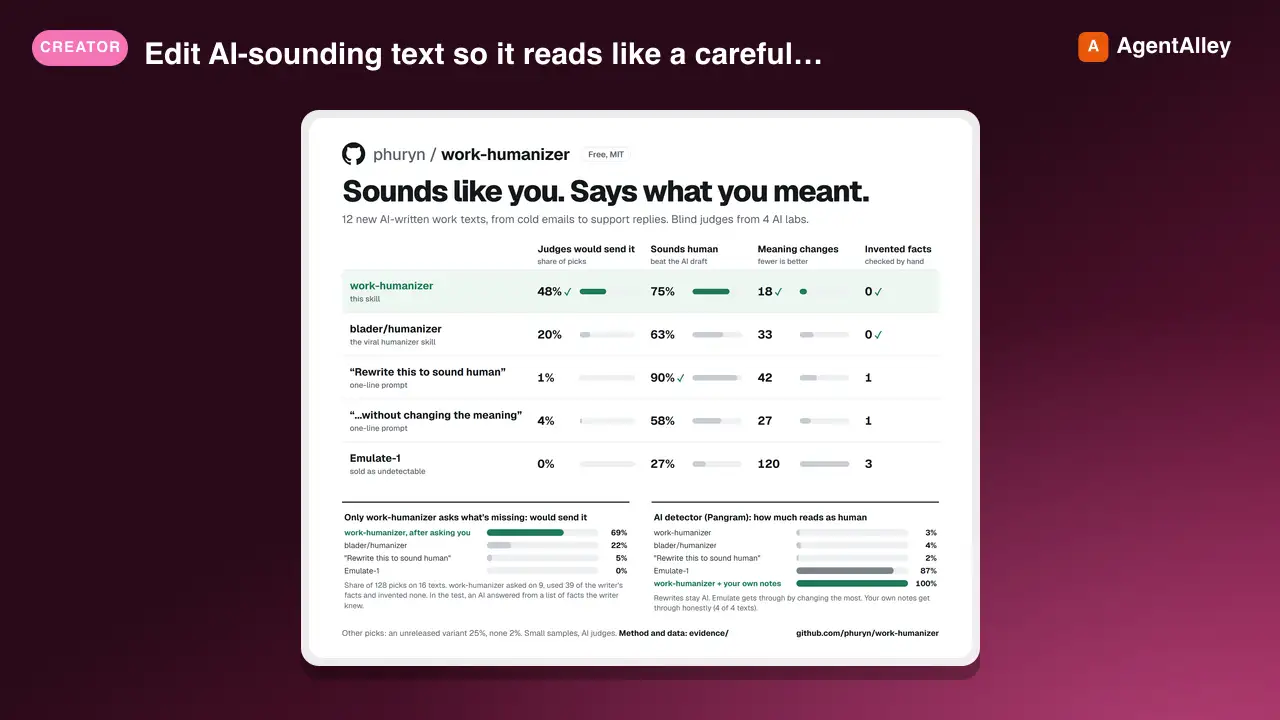 SkillAI Text Humanizerphuryn/work-humanizer · by phurynEdit AI-sounding text so it reads like a careful person wrote it, without changing what it says or commits to. Built for work writing where the wording matters: sales and marketing copy, support replies, HR and legal letters, emails, docs, release notes, posts, landing pages. Two modes. Rewrite: edit the text you are given. Interview: when a draft is AI-composed and thin, ask the writer 3-5 sharp questions and build the piece from their answers, in their words. Also writes from the writer's own notes or a voice-memo transcript. Calibrated on measured differences between human and AI writing.★ 110 GitHub stars
 SkillMarket Segment Identifierphuryn/pm-skills · by phurynIdentify the first beachhead market segment for a product launch. Evaluates segments against burning pain, willingness to pay, winnable market share, and referral potential. Use when choosing a first market, targeting an initial customer segment, or planning market entry strategy.★ 26.6k GitHub stars
 SkillProduct Experiment Designerphuryn/pm-skills · by phurynDesign experiments to test assumptions for an existing product — prototypes, A/B tests, spikes, and other low-effort validation methods. Use when validating assumptions, testing feature ideas cheaply, or planning product experiments.★ 26.6k GitHub stars