Startup Canvas Generator
Startup canvas
Generate a Startup Canvas combining Product Strategy (9 sections) and Business Model (costs + revenue) for a new product. An alternative to BMC and Lean Canvas that separates strategy from business model.
---
name: startup-canvas
description: "Generate a Startup Canvas combining Product Strategy (9 sections) and Business Model (costs + revenue) for a new product. An alternative to BMC and Lean Canvas that separates strategy from business model. Use when launching a new product or evaluating a startup concept."
---
# Startup Canvas

## Metadata
- **Name**: startup-canvas
- **Description**: Generate a Startup Canvas for a new product. Combines the 9-section Product Strategy Canvas with a Business Model (Cost Structure + Revenue Streams). Designed specifically for startups and new products.
- **Triggers**: startup canvas, new product canvas, startup strategy, startup business model

## Domain Context

### Startup Canvas vs Business Model Canvas vs Lean Canvas

Popular approaches like Business Model Canvas (Strategyzer) and Lean Canvas (Ash Maurya) mix strategy and business model into one artifact. The **Startup Canvas** (Paweł Huryn) separates them: 9 strategy sections from the Product Strategy Canvas + Cost Structure & Revenue Streams.

**Why not Business Model Canvas?**
Overview
Popular approaches like Business Model Canvas (Strategyzer) and Lean Canvas (Ash Maurya) mix strategy and business model into one artifact. The Startup Canvas (Paweł Huryn) separates them: 9 strategy sections from the Product Strategy Canvas + Cost Structure & Revenue Streams.
What you get
- Define the vision and aspirational impact
- Identify 2–3 target market segments with JTBD
- Establish cost positioning (low cost vs premium)
- Develop value propositions for each segment
- List explicit trade-offs
- Set North Star and quarterly OMTM
Manual install (npx, ZIP)
npx skills add phuryn/pm-skills --skill startup-canvas -g -a claude-codenpx degit phuryn/pm-skills/pm-product-strategy/skills/startup-canvas#main ~/.claude/skills/startup-canvasConnects with Agent Alley MCP · agentalley.io/mcp
Files included
SKILL.md6.2 KB
Read SKILL.md here
Show the full text139 lines
Startup Canvas
Metadata
- Name: startup-canvas
- Description: Generate a Startup Canvas for a new product. Combines the 9-section Product Strategy Canvas with a Business Model (Cost Structure + Revenue Streams). Designed specifically for startups and new products.
- Triggers: startup canvas, new product canvas, startup strategy, startup business model
Domain Context
Startup Canvas vs Business Model Canvas vs Lean Canvas
Popular approaches like Business Model Canvas (Strategyzer) and Lean Canvas (Ash Maurya) mix strategy and business model into one artifact. The Startup Canvas (Paweł Huryn) separates them: 9 strategy sections from the Product Strategy Canvas + Cost Structure & Revenue Streams.
Why not Business Model Canvas?
- No vision — why should your team wake up every day?
- No Can't/Won't test — what stops competitors from copying you?
- No trade-offs — what you choose NOT to do creates focus
- No key metrics — how do you know the strategy is working?
- Key Partnerships and Key Resources are rarely useful for early-stage products
Why not Lean Canvas?
- Introduces redundancy: "Problem" overlaps with Market Segments (markets are defined by problems), "Solution" overlaps with Value Proposition (which by definition includes features)
- No vision, no trade-offs, no relative costs
- "Unfair Advantage" is too narrow — the entire strategy should be hard to copy, not just one element
- Doesn't address the holistic fit of strategic choices reinforcing each other
When to use which:
- Business Model Canvas: Established businesses, corporate strategy, investor materials
- Lean Canvas: Quick hypothesis testing when you just need speed
- Startup Canvas: New products where you need both strategic clarity AND a business model — the recommended approach
Instructions
You are a product strategist and startup advisor designing a Startup Canvas for $ARGUMENTS.
Your task is to create a comprehensive Startup Canvas that covers both the strategic choices and the business model for a new product.
Input Requirements
- Product or startup idea
- Target market and customer insights
- Competitive landscape
- Founder/team constraints and resources
Startup Canvas Template
Part 1: Product Strategy (9 Sections)
1. Vision
- How can we inspire people? What are we aspiring to achieve? What values do we uphold?
- Start simple. Your vision will evolve alongside the strategy.
2. Market Segments
- The market is defined by the problems people have (not demographics).
- Jobs to Be Done (JTBD), desired outcomes, constraints.
- What will be your first customer segment? Why this one first?
3. Relative Costs
- Do you optimize for low cost (like Southwest Airlines) or unique value (like Starbucks)?
- Low costs don't necessarily mean low prices.
4. Value Proposition For each market segment:
- What before: Existing, problematic state
- How: Features and capabilities that change the situation
- What after: The benefits and outcomes
- Alternatives: Your unique value vs. competitors and substitutes (consider a Value Curve)
5. Trade-offs
- What will you NOT do? Trade-offs create focus and amplify value.
- Especially important for startups where it's tempting to chase every opportunity.
6. Key Metrics
- A few key metrics to measure if the product and strategy are working.
- North Star Metric and One Metric That Matters (OMTM) for this quarter.
7. Growth
- Product-Led Growth or Sales-Led Growth?
- Preferred channels: Social Media, SEO, Influencers, Resellers?
8. Capabilities
- What competencies and resources do you need to acquire?
- What do you build vs. partner for?
9. Can't/Won't
- What makes you think competitors can't or won't copy your strategy?
- The entire strategy should be difficult to copy — not just one element.
- Do all elements fit together and reinforce each other?
Part 2: Business Model
10. Cost Structure
- Rent, hardware, licenses, technology, marketing, subscriptions, salaries.
- Which are recurring? How will they scale?
11. Revenue Streams
- How much money from each channel?
- Pricing approach: penetration, value-based, competitive, usage-based, SaaS?
- Is the revenue model scalable? What are the biggest uncertainties?
Output Process
- Define the vision and aspirational impact
- Identify 2–3 target market segments with JTBD
- Establish cost positioning (low cost vs premium)
- Develop value propositions for each segment
- List explicit trade-offs
- Set North Star and quarterly OMTM
- Outline growth strategy and channels
- Document required capabilities
- Explain defensibility (Can't/Won't test)
- Estimate cost structure and revenue streams
- Validate strategy coherence: do all elements reinforce each other?
- Surface hypotheses that must be true for success
- Suggest low-effort experiments to test key assumptions
Notes
- The Startup Canvas separates strategy from business model — keep them distinct but connected
- Strategy should pass the Can't/Won't test: your competitors can't or won't copy the integrated set of choices
- After drafting the first version, identify and start testing hypotheses
- Mix and adapt approaches to suit your specific needs rather than following any canvas rigidly
Templates
Further Reading
| 1 | |
| 2 | name startup-canvas |
| 3 | description "Generate a Startup Canvas combining Product Strategy (9 sections) and Business Model (costs + revenue) for a new product. An alternative to BMC and Lean Canvas that separates strategy from business model. Use when launching a new product or evaluating a startup concept." |
| 4 | |
| 5 | # Startup Canvas |
| 6 | |
| 7 | ## Metadata |
| 8 | **Name**: startup-canvas |
| 9 | **Description**: Generate a Startup Canvas for a new product. Combines the 9-section Product Strategy Canvas with a Business Model (Cost Structure + Revenue Streams). Designed specifically for startups and new products. |
| 10 | **Triggers**: startup canvas, new product canvas, startup strategy, startup business model |
| 11 | |
| 12 | ## Domain Context |
| 13 | |
| 14 | ### Startup Canvas vs Business Model Canvas vs Lean Canvas |
| 15 | |
| 16 | Popular approaches like Business Model Canvas (Strategyzer) and Lean Canvas (Ash Maurya) mix strategy and business model into one artifact. The **Startup Canvas** (Paweł Huryn) separates them: 9 strategy sections from the Product Strategy Canvas + Cost Structure & Revenue Streams. |
| 17 | |
| 18 | **Why not Business Model Canvas?** |
| 19 | No vision — why should your team wake up every day? |
| 20 | No Can't/Won't test — what stops competitors from copying you? |
| 21 | No trade-offs — what you choose NOT to do creates focus |
| 22 | No key metrics — how do you know the strategy is working? |
| 23 | Key Partnerships and Key Resources are rarely useful for early-stage products |
| 24 | |
| 25 | **Why not Lean Canvas?** |
| 26 | Introduces redundancy: "Problem" overlaps with Market Segments (markets are defined by problems), "Solution" overlaps with Value Proposition (which by definition includes features) |
| 27 | No vision, no trade-offs, no relative costs |
| 28 | "Unfair Advantage" is too narrow — the entire strategy should be hard to copy, not just one element |
| 29 | Doesn't address the holistic fit of strategic choices reinforcing each other |
| 30 | |
| 31 | **When to use which:** |
| 32 | **Business Model Canvas**: Established businesses, corporate strategy, investor materials |
| 33 | **Lean Canvas**: Quick hypothesis testing when you just need speed |
| 34 | **Startup Canvas**: New products where you need both strategic clarity AND a business model — the recommended approach |
| 35 | |
| 36 | ## Instructions |
| 37 | |
| 38 | You are a product strategist and startup advisor designing a Startup Canvas for $ARGUMENTS. |
| 39 | |
| 40 | Your task is to create a comprehensive Startup Canvas that covers both the strategic choices and the business model for a new product. |
| 41 | |
| 42 | ## Input Requirements |
| 43 | Product or startup idea |
| 44 | Target market and customer insights |
| 45 | Competitive landscape |
| 46 | Founder/team constraints and resources |
| 47 | |
| 48 | ## Startup Canvas Template |
| 49 | |
| 50 | ### Part 1: Product Strategy (9 Sections) |
| 51 | |
| 52 | **1. Vision** |
| 53 | How can we inspire people? What are we aspiring to achieve? What values do we uphold? |
| 54 | Start simple. Your vision will evolve alongside the strategy. |
| 55 | |
| 56 | **2. Market Segments** |
| 57 | The market is defined by the problems people have (not demographics). |
| 58 | Jobs to Be Done (JTBD), desired outcomes, constraints. |
| 59 | What will be your first customer segment? Why this one first? |
| 60 | |
| 61 | **3. Relative Costs** |
| 62 | Do you optimize for low cost (like Southwest Airlines) or unique value (like Starbucks)? |
| 63 | Low costs don't necessarily mean low prices. |
| 64 | |
| 65 | **4. Value Proposition** |
| 66 | For each market segment: |
| 67 | **What before**: Existing, problematic state |
| 68 | **How**: Features and capabilities that change the situation |
| 69 | **What after**: The benefits and outcomes |
| 70 | **Alternatives**: Your unique value vs. competitors and substitutes (consider a Value Curve) |
| 71 | |
| 72 | **5. Trade-offs** |
| 73 | What will you NOT do? Trade-offs create focus and amplify value. |
| 74 | Especially important for startups where it's tempting to chase every opportunity. |
| 75 | |
| 76 | **6. Key Metrics** |
| 77 | A few key metrics to measure if the product and strategy are working. |
| 78 | North Star Metric and One Metric That Matters (OMTM) for this quarter. |
| 79 | |
| 80 | **7. Growth** |
| 81 | Product-Led Growth or Sales-Led Growth? |
| 82 | Preferred channels: Social Media, SEO, Influencers, Resellers? |
| 83 | |
| 84 | **8. Capabilities** |
| 85 | What competencies and resources do you need to acquire? |
| 86 | What do you build vs. partner for? |
| 87 | |
| 88 | **9. Can't/Won't** |
| 89 | What makes you think competitors can't or won't copy your strategy? |
| 90 | The entire strategy should be difficult to copy — not just one element. |
| 91 | Do all elements fit together and reinforce each other? |
| 92 | |
| 93 | ### Part 2: Business Model |
| 94 | |
| 95 | **10. Cost Structure** |
| 96 | Rent, hardware, licenses, technology, marketing, subscriptions, salaries. |
| 97 | Which are recurring? How will they scale? |
| 98 | |
| 99 | **11. Revenue Streams** |
| 100 | How much money from each channel? |
| 101 | Pricing approach: penetration, value-based, competitive, usage-based, SaaS? |
| 102 | Is the revenue model scalable? What are the biggest uncertainties? |
| 103 | |
| 104 | ## Output Process |
| 105 | Define the vision and aspirational impact |
| 106 | Identify 2–3 target market segments with JTBD |
| 107 | Establish cost positioning (low cost vs premium) |
| 108 | Develop value propositions for each segment |
| 109 | List explicit trade-offs |
| 110 | Set North Star and quarterly OMTM |
| 111 | Outline growth strategy and channels |
| 112 | Document required capabilities |
| 113 | Explain defensibility (Can't/Won't test) |
| 114 | Estimate cost structure and revenue streams |
| 115 | Validate strategy coherence: do all elements reinforce each other? |
| 116 | Surface hypotheses that must be true for success |
| 117 | Suggest low-effort experiments to test key assumptions |
| 118 | |
| 119 | ## Notes |
| 120 | The Startup Canvas separates strategy from business model — keep them distinct but connected |
| 121 | Strategy should pass the Can't/Won't test: your competitors can't or won't copy the integrated set of choices |
| 122 | After drafting the first version, identify and start testing hypotheses |
| 123 | Mix and adapt approaches to suit your specific needs rather than following any canvas rigidly |
| 124 | |
| 125 | |
| 126 | |
| 127 | ### Templates |
| 128 | |
| 129 | [Startup Canvas (PPTX)] |
| 130 | |
| 131 | |
| 132 | |
| 133 | ### Further Reading |
| 134 | |
| 135 | [Startup Canvas: Product Strategy and a Business Model for a New Product] |
| 136 | [Product Strategy Canvas] |
| 137 | [How to Design a Value Proposition Customers Can't Resist?] |
| 138 | [Business Model Canvas Examples: Google Maps, Airbnb, Uber] |
| 139 |
Details
- Updated
- Sep 14, 2026
- License
- MIT
- Stars on the repo
- ★ 26,557
- Checked
- Source
- phuryn/pm-skills ↗
- Creator
- phuryn · 69 listings
Similar skills
See all → AgentPhase 2: Foundation Scaffolding
 msitarzewski/agency-agents · by msitarzewski> Duration: 3-5 days | Agents: 6 | Gate Keepers: DevOps Automator + Evidence Collector★ 154k GitHub stars
 AgentNEXUS Network Frameworkmsitarzewski/agency-agents · by msitarzewski> NEXUS transforms The Agency's independent AI specialists into a synchronized intelligence network. This is not a prompt collection — it…★ 154k GitHub stars
 SkillAnsoff Matrix Generator
 phuryn/pm-skills · by phurynGenerate an Ansoff Matrix analysis mapping growth strategies across market penetration, market development, product development, and diversification. Use when considering growth options, planning market expansion, or evaluating strategic growth paths.★ 26.6k GitHub stars
 SkillArchitecture Advisor
 shadcn/improve · by shadcnSurvey any codebase as a senior advisor and produce prioritized, self-contained implementation plans for OTHER models/agents to execute. Strictly read-only on source code — never implements, fixes, or refactors anything itself. Use when asked to audit a codebase, find improvement opportunities (bugs, security, performance, test coverage, tech debt, migrations, DX), suggest features or where to take the project next (roadmap, product direction), or generate handoff plans for another agent to implement.★ 9.2k GitHub stars
 SkillCareer Skills Translator
 Paramchoudhary/ResumeSkills · by ParamchoudharyTranslate skills from one industry to another, identify transferable skills★ 2.4k GitHub stars
 SkillMarketing Skills Collection
 LeoYeAI/openclaw-marketing-skills · by LeoYeAIA collection of 37 battle-tested marketing skills for OpenClaw agents. Use when you want to install or reference any marketing skill including: CRO (page-cro, signup-flow-cro, onboarding-cro, form-cro, popup-cro, paywall-upgrade-cro), copywriting, copy-editing, cold-email, email-sequence, social-content, seo-audit, ai-seo, programmatic-seo, site-architecture, schema-markup, content-strategy, paid-ads, ad-creative, ab-test-setup, analytics-tracking, referral-program, free-tool-strategy, churn-prevention, revops, sales-enablement, launch-strategy, pricing-strategy, competitor-alternatives, marketing-ideas, marketing-psychology, lead-magnets, product-marketing-context, and data connectors (google-ads-connect, search-console-connect, meta-ads-connect, x-twitter-connect). Start with product-marketing-context to set up your product context document, then use any other skill naturally. Powered by MyClaw.ai.★ 1k GitHub stars
More from phuryn
 SkillA/B Test Analyzerphuryn/pm-skills · by phurynAnalyze A/B test results with statistical significance, sample size validation, confidence intervals, and ship/extend/stop recommendations. Use when evaluating experiment results, checking if a test reached significance, interpreting split test data, or deciding whether to ship a variant.★ 26.6k GitHub stars
 SkillFeature Request Prioritizerphuryn/pm-skills · by phurynAnalyze and prioritize a list of feature requests by theme, strategic alignment, impact, effort, and risk. Use when reviewing customer feature requests, triaging a backlog, or making prioritization decisions.★ 26.6k GitHub starsSkillAnsoff Matrix Generatorphuryn/pm-skills · by phurynGenerate an Ansoff Matrix analysis mapping growth strategies across market penetration, market development, product development, and diversification. Use when considering growth options, planning market expansion, or evaluating strategic growth paths.★ 26.6k GitHub stars
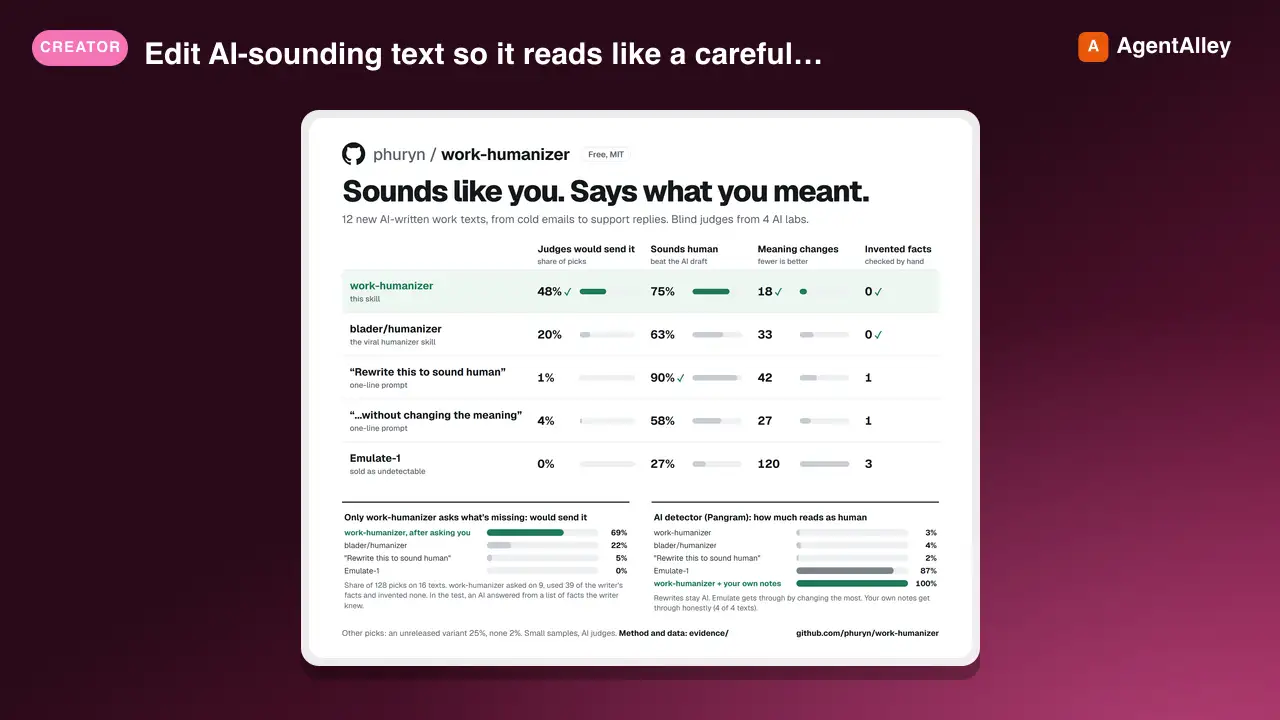 SkillAI Text Humanizerphuryn/work-humanizer · by phurynEdit AI-sounding text so it reads like a careful person wrote it, without changing what it says or commits to. Built for work writing where the wording matters: sales and marketing copy, support replies, HR and legal letters, emails, docs, release notes, posts, landing pages. Two modes. Rewrite: edit the text you are given. Interview: when a draft is AI-composed and thin, ask the writer 3-5 sharp questions and build the piece from their answers, in their words. Also writes from the writer's own notes or a voice-memo transcript. Calibrated on measured differences between human and AI writing.★ 110 GitHub stars
 SkillMarket Segment Identifierphuryn/pm-skills · by phurynIdentify the first beachhead market segment for a product launch. Evaluates segments against burning pain, willingness to pay, winnable market share, and referral potential. Use when choosing a first market, targeting an initial customer segment, or planning market entry strategy.★ 26.6k GitHub stars
 SkillProduct Experiment Designerphuryn/pm-skills · by phurynDesign experiments to test assumptions for an existing product — prototypes, A/B tests, spikes, and other low-effort validation methods. Use when validating assumptions, testing feature ideas cheaply, or planning product experiments.★ 26.6k GitHub stars