Sprint Retrospective Facilitator
Retro
Facilitate a structured sprint retrospective — what went well, what didn't, and prioritized action items with owners and deadlines. Use when running a retrospective, reflecting on a sprint, creating action items from team feedback, or…
---
name: retro
description: "Facilitate a structured sprint retrospective — what went well, what didn't, and prioritized action items with owners and deadlines. Use when running a retrospective, reflecting on a sprint, creating action items from team feedback, or learning how to run effective retros."
---

## Sprint Retrospective Facilitator

Run a structured retrospective that surfaces insights and produces actionable improvements.

### Context

You are facilitating a retrospective for **$ARGUMENTS**.

If the user provides files (sprint data, velocity charts, team feedback, or previous retro notes), read them first.

### Instructions

1. **Choose a retro format** based on context (or let the user pick):
Overview
Run a structured retrospective that surfaces insights and produces actionable improvements.
Manual install (npx, ZIP)
npx skills add phuryn/pm-skills --skill retro -g -a claude-codenpx degit phuryn/pm-skills/pm-execution/skills/retro#main ~/.claude/skills/retroConnects with Agent Alley MCP · agentalley.io/mcp
Files included
SKILL.md2.7 KB
Read SKILL.md here
Show the full text77 lines
Sprint Retrospective Facilitator
Run a structured retrospective that surfaces insights and produces actionable improvements.
Context
You are facilitating a retrospective for $ARGUMENTS.
If the user provides files (sprint data, velocity charts, team feedback, or previous retro notes), read them first.
Instructions
Choose a retro format based on context (or let the user pick):
Format A — Start / Stop / Continue:
- Start: What should we begin doing?
- Stop: What should we stop doing?
- Continue: What's working well that we should keep?
Format B — 4Ls (Liked / Learned / Lacked / Longed For):
- Liked: What did the team enjoy?
- Learned: What new knowledge was gained?
- Lacked: What was missing?
- Longed For: What do we wish we had?
Format C — Sailboat:
- Wind (propels us): What's driving us forward?
- Anchor (holds us back): What's slowing us down?
- Rocks (risks): What dangers lie ahead?
- Island (goal): Where are we trying to get to?
If the user provides raw feedback (e.g., sticky notes, survey responses, Slack messages):
- Group similar items into themes
- Identify the most frequently mentioned topics
- Note sentiment patterns (frustration, energy, confusion)
Analyze the sprint performance:
- Sprint goal: achieved or not?
- Velocity vs. commitment (over-committed? under-committed?)
- Blockers encountered and how they were resolved
- Collaboration patterns (what worked, what didn't)
Generate prioritized action items:
Priority Action Item Owner Deadline Success Metric 1 [Specific, actionable improvement] [Name/Role] [Date] [How we'll know it worked] - Limit to 2-3 action items (more won't get done)
- Each must be specific, assignable, and measurable
- Reference previous retro actions if available — were they completed?
Create the retro summary:
## Sprint [X] Retrospective — [Date]

### Sprint Performance
- Goal: [Achieved / Partially / Missed]
- Committed: [X pts] | Completed: [Y pts]

### Key Themes
1. [Theme] — [summary]

### Action Items
1. [Action] — [Owner] — [By date]

### Carry-over from Last Retro
- [Previous action] — [Status: Done / In Progress / Not Started]
Save as markdown. Keep the tone constructive — the goal is improvement, not blame.
| 1 | |
| 2 | name retro |
| 3 | description "Facilitate a structured sprint retrospective — what went well, what didn't, and prioritized action items with owners and deadlines. Use when running a retrospective, reflecting on a sprint, creating action items from team feedback, or learning how to run effective retros." |
| 4 | |
| 5 | |
| 6 | ## Sprint Retrospective Facilitator |
| 7 | |
| 8 | Run a structured retrospective that surfaces insights and produces actionable improvements. |
| 9 | |
| 10 | ### Context |
| 11 | |
| 12 | You are facilitating a retrospective for **$ARGUMENTS**. |
| 13 | |
| 14 | If the user provides files (sprint data, velocity charts, team feedback, or previous retro notes), read them first. |
| 15 | |
| 16 | ### Instructions |
| 17 | |
| 18 | **Choose a retro format** based on context (or let the user pick): |
| 19 | |
| 20 | **Format A — Start / Stop / Continue**: |
| 21 | **Start**: What should we begin doing? |
| 22 | **Stop**: What should we stop doing? |
| 23 | **Continue**: What's working well that we should keep? |
| 24 | |
| 25 | **Format B — 4Ls (Liked / Learned / Lacked / Longed For)**: |
| 26 | **Liked**: What did the team enjoy? |
| 27 | **Learned**: What new knowledge was gained? |
| 28 | **Lacked**: What was missing? |
| 29 | **Longed For**: What do we wish we had? |
| 30 | |
| 31 | **Format C — Sailboat**: |
| 32 | **Wind (propels us)**: What's driving us forward? |
| 33 | **Anchor (holds us back)**: What's slowing us down? |
| 34 | **Rocks (risks)**: What dangers lie ahead? |
| 35 | **Island (goal)**: Where are we trying to get to? |
| 36 | |
| 37 | **If the user provides raw feedback** (e.g., sticky notes, survey responses, Slack messages): |
| 38 | Group similar items into themes |
| 39 | Identify the most frequently mentioned topics |
| 40 | Note sentiment patterns (frustration, energy, confusion) |
| 41 | |
| 42 | **Analyze the sprint performance**: |
| 43 | Sprint goal: achieved or not? |
| 44 | Velocity vs. commitment (over-committed? under-committed?) |
| 45 | Blockers encountered and how they were resolved |
| 46 | Collaboration patterns (what worked, what didn't) |
| 47 | |
| 48 | **Generate prioritized action items**: |
| 49 | |
| 50 | | Priority | Action Item | Owner | Deadline | Success Metric | |
| 51 | |---|---|---|---|---| |
| 52 | | 1 | [Specific, actionable improvement] | [Name/Role] | [Date] | [How we'll know it worked] | |
| 53 | |
| 54 | Limit to 2-3 action items (more won't get done) |
| 55 | Each must be specific, assignable, and measurable |
| 56 | Reference previous retro actions if available — were they completed? |
| 57 | |
| 58 | **Create the retro summary**: |
| 59 | |
| 60 | ## Sprint [X] Retrospective — [Date] |
| 61 | |
| 62 | ### Sprint Performance |
| 63 | - Goal: [Achieved / Partially / Missed] |
| 64 | - Committed: [X pts] | Completed: [Y pts] |
| 65 | |
| 66 | ### Key Themes |
| 67 | 1. [Theme] — [summary] |
| 68 | |
| 69 | ### Action Items |
| 70 | 1. [Action] — [Owner] — [By date] |
| 71 | |
| 72 | ### Carry-over from Last Retro |
| 73 | - [Previous action] — [Status: Done / In Progress / Not Started] |
| 74 | |
| 75 | |
| 76 | Save as markdown. Keep the tone constructive — the goal is improvement, not blame. |
| 77 |
Details
- Updated
- Sep 14, 2026
- License
- MIT
- Stars on the repo
- ★ 26,557
- Checked
- Source
- phuryn/pm-skills ↗
- Creator
- phuryn · 69 listings
Similar skills
See all → AgentPhase 2: Foundation Scaffolding
 msitarzewski/agency-agents · by msitarzewski> Duration: 3-5 days | Agents: 6 | Gate Keepers: DevOps Automator + Evidence Collector★ 154k GitHub stars
 AgentNEXUS Network Frameworkmsitarzewski/agency-agents · by msitarzewski> NEXUS transforms The Agency's independent AI specialists into a synchronized intelligence network. This is not a prompt collection — it…★ 154k GitHub stars
 SkillAnsoff Matrix Generator
 phuryn/pm-skills · by phurynGenerate an Ansoff Matrix analysis mapping growth strategies across market penetration, market development, product development, and diversification. Use when considering growth options, planning market expansion, or evaluating strategic growth paths.★ 26.6k GitHub stars
 SkillArchitecture Advisor
 shadcn/improve · by shadcnSurvey any codebase as a senior advisor and produce prioritized, self-contained implementation plans for OTHER models/agents to execute. Strictly read-only on source code — never implements, fixes, or refactors anything itself. Use when asked to audit a codebase, find improvement opportunities (bugs, security, performance, test coverage, tech debt, migrations, DX), suggest features or where to take the project next (roadmap, product direction), or generate handoff plans for another agent to implement.★ 9.2k GitHub stars
 SkillCareer Skills Translator
 Paramchoudhary/ResumeSkills · by ParamchoudharyTranslate skills from one industry to another, identify transferable skills★ 2.4k GitHub stars
 SkillMarketing Skills Collection
 LeoYeAI/openclaw-marketing-skills · by LeoYeAIA collection of 37 battle-tested marketing skills for OpenClaw agents. Use when you want to install or reference any marketing skill including: CRO (page-cro, signup-flow-cro, onboarding-cro, form-cro, popup-cro, paywall-upgrade-cro), copywriting, copy-editing, cold-email, email-sequence, social-content, seo-audit, ai-seo, programmatic-seo, site-architecture, schema-markup, content-strategy, paid-ads, ad-creative, ab-test-setup, analytics-tracking, referral-program, free-tool-strategy, churn-prevention, revops, sales-enablement, launch-strategy, pricing-strategy, competitor-alternatives, marketing-ideas, marketing-psychology, lead-magnets, product-marketing-context, and data connectors (google-ads-connect, search-console-connect, meta-ads-connect, x-twitter-connect). Start with product-marketing-context to set up your product context document, then use any other skill naturally. Powered by MyClaw.ai.★ 1k GitHub stars
More from phuryn
 SkillA/B Test Analyzerphuryn/pm-skills · by phurynAnalyze A/B test results with statistical significance, sample size validation, confidence intervals, and ship/extend/stop recommendations. Use when evaluating experiment results, checking if a test reached significance, interpreting split test data, or deciding whether to ship a variant.★ 26.6k GitHub stars
 SkillFeature Request Prioritizerphuryn/pm-skills · by phurynAnalyze and prioritize a list of feature requests by theme, strategic alignment, impact, effort, and risk. Use when reviewing customer feature requests, triaging a backlog, or making prioritization decisions.★ 26.6k GitHub starsSkillAnsoff Matrix Generatorphuryn/pm-skills · by phurynGenerate an Ansoff Matrix analysis mapping growth strategies across market penetration, market development, product development, and diversification. Use when considering growth options, planning market expansion, or evaluating strategic growth paths.★ 26.6k GitHub stars
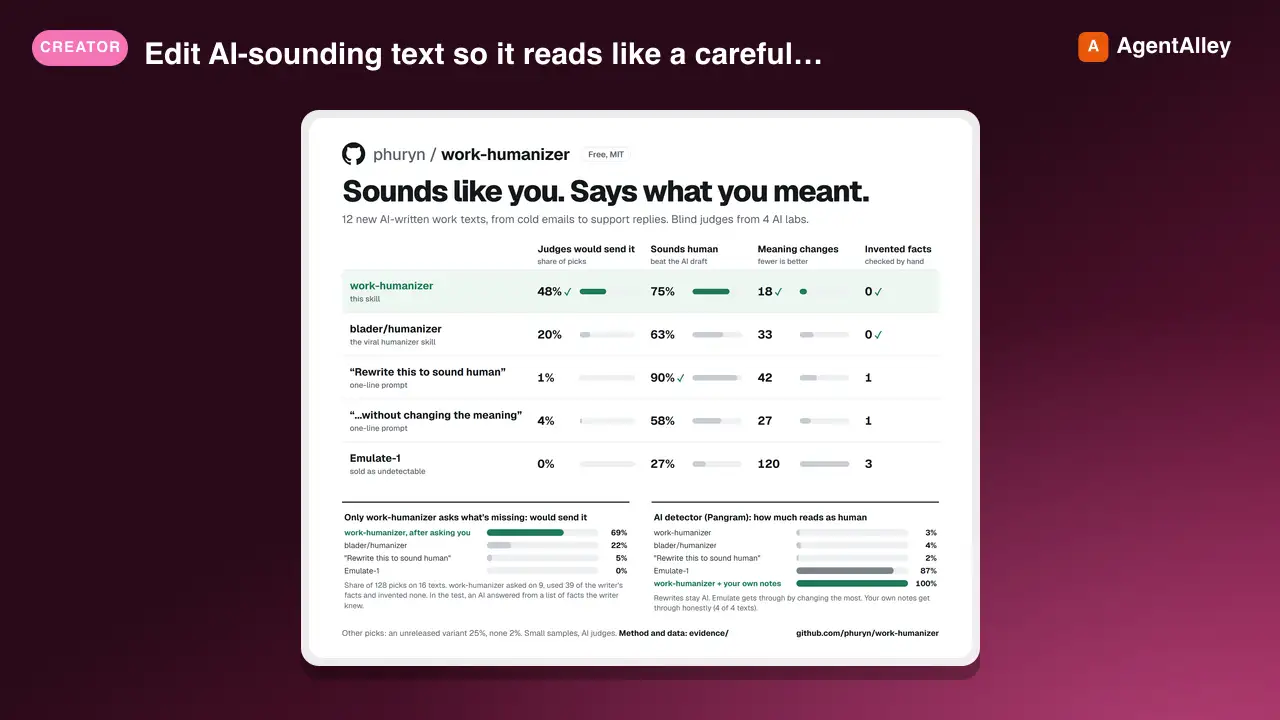 SkillAI Text Humanizerphuryn/work-humanizer · by phurynEdit AI-sounding text so it reads like a careful person wrote it, without changing what it says or commits to. Built for work writing where the wording matters: sales and marketing copy, support replies, HR and legal letters, emails, docs, release notes, posts, landing pages. Two modes. Rewrite: edit the text you are given. Interview: when a draft is AI-composed and thin, ask the writer 3-5 sharp questions and build the piece from their answers, in their words. Also writes from the writer's own notes or a voice-memo transcript. Calibrated on measured differences between human and AI writing.★ 110 GitHub stars
 SkillMarket Segment Identifierphuryn/pm-skills · by phurynIdentify the first beachhead market segment for a product launch. Evaluates segments against burning pain, willingness to pay, winnable market share, and referral potential. Use when choosing a first market, targeting an initial customer segment, or planning market entry strategy.★ 26.6k GitHub stars
 SkillProduct Experiment Designerphuryn/pm-skills · by phurynDesign experiments to test assumptions for an existing product — prototypes, A/B tests, spikes, and other low-effort validation methods. Use when validating assumptions, testing feature ideas cheaply, or planning product experiments.★ 26.6k GitHub stars