Opportunity Solution Tree
Opportunity solution tree
Build an Opportunity Solution Tree (OST) to structure product discovery — map a desired outcome to opportunities, solutions, and experiments. Based on Teresa Torres' Continuous Discovery Habits.
---
name: opportunity-solution-tree
description: "Build an Opportunity Solution Tree (OST) to structure product discovery — map a desired outcome to opportunities, solutions, and experiments. Based on Teresa Torres' Continuous Discovery Habits. Use when structuring discovery work, mapping opportunities to solutions, or deciding what to build next."
---

## Opportunity Solution Tree (OST)

A visual framework for structuring continuous product discovery. Connects a desired **outcome** to customer **opportunities**, possible **solutions**, and **experiments** to validate them.

### Domain Context

The **Opportunity Solution Tree** (Teresa Torres, *Continuous Discovery Habits*) is the backbone of modern product discovery. It prevents teams from jumping to solutions by forcing them to first map the opportunity space.

**Structure (4 levels):**

1. **Desired Outcome** (top) — The measurable business or product outcome the team is pursuing. Should be a single, clear metric (e.g., "increase 7-day retention to 40%"). This comes from your OKRs or product strategy.

2. **Opportunities** (second level) — Customer needs, pain points, or desires discovered through research. These are problems worth solving — not features. Frame them from the customer's perspective: "I struggle to..." or "I wish I could..." Prioritize using Opportunity Score: **Importance × (1 − Satisfaction)** (Dan Olsen, *The Lean Product Playbook*). Normalize Importance and Satisfaction to 0–1.
Overview
A visual framework for structuring continuous product discovery. Connects a desired outcome to customer opportunities, possible solutions, and experiments to validate them.
Manual install (npx, ZIP)
npx skills add phuryn/pm-skills --skill opportunity-solution-tree -g -a claude-codenpx degit phuryn/pm-skills/pm-product-discovery/skills/opportunity-solution-tree#main ~/.claude/skills/opportunity-solution-treeConnects with Agent Alley MCP · agentalley.io/mcp
Files included
SKILL.md4.2 KB
Read SKILL.md here
Show the full text65 lines
Opportunity Solution Tree (OST)
A visual framework for structuring continuous product discovery. Connects a desired outcome to customer opportunities, possible solutions, and experiments to validate them.
Domain Context
The Opportunity Solution Tree (Teresa Torres, Continuous Discovery Habits) is the backbone of modern product discovery. It prevents teams from jumping to solutions by forcing them to first map the opportunity space.
Structure (4 levels):
Desired Outcome (top) — The measurable business or product outcome the team is pursuing. Should be a single, clear metric (e.g., "increase 7-day retention to 40%"). This comes from your OKRs or product strategy.
Opportunities (second level) — Customer needs, pain points, or desires discovered through research. These are problems worth solving — not features. Frame them from the customer's perspective: "I struggle to..." or "I wish I could..." Prioritize using Opportunity Score: Importance × (1 − Satisfaction) (Dan Olsen, The Lean Product Playbook). Normalize Importance and Satisfaction to 0–1.
Solutions (third level) — Possible ways to address each opportunity. Generate multiple solutions per opportunity — don't commit to the first idea. The Product Trio (PM + Designer + Engineer) should ideate together. "Best ideas often come from engineers."
Experiments (bottom) — Fast, cheap tests to validate whether a solution actually addresses the opportunity. Use assumption testing (Value, Usability, Viability, Feasibility risks). Prefer experiments with "skin-in-the-game" (Alberto Savoia) over opinion-based validation.
Key principles:
- One outcome at a time. Don't try to solve everything. Focus the tree on a single desired outcome.
- Opportunities, not features. "Never allow customers to design solutions. Prioritize opportunities (problems), not features."
- Compare and contrast. Always generate at least 3 solutions per opportunity before choosing. Avoid the "first idea" trap.
- Discovery is not linear. Loop back if experiments fail. Kill solutions that don't validate. Explore new branches.
- Continuous, not periodic. Update the tree weekly as you learn from interviews, analytics, and experiments.
Instructions
You are helping a product team build an Opportunity Solution Tree for $ARGUMENTS.
Input Requirements
- A desired outcome or business metric to improve
- Customer research data (interviews, surveys, analytics, feedback)
- Optionally: existing opportunities or solution ideas to organize
Process
Define the desired outcome — Confirm or help articulate a single, measurable outcome at the top of the tree.
Map opportunities — From provided research, identify 3-7 customer opportunities (needs/pains). Group related opportunities. Frame each from the customer's perspective.
Prioritize opportunities — Use Opportunity Score or qualitative assessment to rank. Focus on the top 2-3.
Generate solutions — For each prioritized opportunity, brainstorm 3+ solutions from PM, Designer, and Engineer perspectives.
Design experiments — For the most promising solutions, suggest 1-2 fast experiments. Specify: hypothesis, method, metric, success threshold.
Visualize the tree — Present the full OST in a clear hierarchical format.
Think step by step. Save as markdown if substantial.
Further Reading
| 1 | |
| 2 | name opportunity-solution-tree |
| 3 | description "Build an Opportunity Solution Tree (OST) to structure product discovery — map a desired outcome to opportunities, solutions, and experiments. Based on Teresa Torres' Continuous Discovery Habits. Use when structuring discovery work, mapping opportunities to solutions, or deciding what to build next." |
| 4 | |
| 5 | |
| 6 | ## Opportunity Solution Tree (OST) |
| 7 | |
| 8 | A visual framework for structuring continuous product discovery. Connects a desired **outcome** to customer **opportunities**, possible **solutions**, and **experiments** to validate them. |
| 9 | |
| 10 | ### Domain Context |
| 11 | |
| 12 | The **Opportunity Solution Tree** (Teresa Torres, *Continuous Discovery Habits*) is the backbone of modern product discovery. It prevents teams from jumping to solutions by forcing them to first map the opportunity space. |
| 13 | |
| 14 | **Structure (4 levels):** |
| 15 | |
| 16 | **Desired Outcome** (top) — The measurable business or product outcome the team is pursuing. Should be a single, clear metric (e.g., "increase 7-day retention to 40%"). This comes from your OKRs or product strategy. |
| 17 | |
| 18 | **Opportunities** (second level) — Customer needs, pain points, or desires discovered through research. These are problems worth solving — not features. Frame them from the customer's perspective: "I struggle to..." or "I wish I could..." Prioritize using Opportunity Score: **Importance × (1 − Satisfaction)** (Dan Olsen, *The Lean Product Playbook*). Normalize Importance and Satisfaction to 0–1. |
| 19 | |
| 20 | **Solutions** (third level) — Possible ways to address each opportunity. Generate multiple solutions per opportunity — don't commit to the first idea. The **Product Trio** (PM + Designer + Engineer) should ideate together. "Best ideas often come from engineers." |
| 21 | |
| 22 | **Experiments** (bottom) — Fast, cheap tests to validate whether a solution actually addresses the opportunity. Use assumption testing (Value, Usability, Viability, Feasibility risks). Prefer experiments with "skin-in-the-game" (Alberto Savoia) over opinion-based validation. |
| 23 | |
| 24 | **Key principles:** |
| 25 | |
| 26 | **One outcome at a time.** Don't try to solve everything. Focus the tree on a single desired outcome. |
| 27 | **Opportunities, not features.** "Never allow customers to design solutions. Prioritize opportunities (problems), not features." |
| 28 | **Compare and contrast.** Always generate at least 3 solutions per opportunity before choosing. Avoid the "first idea" trap. |
| 29 | **Discovery is not linear.** Loop back if experiments fail. Kill solutions that don't validate. Explore new branches. |
| 30 | **Continuous, not periodic.** Update the tree weekly as you learn from interviews, analytics, and experiments. |
| 31 | |
| 32 | ### Instructions |
| 33 | |
| 34 | You are helping a product team build an Opportunity Solution Tree for **$ARGUMENTS**. |
| 35 | |
| 36 | ### Input Requirements |
| 37 | A desired outcome or business metric to improve |
| 38 | Customer research data (interviews, surveys, analytics, feedback) |
| 39 | Optionally: existing opportunities or solution ideas to organize |
| 40 | |
| 41 | ### Process |
| 42 | |
| 43 | **Define the desired outcome** — Confirm or help articulate a single, measurable outcome at the top of the tree. |
| 44 | |
| 45 | **Map opportunities** — From provided research, identify 3-7 customer opportunities (needs/pains). Group related opportunities. Frame each from the customer's perspective. |
| 46 | |
| 47 | **Prioritize opportunities** — Use Opportunity Score or qualitative assessment to rank. Focus on the top 2-3. |
| 48 | |
| 49 | **Generate solutions** — For each prioritized opportunity, brainstorm 3+ solutions from PM, Designer, and Engineer perspectives. |
| 50 | |
| 51 | **Design experiments** — For the most promising solutions, suggest 1-2 fast experiments. Specify: hypothesis, method, metric, success threshold. |
| 52 | |
| 53 | **Visualize the tree** — Present the full OST in a clear hierarchical format. |
| 54 | |
| 55 | Think step by step. Save as markdown if substantial. |
| 56 | |
| 57 | |
| 58 | |
| 59 | ### Further Reading |
| 60 | |
| 61 | [The Extended Opportunity Solution Tree] |
| 62 | [What Is Product Discovery? The Ultimate Guide Step-by-Step] |
| 63 | [Product Trio: Beyond the Obvious] |
| 64 | [Continuous Product Discovery Masterclass (CPDM)] (video course) |
| 65 |
Details
- Updated
- Sep 14, 2026
- License
- MIT
- Stars on the repo
- ★ 26,557
- Checked
- Source
- phuryn/pm-skills ↗
- Creator
- phuryn · 69 listings
Similar skills
See all → AgentPhase 2: Foundation Scaffolding
 msitarzewski/agency-agents · by msitarzewski> Duration: 3-5 days | Agents: 6 | Gate Keepers: DevOps Automator + Evidence Collector★ 154k GitHub stars
 AgentNEXUS Network Frameworkmsitarzewski/agency-agents · by msitarzewski> NEXUS transforms The Agency's independent AI specialists into a synchronized intelligence network. This is not a prompt collection — it…★ 154k GitHub stars
 SkillAnsoff Matrix Generator
 phuryn/pm-skills · by phurynGenerate an Ansoff Matrix analysis mapping growth strategies across market penetration, market development, product development, and diversification. Use when considering growth options, planning market expansion, or evaluating strategic growth paths.★ 26.6k GitHub stars
 SkillArchitecture Advisor
 shadcn/improve · by shadcnSurvey any codebase as a senior advisor and produce prioritized, self-contained implementation plans for OTHER models/agents to execute. Strictly read-only on source code — never implements, fixes, or refactors anything itself. Use when asked to audit a codebase, find improvement opportunities (bugs, security, performance, test coverage, tech debt, migrations, DX), suggest features or where to take the project next (roadmap, product direction), or generate handoff plans for another agent to implement.★ 9.2k GitHub stars
 SkillCareer Skills Translator
 Paramchoudhary/ResumeSkills · by ParamchoudharyTranslate skills from one industry to another, identify transferable skills★ 2.4k GitHub stars
 SkillMarketing Skills Collection
 LeoYeAI/openclaw-marketing-skills · by LeoYeAIA collection of 37 battle-tested marketing skills for OpenClaw agents. Use when you want to install or reference any marketing skill including: CRO (page-cro, signup-flow-cro, onboarding-cro, form-cro, popup-cro, paywall-upgrade-cro), copywriting, copy-editing, cold-email, email-sequence, social-content, seo-audit, ai-seo, programmatic-seo, site-architecture, schema-markup, content-strategy, paid-ads, ad-creative, ab-test-setup, analytics-tracking, referral-program, free-tool-strategy, churn-prevention, revops, sales-enablement, launch-strategy, pricing-strategy, competitor-alternatives, marketing-ideas, marketing-psychology, lead-magnets, product-marketing-context, and data connectors (google-ads-connect, search-console-connect, meta-ads-connect, x-twitter-connect). Start with product-marketing-context to set up your product context document, then use any other skill naturally. Powered by MyClaw.ai.★ 1k GitHub stars
More from phuryn
 SkillA/B Test Analyzerphuryn/pm-skills · by phurynAnalyze A/B test results with statistical significance, sample size validation, confidence intervals, and ship/extend/stop recommendations. Use when evaluating experiment results, checking if a test reached significance, interpreting split test data, or deciding whether to ship a variant.★ 26.6k GitHub stars
 SkillFeature Request Prioritizerphuryn/pm-skills · by phurynAnalyze and prioritize a list of feature requests by theme, strategic alignment, impact, effort, and risk. Use when reviewing customer feature requests, triaging a backlog, or making prioritization decisions.★ 26.6k GitHub starsSkillAnsoff Matrix Generatorphuryn/pm-skills · by phurynGenerate an Ansoff Matrix analysis mapping growth strategies across market penetration, market development, product development, and diversification. Use when considering growth options, planning market expansion, or evaluating strategic growth paths.★ 26.6k GitHub stars
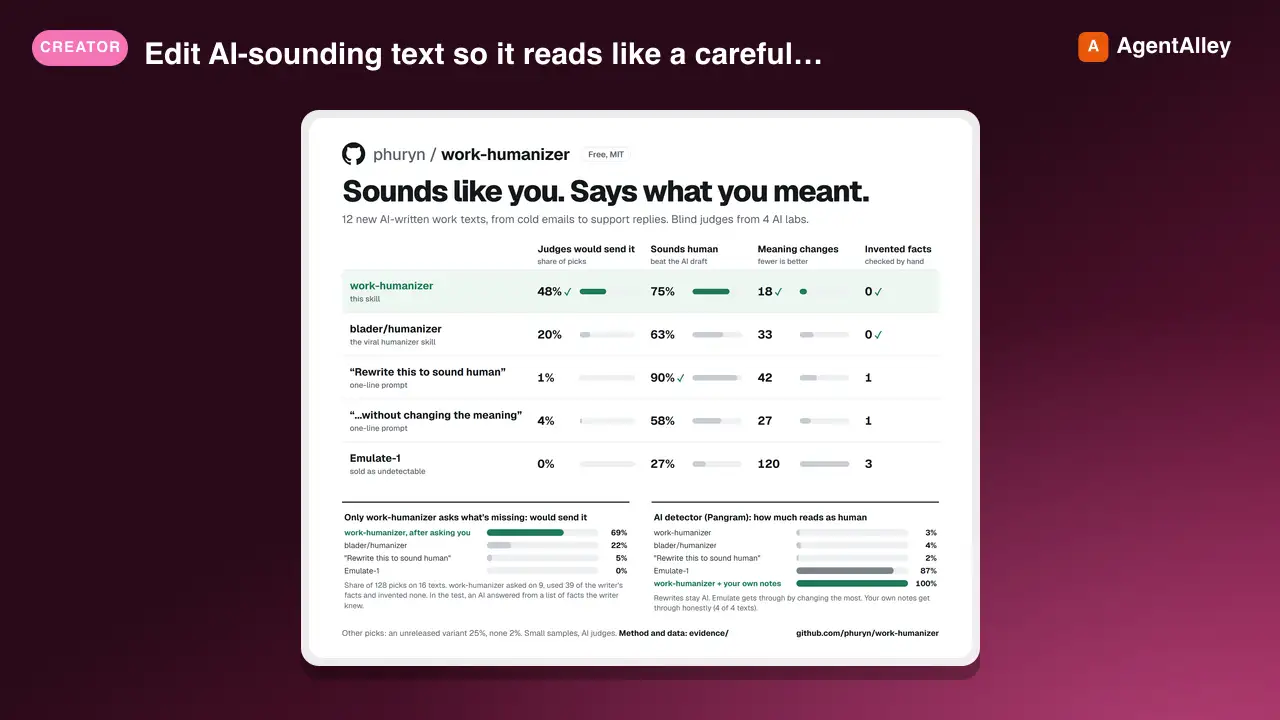 SkillAI Text Humanizerphuryn/work-humanizer · by phurynEdit AI-sounding text so it reads like a careful person wrote it, without changing what it says or commits to. Built for work writing where the wording matters: sales and marketing copy, support replies, HR and legal letters, emails, docs, release notes, posts, landing pages. Two modes. Rewrite: edit the text you are given. Interview: when a draft is AI-composed and thin, ask the writer 3-5 sharp questions and build the piece from their answers, in their words. Also writes from the writer's own notes or a voice-memo transcript. Calibrated on measured differences between human and AI writing.★ 110 GitHub stars
 SkillMarket Segment Identifierphuryn/pm-skills · by phurynIdentify the first beachhead market segment for a product launch. Evaluates segments against burning pain, willingness to pay, winnable market share, and referral potential. Use when choosing a first market, targeting an initial customer segment, or planning market entry strategy.★ 26.6k GitHub stars
 SkillProduct Experiment Designerphuryn/pm-skills · by phurynDesign experiments to test assumptions for an existing product — prototypes, A/B tests, spikes, and other low-effort validation methods. Use when validating assumptions, testing feature ideas cheaply, or planning product experiments.★ 26.6k GitHub stars