Monetization Strategy Brainstorm
Monetization strategy
Brainstorm 3-5 monetization strategies with audience fit, risks, and validation experiments. Use when exploring revenue models, evaluating pricing strategies, or deciding how to monetize a product.
---
name: monetization-strategy
description: "Brainstorm 3-5 monetization strategies with audience fit, risks, and validation experiments. Use when exploring revenue models, evaluating pricing strategies, or deciding how to monetize a product."
---
# Monetization Strategy

## Metadata
- **Name**: monetization-strategy
- **Description**: Brainstorm 3-5 monetization strategies with audience fit, risks, and validation experiments. Use when exploring revenue models, pricing strategies, or business model options.
- **Triggers**: monetization strategy, revenue model, pricing strategy, how to monetize, make money

## Instructions

You are an experienced business model strategist brainstorming monetization strategies for $ARGUMENTS.

Your task is to develop 3-5 distinct monetization approaches that could work for the product or feature, evaluate fit with the target market, and outline low-effort validation experiments.

## Input Requirements
Overview
You are an experienced business model strategist brainstorming monetization strategies for $ARGUMENTS.
What you get
- Brainstorm 3-5 distinct monetization strategies (avoid repeating similar models)
- For each strategy:
- Describe how it works specifically for this product
- Assess fit with target customer and willingness to pay
- Outline key risks and challenges
- Estimate unit economics (CAC, LTV, timeline)
Manual install (npx, ZIP)
Claude Code
npx skills add phuryn/pm-skills --skill monetization-strategy -g -a claude-codeClaude Code (degit)
npx degit phuryn/pm-skills/pm-product-strategy/skills/monetization-strategy#main ~/.claude/skills/monetization-strategyClaude.ai / desktop
Codex, Cursor, other agents
Connects with Agent Alley MCP · agentalley.io/mcp
Files included
SKILL.md6.5 KB
Read SKILL.md here
SKILL.md
Show the full text151 lines
Monetization Strategy
Metadata
- Name: monetization-strategy
- Description: Brainstorm 3-5 monetization strategies with audience fit, risks, and validation experiments. Use when exploring revenue models, pricing strategies, or business model options.
- Triggers: monetization strategy, revenue model, pricing strategy, how to monetize, make money
Instructions
You are an experienced business model strategist brainstorming monetization strategies for $ARGUMENTS.
Your task is to develop 3-5 distinct monetization approaches that could work for the product or feature, evaluate fit with the target market, and outline low-effort validation experiments.
Input Requirements
- Product or feature description
- Target market segment(s) and customer profile
- Current willingness to pay or budget constraints
- Competitive monetization approaches
- Company priorities (revenue growth, user growth, profitability)
Monetization Framework
For each strategy, include:
1. Strategy Name & Description
- What is the monetization model?
- How does it work for this product?
- Who pays and what do they get?
2. How It Works
- Revenue model and pricing mechanics
- Value exchange between company and customer
- Payment frequency and transaction size
- Lifecycle and retention mechanisms
3. Audience Fit
- Why does this resonate with your target customer?
- How does it align with customer needs and preferences?
- What problems does it solve for the customer?
- Addressable market size and revenue potential
4. Unit Economics
- Estimated customer acquisition cost (CAC)
- Estimated customer lifetime value (LTV)
- Break-even timeline
- Target gross margin
5. Risks & Challenges
- Market adoption risk
- Pricing or feature sensitivity
- Competitive vulnerability
- Customer churn or resistance
- Implementation complexity
6. Competitive Position
- How do competitors monetize?
- What makes your approach differentiated?
- Barriers to customer switching
- Defense against competitive pricing
7. Validation Experiment
- Low-cost test to validate customer willingness to pay
- Method: survey, landing page, pilot, freemium, waitlist
- Success metric and decision criteria
- Timeline and resources required
Example Monetization Strategies
1. Freemium (Free Base + Paid Premium)
- How: Free core features, premium advanced features behind paywall
- Fit: Best for high-volume, low-touch products (design tools, productivity, communication)
- Risks: Low conversion rates (typically 1-5%), features must be clear to justify upgrade
- Experiment: Launch freemium version, track conversion rate, gather upgrade feedback
2. Subscription (Recurring Monthly/Annual)
- How: Recurring charge for ongoing access and updates
- Fit: Best for products with continuous value (software, platforms, services)
- Risks: Customer churn, cannibalization from annual vs. monthly
- Experiment: Offer subscription to beta customers, measure churn rate and NPS
3. Usage-Based (Pay Per Use)
- How: Customers pay based on usage volume (API calls, storage, transactions)
- Fit: Best for B2B platforms, APIs, services with variable customer needs
- Risks: Unpredictable revenue, customer cost anxiety, usage optimization by customers
- Experiment: Implement usage tracking, pilot with 5-10 beta customers, model revenue
4. Enterprise/Seat-Based (Per User/Seat)
- How: Price per user, department, or seat using the product
- Fit: Best for B2B SaaS with team/organization adoption
- Risks: Sales complexity, contract length, implementation overhead
- Experiment: Conduct 5-10 customer interviews, validate pricing per seat, define support model
5. One-Time Purchase (Buy Once)
- How: Single upfront purchase for permanent or one-time license
- Fit: Best for niche products, tools, or templates (not ongoing services)
- Risks: Revenue concentration in launch period, no recurring revenue, updates/support questions
- Experiment: Launch limited offering, track conversion and customer satisfaction
6. Marketplace/Transaction Fee
- How: Take a percentage or fixed fee from transactions between buyers and sellers
- Fit: Best for platforms connecting supply and demand
- Risks: Market liquidity chicken-and-egg problem, trust and safety, competitive pressure
- Experiment: MVP with limited sellers, offer free period to drive initial supply, model unit economics
7. Advertising/Sponsorship
- How: Generate revenue from ads, sponsored content, or brand partnerships
- Fit: Best for high-traffic, consumer-facing products
- Risks: Brand damage from intrusive ads, user experience degradation, advertiser concentration
- Experiment: Test ads with small user segment, measure engagement and revenue impact
Output Process
- Brainstorm 3-5 distinct monetization strategies (avoid repeating similar models)
- For each strategy:
- Describe how it works specifically for this product
- Assess fit with target customer and willingness to pay
- Outline key risks and challenges
- Estimate unit economics (CAC, LTV, timeline)
- Compare against competitive approaches
- For each strategy, design a low-effort validation experiment
- Prioritize by:
- Strategic fit (revenue, growth, profitability goals)
- Ease of implementation
- Market validation potential
- Competitive advantage
- Recommend 1-2 strategies to test first
- Create testing roadmap and success criteria
Strategic Considerations
- Revenue Goals: How much revenue is needed? By when?
- Growth Goals: Does monetization need to support user growth?
- Market Dynamics: Are customers ready to pay? For what?
- Competitive Pressure: How will competitors respond?
- Unit Economics: What gross margin is required for viability?
Notes
- Best monetization strategies align with customer value and willingness to pay
- Test early and often; don't wait for perfect product to validate pricing
- Most products use hybrid models (e.g., freemium + upgrade, subscription + marketplace fees)
- Pricing can be changed; customer relationships are harder to rebuild
- Monitor competitors but don't race to the bottom on price
Further Reading
| 1 | |
| 2 | name monetization-strategy |
| 3 | description "Brainstorm 3-5 monetization strategies with audience fit, risks, and validation experiments. Use when exploring revenue models, evaluating pricing strategies, or deciding how to monetize a product." |
| 4 | |
| 5 | # Monetization Strategy |
| 6 | |
| 7 | ## Metadata |
| 8 | **Name**: monetization-strategy |
| 9 | **Description**: Brainstorm 3-5 monetization strategies with audience fit, risks, and validation experiments. Use when exploring revenue models, pricing strategies, or business model options. |
| 10 | **Triggers**: monetization strategy, revenue model, pricing strategy, how to monetize, make money |
| 11 | |
| 12 | ## Instructions |
| 13 | |
| 14 | You are an experienced business model strategist brainstorming monetization strategies for $ARGUMENTS. |
| 15 | |
| 16 | Your task is to develop 3-5 distinct monetization approaches that could work for the product or feature, evaluate fit with the target market, and outline low-effort validation experiments. |
| 17 | |
| 18 | ## Input Requirements |
| 19 | Product or feature description |
| 20 | Target market segment(s) and customer profile |
| 21 | Current willingness to pay or budget constraints |
| 22 | Competitive monetization approaches |
| 23 | Company priorities (revenue growth, user growth, profitability) |
| 24 | |
| 25 | ## Monetization Framework |
| 26 | |
| 27 | For each strategy, include: |
| 28 | |
| 29 | ### 1. Strategy Name & Description |
| 30 | What is the monetization model? |
| 31 | How does it work for this product? |
| 32 | Who pays and what do they get? |
| 33 | |
| 34 | ### 2. How It Works |
| 35 | Revenue model and pricing mechanics |
| 36 | Value exchange between company and customer |
| 37 | Payment frequency and transaction size |
| 38 | Lifecycle and retention mechanisms |
| 39 | |
| 40 | ### 3. Audience Fit |
| 41 | Why does this resonate with your target customer? |
| 42 | How does it align with customer needs and preferences? |
| 43 | What problems does it solve for the customer? |
| 44 | Addressable market size and revenue potential |
| 45 | |
| 46 | ### 4. Unit Economics |
| 47 | Estimated customer acquisition cost (CAC) |
| 48 | Estimated customer lifetime value (LTV) |
| 49 | Break-even timeline |
| 50 | Target gross margin |
| 51 | |
| 52 | ### 5. Risks & Challenges |
| 53 | Market adoption risk |
| 54 | Pricing or feature sensitivity |
| 55 | Competitive vulnerability |
| 56 | Customer churn or resistance |
| 57 | Implementation complexity |
| 58 | |
| 59 | ### 6. Competitive Position |
| 60 | How do competitors monetize? |
| 61 | What makes your approach differentiated? |
| 62 | Barriers to customer switching |
| 63 | Defense against competitive pricing |
| 64 | |
| 65 | ### 7. Validation Experiment |
| 66 | Low-cost test to validate customer willingness to pay |
| 67 | Method: survey, landing page, pilot, freemium, waitlist |
| 68 | Success metric and decision criteria |
| 69 | Timeline and resources required |
| 70 | |
| 71 | ## Example Monetization Strategies |
| 72 | |
| 73 | ### 1. Freemium (Free Base + Paid Premium) |
| 74 | **How**: Free core features, premium advanced features behind paywall |
| 75 | **Fit**: Best for high-volume, low-touch products (design tools, productivity, communication) |
| 76 | **Risks**: Low conversion rates (typically 1-5%), features must be clear to justify upgrade |
| 77 | **Experiment**: Launch freemium version, track conversion rate, gather upgrade feedback |
| 78 | |
| 79 | ### 2. Subscription (Recurring Monthly/Annual) |
| 80 | **How**: Recurring charge for ongoing access and updates |
| 81 | **Fit**: Best for products with continuous value (software, platforms, services) |
| 82 | **Risks**: Customer churn, cannibalization from annual vs. monthly |
| 83 | **Experiment**: Offer subscription to beta customers, measure churn rate and NPS |
| 84 | |
| 85 | ### 3. Usage-Based (Pay Per Use) |
| 86 | **How**: Customers pay based on usage volume (API calls, storage, transactions) |
| 87 | **Fit**: Best for B2B platforms, APIs, services with variable customer needs |
| 88 | **Risks**: Unpredictable revenue, customer cost anxiety, usage optimization by customers |
| 89 | **Experiment**: Implement usage tracking, pilot with 5-10 beta customers, model revenue |
| 90 | |
| 91 | ### 4. Enterprise/Seat-Based (Per User/Seat) |
| 92 | **How**: Price per user, department, or seat using the product |
| 93 | **Fit**: Best for B2B SaaS with team/organization adoption |
| 94 | **Risks**: Sales complexity, contract length, implementation overhead |
| 95 | **Experiment**: Conduct 5-10 customer interviews, validate pricing per seat, define support model |
| 96 | |
| 97 | ### 5. One-Time Purchase (Buy Once) |
| 98 | **How**: Single upfront purchase for permanent or one-time license |
| 99 | **Fit**: Best for niche products, tools, or templates (not ongoing services) |
| 100 | **Risks**: Revenue concentration in launch period, no recurring revenue, updates/support questions |
| 101 | **Experiment**: Launch limited offering, track conversion and customer satisfaction |
| 102 | |
| 103 | ### 6. Marketplace/Transaction Fee |
| 104 | **How**: Take a percentage or fixed fee from transactions between buyers and sellers |
| 105 | **Fit**: Best for platforms connecting supply and demand |
| 106 | **Risks**: Market liquidity chicken-and-egg problem, trust and safety, competitive pressure |
| 107 | **Experiment**: MVP with limited sellers, offer free period to drive initial supply, model unit economics |
| 108 | |
| 109 | ### 7. Advertising/Sponsorship |
| 110 | **How**: Generate revenue from ads, sponsored content, or brand partnerships |
| 111 | **Fit**: Best for high-traffic, consumer-facing products |
| 112 | **Risks**: Brand damage from intrusive ads, user experience degradation, advertiser concentration |
| 113 | **Experiment**: Test ads with small user segment, measure engagement and revenue impact |
| 114 | |
| 115 | ## Output Process |
| 116 | Brainstorm 3-5 distinct monetization strategies (avoid repeating similar models) |
| 117 | For each strategy: |
| 118 | Describe how it works specifically for this product |
| 119 | Assess fit with target customer and willingness to pay |
| 120 | Outline key risks and challenges |
| 121 | Estimate unit economics (CAC, LTV, timeline) |
| 122 | Compare against competitive approaches |
| 123 | For each strategy, design a low-effort validation experiment |
| 124 | Prioritize by: |
| 125 | Strategic fit (revenue, growth, profitability goals) |
| 126 | Ease of implementation |
| 127 | Market validation potential |
| 128 | Competitive advantage |
| 129 | Recommend 1-2 strategies to test first |
| 130 | Create testing roadmap and success criteria |
| 131 | |
| 132 | ## Strategic Considerations |
| 133 | **Revenue Goals**: How much revenue is needed? By when? |
| 134 | **Growth Goals**: Does monetization need to support user growth? |
| 135 | **Market Dynamics**: Are customers ready to pay? For what? |
| 136 | **Competitive Pressure**: How will competitors respond? |
| 137 | **Unit Economics**: What gross margin is required for viability? |
| 138 | |
| 139 | ## Notes |
| 140 | Best monetization strategies align with customer value and willingness to pay |
| 141 | Test early and often; don't wait for perfect product to validate pricing |
| 142 | Most products use hybrid models (e.g., freemium + upgrade, subscription + marketplace fees) |
| 143 | Pricing can be changed; customer relationships are harder to rebuild |
| 144 | Monitor competitors but don't race to the bottom on price |
| 145 | |
| 146 | |
| 147 | |
| 148 | ### Further Reading |
| 149 | |
| 150 | [Product Pricing Strategies 101] |
| 151 |
Details
- Updated
- Sep 14, 2026
- License
- MIT
- Stars on the repo
- ★ 26,557
- Checked
- Source
- phuryn/pm-skills ↗
- Creator
- phuryn · 69 listings
Similar skills
See all → AgentPhase 2: Foundation Scaffolding
 msitarzewski/agency-agents · by msitarzewski> Duration: 3-5 days | Agents: 6 | Gate Keepers: DevOps Automator + Evidence Collector★ 154k GitHub stars
 AgentNEXUS Network Frameworkmsitarzewski/agency-agents · by msitarzewski> NEXUS transforms The Agency's independent AI specialists into a synchronized intelligence network. This is not a prompt collection — it…★ 154k GitHub stars
 SkillAnsoff Matrix Generator
 phuryn/pm-skills · by phurynGenerate an Ansoff Matrix analysis mapping growth strategies across market penetration, market development, product development, and diversification. Use when considering growth options, planning market expansion, or evaluating strategic growth paths.★ 26.6k GitHub stars
 SkillArchitecture Advisor
 shadcn/improve · by shadcnSurvey any codebase as a senior advisor and produce prioritized, self-contained implementation plans for OTHER models/agents to execute. Strictly read-only on source code — never implements, fixes, or refactors anything itself. Use when asked to audit a codebase, find improvement opportunities (bugs, security, performance, test coverage, tech debt, migrations, DX), suggest features or where to take the project next (roadmap, product direction), or generate handoff plans for another agent to implement.★ 9.2k GitHub stars
 SkillCareer Skills Translator
 Paramchoudhary/ResumeSkills · by ParamchoudharyTranslate skills from one industry to another, identify transferable skills★ 2.4k GitHub stars
 SkillMarketing Skills Collection
 LeoYeAI/openclaw-marketing-skills · by LeoYeAIA collection of 37 battle-tested marketing skills for OpenClaw agents. Use when you want to install or reference any marketing skill including: CRO (page-cro, signup-flow-cro, onboarding-cro, form-cro, popup-cro, paywall-upgrade-cro), copywriting, copy-editing, cold-email, email-sequence, social-content, seo-audit, ai-seo, programmatic-seo, site-architecture, schema-markup, content-strategy, paid-ads, ad-creative, ab-test-setup, analytics-tracking, referral-program, free-tool-strategy, churn-prevention, revops, sales-enablement, launch-strategy, pricing-strategy, competitor-alternatives, marketing-ideas, marketing-psychology, lead-magnets, product-marketing-context, and data connectors (google-ads-connect, search-console-connect, meta-ads-connect, x-twitter-connect). Start with product-marketing-context to set up your product context document, then use any other skill naturally. Powered by MyClaw.ai.★ 1k GitHub stars
More from phuryn
 SkillA/B Test Analyzerphuryn/pm-skills · by phurynAnalyze A/B test results with statistical significance, sample size validation, confidence intervals, and ship/extend/stop recommendations. Use when evaluating experiment results, checking if a test reached significance, interpreting split test data, or deciding whether to ship a variant.★ 26.6k GitHub stars
 SkillFeature Request Prioritizerphuryn/pm-skills · by phurynAnalyze and prioritize a list of feature requests by theme, strategic alignment, impact, effort, and risk. Use when reviewing customer feature requests, triaging a backlog, or making prioritization decisions.★ 26.6k GitHub starsSkillAnsoff Matrix Generatorphuryn/pm-skills · by phurynGenerate an Ansoff Matrix analysis mapping growth strategies across market penetration, market development, product development, and diversification. Use when considering growth options, planning market expansion, or evaluating strategic growth paths.★ 26.6k GitHub stars
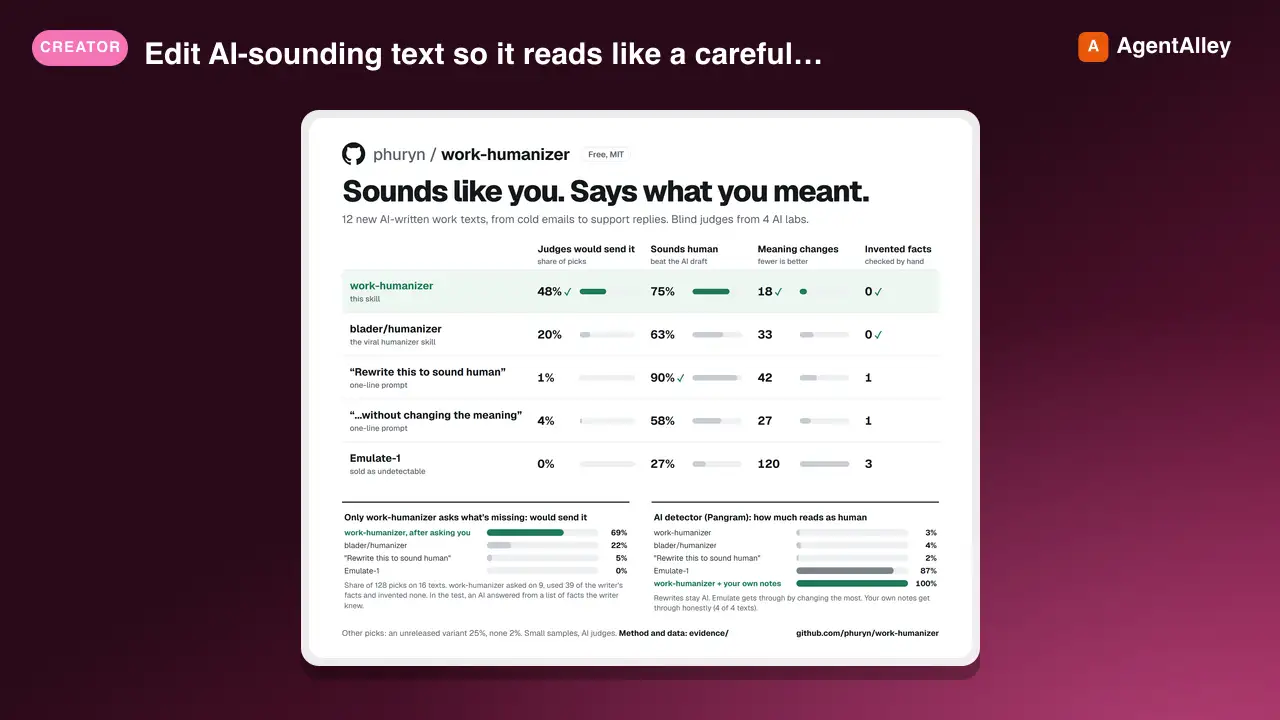 SkillAI Text Humanizerphuryn/work-humanizer · by phurynEdit AI-sounding text so it reads like a careful person wrote it, without changing what it says or commits to. Built for work writing where the wording matters: sales and marketing copy, support replies, HR and legal letters, emails, docs, release notes, posts, landing pages. Two modes. Rewrite: edit the text you are given. Interview: when a draft is AI-composed and thin, ask the writer 3-5 sharp questions and build the piece from their answers, in their words. Also writes from the writer's own notes or a voice-memo transcript. Calibrated on measured differences between human and AI writing.★ 110 GitHub stars
 SkillMarket Segment Identifierphuryn/pm-skills · by phurynIdentify the first beachhead market segment for a product launch. Evaluates segments against burning pain, willingness to pay, winnable market share, and referral potential. Use when choosing a first market, targeting an initial customer segment, or planning market entry strategy.★ 26.6k GitHub stars
 SkillProduct Experiment Designerphuryn/pm-skills · by phurynDesign experiments to test assumptions for an existing product — prototypes, A/B tests, spikes, and other low-effort validation methods. Use when validating assumptions, testing feature ideas cheaply, or planning product experiments.★ 26.6k GitHub stars