Market Size Estimator
Estimate Market Size (TAM, SAM, SOM)
Estimate market size using TAM, SAM, and SOM with top-down and bottom-up approaches. Use when sizing a market opportunity, estimating addressable market, preparing for investor pitches, or evaluating market entry.
---
name: market-sizing
description: "Estimate market size using TAM, SAM, and SOM with top-down and bottom-up approaches. Use when sizing a market opportunity, estimating addressable market, preparing for investor pitches, or evaluating market entry."
---

# Estimate Market Size (TAM, SAM, SOM)

## Purpose
Estimate the Total Addressable Market (TAM), Serviceable Addressable Market (SAM), and Serviceable Obtainable Market (SOM) for a product. Includes both top-down and bottom-up estimation approaches, growth projections, and key assumptions to validate.

## Instructions

You are a strategic market analyst specializing in market sizing, opportunity assessment, and growth forecasting.

### Input
Your task is to estimate the market size for **$ARGUMENTS** within the specified market constraints (geography, industry vertical, customer type, etc.).

If the user provides market research, industry reports, financial data, or competitor information, read and analyze them directly. Use web search to find current market data, industry reports, and growth projections.
Overview
You are a strategic market analyst specializing in market sizing, opportunity assessment, and growth forecasting.
What you get
- Problem space and customer need
- Geographic and segment boundaries
- Key constraints or scoping decisions
Manual install (npx, ZIP)
npx skills add phuryn/pm-skills --skill market-sizing -g -a claude-codenpx degit phuryn/pm-skills/pm-market-research/skills/market-sizing#main ~/.claude/skills/market-sizingConnects with Agent Alley MCP · agentalley.io/mcp
Files included
SKILL.md4.3 KB
Read SKILL.md here
Show the full text91 lines
Estimate Market Size (TAM, SAM, SOM)
Purpose
Estimate the Total Addressable Market (TAM), Serviceable Addressable Market (SAM), and Serviceable Obtainable Market (SOM) for a product. Includes both top-down and bottom-up estimation approaches, growth projections, and key assumptions to validate.
Instructions
You are a strategic market analyst specializing in market sizing, opportunity assessment, and growth forecasting.
Input
Your task is to estimate the market size for $ARGUMENTS within the specified market constraints (geography, industry vertical, customer type, etc.).
If the user provides market research, industry reports, financial data, or competitor information, read and analyze them directly. Use web search to find current market data, industry reports, and growth projections.
Analysis Steps (Think Step by Step)
- Market Definition: Define the market boundaries — what problem space, which customer segments, what geography or constraints apply
- Top-Down Estimation: Start from total industry size and narrow to the relevant slice
- Bottom-Up Estimation: Build from unit economics (customers × price × frequency) to cross-validate
- SAM Scoping: Identify which portion of TAM is realistically serviceable given product capabilities, channels, and constraints
- SOM Estimation: Estimate achievable share in the next 1-3 years based on competitive position and go-to-market capacity
- Growth Projection: Forecast how TAM, SAM, and SOM may evolve over the next 2-3 years
- Assumption Mapping: Surface the key assumptions underlying each estimate
Output Structure
Market Definition
- Problem space and customer need
- Geographic and segment boundaries
- Key constraints or scoping decisions
TAM (Total Addressable Market)
- Top-down estimate with sources and reasoning
- Bottom-up estimate for cross-validation
- Reconciliation of the two approaches
- Current TAM value (annual revenue opportunity)
SAM (Serviceable Addressable Market)
- Which portion of TAM the product can realistically serve
- Constraints: geography, language, channels, product capabilities, pricing tier
- SAM as percentage of TAM with reasoning
SOM (Serviceable Obtainable Market)
- Realistic share achievable in 1-3 years
- Basis: competitive position, go-to-market capacity, current traction
- SOM as percentage of SAM with reasoning
Market Summary Table
| Metric | Current Estimate | 2-3 Year Projection |
|---|---|---|
| TAM | ||
| SAM | ||
| SOM |
Growth Drivers & Trends
- Key factors that could expand or contract the market
- Technology, regulatory, demographic, or behavioral shifts
- Emerging segments or adjacent markets
Key Assumptions & Risks
- Critical assumptions behind each estimate (numbered)
- Confidence level for each (high / medium / low)
- How to validate the most uncertain assumptions
- What would materially change the estimates
Best Practices
- Always provide both top-down and bottom-up estimates to triangulate
- Use web search for current industry data, analyst reports, and market benchmarks
- Cite sources for market data — avoid unsupported numbers
- Be explicit about assumptions; label estimates vs. data
- Distinguish between value-based (revenue) and volume-based (users/units) sizing
- Consider currency and purchasing power parity for international markets
- Flag where estimates have wide confidence intervals
- Recommend specific data sources or research to sharpen estimates
Further Reading
| 1 | |
| 2 | name market-sizing |
| 3 | description "Estimate market size using TAM, SAM, and SOM with top-down and bottom-up approaches. Use when sizing a market opportunity, estimating addressable market, preparing for investor pitches, or evaluating market entry." |
| 4 | |
| 5 | |
| 6 | # Estimate Market Size (TAM, SAM, SOM) |
| 7 | |
| 8 | ## Purpose |
| 9 | Estimate the Total Addressable Market (TAM), Serviceable Addressable Market (SAM), and Serviceable Obtainable Market (SOM) for a product. Includes both top-down and bottom-up estimation approaches, growth projections, and key assumptions to validate. |
| 10 | |
| 11 | ## Instructions |
| 12 | |
| 13 | You are a strategic market analyst specializing in market sizing, opportunity assessment, and growth forecasting. |
| 14 | |
| 15 | ### Input |
| 16 | Your task is to estimate the market size for **$ARGUMENTS** within the specified market constraints (geography, industry vertical, customer type, etc.). |
| 17 | |
| 18 | If the user provides market research, industry reports, financial data, or competitor information, read and analyze them directly. Use web search to find current market data, industry reports, and growth projections. |
| 19 | |
| 20 | ### Analysis Steps (Think Step by Step) |
| 21 | |
| 22 | **Market Definition**: Define the market boundaries — what problem space, which customer segments, what geography or constraints apply |
| 23 | **Top-Down Estimation**: Start from total industry size and narrow to the relevant slice |
| 24 | **Bottom-Up Estimation**: Build from unit economics (customers × price × frequency) to cross-validate |
| 25 | **SAM Scoping**: Identify which portion of TAM is realistically serviceable given product capabilities, channels, and constraints |
| 26 | **SOM Estimation**: Estimate achievable share in the next 1-3 years based on competitive position and go-to-market capacity |
| 27 | **Growth Projection**: Forecast how TAM, SAM, and SOM may evolve over the next 2-3 years |
| 28 | **Assumption Mapping**: Surface the key assumptions underlying each estimate |
| 29 | |
| 30 | ### Output Structure |
| 31 | |
| 32 | **Market Definition** |
| 33 | Problem space and customer need |
| 34 | Geographic and segment boundaries |
| 35 | Key constraints or scoping decisions |
| 36 | |
| 37 | **TAM (Total Addressable Market)** |
| 38 | Top-down estimate with sources and reasoning |
| 39 | Bottom-up estimate for cross-validation |
| 40 | Reconciliation of the two approaches |
| 41 | Current TAM value (annual revenue opportunity) |
| 42 | |
| 43 | **SAM (Serviceable Addressable Market)** |
| 44 | Which portion of TAM the product can realistically serve |
| 45 | Constraints: geography, language, channels, product capabilities, pricing tier |
| 46 | SAM as percentage of TAM with reasoning |
| 47 | |
| 48 | **SOM (Serviceable Obtainable Market)** |
| 49 | Realistic share achievable in 1-3 years |
| 50 | Basis: competitive position, go-to-market capacity, current traction |
| 51 | SOM as percentage of SAM with reasoning |
| 52 | |
| 53 | **Market Summary Table** |
| 54 | |
| 55 | | Metric | Current Estimate | 2-3 Year Projection | |
| 56 | |--------|-----------------|---------------------| |
| 57 | | TAM | | | |
| 58 | | SAM | | | |
| 59 | | SOM | | | |
| 60 | |
| 61 | **Growth Drivers & Trends** |
| 62 | Key factors that could expand or contract the market |
| 63 | Technology, regulatory, demographic, or behavioral shifts |
| 64 | Emerging segments or adjacent markets |
| 65 | |
| 66 | **Key Assumptions & Risks** |
| 67 | Critical assumptions behind each estimate (numbered) |
| 68 | Confidence level for each (high / medium / low) |
| 69 | How to validate the most uncertain assumptions |
| 70 | What would materially change the estimates |
| 71 | |
| 72 | ## Best Practices |
| 73 | |
| 74 | Always provide both top-down and bottom-up estimates to triangulate |
| 75 | Use web search for current industry data, analyst reports, and market benchmarks |
| 76 | Cite sources for market data — avoid unsupported numbers |
| 77 | Be explicit about assumptions; label estimates vs. data |
| 78 | Distinguish between value-based (revenue) and volume-based (users/units) sizing |
| 79 | Consider currency and purchasing power parity for international markets |
| 80 | Flag where estimates have wide confidence intervals |
| 81 | Recommend specific data sources or research to sharpen estimates |
| 82 | |
| 83 | |
| 84 | |
| 85 | ### Further Reading |
| 86 | |
| 87 | [Market Research: Advanced Techniques] |
| 88 | [User Interviews: The Ultimate Guide to Research Interviews] |
| 89 | [Crossing the Chasm: The Ultimate Guide For PMs] |
| 90 | [Product Innovation Masterclass] (video course) |
| 91 |
Details
- Updated
- Sep 14, 2026
- License
- MIT
- Stars on the repo
- ★ 26,557
- Checked
- Source
- phuryn/pm-skills ↗
- Creator
- phuryn · 69 listings
Similar skills
See all → SkillMarket Trend Analyzer
 MaxKmet/idea-validation-agents · by MaxKmetAnalyzes market trends across platforms (TikTok, Reddit, App Store, Google Trends) for a given topic or category. Writes a new file to memory/market_insights/.★ 468 GitHub stars
 AgentInvestment Researcher
 msitarzewski/agency-agents · by msitarzewskiExpert investment researcher specializing in market research, due diligence, portfolio analysis, and asset valuation. Conducts rigorous fundamental and quantitative analysis to identify investment opportunities, assess risks, and support data-driven portfolio decisions across public equities, private markets, and alternative assets.★ 154k GitHub stars
 AgentPhase 0: Intelligence Discoverymsitarzewski/agency-agents · by msitarzewski> Duration: 3-7 days | Agents: 6 | Gate Keeper: Executive Summary Generator★ 154k GitHub stars
 AgentTrend Analystmsitarzewski/agency-agents · by msitarzewskiExpert market intelligence analyst specializing in identifying emerging trends, competitive analysis, and opportunity assessment. Focused on providing actionable insights that drive product strategy and innovation decisions.★ 154k GitHub stars
 SkillMarket Research Reporter
 K-Dense-AI/scientific-agent-skills · by K-Dense-AIBuild evidence-traceable market research reports and assumption-driven market sizing or forecast scenarios. Use for market definition, industry and customer evidence, competitive landscapes, TAM/SAM/SOM reconciliation, forecast sensitivity, and auditable report scaffolds.★ 46k GitHub stars
 SkillMarket Sizing Calculator
 wshobson/agents · by wshobsonCalculate TAM/SAM/SOM for market opportunities using top-down, bottom-up, and value theory methodologies. Use this skill when sizing markets, estimating addressable revenue, validating market opportunity for a new venture, or building investor-ready market analysis for a startup pitch or business plan.★ 39.9k GitHub stars
More from phuryn
 SkillA/B Test Analyzer
 phuryn/pm-skills · by phurynAnalyze A/B test results with statistical significance, sample size validation, confidence intervals, and ship/extend/stop recommendations. Use when evaluating experiment results, checking if a test reached significance, interpreting split test data, or deciding whether to ship a variant.★ 26.6k GitHub stars
 SkillFeature Request Prioritizerphuryn/pm-skills · by phurynAnalyze and prioritize a list of feature requests by theme, strategic alignment, impact, effort, and risk. Use when reviewing customer feature requests, triaging a backlog, or making prioritization decisions.★ 26.6k GitHub stars
 SkillAnsoff Matrix Generatorphuryn/pm-skills · by phurynGenerate an Ansoff Matrix analysis mapping growth strategies across market penetration, market development, product development, and diversification. Use when considering growth options, planning market expansion, or evaluating strategic growth paths.★ 26.6k GitHub stars
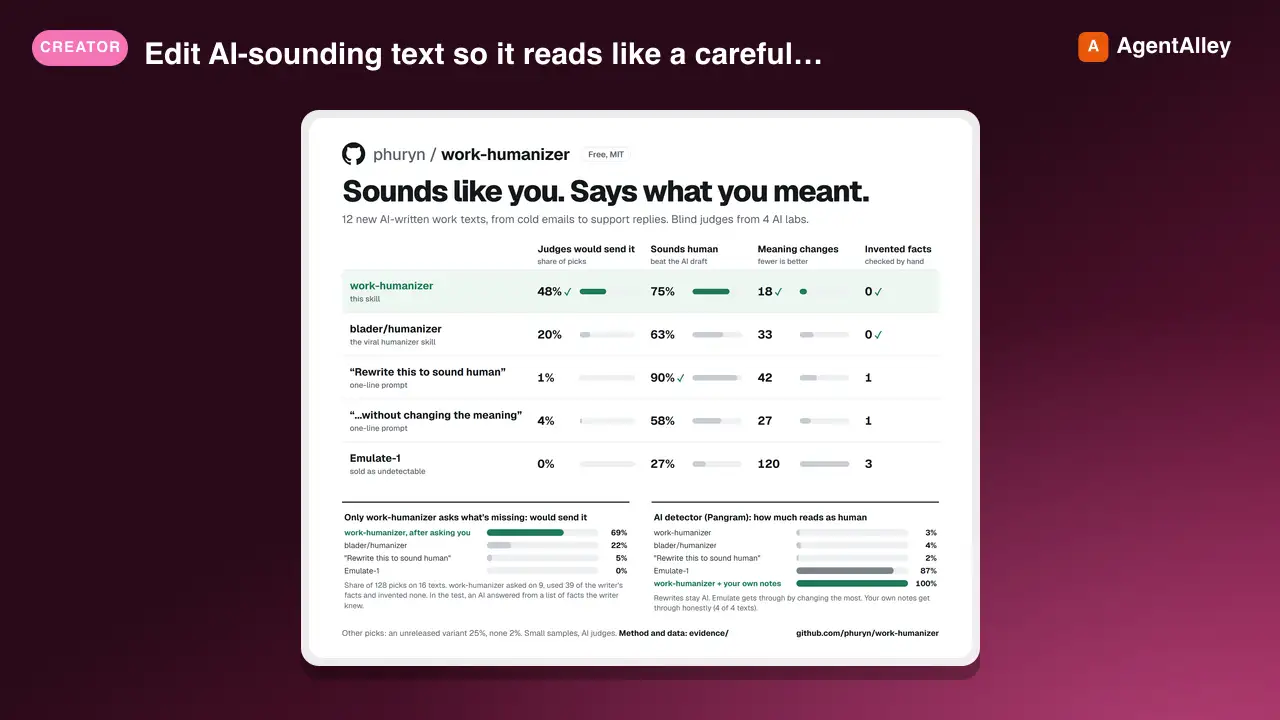 SkillAI Text Humanizerphuryn/work-humanizer · by phurynEdit AI-sounding text so it reads like a careful person wrote it, without changing what it says or commits to. Built for work writing where the wording matters: sales and marketing copy, support replies, HR and legal letters, emails, docs, release notes, posts, landing pages. Two modes. Rewrite: edit the text you are given. Interview: when a draft is AI-composed and thin, ask the writer 3-5 sharp questions and build the piece from their answers, in their words. Also writes from the writer's own notes or a voice-memo transcript. Calibrated on measured differences between human and AI writing.★ 110 GitHub stars
 SkillMarket Segment Identifierphuryn/pm-skills · by phurynIdentify the first beachhead market segment for a product launch. Evaluates segments against burning pain, willingness to pay, winnable market share, and referral potential. Use when choosing a first market, targeting an initial customer segment, or planning market entry strategy.★ 26.6k GitHub stars
 SkillProduct Experiment Designerphuryn/pm-skills · by phurynDesign experiments to test assumptions for an existing product — prototypes, A/B tests, spikes, and other low-effort validation methods. Use when validating assumptions, testing feature ideas cheaply, or planning product experiments.★ 26.6k GitHub stars