ICP Identifier
Ideal customer profile
Identify the Ideal Customer Profile (ICP) from research data with demographics, behaviors, JTBD, and needs. Use when defining your ICP, analyzing PMF survey data, or understanding who your best customers are.
---
name: ideal-customer-profile
description: "Identify the Ideal Customer Profile (ICP) from research data with demographics, behaviors, JTBD, and needs. Use when defining your ICP, analyzing PMF survey data, or understanding who your best customers are."
---
# Ideal Customer Profile

## Overview
Identify your Ideal Customer Profile (ICP) from research and survey data. This skill synthesizes customer research to define the customer most likely to find value, retain, and expand with your product.

## When to Use
- Defining ICP from product-market fit survey data
- Targeting high-value customer segments
- Analyzing customer success and expansion patterns
- Prioritizing sales and marketing efforts
- Evaluating new customer opportunities for fit
- Refining target market definition

## ICP Framework Components
Overview
Identify the Ideal Customer Profile (ICP) from research data with demographics, behaviors, JTBD, and needs. Use when defining your ICP, analyzing PMF survey data, or understanding who your best customers are.
What you get
- Firmographic profile (company size, industry, location)
- Behavioral profile (buying patterns, adoption style)
- Complete JTBD mapping (functional, emotional, social jobs)
- Top 5-7 pain points and specific needs
- Quantified impact metrics (cost of problem, value of solution)
- Decision-making process and key stakeholders
Manual install (npx, ZIP)
npx skills add phuryn/pm-skills --skill ideal-customer-profile -g -a claude-codenpx degit phuryn/pm-skills/pm-go-to-market/skills/ideal-customer-profile#main ~/.claude/skills/ideal-customer-profileConnects with Agent Alley MCP · agentalley.io/mcp
Files included
SKILL.md5.9 KB
Read SKILL.md here
Show the full text165 lines
Ideal Customer Profile
Overview
Identify your Ideal Customer Profile (ICP) from research and survey data. This skill synthesizes customer research to define the customer most likely to find value, retain, and expand with your product.
When to Use
- Defining ICP from product-market fit survey data
- Targeting high-value customer segments
- Analyzing customer success and expansion patterns
- Prioritizing sales and marketing efforts
- Evaluating new customer opportunities for fit
- Refining target market definition
ICP Framework Components
Demographics
Who are they from a firmographic and personal perspective?
- Company size (employees, revenue)
- Industry or vertical
- Geographic location
- Job title and department
- Years of experience in role
- Education and background
- Organizational structure and reporting
Behaviors
How do they work and make decisions?
- How they discover and evaluate solutions
- Buying process and decision-making timeline
- Technical literacy and product adoption speed
- Collaboration style (solo decision vs committee)
- Change management and adoption style
- Tool switching frequency
- Community involvement and peer influence
Jobs to Be Done (JTBD)
What are they trying to accomplish?
- Primary job/goal they're trying to achieve
- Secondary jobs that support the primary job
- Emotional jobs (how they want to feel)
- Social jobs (status and perception)
- Jobs they avoid or want to eliminate
- Frequency and importance of each job
- Success metrics for completing job
Needs and Pain Points
What problems does your product solve?
- Specific pain points they experience
- Current workarounds and limitations
- Impact on productivity or outcomes
- Cost or time burden of the problem
- Emotional frustration levels
- Barriers to solving the problem
- Available budget to solve
- Competing priorities
How It Works
Step 1: Gather Customer Data
Collect research about actual and potential customers:
- Product-market fit survey responses
- Customer interview transcripts
- Trial or freemium user behavior data
- Customer feedback and support tickets
- Churn analysis and customer lifecycle data
- Win/loss analysis from sales
- Competitor customer analysis
Step 2: Segment by Value
Identify customer cohorts and their value:
- Highest LTV (lifetime value) customers
- Fastest time-to-value customers
- Lowest churn rate customers
- Highest expansion/upsell customers
- Most enthusiastic/engaged customers
- Best reference/case study potential
- Most aligned with product vision
Step 3: Profile Demographics
Extract firmographic patterns:
- Common company sizes (employee count, revenue)
- Industry verticals and sub-verticals
- Geographic concentrations
- Typical department and reporting structure
- Budget holders and budget available
- Company stage (startup, growth, enterprise)
- Company culture indicators
Step 4: Identify Behaviors
Map decision-making and adoption patterns:
- How they discovered your product (channel)
- Evaluation process and timeline
- Key stakeholders in decision
- Obstacles during sales process
- Product adoption speed and breadth
- Team involvement in onboarding
- Frequency of feature usage
- Support and service needs
Step 5: Define JTBD
Articulate what they're trying to accomplish:
- Primary job/goal (functional job)
- Emotional dimensions (how they want to feel)
- Social dimensions (team and stakeholder impact)
- Success metrics (how they measure success)
- Context and constraints (when, where, with whom)
- Competing jobs and priorities
- Importance ranking of various jobs
Step 6: Document Pain Points and Needs
Synthesize specific problem areas:
- Before state (current situation and frustrations)
- Desired after state (ideal future state)
- Gap size and impact quantification
- Emotional dimensions of the problem
- Resource constraints preventing solutions
- Skepticism or hesitations
- Success criteria for solution
Input Format
Use $ARGUMENTS to pass:
- Research data (surveys, interviews, transcripts)
- Customer success/metrics data
- Product usage analytics
- Sales activity and win/loss data
- Existing customer database
- Competitive intelligence
Output
A comprehensive ICP definition including:
- Firmographic profile (company size, industry, location)
- Behavioral profile (buying patterns, adoption style)
- Complete JTBD mapping (functional, emotional, social jobs)
- Top 5-7 pain points and specific needs
- Quantified impact metrics (cost of problem, value of solution)
- Decision-making process and key stakeholders
- Typical customer journey and timeline
- Go-to-market implications and messaging
- Disqualification criteria (who is NOT a good fit)
- High-value segment within ICP (ideal-of-the-ideal)
Framework
Based on Jobs to Be Done theory by Clayton Christensen and customer profiling methodology. Combines behavioral data with motivational insights to define actionable customer profiles.
Tips
- Use quantitative and qualitative data together
- Interview 10+ high-value customers for pattern identification
- Look for non-obvious demographic patterns (outliers can be high-value)
- Define both ideal ICP and acceptable secondary segments
- Revisit ICP quarterly as you gather more customer data
- Use ICP to evaluate all new sales opportunities
- Share ICP across entire organization (marketing, sales, product)
- Remember: ICP should drive focus, not exclude all others
Further Reading
| 1 | |
| 2 | name ideal-customer-profile |
| 3 | description "Identify the Ideal Customer Profile (ICP) from research data with demographics, behaviors, JTBD, and needs. Use when defining your ICP, analyzing PMF survey data, or understanding who your best customers are." |
| 4 | |
| 5 | # Ideal Customer Profile |
| 6 | |
| 7 | ## Overview |
| 8 | Identify your Ideal Customer Profile (ICP) from research and survey data. This skill synthesizes customer research to define the customer most likely to find value, retain, and expand with your product. |
| 9 | |
| 10 | ## When to Use |
| 11 | Defining ICP from product-market fit survey data |
| 12 | Targeting high-value customer segments |
| 13 | Analyzing customer success and expansion patterns |
| 14 | Prioritizing sales and marketing efforts |
| 15 | Evaluating new customer opportunities for fit |
| 16 | Refining target market definition |
| 17 | |
| 18 | ## ICP Framework Components |
| 19 | |
| 20 | ### Demographics |
| 21 | Who are they from a firmographic and personal perspective? |
| 22 | Company size (employees, revenue) |
| 23 | Industry or vertical |
| 24 | Geographic location |
| 25 | Job title and department |
| 26 | Years of experience in role |
| 27 | Education and background |
| 28 | Organizational structure and reporting |
| 29 | |
| 30 | ### Behaviors |
| 31 | How do they work and make decisions? |
| 32 | How they discover and evaluate solutions |
| 33 | Buying process and decision-making timeline |
| 34 | Technical literacy and product adoption speed |
| 35 | Collaboration style (solo decision vs committee) |
| 36 | Change management and adoption style |
| 37 | Tool switching frequency |
| 38 | Community involvement and peer influence |
| 39 | |
| 40 | ### Jobs to Be Done (JTBD) |
| 41 | What are they trying to accomplish? |
| 42 | Primary job/goal they're trying to achieve |
| 43 | Secondary jobs that support the primary job |
| 44 | Emotional jobs (how they want to feel) |
| 45 | Social jobs (status and perception) |
| 46 | Jobs they avoid or want to eliminate |
| 47 | Frequency and importance of each job |
| 48 | Success metrics for completing job |
| 49 | |
| 50 | ### Needs and Pain Points |
| 51 | What problems does your product solve? |
| 52 | Specific pain points they experience |
| 53 | Current workarounds and limitations |
| 54 | Impact on productivity or outcomes |
| 55 | Cost or time burden of the problem |
| 56 | Emotional frustration levels |
| 57 | Barriers to solving the problem |
| 58 | Available budget to solve |
| 59 | Competing priorities |
| 60 | |
| 61 | ## How It Works |
| 62 | |
| 63 | ### Step 1: Gather Customer Data |
| 64 | Collect research about actual and potential customers: |
| 65 | Product-market fit survey responses |
| 66 | Customer interview transcripts |
| 67 | Trial or freemium user behavior data |
| 68 | Customer feedback and support tickets |
| 69 | Churn analysis and customer lifecycle data |
| 70 | Win/loss analysis from sales |
| 71 | Competitor customer analysis |
| 72 | |
| 73 | ### Step 2: Segment by Value |
| 74 | Identify customer cohorts and their value: |
| 75 | Highest LTV (lifetime value) customers |
| 76 | Fastest time-to-value customers |
| 77 | Lowest churn rate customers |
| 78 | Highest expansion/upsell customers |
| 79 | Most enthusiastic/engaged customers |
| 80 | Best reference/case study potential |
| 81 | Most aligned with product vision |
| 82 | |
| 83 | ### Step 3: Profile Demographics |
| 84 | Extract firmographic patterns: |
| 85 | Common company sizes (employee count, revenue) |
| 86 | Industry verticals and sub-verticals |
| 87 | Geographic concentrations |
| 88 | Typical department and reporting structure |
| 89 | Budget holders and budget available |
| 90 | Company stage (startup, growth, enterprise) |
| 91 | Company culture indicators |
| 92 | |
| 93 | ### Step 4: Identify Behaviors |
| 94 | Map decision-making and adoption patterns: |
| 95 | How they discovered your product (channel) |
| 96 | Evaluation process and timeline |
| 97 | Key stakeholders in decision |
| 98 | Obstacles during sales process |
| 99 | Product adoption speed and breadth |
| 100 | Team involvement in onboarding |
| 101 | Frequency of feature usage |
| 102 | Support and service needs |
| 103 | |
| 104 | ### Step 5: Define JTBD |
| 105 | Articulate what they're trying to accomplish: |
| 106 | Primary job/goal (functional job) |
| 107 | Emotional dimensions (how they want to feel) |
| 108 | Social dimensions (team and stakeholder impact) |
| 109 | Success metrics (how they measure success) |
| 110 | Context and constraints (when, where, with whom) |
| 111 | Competing jobs and priorities |
| 112 | Importance ranking of various jobs |
| 113 | |
| 114 | ### Step 6: Document Pain Points and Needs |
| 115 | Synthesize specific problem areas: |
| 116 | Before state (current situation and frustrations) |
| 117 | Desired after state (ideal future state) |
| 118 | Gap size and impact quantification |
| 119 | Emotional dimensions of the problem |
| 120 | Resource constraints preventing solutions |
| 121 | Skepticism or hesitations |
| 122 | Success criteria for solution |
| 123 | |
| 124 | ## Input Format |
| 125 | Use $ARGUMENTS to pass: |
| 126 | Research data (surveys, interviews, transcripts) |
| 127 | Customer success/metrics data |
| 128 | Product usage analytics |
| 129 | Sales activity and win/loss data |
| 130 | Existing customer database |
| 131 | Competitive intelligence |
| 132 | |
| 133 | ## Output |
| 134 | A comprehensive ICP definition including: |
| 135 | Firmographic profile (company size, industry, location) |
| 136 | Behavioral profile (buying patterns, adoption style) |
| 137 | Complete JTBD mapping (functional, emotional, social jobs) |
| 138 | Top 5-7 pain points and specific needs |
| 139 | Quantified impact metrics (cost of problem, value of solution) |
| 140 | Decision-making process and key stakeholders |
| 141 | Typical customer journey and timeline |
| 142 | Go-to-market implications and messaging |
| 143 | Disqualification criteria (who is NOT a good fit) |
| 144 | High-value segment within ICP (ideal-of-the-ideal) |
| 145 | |
| 146 | ## Framework |
| 147 | Based on Jobs to Be Done theory by Clayton Christensen and customer profiling methodology. Combines behavioral data with motivational insights to define actionable customer profiles. |
| 148 | |
| 149 | ## Tips |
| 150 | Use quantitative and qualitative data together |
| 151 | Interview 10+ high-value customers for pattern identification |
| 152 | Look for non-obvious demographic patterns (outliers can be high-value) |
| 153 | Define both ideal ICP and acceptable secondary segments |
| 154 | Revisit ICP quarterly as you gather more customer data |
| 155 | Use ICP to evaluate all new sales opportunities |
| 156 | Share ICP across entire organization (marketing, sales, product) |
| 157 | Remember: ICP should drive focus, not exclude all others |
| 158 | |
| 159 | |
| 160 | |
| 161 | ### Further Reading |
| 162 | |
| 163 | [5 GTM Principles You Should Know as a PM] |
| 164 | [How to Design a Value Proposition Customers Can't Resist?] |
| 165 |
Details
- Updated
- Sep 14, 2026
- License
- MIT
- Stars on the repo
- ★ 26,557
- Checked
- Source
- phuryn/pm-skills ↗
- Creator
- phuryn · 69 listings
Similar skills
See all → SkillAI Sales Team Orchestrator
 zubair-trabzada/ai-sales-team-claude · by zubair-trabzadaYou are a comprehensive AI sales intelligence and outreach system for Claude Code. You help founders, sales teams, agency owners, and…★ 1.4k GitHub stars
 SkillCold Email Automation
 growthenginenowoslawski/coldoutboundskills · by growthenginenowoslawskiAutonomous cold email campaign launcher. Takes one target company domain, scrapes their website, generates an ICP with Claude, pulls matching leads via Prospeo, enriches emails + company descriptions, personalizes each lead with parallel Claude Code Task sub-agents (A/B/C variants), and uploads as a live Smartlead campaign. Uses local JSON files for state (no database required). Use for automated daily campaign launches after you have an initial `client-profile.yaml` from /icp-onboarding. Triggers on "auto-research", "launch an automated campaign", "daily campaign", "run the research loop".★ 736 GitHub stars
 SkillABM Campaign Playbook
 explorium-ai/gtm-skills · by explorium-aiABM campaign skill for Claude Code: run a full Account-Based Marketing campaign end-to-end — from ICP definition to live LinkedIn Ads. Builds targeted account lists with Vibe Prospecting, enriches and scores companies with real-time B2B data, generates personalized ad creatives with Claude Code and Figma, pushes matched audiences to LinkedIn Ads, and monitors campaigns daily at scale. The complete GTM skill for AI-driven account-based marketing in Claude Code, Codex, Hermes-Agent, and OpenClaw. No agency needed.★ 197 GitHub stars
 SkillDecision-Maker Shortlistexplorium-ai/gtm-skills · by explorium-aiContact data skill for Claude Code and Codex: build a ranked shortlist of decision-makers and contacts at a target company for outbound prospecting, deal acceleration, or renewal/expansion plays. Returns verified contact data including email, phone, LinkedIn profile, title, seniority, and department. Provide a company name or domain plus optional seniority focus or use case. Use for contact data enrichment, LinkedIn profile lookup, and building outbound contact lists. Works in Claude Code, Codex, Hermes-Agent, and OpenClaw.★ 197 GitHub stars
 SkillAccount Fit Scorerexplorium-ai/gtm-skills · by explorium-aiLead scoring and buying signals skill for Claude Code and Codex: rank a list of accounts by ICP fit, buying intent, real-time trigger events, and workforce momentum. Returns composite score (0-100), tier (A/B/C), and a 'why now' signal per account. Use for account-based selling, ABM list prioritization, territory planning, signal-based selling, and buyer-intent ranking. Triggers on 'score these accounts', 'rank by ICP fit and intent', 'prioritize this account list', 'which accounts have the strongest buying signals', 'ICP scoring', 'account prioritization'. Works in Claude Code, Codex, Hermes-Agent, OpenClaw, and Claude Cowork.★ 197 GitHub stars
 SkillApollo Hyper Orchestrator
 hyperfx-ai/marketing-skills · by hyperfx-aiRun end-to-end B2B cold-email outreach through the Hyper MCP — enrich prospects with Apollo, scrape per-prospect signals from company sites and LinkedIn, draft personalized emails using proven hook frameworks, send via Gmail with safe defaults, and route replies into labeled folders. Use when the user wants to write cold emails, run an outbound sequence, prospect a list, build a follow-up cadence, "reach out to leads," or asks why nobody is replying to their cold emails.★ 90 GitHub stars
More from phuryn
 SkillA/B Test Analyzer
 phuryn/pm-skills · by phurynAnalyze A/B test results with statistical significance, sample size validation, confidence intervals, and ship/extend/stop recommendations. Use when evaluating experiment results, checking if a test reached significance, interpreting split test data, or deciding whether to ship a variant.★ 26.6k GitHub stars
 SkillFeature Request Prioritizerphuryn/pm-skills · by phurynAnalyze and prioritize a list of feature requests by theme, strategic alignment, impact, effort, and risk. Use when reviewing customer feature requests, triaging a backlog, or making prioritization decisions.★ 26.6k GitHub stars
 SkillAnsoff Matrix Generatorphuryn/pm-skills · by phurynGenerate an Ansoff Matrix analysis mapping growth strategies across market penetration, market development, product development, and diversification. Use when considering growth options, planning market expansion, or evaluating strategic growth paths.★ 26.6k GitHub stars
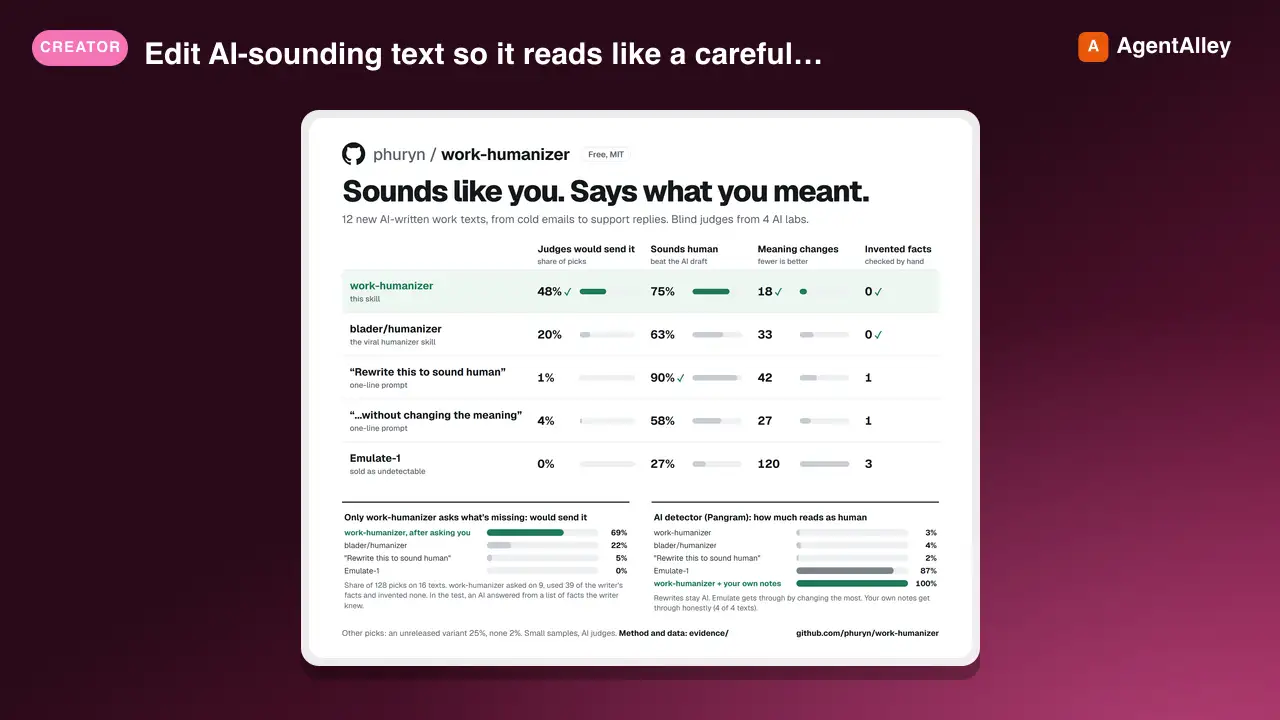 SkillAI Text Humanizerphuryn/work-humanizer · by phurynEdit AI-sounding text so it reads like a careful person wrote it, without changing what it says or commits to. Built for work writing where the wording matters: sales and marketing copy, support replies, HR and legal letters, emails, docs, release notes, posts, landing pages. Two modes. Rewrite: edit the text you are given. Interview: when a draft is AI-composed and thin, ask the writer 3-5 sharp questions and build the piece from their answers, in their words. Also writes from the writer's own notes or a voice-memo transcript. Calibrated on measured differences between human and AI writing.★ 110 GitHub stars
 SkillMarket Segment Identifierphuryn/pm-skills · by phurynIdentify the first beachhead market segment for a product launch. Evaluates segments against burning pain, willingness to pay, winnable market share, and referral potential. Use when choosing a first market, targeting an initial customer segment, or planning market entry strategy.★ 26.6k GitHub stars
 SkillProduct Experiment Designerphuryn/pm-skills · by phurynDesign experiments to test assumptions for an existing product — prototypes, A/B tests, spikes, and other low-effort validation methods. Use when validating assumptions, testing feature ideas cheaply, or planning product experiments.★ 26.6k GitHub stars