Property-Based Test Hardening
Hardening
Hardens LifeOS tests via property/mutation testing. USE WHEN harden, hardening, property test, property based testing, PBT, fast-check, mutation test, mutation testing, Stryker, CRAP score, CRAP analysis, DRY scan, jscpd, acceptance…
---
name: Hardening
version: 1.0.6
description: "Hardens LifeOS tests via property/mutation testing. USE WHEN harden, hardening, property test, property based testing, PBT, fast-check, mutation test, mutation testing, Stryker, CRAP score, CRAP analysis, DRY scan, jscpd, acceptance test mutation, strengthen tests, sharpen ISCs, find bugs example tests miss, universal quantified claim, shrink counterexample, what bugs am I missing, test the tests, test of the test. NOT FOR writing new feature tests (use bun test directly), grading agent output quality (use Evals), UI verification with real Chrome (use Interceptor), finding security vulnerabilities, or building new functionality."
---

# Hardening Skill

## What It Does

Hardening sharpens what already exists — tests, ISCs, and code — without adding new functionality. Five workflows target test-surface and code-surface robustness: property-based testing via fast-check, mutation testing via Stryker, CRAP-complexity scoring, DRY duplication detection, and acceptance-test mutation that perturbs ISC text to catch fluff.

## The Problem

Example-based tests check a handful of inputs the author thought of, so the bugs that survive are the inputs the author didn't think of. A test suite can be green and still be weak. ISCs can read as crisp pass/fail and still be fluff that anything would satisfy. You can't see any of this by reading the tests — you need to test the tests. This skill mechanizes that: property tests express the universal claim and shrink failures to the minimal counterexample, mutation testing proves the suite catches injected bugs, and acceptance-test mutation proves each ISC actually constrains the work.

## How It Works
Overview
Hardening sharpens what already exists — tests, ISCs, and code — without adding new functionality. Five workflows target test-surface and code-surface robustness: property-based testing via fast-check, mutation testing via Stryker, CRAP-complexity scoring, DRY duplication detection, and acceptance-test mutation that perturbs ISC text to catch fluff.
Manual install (npx, ZIP)
npx skills add danielmiessler/LifeOS --skill Hardening -g -a claude-codenpx degit danielmiessler/LifeOS/LifeOS/install/skills/Hardening#main ~/.claude/skills/hardeningConnects with Agent Alley MCP · agentalley.io/mcp
Files included
SKILL.md6.0 KB
Read SKILL.md here
Show the full text69 lines
Hardening Skill
What It Does
Hardening sharpens what already exists — tests, ISCs, and code — without adding new functionality. Five workflows target test-surface and code-surface robustness: property-based testing via fast-check, mutation testing via Stryker, CRAP-complexity scoring, DRY duplication detection, and acceptance-test mutation that perturbs ISC text to catch fluff.
The Problem
Example-based tests check a handful of inputs the author thought of, so the bugs that survive are the inputs the author didn't think of. A test suite can be green and still be weak. ISCs can read as crisp pass/fail and still be fluff that anything would satisfy. You can't see any of this by reading the tests — you need to test the tests. This skill mechanizes that: property tests express the universal claim and shrink failures to the minimal counterexample, mutation testing proves the suite catches injected bugs, and acceptance-test mutation proves each ISC actually constrains the work.
How It Works
Hardening techniques sharpen what already exists — tests, ISCs, code. They don't add new functionality. Five workflows, all targeting test-surface and code-surface robustness.
Workflow Routing
| Workflow | Trigger | File |
|---|---|---|
| PropertyTest | property test, property based testing, PBT, fast-check, universal quantified claim, shrink counterexample — pure functions, parsers, serializers, data transforms, invariants | Workflows/PropertyTest.md |
| MutationTest | mutation test, mutation testing, Stryker, test the tests | — planned, not yet built (stub; see Status) |
| CrapAnalysis | CRAP score, CRAP analysis, risky undertested code | — planned, not yet built (stub; see Status) |
| DryAnalysis | DRY scan, jscpd, duplication rot | — planned, not yet built (stub; see Status) |
| AcceptanceTestMutation | acceptance test mutation, sharpen ISCs, detect fluff ISCs | — planned, not yet built (stub; see Status) |
Doctrine
These workflows operate against the existing test surface. PropertyTest doesn't replace bun-test examples — properties express the universal claim, examples are sampled instances of it. MutationTest doesn't replace test authoring — it grades existing tests' robustness. CRAP and DRY don't add tests — they prioritize where to add them. Acceptance-test mutation doesn't add ISCs — it mechanizes the Fluff vs Load-bearing distinction from ISAFormat.md.
All five satisfy the same intent: strengthen the test of the test, the test of the ISC, the test of the code. The unifying frame is meta-test — testing the things that test the system.
Status
| Workflow | State | Blocker |
|---|---|---|
| PropertyTest | Fully scaffolded (v1.0) | None — ready to use |
| MutationTest | Stub | Stryker integration; deferred to v6.11.0 |
| CrapAnalysis | Stub | AST walker (oxc or bun build --print-ir) |
| DryAnalysis | Stub | jscpd wrapper |
| AcceptanceTestMutation | Stub | ISC text perturbation generator |
Integration Points
- Testing Doctrine Rule #11 — names fast-check as the property-testing primitive (
LIFEOS/DOCUMENTATION/Testing/TestingDoctrine.md). - ISA format — new
bun-propertyISC type withproperty | generator | runscolumns (LIFEOS/DOCUMENTATION/ISA/ISAFormat.md§ ISC Type Vocabulary). - Algorithm — hardening is elected during VERIFY when a run's claims warrant property/mutation depth; spend is discovered from the work (the v6.10.0-era tier-gated proposal predates the 2026-07-11 tier retirement).
- System prompt — Verification Is the Mechanism section at top (
LIFEOS/LIFEOS_SYSTEM_PROMPT.md). - BitterPillEngineering skill —
AcceptanceTestMutationis the mechanized form of BPE's "would a smarter model render this rule unnecessary" applied to ISCs.
Gotchas
- fast-check shrinking is deterministic only when the seed is captured. Always pin the seed in a comment when a property fails:
// fc seed: 0xdeadbeef. numRuns: 1000is the default budget. Increase to 10000 for invariant-critical properties; lower to 100 for slow generators (custom record types with large constraints).- Property tests spuriously fail with poorly-constrained generators. Constrain integer ranges, string lengths, and record nesting depth explicitly.
- Properties on impure functions (functions that touch disk, network, clock) are wrong — fast-check generates random inputs but the property must be deterministic given the input. Either mock side effects or extract the pure core.
- Generator over-constraint hides bugs (
fc.integer({min: 0, max: 100})for code that handles all integers). Constrain only what the function actually demands. - Generator under-constraint produces invalid inputs (
fc.string()when the function only accepts ASCII). The property must hold across the function's actual valid input domain, no wider.
Examples
- "Property-test the slug parser" → PropertyTest: express round-trip/idempotence claims as fast-check properties, run 1000 random inputs, pin the seed on any failure.
- "What bugs are my example tests missing?" → PropertyTest candidate detection: scan for pure functions (parsers, serializers, transforms) with only example coverage.
- "Mutation-test the hooks suite" → MutationTest is a stub (see Status) — not runnable yet; don't promise kill-rate numbers.
| 1 | |
| 2 | name Hardening |
| 3 | version 1.0.6 |
| 4 | description "Hardens LifeOS tests via property/mutation testing. USE WHEN harden, hardening, property test, property based testing, PBT, fast-check, mutation test, mutation testing, Stryker, CRAP score, CRAP analysis, DRY scan, jscpd, acceptance test mutation, strengthen tests, sharpen ISCs, find bugs example tests miss, universal quantified claim, shrink counterexample, what bugs am I missing, test the tests, test of the test. NOT FOR writing new feature tests (use bun test directly), grading agent output quality (use Evals), UI verification with real Chrome (use Interceptor), finding security vulnerabilities, or building new functionality." |
| 5 | |
| 6 | |
| 7 | # Hardening Skill |
| 8 | |
| 9 | ## What It Does |
| 10 | |
| 11 | Hardening sharpens what already exists — tests, ISCs, and code — without adding new functionality. Five workflows target test-surface and code-surface robustness: property-based testing via fast-check, mutation testing via Stryker, CRAP-complexity scoring, DRY duplication detection, and acceptance-test mutation that perturbs ISC text to catch fluff. |
| 12 | |
| 13 | ## The Problem |
| 14 | |
| 15 | Example-based tests check a handful of inputs the author thought of, so the bugs that survive are the inputs the author didn't think of. A test suite can be green and still be weak. ISCs can read as crisp pass/fail and still be fluff that anything would satisfy. You can't see any of this by reading the tests — you need to test the tests. This skill mechanizes that: property tests express the universal claim and shrink failures to the minimal counterexample, mutation testing proves the suite catches injected bugs, and acceptance-test mutation proves each ISC actually constrains the work. |
| 16 | |
| 17 | ## How It Works |
| 18 | |
| 19 | Hardening techniques sharpen what already exists — tests, ISCs, code. They don't add new functionality. Five workflows, all targeting test-surface and code-surface robustness. |
| 20 | |
| 21 | ## Workflow Routing |
| 22 | |
| 23 | | Workflow | Trigger | File | |
| 24 | |----------|---------|------| |
| 25 | | PropertyTest | property test, property based testing, PBT, fast-check, universal quantified claim, shrink counterexample — pure functions, parsers, serializers, data transforms, invariants | `Workflows/PropertyTest.md` | |
| 26 | | MutationTest | mutation test, mutation testing, Stryker, test the tests | — planned, not yet built (stub; see Status) | |
| 27 | | CrapAnalysis | CRAP score, CRAP analysis, risky undertested code | — planned, not yet built (stub; see Status) | |
| 28 | | DryAnalysis | DRY scan, jscpd, duplication rot | — planned, not yet built (stub; see Status) | |
| 29 | | AcceptanceTestMutation | acceptance test mutation, sharpen ISCs, detect fluff ISCs | — planned, not yet built (stub; see Status) | |
| 30 | |
| 31 | ## Doctrine |
| 32 | |
| 33 | These workflows operate against the **existing** test surface. PropertyTest doesn't replace bun-test examples — properties express the universal claim, examples are sampled instances of it. MutationTest doesn't replace test authoring — it grades existing tests' robustness. CRAP and DRY don't add tests — they prioritize where to add them. Acceptance-test mutation doesn't add ISCs — it mechanizes the Fluff vs Load-bearing distinction from `ISAFormat.md`. |
| 34 | |
| 35 | All five satisfy the same intent: **strengthen the test of the test, the test of the ISC, the test of the code.** The unifying frame is meta-test — testing the things that test the system. |
| 36 | |
| 37 | ## Status |
| 38 | |
| 39 | | Workflow | State | Blocker | |
| 40 | |----------|-------|---------| |
| 41 | | **PropertyTest** | Fully scaffolded (v1.0) | None — ready to use | |
| 42 | | **MutationTest** | Stub | Stryker integration; deferred to v6.11.0 | |
| 43 | | **CrapAnalysis** | Stub | AST walker (oxc or `bun build --print-ir`) | |
| 44 | | **DryAnalysis** | Stub | jscpd wrapper | |
| 45 | | **AcceptanceTestMutation** | Stub | ISC text perturbation generator | |
| 46 | |
| 47 | ## Integration Points |
| 48 | |
| 49 | **Testing Doctrine Rule #11** — names fast-check as the property-testing primitive (`LIFEOS/DOCUMENTATION/Testing/TestingDoctrine.md`). |
| 50 | **ISA format** — new `bun-property` ISC type with `property | generator | runs` columns (`LIFEOS/DOCUMENTATION/ISA/ISAFormat.md` § ISC Type Vocabulary). |
| 51 | **Algorithm** — hardening is elected during VERIFY when a run's claims warrant property/mutation depth; spend is discovered from the work (the v6.10.0-era tier-gated proposal predates the 2026-07-11 tier retirement). |
| 52 | **System prompt** — Verification Is the Mechanism section at top (`LIFEOS/LIFEOS_SYSTEM_PROMPT.md`). |
| 53 | **BitterPillEngineering skill** — `AcceptanceTestMutation` is the mechanized form of BPE's "would a smarter model render this rule unnecessary" applied to ISCs. |
| 54 | |
| 55 | ## Gotchas |
| 56 | |
| 57 | fast-check shrinking is deterministic only when the seed is captured. **Always pin the seed in a comment when a property fails:** `// fc seed: 0xdeadbeef`. |
| 58 | `numRuns: 1000` is the default budget. Increase to 10000 for invariant-critical properties; lower to 100 for slow generators (custom record types with large constraints). |
| 59 | Property tests spuriously fail with poorly-constrained generators. Constrain integer ranges, string lengths, and record nesting depth explicitly. |
| 60 | Properties on impure functions (functions that touch disk, network, clock) are wrong — fast-check generates random inputs but the property must be deterministic given the input. Either mock side effects or extract the pure core. |
| 61 | Generator over-constraint hides bugs (`fc.integer({min: 0, max: 100})` for code that handles all integers). Constrain only what the function actually demands. |
| 62 | Generator under-constraint produces invalid inputs (`fc.string()` when the function only accepts ASCII). The property must hold across the function's actual valid input domain, no wider. |
| 63 | |
| 64 | ## Examples |
| 65 | |
| 66 | "Property-test the slug parser" → PropertyTest: express round-trip/idempotence claims as fast-check properties, run 1000 random inputs, pin the seed on any failure. |
| 67 | "What bugs are my example tests missing?" → PropertyTest candidate detection: scan for pure functions (parsers, serializers, transforms) with only example coverage. |
| 68 | "Mutation-test the hooks suite" → MutationTest is a stub (see Status) — not runnable yet; don't promise kill-rate numbers. |
| 69 |
Details
- Version
- 1.0.6
- License
- MIT
- Stars on the repo
- ★ 19,269
- Checked
- Source
- danielmiessler/LifeOS ↗
- Creator
- danielmiessler · 63 listings
Similar skills
See all → SkilliOS Simulator Testing Scripts
 conorluddy/ios-simulator-skill · by conorluddy29 production-ready scripts for iOS app testing, building, and automation. Provides semantic UI navigation, build automation, accessibility testing, and simulator lifecycle management. Optimized for AI agents with minimal token output.★ 1.3k GitHub stars
 SkillMoAI Autonomous Orchestrator
 modu-ai/moai-adk · by modu-aiMoAI unified orchestrator for autonomous development. Routes natural language or subcommands (plan, run, sync, project, fix, loop, mx, feedback, review, clean, codemaps, gate, e2e, harness, goal, gtd, todo) to specialized agents.★ 1.2k GitHub stars
 SkillAndroid Test Writer
 HoangNguyen0403/agent-skills-standard · by HoangNguyen0403Write Android unit, Compose UI, and Hilt-integrated tests. Use when designing test behavior with MockK or coroutine test utilities; defer database/WorkManager-specific recipes to the owning feature skill.★ 569 GitHub stars
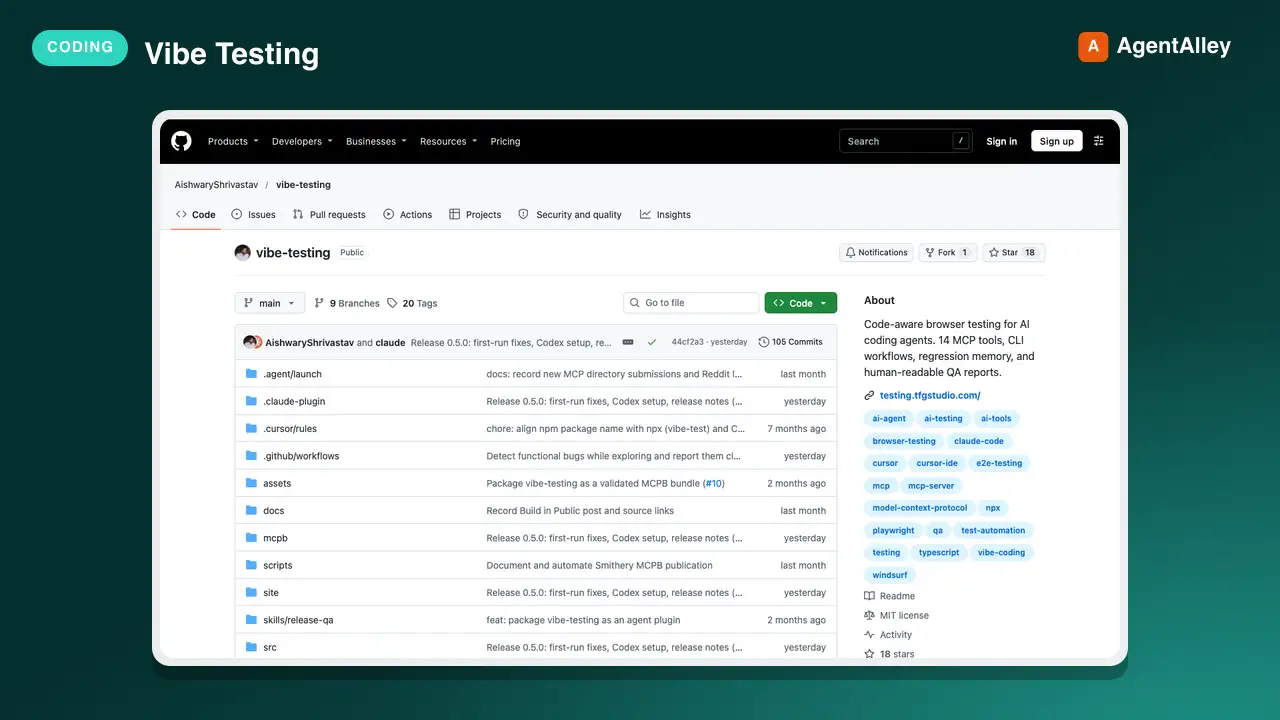 AgentVibe Testing
 AishwaryShrivastav/vibe-testing · by AishwaryShrivastavCode-aware browser testing for AI coding agents. 14 MCP tools, CLI workflows, regression memory, and human-readable QA reports.★ 18 GitHub stars
 SkillFeature Testing Framework
 obra/superpowers · by obraUse when implementing any feature or bugfix, before writing implementation code★ 290k GitHub stars
 SkillWeb App Tester
 anthropics/skills · by anthropicsToolkit for interacting with and testing local web applications using Playwright. Supports verifying frontend functionality, debugging UI behavior, capturing browser screenshots, and viewing browser logs.★ 178k GitHub stars
More from danielmiessler
 SkillScope Oscillation Analyzer
 danielmiessler/LifeOS · by danielmiessler3-pass scope oscillation that holds a question constant while shifting zoom — narrow/tactical, wide/strategic, then synthesis — to surface design tensions, scope recommendations, and coherence assessments invisible at any single zoom level. USE WHEN aperture oscillation, oscillate scope, zoom in and out, tactical vs strategic, scope framing, design tension, system coherence check, local vs global design, wrong scope, scope negotiation. NOT FOR lens rotation across angles (use IterativeDepth).★ 19.3k GitHub stars
 SkillAphorism Library Managerdanielmiessler/LifeOS · by danielmiesslerCurated aphorism collection with CRUD — content-based matching, themed search, thinker research, DB maintenance. Quotes organized by author/theme/context/usage to prevent repetition. Four workflows: FindAphorism, AddAphorism, ResearchThinker, SearchAphorisms. Themes: Stoicism, Wisdom, Truth-seeking, Excellence, Resilience, Curiosity. USE WHEN aphorism, quote, find a quote, research thinker, add aphorism, quote for newsletter, what did X say about, quote bank. NOT FOR creative writing or social posts.★ 19.3k GitHub stars
 SkillSocial Platform Scraperdanielmiessler/LifeOS · by danielmiesslerScrapes social platforms, business data, and e-commerce via Apify actors — Instagram, LinkedIn, TikTok, YouTube, Facebook, Google Maps, Amazon, and web crawls — filtering in code. USE WHEN scrape Instagram, scrape LinkedIn, scrape TikTok, scrape YouTube, scrape Facebook, Google Maps leads, Amazon reviews, business intelligence, multi-platform social listening, competitive analysis, lead generation, social monitoring, Apify actors, web crawl, extract contacts. NOT FOR X/Twitter account operations like posting, threads, or bookmarks (those need a dedicated X API client), 4-tier progressive scraping with proxy escalation (use BrightData), or real-Chrome bot bypass and computer use (use Interceptor).★ 19.3k GitHub stars
 SkillVisual Content Generatordanielmiessler/LifeOS · by danielmiesslerStatic visual content across 20+ formats — diagrams, mermaid, infographics, D3 dashboards, comics, icons, wallpaper — via Nano Banana Pro (default), Nano Banana, and Flux. USE WHEN art, illustration, diagram, flowchart, infographic, header image, blog social thumbnail, visualize, generate image, mermaid, architecture diagram, comic, icon, blog art, framework diagram, D3 chart, remove background, wallpaper. NOT FOR locked house-style YouTube/channel/video thumbnails, video or animation (use Remotion), or web UI design and integrated frontend layout (use Webdesign).★ 19.3k GitHub stars
 SkillArXiv Paper Finderdanielmiessler/LifeOS · by danielmiesslerSearch and retrieve arXiv academic papers by topic, category, or paper ID — with AlphaXiv-enriched AI-generated overviews. Uses arXiv Atom API across cs.AI/cs.LG/cs.CL/cs.CR/cs.MA/cs.SE/cs.IR. Three workflows: Latest, Search, Paper. USE WHEN arxiv, papers, latest papers, research papers, recent ML papers, paper lookup, summarize paper, latest LLM papers, AI safety papers, cs.AI latest. NOT FOR general research (Research), URL parsing, or annual reports.★ 19.3k GitHub stars
 SkillFiller Removal Audio Editordanielmiessler/LifeOS · by danielmiesslerAI audio editing pipeline: Whisper word-level transcription → Claude segment classification (KEEP/CUT_FILLER/CUT_FALSE_START/CUT_STUTTER/CUT_DEAD_AIR) → ffmpeg with 40ms qsin crossfades and room-tone fill → optional Cleanvoice cloud polish; plus GateScan/GateRepair for noise-gate ticking artifacts. Modes: --preview, --aggressive, --polish. Workflow: Clean. USE WHEN clean audio, edit audio, remove filler words, clean podcast, remove ums, cut dead air, polish audio, trim recording, cut stutters, ticking audio, clicking audio, audio clicks, gate artifacts, popping audio. NOT FOR video composition (use Remotion).★ 19.3k GitHub stars