GTM Motions Selector
Gtm motions
Identify the best GTM motions and tools across 7 motion types: Inbound, Outbound, Paid Digital, Community, Partners, ABM, and PLG. Use when selecting marketing channels, choosing between inbound and outbound strategy, or planning…
---
name: gtm-motions
description: "Identify the best GTM motions and tools across 7 motion types: Inbound, Outbound, Paid Digital, Community, Partners, ABM, and PLG. Use when selecting marketing channels, choosing between inbound and outbound strategy, or planning cross-channel campaigns."
---
# GTM Motions

## Overview
Identify and evaluate the best go-to-market motions for your product. This skill analyzes seven proven GTM approaches with specific tools and tactics to help you build a balanced acquisition strategy.

## When to Use
- Selecting marketing channels for your product
- Choosing between inbound vs outbound strategy
- Building your GTM toolkit and tech stack
- Evaluating PLG vs traditional sales motion
- Planning cross-channel marketing campaigns

## The 7 GTM Motions
Overview
Identify the best GTM motions and tools across 7 motion types: Inbound, Outbound, Paid Digital, Community, Partners, ABM, and PLG. Use when selecting marketing channels, choosing between inbound and outbound strategy, or planning cross-channel campaigns.
What you get
- Scoring of all 7 motions for your product
- Recommended motion stack (primary and secondary)
- Tool recommendations for each motion
- 90-day execution plan with milestones
- Resource and budget requirements
- Success metrics and measurement framework
Manual install (npx, ZIP)
npx skills add phuryn/pm-skills --skill gtm-motions -g -a claude-codenpx degit phuryn/pm-skills/pm-go-to-market/skills/gtm-motions#main ~/.claude/skills/gtm-motionsConnects with Agent Alley MCP · agentalley.io/mcp
Files included
SKILL.md7.4 KB
Read SKILL.md here
Show the full text156 lines
GTM Motions
Overview
Identify and evaluate the best go-to-market motions for your product. This skill analyzes seven proven GTM approaches with specific tools and tactics to help you build a balanced acquisition strategy.
When to Use
- Selecting marketing channels for your product
- Choosing between inbound vs outbound strategy
- Building your GTM toolkit and tech stack
- Evaluating PLG vs traditional sales motion
- Planning cross-channel marketing campaigns
The 7 GTM Motions
1. Inbound Marketing
Attract customers through valuable content and thought leadership.
- Tools: LinkedIn, SEMRush, Grammarly, HubSpot, Airtable
- Tactics: Blog content, webinars, whitepapers, SEO, email nurture sequences
- Best For: B2B SaaS, technical products, long sales cycles
- Strength: Builds brand authority and attracts high-intent prospects
- Challenge: Requires consistent content creation; slower to show results
2. Outbound Sales
Proactively reach target prospects through direct engagement.
- Tools: LinkedIn Sales Navigator, ZoomInfo, Lemlist, Apollo, Hunter
- Tactics: Cold email campaigns, LinkedIn outreach, phone prospecting, personalized demos
- Best For: Enterprise sales, high-value contracts, niche markets
- Strength: Predictable pipeline generation; control over target selection
- Challenge: Low response rates; resource-intensive; requires skilled sales team
3. Paid Digital Advertising
Reach target audiences through paid channels with precision targeting.
- Tools: Google Ads, Meta Ads, LinkedIn Ads, Newswire, Retargeting platforms
- Tactics: Search ads, display advertising, social ads, video advertising, retargeting
- Best For: Products with clear target demographics, competitive keywords
- Strength: Fast results; scalable; measurable ROI; precise targeting
- Challenge: Can be expensive; requires continuous optimization; competitive
4. Community Marketing
Build engaged communities where customers help each other and spread the word.
- Tools: Slack, Reddit, Discord, Circle, Mighty Networks, WhatsApp
- Tactics: Community forums, user groups, events, mentorship, ambassador programs
- Best For: Developer products, communities of practice, loyal user bases
- Strength: Builds loyalty; organic word-of-mouth; valuable feedback; low CAC
- Challenge: Requires active moderation; time to build critical mass
5. Partner Marketing
Leverage partner networks to co-market and reach new audiences.
- Tools: Miro, AWS Startups, Oracle Partners, Stripe, Shopify App Store
- Tactics: Partner integrations, co-marketing agreements, channel partnerships, resellers
- Best For: Complementary products, platform ecosystems, expanding market reach
- Strength: Access to established customer bases; shared costs; credibility
- Challenge: Partner alignment; revenue sharing; dependency on partners
6. Account-Based Marketing (ABM)
Treat high-value accounts as individual markets with personalized campaigns.
- Tools: Pipedrive, Hunter, Clay, 6sense, Terminus, Demandbase
- Tactics: Personalized messaging, account-targeted content, coordinated sales/marketing
- Best For: Enterprise deals, limited target accounts, high deal values
- Strength: Higher conversion rates; larger deal sizes; strong sales-marketing alignment
- Challenge: Requires detailed account research; resource intensive; not scalable to SMB
7. Product-Led Growth (PLG)
Drive adoption through the product experience itself with minimal sales friction.
- Tools: Hotjar, Amplitude, Sentry, PostHog, Intercom, Appcues
- Tactics: Free trials, freemium models, in-app onboarding, self-serve demos, product analytics
- Best For: Self-service products, SMB market, low ACV, viral potential
- Strength: Low CAC; aligns product and growth; strong PMF signals; scalable
- Challenge: Requires excellent product experience; lower price points; longer ROI
How It Works
Step 1: Understand Your Product
Define product characteristics:
- Price point and ACV (contract value)
- Sales cycle length
- Buyer type and decision-making process
- Product complexity and learning curve
- Target market size and concentration
Step 2: Evaluate Market Conditions
Assess your market dynamics:
- Competitive intensity of your keywords/channels
- Target audience location and accessibility
- Budget availability for paid channels
- Your team size and capabilities
- Timeline to revenue generation
Step 3: Score Each Motion
Rate fit for your product (1-10 scale):
- Inbound: Content creation capability, brand building timeline
- Outbound: Prospect list availability, sales team capacity
- Paid: Budget flexibility, target audience clarity, conversion potential
- Community: Existing communities, product network effects
- Partners: Complementary products, channel availability
- ABM: Deal size and account concentration
- PLG: Product trial-ability, pricing flexibility
Step 4: Design Motion Stack
Select and prioritize 2-4 motions to execute:
- Primary motion (highest potential for your business)
- Secondary motions (complementary acquisition channels)
- Motion sequencing (which to start first)
- Resource allocation across channels
Step 5: Build Execution Plan
Create 90-day implementation roadmap:
- Quick wins and early validation
- Team and tool requirements
- Success metrics for each motion
- Optimization and scaling strategy
- Budget and resource allocation
Input Format
Use $ARGUMENTS to pass:
- Product description and positioning
- Target customer profile and market
- Price point and sales cycle
- Team size and capabilities
- Budget and timeline constraints
- Existing channels or data
Output
A comprehensive GTM motions analysis including:
- Scoring of all 7 motions for your product
- Recommended motion stack (primary and secondary)
- Tool recommendations for each motion
- 90-day execution plan with milestones
- Resource and budget requirements
- Success metrics and measurement framework
- Competitive differentiation through motion choice
Framework
Based on Product Compass GTM motion analysis. Provides a systematic approach to balancing customer acquisition across multiple channels.
Tips
- Most successful products use 2-4 complementary motions
- Start with your strongest motion; add complexity gradually
- Paid channels fund growth while organic channels build long-term value
- Revisit motion mix quarterly as company scales
- Combine inbound (brand) with outbound (sales) for B2B strength
- Use PLG to reduce CAC; use paid to accelerate proven channels
Further Reading
| 1 | |
| 2 | name gtm-motions |
| 3 | description "Identify the best GTM motions and tools across 7 motion types: Inbound, Outbound, Paid Digital, Community, Partners, ABM, and PLG. Use when selecting marketing channels, choosing between inbound and outbound strategy, or planning cross-channel campaigns." |
| 4 | |
| 5 | # GTM Motions |
| 6 | |
| 7 | ## Overview |
| 8 | Identify and evaluate the best go-to-market motions for your product. This skill analyzes seven proven GTM approaches with specific tools and tactics to help you build a balanced acquisition strategy. |
| 9 | |
| 10 | ## When to Use |
| 11 | Selecting marketing channels for your product |
| 12 | Choosing between inbound vs outbound strategy |
| 13 | Building your GTM toolkit and tech stack |
| 14 | Evaluating PLG vs traditional sales motion |
| 15 | Planning cross-channel marketing campaigns |
| 16 | |
| 17 | ## The 7 GTM Motions |
| 18 | |
| 19 | ### 1. Inbound Marketing |
| 20 | Attract customers through valuable content and thought leadership. |
| 21 | **Tools**: LinkedIn, SEMRush, Grammarly, HubSpot, Airtable |
| 22 | **Tactics**: Blog content, webinars, whitepapers, SEO, email nurture sequences |
| 23 | **Best For**: B2B SaaS, technical products, long sales cycles |
| 24 | **Strength**: Builds brand authority and attracts high-intent prospects |
| 25 | **Challenge**: Requires consistent content creation; slower to show results |
| 26 | |
| 27 | ### 2. Outbound Sales |
| 28 | Proactively reach target prospects through direct engagement. |
| 29 | **Tools**: LinkedIn Sales Navigator, ZoomInfo, Lemlist, Apollo, Hunter |
| 30 | **Tactics**: Cold email campaigns, LinkedIn outreach, phone prospecting, personalized demos |
| 31 | **Best For**: Enterprise sales, high-value contracts, niche markets |
| 32 | **Strength**: Predictable pipeline generation; control over target selection |
| 33 | **Challenge**: Low response rates; resource-intensive; requires skilled sales team |
| 34 | |
| 35 | ### 3. Paid Digital Advertising |
| 36 | Reach target audiences through paid channels with precision targeting. |
| 37 | **Tools**: Google Ads, Meta Ads, LinkedIn Ads, Newswire, Retargeting platforms |
| 38 | **Tactics**: Search ads, display advertising, social ads, video advertising, retargeting |
| 39 | **Best For**: Products with clear target demographics, competitive keywords |
| 40 | **Strength**: Fast results; scalable; measurable ROI; precise targeting |
| 41 | **Challenge**: Can be expensive; requires continuous optimization; competitive |
| 42 | |
| 43 | ### 4. Community Marketing |
| 44 | Build engaged communities where customers help each other and spread the word. |
| 45 | **Tools**: Slack, Reddit, Discord, Circle, Mighty Networks, WhatsApp |
| 46 | **Tactics**: Community forums, user groups, events, mentorship, ambassador programs |
| 47 | **Best For**: Developer products, communities of practice, loyal user bases |
| 48 | **Strength**: Builds loyalty; organic word-of-mouth; valuable feedback; low CAC |
| 49 | **Challenge**: Requires active moderation; time to build critical mass |
| 50 | |
| 51 | ### 5. Partner Marketing |
| 52 | Leverage partner networks to co-market and reach new audiences. |
| 53 | **Tools**: Miro, AWS Startups, Oracle Partners, Stripe, Shopify App Store |
| 54 | **Tactics**: Partner integrations, co-marketing agreements, channel partnerships, resellers |
| 55 | **Best For**: Complementary products, platform ecosystems, expanding market reach |
| 56 | **Strength**: Access to established customer bases; shared costs; credibility |
| 57 | **Challenge**: Partner alignment; revenue sharing; dependency on partners |
| 58 | |
| 59 | ### 6. Account-Based Marketing (ABM) |
| 60 | Treat high-value accounts as individual markets with personalized campaigns. |
| 61 | **Tools**: Pipedrive, Hunter, Clay, 6sense, Terminus, Demandbase |
| 62 | **Tactics**: Personalized messaging, account-targeted content, coordinated sales/marketing |
| 63 | **Best For**: Enterprise deals, limited target accounts, high deal values |
| 64 | **Strength**: Higher conversion rates; larger deal sizes; strong sales-marketing alignment |
| 65 | **Challenge**: Requires detailed account research; resource intensive; not scalable to SMB |
| 66 | |
| 67 | ### 7. Product-Led Growth (PLG) |
| 68 | Drive adoption through the product experience itself with minimal sales friction. |
| 69 | **Tools**: Hotjar, Amplitude, Sentry, PostHog, Intercom, Appcues |
| 70 | **Tactics**: Free trials, freemium models, in-app onboarding, self-serve demos, product analytics |
| 71 | **Best For**: Self-service products, SMB market, low ACV, viral potential |
| 72 | **Strength**: Low CAC; aligns product and growth; strong PMF signals; scalable |
| 73 | **Challenge**: Requires excellent product experience; lower price points; longer ROI |
| 74 | |
| 75 | ## How It Works |
| 76 | |
| 77 | ### Step 1: Understand Your Product |
| 78 | Define product characteristics: |
| 79 | Price point and ACV (contract value) |
| 80 | Sales cycle length |
| 81 | Buyer type and decision-making process |
| 82 | Product complexity and learning curve |
| 83 | Target market size and concentration |
| 84 | |
| 85 | ### Step 2: Evaluate Market Conditions |
| 86 | Assess your market dynamics: |
| 87 | Competitive intensity of your keywords/channels |
| 88 | Target audience location and accessibility |
| 89 | Budget availability for paid channels |
| 90 | Your team size and capabilities |
| 91 | Timeline to revenue generation |
| 92 | |
| 93 | ### Step 3: Score Each Motion |
| 94 | Rate fit for your product (1-10 scale): |
| 95 | Inbound: Content creation capability, brand building timeline |
| 96 | Outbound: Prospect list availability, sales team capacity |
| 97 | Paid: Budget flexibility, target audience clarity, conversion potential |
| 98 | Community: Existing communities, product network effects |
| 99 | Partners: Complementary products, channel availability |
| 100 | ABM: Deal size and account concentration |
| 101 | PLG: Product trial-ability, pricing flexibility |
| 102 | |
| 103 | ### Step 4: Design Motion Stack |
| 104 | Select and prioritize 2-4 motions to execute: |
| 105 | Primary motion (highest potential for your business) |
| 106 | Secondary motions (complementary acquisition channels) |
| 107 | Motion sequencing (which to start first) |
| 108 | Resource allocation across channels |
| 109 | |
| 110 | ### Step 5: Build Execution Plan |
| 111 | Create 90-day implementation roadmap: |
| 112 | Quick wins and early validation |
| 113 | Team and tool requirements |
| 114 | Success metrics for each motion |
| 115 | Optimization and scaling strategy |
| 116 | Budget and resource allocation |
| 117 | |
| 118 | ## Input Format |
| 119 | Use $ARGUMENTS to pass: |
| 120 | Product description and positioning |
| 121 | Target customer profile and market |
| 122 | Price point and sales cycle |
| 123 | Team size and capabilities |
| 124 | Budget and timeline constraints |
| 125 | Existing channels or data |
| 126 | |
| 127 | ## Output |
| 128 | A comprehensive GTM motions analysis including: |
| 129 | Scoring of all 7 motions for your product |
| 130 | Recommended motion stack (primary and secondary) |
| 131 | Tool recommendations for each motion |
| 132 | 90-day execution plan with milestones |
| 133 | Resource and budget requirements |
| 134 | Success metrics and measurement framework |
| 135 | Competitive differentiation through motion choice |
| 136 | |
| 137 | ## Framework |
| 138 | Based on Product Compass GTM motion analysis. Provides a systematic approach to balancing customer acquisition across multiple channels. |
| 139 | |
| 140 | ## Tips |
| 141 | Most successful products use 2-4 complementary motions |
| 142 | Start with your strongest motion; add complexity gradually |
| 143 | Paid channels fund growth while organic channels build long-term value |
| 144 | Revisit motion mix quarterly as company scales |
| 145 | Combine inbound (brand) with outbound (sales) for B2B strength |
| 146 | Use PLG to reduce CAC; use paid to accelerate proven channels |
| 147 | |
| 148 | |
| 149 | |
| 150 | ### Further Reading |
| 151 | |
| 152 | [5 GTM Principles You Should Know as a PM] |
| 153 | [OpenAI’s Product Leader Shares 3-Layer Distribution Framework To Win Mind & Market Share in the AI World] |
| 154 | [Product Management vs. Product Marketing vs. Product Growth 101] |
| 155 | [How to Design a Value Proposition Customers Can't Resist?] |
| 156 |
Details
- Updated
- Sep 14, 2026
- License
- MIT
- Stars on the repo
- ★ 26,557
- Checked
- Source
- phuryn/pm-skills ↗
- Creator
- phuryn · 69 listings
Similar skills
See all → AgentPhase 2: Foundation Scaffolding
 msitarzewski/agency-agents · by msitarzewski> Duration: 3-5 days | Agents: 6 | Gate Keepers: DevOps Automator + Evidence Collector★ 154k GitHub stars
 AgentNEXUS Network Frameworkmsitarzewski/agency-agents · by msitarzewski> NEXUS transforms The Agency's independent AI specialists into a synchronized intelligence network. This is not a prompt collection — it…★ 154k GitHub stars
 SkillAnsoff Matrix Generator
 phuryn/pm-skills · by phurynGenerate an Ansoff Matrix analysis mapping growth strategies across market penetration, market development, product development, and diversification. Use when considering growth options, planning market expansion, or evaluating strategic growth paths.★ 26.6k GitHub stars
 SkillArchitecture Advisor
 shadcn/improve · by shadcnSurvey any codebase as a senior advisor and produce prioritized, self-contained implementation plans for OTHER models/agents to execute. Strictly read-only on source code — never implements, fixes, or refactors anything itself. Use when asked to audit a codebase, find improvement opportunities (bugs, security, performance, test coverage, tech debt, migrations, DX), suggest features or where to take the project next (roadmap, product direction), or generate handoff plans for another agent to implement.★ 9.2k GitHub stars
 SkillCareer Skills Translator
 Paramchoudhary/ResumeSkills · by ParamchoudharyTranslate skills from one industry to another, identify transferable skills★ 2.4k GitHub stars
 SkillMarketing Skills Collection
 LeoYeAI/openclaw-marketing-skills · by LeoYeAIA collection of 37 battle-tested marketing skills for OpenClaw agents. Use when you want to install or reference any marketing skill including: CRO (page-cro, signup-flow-cro, onboarding-cro, form-cro, popup-cro, paywall-upgrade-cro), copywriting, copy-editing, cold-email, email-sequence, social-content, seo-audit, ai-seo, programmatic-seo, site-architecture, schema-markup, content-strategy, paid-ads, ad-creative, ab-test-setup, analytics-tracking, referral-program, free-tool-strategy, churn-prevention, revops, sales-enablement, launch-strategy, pricing-strategy, competitor-alternatives, marketing-ideas, marketing-psychology, lead-magnets, product-marketing-context, and data connectors (google-ads-connect, search-console-connect, meta-ads-connect, x-twitter-connect). Start with product-marketing-context to set up your product context document, then use any other skill naturally. Powered by MyClaw.ai.★ 1k GitHub stars
More from phuryn
 SkillA/B Test Analyzerphuryn/pm-skills · by phurynAnalyze A/B test results with statistical significance, sample size validation, confidence intervals, and ship/extend/stop recommendations. Use when evaluating experiment results, checking if a test reached significance, interpreting split test data, or deciding whether to ship a variant.★ 26.6k GitHub stars
 SkillFeature Request Prioritizerphuryn/pm-skills · by phurynAnalyze and prioritize a list of feature requests by theme, strategic alignment, impact, effort, and risk. Use when reviewing customer feature requests, triaging a backlog, or making prioritization decisions.★ 26.6k GitHub starsSkillAnsoff Matrix Generatorphuryn/pm-skills · by phurynGenerate an Ansoff Matrix analysis mapping growth strategies across market penetration, market development, product development, and diversification. Use when considering growth options, planning market expansion, or evaluating strategic growth paths.★ 26.6k GitHub stars
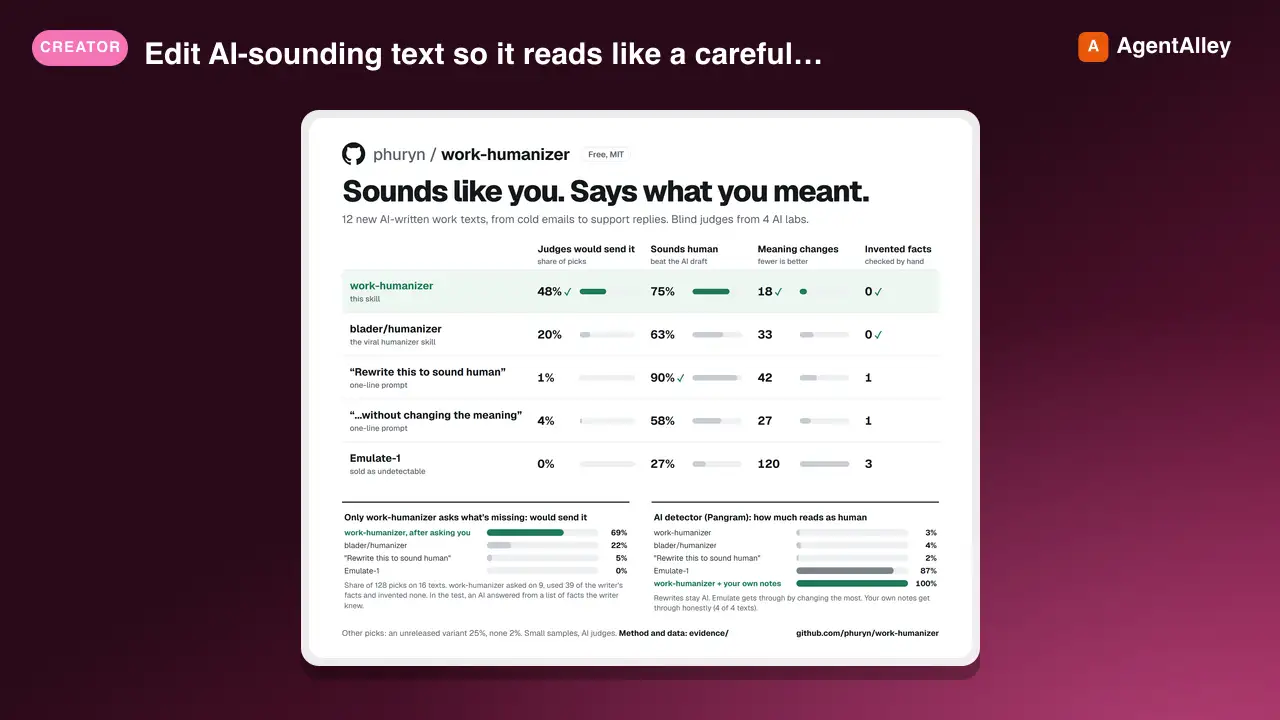 SkillAI Text Humanizerphuryn/work-humanizer · by phurynEdit AI-sounding text so it reads like a careful person wrote it, without changing what it says or commits to. Built for work writing where the wording matters: sales and marketing copy, support replies, HR and legal letters, emails, docs, release notes, posts, landing pages. Two modes. Rewrite: edit the text you are given. Interview: when a draft is AI-composed and thin, ask the writer 3-5 sharp questions and build the piece from their answers, in their words. Also writes from the writer's own notes or a voice-memo transcript. Calibrated on measured differences between human and AI writing.★ 110 GitHub stars
 SkillMarket Segment Identifierphuryn/pm-skills · by phurynIdentify the first beachhead market segment for a product launch. Evaluates segments against burning pain, willingness to pay, winnable market share, and referral potential. Use when choosing a first market, targeting an initial customer segment, or planning market entry strategy.★ 26.6k GitHub stars
 SkillProduct Experiment Designerphuryn/pm-skills · by phurynDesign experiments to test assumptions for an existing product — prototypes, A/B tests, spikes, and other low-effort validation methods. Use when validating assumptions, testing feature ideas cheaply, or planning product experiments.★ 26.6k GitHub stars