Competitive Battlecard
Competitive battlecard
Create sales-ready competitive battlecards comparing your product against a specific competitor — positioning, feature comparison, objection handling, and win/loss patterns.
---
name: competitive-battlecard
description: "Create sales-ready competitive battlecards comparing your product against a specific competitor — positioning, feature comparison, objection handling, and win/loss patterns. Use when preparing sales teams, creating competitive materials, or responding to 'why not competitor X?'"
---

## Competitive Battlecard

Create a concise, sales-ready battlecard for use against a specific competitor.

### Context

You are creating a competitive battlecard for **$ARGUMENTS**.

Use web search to research the competitor's current product, pricing, positioning, and recent changes. If the user provides files (feature lists, win/loss data, sales call notes), read them first.

### Instructions

1. **Research the competitor** (use web search):
Overview
Create a concise, sales-ready battlecard for use against a specific competitor.
Manual install (npx, ZIP)
npx skills add phuryn/pm-skills --skill competitive-battlecard -g -a claude-codenpx degit phuryn/pm-skills/pm-go-to-market/skills/competitive-battlecard#main ~/.claude/skills/competitive-battlecardConnects with Agent Alley MCP · agentalley.io/mcp
Files included
SKILL.md2.8 KB
Read SKILL.md here
Show the full text78 lines
Competitive Battlecard
Create a concise, sales-ready battlecard for use against a specific competitor.
Context
You are creating a competitive battlecard for $ARGUMENTS.
Use web search to research the competitor's current product, pricing, positioning, and recent changes. If the user provides files (feature lists, win/loss data, sales call notes), read them first.
Instructions
Research the competitor (use web search):
- Current product offerings and features
- Pricing tiers and model
- Target market and positioning
- Recent product launches or changes
- Known strengths and weaknesses
- Customer reviews and sentiment (G2, Capterra, Reddit)
Create the battlecard with these sections:
Company Overview
- Founded, HQ, funding/revenue (if public)
- Target market and ICP
- Positioning in one sentence
Quick Comparison
Capability Us Them Winner [Feature area 1] [Our approach] [Their approach] [Us/Them/Tie] [Feature area 2] ... ... ... Pricing ... ... ... Support ... ... ... Where We Win
- [Advantage 1]: [Proof point or customer quote]
- [Advantage 2]: [Specific capability they lack]
- [Advantage 3]: [Better approach with reasoning]
Where They Win
- [Their strength 1]: [Our counter-positioning]
- [Their strength 2]: [How we mitigate this gap]
Common Objections & Responses
Prospect Says Respond With "Competitor X has [feature]" "[Our alternative approach and why it's better for them]" "They're cheaper" "[Value framing: total cost of ownership, ROI, hidden costs]" "They're more established" "[Our advantages: speed, innovation, focus, support]" Landmines to Plant
Questions to ask the prospect that highlight competitor weaknesses:
- "How important is [area where we excel] to your team?"
- "Have you evaluated [specific capability they lack]?"
Win/Loss Patterns
- We tend to win when: [pattern]
- We tend to lose when: [pattern]
- Key differentiator in competitive deals: [what tips the scale]
Keep it scannable: Sales reps need to reference this during calls. Use tables, bold text, and short bullets.
Save as markdown. Format for easy printing or sharing in Notion/Confluence.
Further Reading
| 1 | |
| 2 | name competitive-battlecard |
| 3 | description "Create sales-ready competitive battlecards comparing your product against a specific competitor — positioning, feature comparison, objection handling, and win/loss patterns. Use when preparing sales teams, creating competitive materials, or responding to 'why not competitor X?'" |
| 4 | |
| 5 | |
| 6 | ## Competitive Battlecard |
| 7 | |
| 8 | Create a concise, sales-ready battlecard for use against a specific competitor. |
| 9 | |
| 10 | ### Context |
| 11 | |
| 12 | You are creating a competitive battlecard for **$ARGUMENTS**. |
| 13 | |
| 14 | Use web search to research the competitor's current product, pricing, positioning, and recent changes. If the user provides files (feature lists, win/loss data, sales call notes), read them first. |
| 15 | |
| 16 | ### Instructions |
| 17 | |
| 18 | **Research the competitor** (use web search): |
| 19 | Current product offerings and features |
| 20 | Pricing tiers and model |
| 21 | Target market and positioning |
| 22 | Recent product launches or changes |
| 23 | Known strengths and weaknesses |
| 24 | Customer reviews and sentiment (G2, Capterra, Reddit) |
| 25 | |
| 26 | **Create the battlecard** with these sections: |
| 27 | |
| 28 | ### Company Overview |
| 29 | Founded, HQ, funding/revenue (if public) |
| 30 | Target market and ICP |
| 31 | Positioning in one sentence |
| 32 | |
| 33 | ### Quick Comparison |
| 34 | |
| 35 | | Capability | Us | Them | Winner | |
| 36 | |---|---|---|---| |
| 37 | | [Feature area 1] | [Our approach] | [Their approach] | [Us/Them/Tie] | |
| 38 | | [Feature area 2] | ... | ... | ... | |
| 39 | | Pricing | ... | ... | ... | |
| 40 | | Support | ... | ... | ... | |
| 41 | |
| 42 | ### Where We Win |
| 43 | [Advantage 1]: [Proof point or customer quote] |
| 44 | [Advantage 2]: [Specific capability they lack] |
| 45 | [Advantage 3]: [Better approach with reasoning] |
| 46 | |
| 47 | ### Where They Win |
| 48 | [Their strength 1]: [Our counter-positioning] |
| 49 | [Their strength 2]: [How we mitigate this gap] |
| 50 | |
| 51 | ### Common Objections & Responses |
| 52 | |
| 53 | | Prospect Says | Respond With | |
| 54 | |---|---| |
| 55 | | "Competitor X has [feature]" | "[Our alternative approach and why it's better for them]" | |
| 56 | | "They're cheaper" | "[Value framing: total cost of ownership, ROI, hidden costs]" | |
| 57 | | "They're more established" | "[Our advantages: speed, innovation, focus, support]" | |
| 58 | |
| 59 | ### Landmines to Plant |
| 60 | Questions to ask the prospect that highlight competitor weaknesses: |
| 61 | "How important is [area where we excel] to your team?" |
| 62 | "Have you evaluated [specific capability they lack]?" |
| 63 | |
| 64 | ### Win/Loss Patterns |
| 65 | We tend to win when: [pattern] |
| 66 | We tend to lose when: [pattern] |
| 67 | Key differentiator in competitive deals: [what tips the scale] |
| 68 | |
| 69 | **Keep it scannable**: Sales reps need to reference this during calls. Use tables, bold text, and short bullets. |
| 70 | |
| 71 | Save as markdown. Format for easy printing or sharing in Notion/Confluence. |
| 72 | |
| 73 | |
| 74 | |
| 75 | ### Further Reading |
| 76 | |
| 77 | [How to Design a Value Proposition Customers Can't Resist?] |
| 78 |
Details
- Updated
- Sep 14, 2026
- License
- MIT
- Stars on the repo
- ★ 26,557
- Checked
- Source
- phuryn/pm-skills ↗
- Creator
- phuryn · 69 listings
Similar skills
See all → SkillCompany Valuation Calculator
 himself65/finance-skills · by himself65Estimate the intrinsic value of a public company using DCF, relative (peer multiple) and sum-of-parts (SOTP) methods, then triangulate to an implied share price with upside/downside versus the current market price. Use this skill whenever the user asks: what is AAPL worth", "valuation of NVDA", "fair value of TSLA", "intrinsic value", DCF for MSFT", "build a DCF", "discounted cash flow", "WACC", "terminal value", implied share price", "upside to fair value", "is X overvalued/undervalued", relative valuation", "peer comparison valuation", "EV/EBITDA target", "SOTP", sum of the parts", "how much is [company] worth", "price target from fundamentals", value this company", or any ticker in the context of computing intrinsic or relative valuation. Default to running ALL three methods (DCF + relative + SOTP-if-applicable) and presenting a blended implied price with a sensitivity table. Do not answer valuation questions from memory — always run the workflow.★ 3.3k GitHub stars
 SkillKeyword Gap Analyzer
 Ryze-AI-Adgent/open-seo-mcp-skills · by Ryze-AI-AdgentFind keywords a competitor ranks for that the user's site doesn't — the content gap, prioritized by volume and winnability. Use when asked "what does competitor.com rank for", "keyword gap vs X", "steal competitor keywords", or "why do they outrank us".★ 3.1k GitHub stars
 SkillAd Angle Miner
 gooseworks-ai/goose-skills · by gooseworks-aiMine the highest-converting ad angles from customer reviews, Reddit complaints, support tickets, and competitor ads. Extracts actual pain language, competitor weaknesses, and outcome phrases that real buyers use. Outputs a ranked angle bank with proof quotes and recommended ad formats per angle.★ 1.2k GitHub stars
 SkillCompetitor Content Intelligence
 sandbaseai/sandbase-skills · by sandbaseaiAnalyze competitor content coverage and uncover differentiated content opportunities using web search, page extraction, and DataForSEO content analysis. Use when asked for competitor content research, editorial gap analysis, content brief inputs, or topic whitespace.★ 203 GitHub stars
 SkillCompetitive Win Cards
 growthack88/growth-marketing-os · by growthack88Creates competitive battlecards for sales deal conversations. Produces win themes, landmines to plant, objection handlers, and competitive positioning per competitor. Outputs a structured markdown battlecard with quick-reference sections for live sales calls. Depends on competitor-research for competitive intelligence and consumes product-messaging, win-loss-analysis, and positioning for framing. Feeds into sales-deck, outreach-emails, and demo-script. Triggered by "battlecard", "competitive intel", "win against [competitor]", or "how do we beat [competitor]".★ 117 GitHub stars
 SkillX Audience Analyzer
 sergebulaev/x-skills · by sergebulaevRead your X (Twitter) audience and niche from real data. Pull a handle's recent tweets (yours or a competitor's) with likes, replies, and views, see which formats and hooks are working, read the repliers on a tweet (X gates likers, so repliers are the signal), and scan a niche query for top tweets. Powered by Apify, no login. Triggers on "analyze my tweets", "what is working on X", "read the replies", "competitor tweets", "who is engaging". Not for writing a tweet (use x-post-writer).★ 95 GitHub stars
More from phuryn
 SkillA/B Test Analyzer
 phuryn/pm-skills · by phurynAnalyze A/B test results with statistical significance, sample size validation, confidence intervals, and ship/extend/stop recommendations. Use when evaluating experiment results, checking if a test reached significance, interpreting split test data, or deciding whether to ship a variant.★ 26.6k GitHub stars
 SkillFeature Request Prioritizerphuryn/pm-skills · by phurynAnalyze and prioritize a list of feature requests by theme, strategic alignment, impact, effort, and risk. Use when reviewing customer feature requests, triaging a backlog, or making prioritization decisions.★ 26.6k GitHub stars
 SkillAnsoff Matrix Generatorphuryn/pm-skills · by phurynGenerate an Ansoff Matrix analysis mapping growth strategies across market penetration, market development, product development, and diversification. Use when considering growth options, planning market expansion, or evaluating strategic growth paths.★ 26.6k GitHub stars
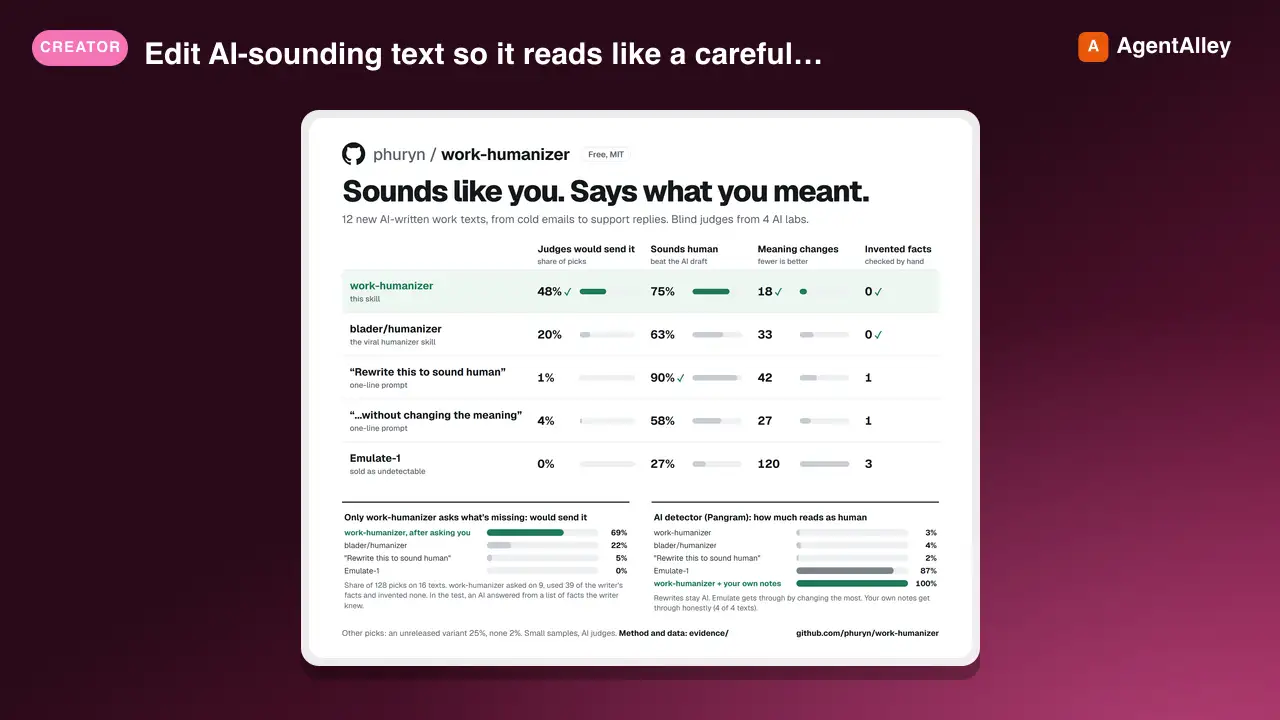 SkillAI Text Humanizerphuryn/work-humanizer · by phurynEdit AI-sounding text so it reads like a careful person wrote it, without changing what it says or commits to. Built for work writing where the wording matters: sales and marketing copy, support replies, HR and legal letters, emails, docs, release notes, posts, landing pages. Two modes. Rewrite: edit the text you are given. Interview: when a draft is AI-composed and thin, ask the writer 3-5 sharp questions and build the piece from their answers, in their words. Also writes from the writer's own notes or a voice-memo transcript. Calibrated on measured differences between human and AI writing.★ 110 GitHub stars
 SkillMarket Segment Identifierphuryn/pm-skills · by phurynIdentify the first beachhead market segment for a product launch. Evaluates segments against burning pain, willingness to pay, winnable market share, and referral potential. Use when choosing a first market, targeting an initial customer segment, or planning market entry strategy.★ 26.6k GitHub stars
 SkillProduct Experiment Designerphuryn/pm-skills · by phurynDesign experiments to test assumptions for an existing product — prototypes, A/B tests, spikes, and other low-effort validation methods. Use when validating assumptions, testing feature ideas cheaply, or planning product experiments.★ 26.6k GitHub stars