Multi-Agent System Designer
Agent Designer — Multi-Agent System Architecture
Use when the user asks to design a multi-agent system, pick an orchestration pattern (supervisor/swarm/pipeline), generate tool schemas for agents, or evaluate agent execution logs for cost, latency, and failure bottlenecks. Examples:…
---
name: "agent-designer"
description: "Use when the user asks to design a multi-agent system, pick an orchestration pattern (supervisor/swarm/pipeline), generate tool schemas for agents, or evaluate agent execution logs for cost, latency, and failure bottlenecks. Examples: 'design an agent architecture for research automation', 'generate Anthropic tool schemas from these tool descriptions', 'analyze these agent run logs for bottlenecks'. NOT for Claude Code workflow files (use workflow-builder) or single-agent prompt design (use agent-workflow-designer)."
---

# Agent Designer — Multi-Agent System Architecture

Design, schema-generate, and evaluate multi-agent systems with three deterministic tools. The scripts are the workflow — do not freehand an architecture when the planner can score one from requirements.

## When to use

- Designing a new multi-agent system from requirements (pattern choice, roles, comms)
- Generating provider-ready tool schemas (Anthropic + OpenAI formats) from plain tool descriptions
- Evaluating execution logs: success rate, latency distribution, cost, bottlenecks

**When NOT to use:** Claude Code Workflow-tool automations → `workflow-builder`; single-agent workflow scaffolds → `agent-workflow-designer`; multi-agent fan-out at runtime → `agenthub`.

## Pattern decision table
Overview
Design, schema-generate, and evaluate multi-agent systems with three deterministic tools. The scripts are the workflow — do not freehand an architecture when the planner can score one from requirements.
Manual install (npx, ZIP)
npx skills add alirezarezvani/claude-skills --skill agent-designer -g -a claude-codemkdir -p ~/.claude/skills && curl -sL https://codeload.github.com/alirezarezvani/claude-skills/tar.gz/19392f7a0826 \
| tar -xz -C ~/.claude/skills --strip-components=3 claude-skills-19392f7a0826/engineering/skills/agent-designerNew-Item -ItemType Directory -Force "$HOME\.claude\skills" | Out-Null; Invoke-WebRequest "https://m.agentalley.io/zip/daf49eea86ee0c1a920d/agent-designer.zip" -OutFile "$env:TEMP\agent-designer.zip"; Expand-Archive "$env:TEMP\agent-designer.zip" -DestinationPath "$HOME\.claude\skills" -ForceConnects with Agent Alley MCP · agentalley.io/mcp
Files included
SKILL.md4.1 KBREADME.md12.2 KBagent_evaluator.py52.3 KBagent_planner.py38.0 KBtool_schema_generator.py36.9 KBassets/3 files · 33.5 KBexpected_outputs/3 files · 40.3 KBreferences/3 files · 43.0 KB
Read the files here
alirezarezvani/
- agent_evaluator.py52.3 KB
- agent_planner.py38.0 KB
- README.md12.2 KB
- SKILL.md4.1 KB
- tool_schema_generator.py36.9 KB
- sample_execution_logs.json15.5 KB
- sample_system_requirements.json2.2 KB
- sample_tool_descriptions.json15.7 KB
Show the full text77 lines
Agent Designer — Multi-Agent System Architecture
Design, schema-generate, and evaluate multi-agent systems with three deterministic tools. The scripts are the workflow — do not freehand an architecture when the planner can score one from requirements.
When to use
- Designing a new multi-agent system from requirements (pattern choice, roles, comms)
- Generating provider-ready tool schemas (Anthropic + OpenAI formats) from plain tool descriptions
- Evaluating execution logs: success rate, latency distribution, cost, bottlenecks
When NOT to use: Claude Code Workflow-tool automations → workflow-builder; single-agent workflow scaffolds → agent-workflow-designer; multi-agent fan-out at runtime → agenthub.
Pattern decision table
| Choose | When | Watch out for |
|---|---|---|
| Single agent | One bounded task, < ~5 tools | Don't add agents you don't need |
| Supervisor | Central decomposition, specialists report back | Supervisor becomes the bottleneck |
| Pipeline | Strictly sequential stages with handoffs | Rigid order; slowest stage gates throughput |
| Hierarchical | Multiple org layers, > ~8 agents | Communication overhead per level |
| Swarm | Parallel peers, fault tolerance over predictability | Hard to debug; needs consensus rules |
The planner applies this scoring deterministically — run it rather than picking by feel.
Workflow
All paths relative to this skill folder. Each step's JSON output is the next step's design input.
1. Design the architecture
Write a requirements JSON (copy assets/sample_system_requirements.json — keys: goal, tasks[], constraints{max_response_time, budget_per_task, concurrent_tasks}, team_size):
python3 agent_planner.py requirements.json --format json -o arch
Emits arch.json with architecture_design (pattern, agents, communication links), mermaid_diagram, and implementation_roadmap. Read architecture_design.pattern and the per-agent role list; present the mermaid diagram to the user.
2. Generate tool schemas
Describe each agent's tools in plain JSON (copy assets/sample_tool_descriptions.json), then:
python3 tool_schema_generator.py tool_descriptions.json --validate -o tools
Emits tools.json (tool_schemas, validation_summary) plus provider-specific tools_anthropic.json / tools_openai.json. Gate: every tool must print ✓ Valid. Fix any invalid schema before proceeding — never hand an agent an unvalidated schema.
3. Evaluate execution logs
Once the system runs (or against assets/sample_execution_logs.json for a dry run):
python3 agent_evaluator.py execution_logs.json --detailed -o eval
Emits eval.json with summary, agent_metrics, bottleneck_analysis, error_analysis, cost_breakdown, sla_compliance, and optimization_recommendations, plus split files (eval_errors.json, eval_recommendations.json).
4. Verification loop
The design is not done until:
tool_schema_generator.py --validatereports 0 invalid schemas.agent_evaluator.pyon a pilot run reports 0 critical issues (the tool printsCRITICAL: N critical issueswhen found). If N > 0, apply the top item ineval_recommendations.json, re-run the pilot, and re-evaluate.- Compare your outputs against
expected_outputs/to confirm the schema shape you're consuming hasn't drifted.
References
references/agent_architecture_patterns.md— pattern trade-offs in depthreferences/tool_design_best_practices.md— schema, idempotency, error-handling rulesreferences/evaluation_methodology.md— metric definitions the evaluator implements
| 1 | |
| 2 | name "agent-designer" |
| 3 | description "Use when the user asks to design a multi-agent system, pick an orchestration pattern (supervisor/swarm/pipeline), generate tool schemas for agents, or evaluate agent execution logs for cost, latency, and failure bottlenecks. Examples: 'design an agent architecture for research automation', 'generate Anthropic tool schemas from these tool descriptions', 'analyze these agent run logs for bottlenecks'. NOT for Claude Code workflow files (use workflow-builder) or single-agent prompt design (use agent-workflow-designer)." |
| 4 | |
| 5 | |
| 6 | # Agent Designer — Multi-Agent System Architecture |
| 7 | |
| 8 | Design, schema-generate, and evaluate multi-agent systems with three deterministic tools. The scripts are the workflow — do not freehand an architecture when the planner can score one from requirements. |
| 9 | |
| 10 | ## When to use |
| 11 | |
| 12 | Designing a new multi-agent system from requirements (pattern choice, roles, comms) |
| 13 | Generating provider-ready tool schemas (Anthropic + OpenAI formats) from plain tool descriptions |
| 14 | Evaluating execution logs: success rate, latency distribution, cost, bottlenecks |
| 15 | |
| 16 | **When NOT to use:** Claude Code Workflow-tool automations → `workflow-builder`; single-agent workflow scaffolds → `agent-workflow-designer`; multi-agent fan-out at runtime → `agenthub`. |
| 17 | |
| 18 | ## Pattern decision table |
| 19 | |
| 20 | | Choose | When | Watch out for | |
| 21 | |---|---|---| |
| 22 | | Single agent | One bounded task, < ~5 tools | Don't add agents you don't need | |
| 23 | | Supervisor | Central decomposition, specialists report back | Supervisor becomes the bottleneck | |
| 24 | | Pipeline | Strictly sequential stages with handoffs | Rigid order; slowest stage gates throughput | |
| 25 | | Hierarchical | Multiple org layers, > ~8 agents | Communication overhead per level | |
| 26 | | Swarm | Parallel peers, fault tolerance over predictability | Hard to debug; needs consensus rules | |
| 27 | |
| 28 | The planner applies this scoring deterministically — run it rather than picking by feel. |
| 29 | |
| 30 | ## Workflow |
| 31 | |
| 32 | All paths relative to this skill folder. Each step's JSON output is the next step's design input. |
| 33 | |
| 34 | ### 1. Design the architecture |
| 35 | |
| 36 | Write a requirements JSON (copy `assets/sample_system_requirements.json` — keys: `goal`, `tasks[]`, `constraints{max_response_time, budget_per_task, concurrent_tasks}`, `team_size`): |
| 37 | |
| 38 | |
| 39 | python3 agent_planner.py requirements.json --format json -o arch |
| 40 | |
| 41 | |
| 42 | Emits `arch.json` with `architecture_design` (pattern, agents, communication links), `mermaid_diagram`, and `implementation_roadmap`. Read `architecture_design.pattern` and the per-agent role list; present the mermaid diagram to the user. |
| 43 | |
| 44 | ### 2. Generate tool schemas |
| 45 | |
| 46 | Describe each agent's tools in plain JSON (copy `assets/sample_tool_descriptions.json`), then: |
| 47 | |
| 48 | |
| 49 | python3 tool_schema_generator.py tool_descriptions.json --validate -o tools |
| 50 | |
| 51 | |
| 52 | Emits `tools.json` (`tool_schemas`, `validation_summary`) plus provider-specific `tools_anthropic.json` / `tools_openai.json`. **Gate: every tool must print `✓ Valid`.** Fix any invalid schema before proceeding — never hand an agent an unvalidated schema. |
| 53 | |
| 54 | ### 3. Evaluate execution logs |
| 55 | |
| 56 | Once the system runs (or against `assets/sample_execution_logs.json` for a dry run): |
| 57 | |
| 58 | |
| 59 | python3 agent_evaluator.py execution_logs.json --detailed -o eval |
| 60 | |
| 61 | |
| 62 | Emits `eval.json` with `summary`, `agent_metrics`, `bottleneck_analysis`, `error_analysis`, `cost_breakdown`, `sla_compliance`, and `optimization_recommendations`, plus split files (`eval_errors.json`, `eval_recommendations.json`). |
| 63 | |
| 64 | ### 4. Verification loop |
| 65 | |
| 66 | The design is not done until: |
| 67 | |
| 68 | `tool_schema_generator.py --validate` reports 0 invalid schemas. |
| 69 | `agent_evaluator.py` on a pilot run reports **0 critical issues** (the tool prints `CRITICAL: N critical issues` when found). If N > 0, apply the top item in `eval_recommendations.json`, re-run the pilot, and re-evaluate. |
| 70 | Compare your outputs against `expected_outputs/` to confirm the schema shape you're consuming hasn't drifted. |
| 71 | |
| 72 | ## References |
| 73 | |
| 74 | `references/agent_architecture_patterns.md` — pattern trade-offs in depth |
| 75 | `references/tool_design_best_practices.md` — schema, idempotency, error-handling rules |
| 76 | `references/evaluation_methodology.md` — metric definitions the evaluator implements |
| 77 |
Details
- Updated
- Aug 30, 2026
- License
- MIT
- Stars on the repo
- ★ 26,349
- Checked
- Source
- alirezarezvani/claude-skills ↗
- Creator
- alirezarezvani · 363 listings
Similar skills
See all → SkillCustom Diagram Designer
 cathrynlavery/diagram-design · by cathrynlaveryCreate branded architecture, architecture delta, IT current-state, flowchart, sequence, state machine, ER/data model, timeline, swimlane, quadrant, radar/spider, polar chart (polar/radial lollipop), loop/flywheel, nested, tree, org chart, layer stack, Venn, pyramid/funnel, treemap and marimekko, heatmap, bar and dumbbell, waterfall, line (slopegraph, ridgeline, streamgraph, bump), Gantt and scatter charts (bubble, beeswarm), high-level, process, medallion, data flow, DP integration, DP security matrix, Sankey, fishbone, Wardley map, kanban, user journey, deployment, dependency graph, UML class, story map, or database schema diagrams as HTML/SVG/PNG, with .drawio, Mermaid, and .excalidraw import, plus lifecycle phase maps, block decomposition trees, and onboarding guidance.★ 43.2k GitHub stars
 SkillArchitecture Pattern Reviewer
 pascalorg/editor · by pascalorgReview a PR against the Pascal architectural rules — package boundaries (core/viewer/editor/nodes), the registry-driven composition model (def.geometry / def.renderer / def.system), legacy-dispatch regressions, the slots + world-scale-UV convention for new nodes/geometry, hook hygiene (useEditor/useScene/useViewer), and selector performance. Use when the user asks to review a PR, audit a branch, or check that changes respect the codebase's architecture.★ 24.6k GitHub stars
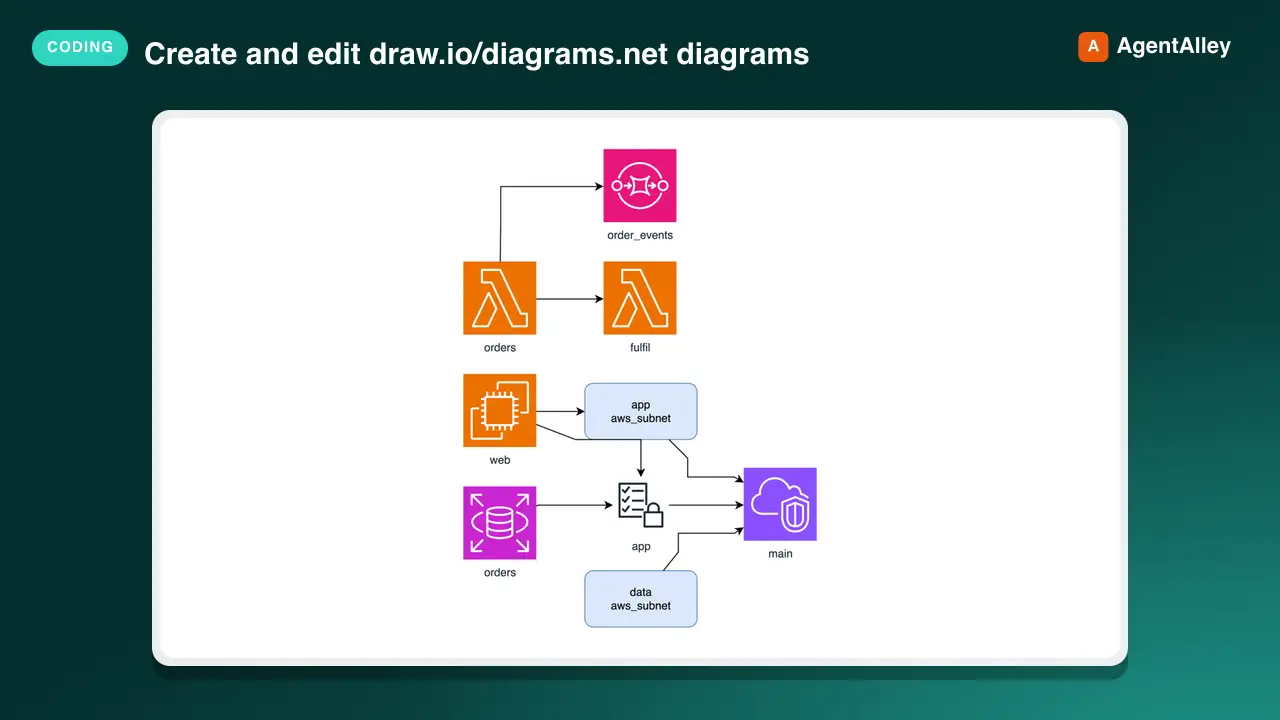 SkillArchitecture Diagram Creator
 Agents365-ai/drawio-skill · by Agents365-aiCreate and edit draw.io/diagrams.net diagrams as editable `.drawio` files. Covers architecture, UML/ERD/sequence, BPMN, network, and swimlane views authored from a description or converted from code, IaC, SQL, and API schemas, plus sync, query, test, review, export, and publish of existing diagrams. Use when the user asks for draw.io/diagrams.net or an editable diagram; prefer Mermaid/PlantUML when diagrams-as-code is enough.★ 9.8k GitHub stars
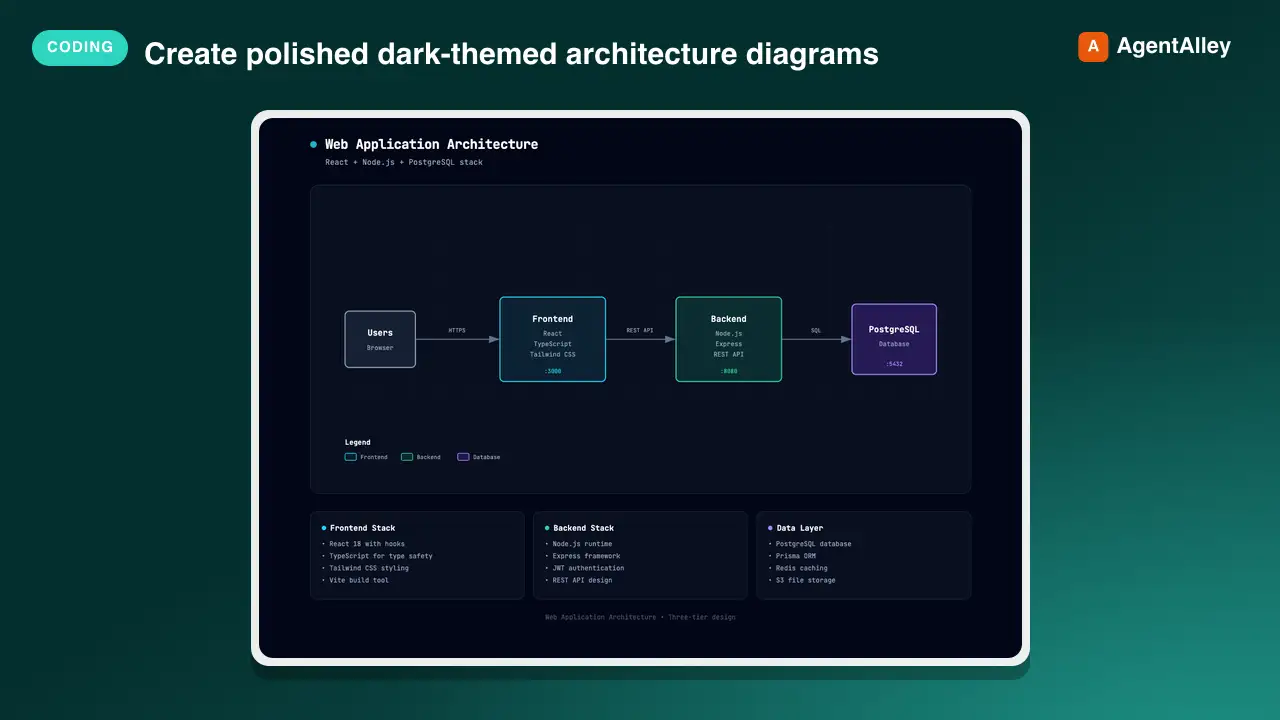 SkillArchitecture Diagram Generator
 Cocoon-AI/architecture-diagram-generator · by Cocoon-AICreate polished dark-themed architecture diagrams as self-contained HTML+SVG files. Use when the user asks for system, infrastructure, cloud, security, or network topology diagrams.★ 7.4k GitHub stars
 SkillLLM Knowledge Distillation
 Ar9av/obsidian-wiki · by Ar9avThe foundational knowledge distillation pattern for building and maintaining an AI-powered Obsidian wiki. Based on Andrej Karpathy's LLM Wiki architecture. Use this skill whenever the user wants to understand the wiki pattern, set up a new knowledge base, or needs guidance on the three-layer architecture (raw sources → wiki → schema). Also use when discussing knowledge management strategy, wiki structure decisions, or how to organize distilled knowledge. This is the "theory" skill — other skills handle specific operations (ingesting, querying, linting).★ 3.5k GitHub stars
 SkillSoftware Design Philosophy
 wondelai/skills · by wondelaiManage software complexity through deep modules, information hiding, and strategic programming. Use when the user mentions "module design", "API too complex", "shallow class", "complexity budget", "strategic vs tactical", "deep module", "information leakage", "pass-through method", "this code is over-engineered", or "simplify this design". Also trigger when reviewing an interface for simplicity, evaluating whether an abstraction is pulling its weight, deciding whether a comment is worth writing, or choosing between general-purpose and special-purpose approaches. Covers deep vs shallow modules, red flags for complexity, and comments as design documentation. For code quality, see clean-code. For architecture boundaries, see clean-architecture.★ 2.2k GitHub stars
More from alirezarezvani
 SkillExperiment Resume Tool
 alirezarezvani/claude-skills · by alirezarezvaniResume a paused experiment. Checkout the experiment branch, read results history, continue iterating. Use when the user runs /ar:ar-resume or asks to pick up a previously started autoresearch experiment.★ 26.3k GitHub stars
 SkillExperiment Dashboard Vieweralirezarezvani/claude-skills · by alirezarezvaniShow experiment dashboard with results, active loops, and progress. Use when the user runs /ar:ar-status or asks how an autoresearch experiment is going.★ 26.3k GitHub stars
 SkillAutonomous Experiment Runneralirezarezvani/claude-skills · by alirezarezvaniStart an autonomous experiment loop with user-selected interval (10min, 1h, daily, weekly, monthly). Uses CronCreate for scheduling. Use when the user runs /ar:loop or asks to run an autoresearch experiment continuously on a schedule.★ 26.3k GitHub stars
 SkillSingle Experiment Iteratoralirezarezvani/claude-skills · by alirezarezvaniRun a single experiment iteration. Edit the target file, evaluate, keep or discard. Use when the user runs /ar:run or asks for one manual autoresearch iteration.★ 26.3k GitHub stars
 SkillAutoresearch Experiment Setupalirezarezvani/claude-skills · by alirezarezvaniSet up a new autoresearch experiment interactively. Collects domain, target file, eval command, metric, direction, and evaluator. Use when the user runs /ar:setup or asks to start optimizing a file with the autoresearch loop.★ 26.3k GitHub stars
 SkillExecutive Boardroom Deliberatoralirezarezvani/claude-skills · by alirezarezvani/cs:boardroom <brief> — 6-phase multi-role deliberation across the C-suite with Phase 2 isolation, critic pre-screen, and synthesis. Outputs a board memo. Use when a decision spans multiple executive domains — e.g. a pricing change touching finance, positioning, and product, or a raise-vs-cut runway call.★ 26.3k GitHub stars