Case Study Template
Template: Case Study
Template Name: Case Study (Results-Focused Narrative)
# Template: Case Study

**Template Name:** Case Study (Results-Focused Narrative)
**Target Word Count:** 1,500-2,000 words
**Description:** A narrative-driven analysis of a specific project, campaign, or initiative that documents the challenge, strategy, execution, and measurable results. Designed to build credibility, demonstrate expertise through real outcomes, and rank for "[topic] case study," "how [company] achieved [result]," and long-tail problem-solution queries.

## When to Use This Template

- **Content Goals:** Build trust and authority through documented results, generate leads by demonstrating competence, create reference material for sales conversations, attract backlinks from industry publications
- **Search Intent:** Informational / Commercial investigation: the reader wants proof that a strategy works before committing to it themselves
- **Best For:** Client success stories, internal project retrospectives, before/after transformations, strategy validation, process documentation
- **Avoid When:** You lack specific metrics or measurable outcomes (vague "it went well" stories don't qualify), or when the subject hasn't given permission to be referenced

---

## Section-by-Section Structure

---
Overview
Template Name: Case Study (Results-Focused Narrative) Target Word Count: 1,500-2,000 words Description: A narrative-driven analysis of a specific project, campaign, or initiative that documents the challenge, strategy, execution, and measurable results. Designed to build credibility, demonstrate expertise through real outcomes, and rank for "[topic] case study," "how [company] achieved [result]," and long-tail problem-solution queries.
Manual install (npx, ZIP)
npx skills add AgriciDaniel/claude-blog --skill template-case-study -g -a claude-codeConnects with Agent Alley MCP · agentalley.io/mcp
Files included
case-study.md13.0 KB
Read case-study.md here
AgriciDaniel/
Show the full text242 lines
Template: Case Study
Template Name: Case Study (Results-Focused Narrative) Target Word Count: 1,500-2,000 words Description: A narrative-driven analysis of a specific project, campaign, or initiative that documents the challenge, strategy, execution, and measurable results. Designed to build credibility, demonstrate expertise through real outcomes, and rank for "[topic] case study," "how [company] achieved [result]," and long-tail problem-solution queries.
When to Use This Template
- Content Goals: Build trust and authority through documented results, generate leads by demonstrating competence, create reference material for sales conversations, attract backlinks from industry publications
- Search Intent: Informational / Commercial investigation: the reader wants proof that a strategy works before committing to it themselves
- Best For: Client success stories, internal project retrospectives, before/after transformations, strategy validation, process documentation
- Avoid When: You lack specific metrics or measurable outcomes (vague "it went well" stories don't qualify), or when the subject hasn't given permission to be referenced
Section-by-Section Structure
Title (H1)
Format: "How [Company/Team] [Achieved Specific Result] in [Timeframe]"
Examples:
- "How Acme Corp Reduced API Latency by 73% in 6 Weeks"
- "How a 3-Person Team Scaled to 1M Monthly Users in 90 Days"
- "How We Cut Build Times from 12 Minutes to 45 Seconds"
Rules:
- Include the specific result metric in the title: this is the hook
- Include the timeframe to create urgency and credibility
- Use the company/team name if known; use "We" for internal case studies
- Keep under 70 characters if possible
TL;DR Box (40-60 words)
[ANSWER-FIRST] This is the entire case study compressed into a single box. Lead with the headline result number.
Format: A visually distinct callout box (blockquote, colored background, or bordered section) placed immediately after the title.
Structure:
- Headline metric (1 sentence): The single most impressive result.
- How (1 sentence): The core strategy in plain language.
- Timeframe (phrase): How long it took.
Example:
TL;DR: Acme Corp reduced API response times from 1,200ms to 320ms (73% improvement) by migrating from a monolithic REST API to an edge-cached GraphQL gateway. The migration was completed in 6 weeks with zero downtime and a 2-person engineering team.
[STAT: The headline metric that anchors the entire case study]
Introduction (100-150 words)
[ANSWER-FIRST] Open with the key result metric in the very first sentence. Don't build up to it. Lead with it.
Structure:
- Result lead (1 sentence): State the primary outcome with specific numbers.
- Context (2-3 sentences): Who is the subject? What's their scale? Why does this matter to the reader?
- Stakes framing (1 sentence): What was at risk if the problem wasn't solved?
- Promise (1 sentence): What the reader will learn from this case study.
[STAT: Secondary metric that adds dimension to the headline result (e.g., cost savings, time saved, user satisfaction improvement)]
[INFO-GAIN: context detail] Share a specific detail about the company or project that makes this relatable to the reader: team size, budget constraints, tech stack, industry, etc.
[INTERNAL-LINK] Link to a related foundational post: "For background on [strategy/technology], see our [Guide to X]."
The Challenge (200-250 words)
[ANSWER-FIRST] Open with the single most painful symptom of the problem: the thing that made someone say "we have to fix this."
Structure:
- Pain point (1-2 sentences): The specific, felt problem. Use concrete details: error rates, customer complaints, revenue impact.
- Root cause (2-3 sentences): What was actually causing the problem at a technical or strategic level?
- Scale of impact (1-2 sentences): Quantify the damage: how many users affected, how much revenue at risk, how many engineering hours wasted.
- Failed attempts (2-3 sentences): What had already been tried and why it didn't work. This builds narrative tension and demonstrates that the eventual solution wasn't the obvious first choice.
- Decision point (1 sentence): What triggered the decision to try a different approach?
[STAT: Metric quantifying the severity of the problem before the solution]
[INFO-GAIN: failed approach detail] Document a specific failed attempt with enough detail that the reader can learn from it. What was tried, what happened, why it failed.
[IMAGE] Diagram or screenshot showing the "before" state: the broken architecture, the poor metrics dashboard, the error logs.
Example opening:
"At peak traffic, Acme's API was returning 500 errors on 12% of requests, and their largest enterprise client had set a 30-day deadline to fix it or cancel their $2M annual contract."
The Strategy (300-400 words)
[ANSWER-FIRST] Open with the core strategic decision in one sentence: what approach was chosen and the single most important reason why.
Structure:
- Strategic choice (1-2 sentences): What approach was selected? Name the methodology, technology, or framework.
- Why this approach (3-4 sentences): What made this the right choice over alternatives? Reference the failed attempts from the Challenge section. Include specific criteria used in the decision.
- Key decisions (3-5 bullets or sub-sections): Break down the 3-5 most important decisions made during strategy formulation. Each should include the decision, the alternatives considered, and the reasoning.
- Risk assessment (1-2 sentences): What were the known risks and how were they mitigated?
[INFO-GAIN: process documentation] This is the highest-value section. Document the decision-making process with enough specificity that another team could replicate the thinking. Include:
- Selection criteria used to evaluate options
- Trade-offs explicitly discussed and weighed
- Any frameworks, scorecards, or evaluation tools used
- Who was involved in the decision and what perspectives they brought
[VISUAL: decision-matrix] If applicable, include a table showing the options evaluated, the criteria, and the scores that led to the final choice.
[STAT: Supporting data point that justified the strategic choice (e.g., benchmark, industry data, competitor analysis)]
[INTERNAL-LINK] Link to a detailed guide on the strategy or technology chosen: "We wrote a comprehensive guide on [strategy/technology]: read it here."
Example:
"The team chose to migrate from REST to GraphQL: not because of hype, but because their analysis showed that 78% of API calls were over-fetching data by 3-10x, and the client-specific BFF (Backend for Frontend) pattern they'd tried first added latency instead of reducing it."
The Implementation (200-300 words)
[ANSWER-FIRST] Open with the total timeline and team size: "A [N]-person team completed the implementation in [timeframe]."
Structure:
- Team and timeline (1-2 sentences): Who did the work, how long it took, and any phasing.
- Step-by-step execution (numbered list): 4-6 key implementation steps in chronological order. Each step should include what was done, any tools used, and any unexpected challenges.
- Tools and technology (bulleted list): Specific tools, services, and technologies used.
- Critical moment (1-2 sentences): One specific moment where things almost went wrong or an unexpected insight changed the plan.
[IMAGE] Architecture diagram, timeline visualization, or screenshot of the implementation in progress.
[INFO-GAIN: implementation detail] Share a specific technical or operational detail that made a material difference: a configuration setting, a migration trick, a coordination process. The kind of detail that saves someone else hours.
[STAT: Implementation efficiency metric (time spent, cost, iterations required)]
Example step:
- Deployed edge caching layer (Week 3-4): Set up Cloudflare Workers as a caching layer between the GraphQL gateway and origin servers. Used stale-while-revalidate with a 60s TTL: this single change accounted for 40% of the total latency reduction.
The Results (200-300 words)
[ANSWER-FIRST] Open by restating the headline metric, then immediately expand with 2-3 supporting metrics. Use before/after format.
Structure:
- Headline result (1 sentence): The primary metric, stated as before -> after with percentage change.
- Supporting metrics (bulleted list): 3-5 additional measurable outcomes, each with before/after values.
- Business impact (1-2 sentences): Translate technical metrics into business outcomes (revenue retained, customers saved, team hours freed, etc.).
- Timeline (1 sentence): When results were measured relative to implementation completion.
- Unexpected benefits (1-2 sentences): Any positive outcomes that weren't part of the original goals.
[VISUAL: grouped-bar chart] Before/after comparison of 3-5 key metrics. Use a grouped bar chart with clear labels showing the "before" and "after" values side by side.
[STAT: All results metrics with specific before/after numbers]
[IMAGE] Screenshot of the "after" state: the improved dashboard, the clean error logs, the performance graph.
Example:
Metric Before After Change API response time (p95) 1,200ms 320ms -73% Error rate (5xx) 12% 0.3% -97.5% Infrastructure cost $8,400/mo $3,200/mo -62% Client satisfaction (NPS) 24 67 +179%
Key Takeaways (150-200 words)
[ANSWER-FIRST] Open with the single most transferable lesson: "The biggest lesson from this project is [X]."
Format: 3-5 numbered takeaways, each as a bolded insight followed by 1-2 sentences of explanation.
Criteria for each takeaway:
- It must be transferable: applicable to the reader's own situation, not just this specific case
- It must be specific: actionable advice, not a platitude
- It must be earned: grounded in what actually happened in this case study
[INFO-GAIN: contrarian or surprising lesson] Include at least one takeaway that challenges conventional wisdom or contradicts common advice in the space.
Example:
1. Measure the problem before designing the solution. The team spent the first week purely on instrumentation: adding detailed logging and tracing before writing a single line of migration code. This investment paid for itself by revealing that the real bottleneck wasn't where they assumed (database queries) but in serialization overhead.
[INTERNAL-LINK] Link each takeaway to a related deep-dive post where the reader can learn more about that specific principle.
Frequently Asked Questions (3 questions)
[FAQ]
Format: Each question as an H3, answer in 2-4 sentences.
Question selection criteria:
- Applicability question: "Would this approach work for [different context]?" (Address transferability)
- Resource question: "What was the budget/team size for this project?" (Address feasibility)
- Alternative question: "What would you do differently if you started over?" (Demonstrate honest reflection)
[STAT: Include at least one statistic in your FAQ answers]
Example:
Would this approach work for a smaller team?
[2-4 sentence answer addressing how the strategy scales down, with specific modifications for smaller teams.]
What was the total cost of this project?
[2-4 sentence answer with transparent cost breakdown: team time, tools, infrastructure, opportunity cost.]
What would you do differently?
[2-4 sentence answer with honest reflection: this builds trust and demonstrates real expertise.]
Template Checklist
Before publishing, verify:
- Title includes a specific metric, timeframe, and subject
- TL;DR box is present and contains the headline result in under 60 words
- Introduction opens with the result metric, not background context
- The Challenge section quantifies the problem with specific numbers
- The Challenge section documents at least one failed prior attempt
- The Strategy section explains why this approach was chosen over alternatives
- The Strategy section includes enough process detail for replication [INFO-GAIN: process documentation]
- The Implementation section includes specific tools, timeline, and team size
- The Results section has before/after metrics for at least 3 KPIs
- Results include a [VISUAL: grouped-bar chart] for before/after comparison
- Key Takeaways are transferable, specific, and grounded in the case
- At least 3 [INFO-GAIN] elements with original process or observational data
- At least 5 [STAT] markers filled with sourced or first-party statistics
- FAQ addresses applicability, feasibility, and honest reflection
- All [INTERNAL-LINK] zones have contextual links to related content
- Word count falls within 1,500-2,000 range
- Subject has given permission to be referenced (or case is anonymized)
- Meta description written (under 160 characters, includes primary keyword and key metric)
| 1 | # Template: Case Study |
| 2 | |
| 3 | **Template Name:** Case Study (Results-Focused Narrative) |
| 4 | **Target Word Count:** 1,500-2,000 words |
| 5 | **Description:** A narrative-driven analysis of a specific project, campaign, or initiative that documents the challenge, strategy, execution, and measurable results. Designed to build credibility, demonstrate expertise through real outcomes, and rank for "[topic] case study," "how [company] achieved [result]," and long-tail problem-solution queries. |
| 6 | |
| 7 | ## When to Use This Template |
| 8 | |
| 9 | **Content Goals:** Build trust and authority through documented results, generate leads by demonstrating competence, create reference material for sales conversations, attract backlinks from industry publications |
| 10 | **Search Intent:** Informational / Commercial investigation: the reader wants proof that a strategy works before committing to it themselves |
| 11 | **Best For:** Client success stories, internal project retrospectives, before/after transformations, strategy validation, process documentation |
| 12 | **Avoid When:** You lack specific metrics or measurable outcomes (vague "it went well" stories don't qualify), or when the subject hasn't given permission to be referenced |
| 13 | |
| 14 | |
| 15 | |
| 16 | ## Section-by-Section Structure |
| 17 | |
| 18 | |
| 19 | |
| 20 | ### Title (H1) |
| 21 | |
| 22 | **Format:** "How [Company/Team] [Achieved Specific Result] in [Timeframe]" |
| 23 | |
| 24 | **Examples:** |
| 25 | "How Acme Corp Reduced API Latency by 73% in 6 Weeks" |
| 26 | "How a 3-Person Team Scaled to 1M Monthly Users in 90 Days" |
| 27 | "How We Cut Build Times from 12 Minutes to 45 Seconds" |
| 28 | |
| 29 | **Rules:** |
| 30 | Include the specific result metric in the title: this is the hook |
| 31 | Include the timeframe to create urgency and credibility |
| 32 | Use the company/team name if known; use "We" for internal case studies |
| 33 | Keep under 70 characters if possible |
| 34 | |
| 35 | |
| 36 | |
| 37 | ### TL;DR Box (40-60 words) |
| 38 | |
| 39 | [ANSWER-FIRST] This is the entire case study compressed into a single box. Lead with the headline result number. |
| 40 | |
| 41 | **Format:** A visually distinct callout box (blockquote, colored background, or bordered section) placed immediately after the title. |
| 42 | |
| 43 | **Structure:** |
| 44 | **Headline metric** (1 sentence): The single most impressive result. |
| 45 | **How** (1 sentence): The core strategy in plain language. |
| 46 | **Timeframe** (phrase): How long it took. |
| 47 | |
| 48 | **Example:** |
| 49 | > **TL;DR:** Acme Corp reduced API response times from 1,200ms to 320ms (73% improvement) by migrating from a monolithic REST API to an edge-cached GraphQL gateway. The migration was completed in 6 weeks with zero downtime and a 2-person engineering team. |
| 50 | |
| 51 | [STAT: The headline metric that anchors the entire case study] |
| 52 | |
| 53 | |
| 54 | |
| 55 | ### Introduction (100-150 words) |
| 56 | |
| 57 | [ANSWER-FIRST] Open with the key result metric in the very first sentence. Don't build up to it. Lead with it. |
| 58 | |
| 59 | **Structure:** |
| 60 | **Result lead** (1 sentence): State the primary outcome with specific numbers. |
| 61 | **Context** (2-3 sentences): Who is the subject? What's their scale? Why does this matter to the reader? |
| 62 | **Stakes framing** (1 sentence): What was at risk if the problem wasn't solved? |
| 63 | **Promise** (1 sentence): What the reader will learn from this case study. |
| 64 | |
| 65 | [STAT: Secondary metric that adds dimension to the headline result (e.g., cost savings, time saved, user satisfaction improvement)] |
| 66 | |
| 67 | [INFO-GAIN: context detail] Share a specific detail about the company or project that makes this relatable to the reader: team size, budget constraints, tech stack, industry, etc. |
| 68 | |
| 69 | [INTERNAL-LINK] Link to a related foundational post: "For background on [strategy/technology], see our [Guide to X]." |
| 70 | |
| 71 | |
| 72 | |
| 73 | ### The Challenge (200-250 words) |
| 74 | |
| 75 | [ANSWER-FIRST] Open with the single most painful symptom of the problem: the thing that made someone say "we have to fix this." |
| 76 | |
| 77 | **Structure:** |
| 78 | **Pain point** (1-2 sentences): The specific, felt problem. Use concrete details: error rates, customer complaints, revenue impact. |
| 79 | **Root cause** (2-3 sentences): What was actually causing the problem at a technical or strategic level? |
| 80 | **Scale of impact** (1-2 sentences): Quantify the damage: how many users affected, how much revenue at risk, how many engineering hours wasted. |
| 81 | **Failed attempts** (2-3 sentences): What had already been tried and why it didn't work. This builds narrative tension and demonstrates that the eventual solution wasn't the obvious first choice. |
| 82 | **Decision point** (1 sentence): What triggered the decision to try a different approach? |
| 83 | |
| 84 | [STAT: Metric quantifying the severity of the problem before the solution] |
| 85 | |
| 86 | [INFO-GAIN: failed approach detail] Document a specific failed attempt with enough detail that the reader can learn from it. What was tried, what happened, why it failed. |
| 87 | |
| 88 | [IMAGE] Diagram or screenshot showing the "before" state: the broken architecture, the poor metrics dashboard, the error logs. |
| 89 | |
| 90 | **Example opening:** |
| 91 | > "At peak traffic, Acme's API was returning 500 errors on 12% of requests, and their largest enterprise client had set a 30-day deadline to fix it or cancel their $2M annual contract." |
| 92 | |
| 93 | |
| 94 | |
| 95 | ### The Strategy (300-400 words) |
| 96 | |
| 97 | [ANSWER-FIRST] Open with the core strategic decision in one sentence: what approach was chosen and the single most important reason why. |
| 98 | |
| 99 | **Structure:** |
| 100 | **Strategic choice** (1-2 sentences): What approach was selected? Name the methodology, technology, or framework. |
| 101 | **Why this approach** (3-4 sentences): What made this the right choice over alternatives? Reference the failed attempts from the Challenge section. Include specific criteria used in the decision. |
| 102 | **Key decisions** (3-5 bullets or sub-sections): Break down the 3-5 most important decisions made during strategy formulation. Each should include the decision, the alternatives considered, and the reasoning. |
| 103 | **Risk assessment** (1-2 sentences): What were the known risks and how were they mitigated? |
| 104 | |
| 105 | [INFO-GAIN: process documentation] This is the highest-value section. Document the decision-making process with enough specificity that another team could replicate the thinking. Include: |
| 106 | Selection criteria used to evaluate options |
| 107 | Trade-offs explicitly discussed and weighed |
| 108 | Any frameworks, scorecards, or evaluation tools used |
| 109 | Who was involved in the decision and what perspectives they brought |
| 110 | |
| 111 | [VISUAL: decision-matrix] If applicable, include a table showing the options evaluated, the criteria, and the scores that led to the final choice. |
| 112 | |
| 113 | [STAT: Supporting data point that justified the strategic choice (e.g., benchmark, industry data, competitor analysis)] |
| 114 | |
| 115 | [INTERNAL-LINK] Link to a detailed guide on the strategy or technology chosen: "We wrote a comprehensive guide on [strategy/technology]: read it here." |
| 116 | |
| 117 | **Example:** |
| 118 | > "The team chose to migrate from REST to GraphQL: not because of hype, but because their analysis showed that 78% of API calls were over-fetching data by 3-10x, and the client-specific BFF (Backend for Frontend) pattern they'd tried first added latency instead of reducing it." |
| 119 | |
| 120 | |
| 121 | |
| 122 | ### The Implementation (200-300 words) |
| 123 | |
| 124 | [ANSWER-FIRST] Open with the total timeline and team size: "A [N]-person team completed the implementation in [timeframe]." |
| 125 | |
| 126 | **Structure:** |
| 127 | **Team and timeline** (1-2 sentences): Who did the work, how long it took, and any phasing. |
| 128 | **Step-by-step execution** (numbered list): 4-6 key implementation steps in chronological order. Each step should include what was done, any tools used, and any unexpected challenges. |
| 129 | **Tools and technology** (bulleted list): Specific tools, services, and technologies used. |
| 130 | **Critical moment** (1-2 sentences): One specific moment where things almost went wrong or an unexpected insight changed the plan. |
| 131 | |
| 132 | [IMAGE] Architecture diagram, timeline visualization, or screenshot of the implementation in progress. |
| 133 | |
| 134 | [INFO-GAIN: implementation detail] Share a specific technical or operational detail that made a material difference: a configuration setting, a migration trick, a coordination process. The kind of detail that saves someone else hours. |
| 135 | |
| 136 | [STAT: Implementation efficiency metric (time spent, cost, iterations required)] |
| 137 | |
| 138 | **Example step:** |
| 139 | > 3. **Deployed edge caching layer** (Week 3-4): Set up Cloudflare Workers as a caching layer between the GraphQL gateway and origin servers. Used stale-while-revalidate with a 60s TTL: this single change accounted for 40% of the total latency reduction. |
| 140 | |
| 141 | |
| 142 | |
| 143 | ### The Results (200-300 words) |
| 144 | |
| 145 | [ANSWER-FIRST] Open by restating the headline metric, then immediately expand with 2-3 supporting metrics. Use before/after format. |
| 146 | |
| 147 | **Structure:** |
| 148 | **Headline result** (1 sentence): The primary metric, stated as before -> after with percentage change. |
| 149 | **Supporting metrics** (bulleted list): 3-5 additional measurable outcomes, each with before/after values. |
| 150 | **Business impact** (1-2 sentences): Translate technical metrics into business outcomes (revenue retained, customers saved, team hours freed, etc.). |
| 151 | **Timeline** (1 sentence): When results were measured relative to implementation completion. |
| 152 | **Unexpected benefits** (1-2 sentences): Any positive outcomes that weren't part of the original goals. |
| 153 | |
| 154 | [VISUAL: grouped-bar chart] Before/after comparison of 3-5 key metrics. Use a grouped bar chart with clear labels showing the "before" and "after" values side by side. |
| 155 | |
| 156 | [STAT: All results metrics with specific before/after numbers] |
| 157 | |
| 158 | [IMAGE] Screenshot of the "after" state: the improved dashboard, the clean error logs, the performance graph. |
| 159 | |
| 160 | **Example:** |
| 161 | > | Metric | Before | After | Change | |
| 162 | > |--------|--------|-------|--------| |
| 163 | > | API response time (p95) | 1,200ms | 320ms | -73% | |
| 164 | > | Error rate (5xx) | 12% | 0.3% | -97.5% | |
| 165 | > | Infrastructure cost | $8,400/mo | $3,200/mo | -62% | |
| 166 | > | Client satisfaction (NPS) | 24 | 67 | +179% | |
| 167 | |
| 168 | |
| 169 | |
| 170 | ### Key Takeaways (150-200 words) |
| 171 | |
| 172 | [ANSWER-FIRST] Open with the single most transferable lesson: "The biggest lesson from this project is [X]." |
| 173 | |
| 174 | **Format:** 3-5 numbered takeaways, each as a bolded insight followed by 1-2 sentences of explanation. |
| 175 | |
| 176 | **Criteria for each takeaway:** |
| 177 | It must be **transferable**: applicable to the reader's own situation, not just this specific case |
| 178 | It must be **specific**: actionable advice, not a platitude |
| 179 | It must be **earned**: grounded in what actually happened in this case study |
| 180 | |
| 181 | [INFO-GAIN: contrarian or surprising lesson] Include at least one takeaway that challenges conventional wisdom or contradicts common advice in the space. |
| 182 | |
| 183 | **Example:** |
| 184 | > **1. Measure the problem before designing the solution.** |
| 185 | > The team spent the first week purely on instrumentation: adding detailed logging and tracing before writing a single line of migration code. This investment paid for itself by revealing that the real bottleneck wasn't where they assumed (database queries) but in serialization overhead. |
| 186 | |
| 187 | [INTERNAL-LINK] Link each takeaway to a related deep-dive post where the reader can learn more about that specific principle. |
| 188 | |
| 189 | |
| 190 | |
| 191 | ### Frequently Asked Questions (3 questions) |
| 192 | |
| 193 | [FAQ] |
| 194 | |
| 195 | **Format:** Each question as an H3, answer in 2-4 sentences. |
| 196 | |
| 197 | **Question selection criteria:** |
| 198 | **Applicability question:** "Would this approach work for [different context]?" (Address transferability) |
| 199 | **Resource question:** "What was the budget/team size for this project?" (Address feasibility) |
| 200 | **Alternative question:** "What would you do differently if you started over?" (Demonstrate honest reflection) |
| 201 | |
| 202 | [STAT: Include at least one statistic in your FAQ answers] |
| 203 | |
| 204 | **Example:** |
| 205 | |
| 206 | #### Would this approach work for a smaller team? |
| 207 | |
| 208 | [2-4 sentence answer addressing how the strategy scales down, with specific modifications for smaller teams.] |
| 209 | |
| 210 | #### What was the total cost of this project? |
| 211 | |
| 212 | [2-4 sentence answer with transparent cost breakdown: team time, tools, infrastructure, opportunity cost.] |
| 213 | |
| 214 | #### What would you do differently? |
| 215 | |
| 216 | [2-4 sentence answer with honest reflection: this builds trust and demonstrates real expertise.] |
| 217 | |
| 218 | |
| 219 | |
| 220 | ## Template Checklist |
| 221 | |
| 222 | Before publishing, verify: |
| 223 | |
| 224 | [ ] Title includes a specific metric, timeframe, and subject |
| 225 | [ ] TL;DR box is present and contains the headline result in under 60 words |
| 226 | [ ] Introduction opens with the result metric, not background context |
| 227 | [ ] The Challenge section quantifies the problem with specific numbers |
| 228 | [ ] The Challenge section documents at least one failed prior attempt |
| 229 | [ ] The Strategy section explains *why* this approach was chosen over alternatives |
| 230 | [ ] The Strategy section includes enough process detail for replication [INFO-GAIN: process documentation] |
| 231 | [ ] The Implementation section includes specific tools, timeline, and team size |
| 232 | [ ] The Results section has before/after metrics for at least 3 KPIs |
| 233 | [ ] Results include a [VISUAL: grouped-bar chart] for before/after comparison |
| 234 | [ ] Key Takeaways are transferable, specific, and grounded in the case |
| 235 | [ ] At least 3 [INFO-GAIN] elements with original process or observational data |
| 236 | [ ] At least 5 [STAT] markers filled with sourced or first-party statistics |
| 237 | [ ] FAQ addresses applicability, feasibility, and honest reflection |
| 238 | [ ] All [INTERNAL-LINK] zones have contextual links to related content |
| 239 | [ ] Word count falls within 1,500-2,000 range |
| 240 | [ ] Subject has given permission to be referenced (or case is anonymized) |
| 241 | [ ] Meta description written (under 160 characters, includes primary keyword and key metric) |
| 242 |
Details
- Updated
- Sep 18, 2026
- License
- MIT
- Stars on the repo
- ★ 2,219
- Checked
- Source
- AgriciDaniel/claude-blog ↗
- Creator
- AgriciDaniel · 129 listings
Similar skills
See all → SkillAphorism Library Manager
 danielmiessler/LifeOS · by danielmiesslerCurated aphorism collection with CRUD — content-based matching, themed search, thinker research, DB maintenance. Quotes organized by author/theme/context/usage to prevent repetition. Four workflows: FindAphorism, AddAphorism, ResearchThinker, SearchAphorisms. Themes: Stoicism, Wisdom, Truth-seeking, Excellence, Resilience, Curiosity. USE WHEN aphorism, quote, find a quote, research thinker, add aphorism, quote for newsletter, what did X say about, quote bank. NOT FOR creative writing or social posts.★ 19.3k GitHub stars
 SkillCommercial Deal Negotiator
 cbrock84/headcount · by cbrock84Negotiates a commercial deal without giving away the terms that matter — preparing your walk-away and theirs, trading concessions rather than conceding them, recognizing the tactics that create false urgency, protecting price by moving other variables, and closing on terms someone can actually deliver. Use this to prepare for a negotiation, respond to a demand mid-deal, work out why discounts keep landing at quarter end, or review terms before they are signed.★ 2k GitHub stars
 SkillNegotiation & Influence
 samber/cc-skills · by samberInfluence and negotiation toolkit for any interaction needing another person's agreement, even when the user never says 'negotiation'. Covers B2B sales, salary reviews and raise asks, collective bargaining and unions, hard 1:1s, recruitment closes, cross-cultural deals, mediation, and diplomatic messages — declining, pushing back on scope, justifying a delay, raising a concern, getting alignment. Use when the user says 'they just said X, what do I say' or 'draft a reply', or mentions a buyer, champion, procurement, RFP, sponsor, HR, union, or candidate, or a pushback, refusal, ghosting, no-decision, escalation, fixed budget, counter-offer, comp band, strike, BATNA, anchor, or concession.★ 222 GitHub stars
 SkillProfessional Case Study Builder
 realjaymes/marketingagentskills · by realjaymesCreates professional case studies, engagement summaries, and project summaries. Use when the user wants to create a 'case study,' 'client success story,' 'engagement summary,' 'project summary,' or 'portfolio piece.'★ 65 GitHub stars
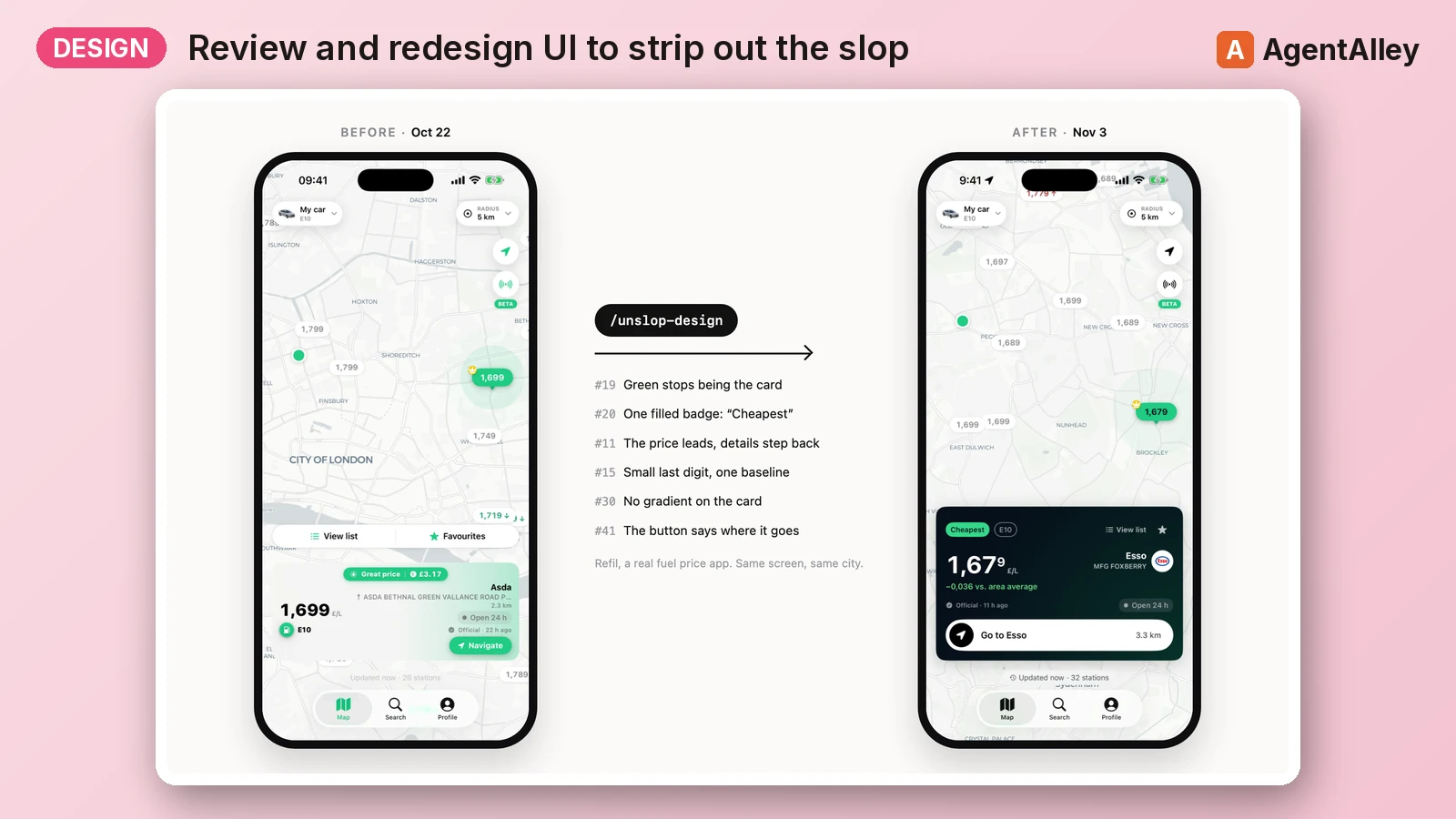 SkillUnslop Design Review
 marcosnovo/unslop-design · by marcosnovoReview and redesign an app or website UI to strip out the "slop" (decorative accent color, gradients, glows, noisy badges, emoji as icons, eyeballed spacing, greetings as titles, Title Case, flat hierarchy, repeated numbers) with a system (spacing, type, color roles, elevation) and two modes: a quick five-fix pass for one screen, or an orchestrated process for a whole app (parallel reviewers, a published winning proposal, devs per area, audits, PR). Covers SwiftUI, Compose and web (dashboards, landing pages, Tailwind), with scripts that scan the code, measure the rendered page and score it from 0 to 100. Use it when asked to "review the design", "make it look less AI", "unslop", "polish this screen", "design review", "winning proposal", "audit this dashboard", or when given videos or screenshots of an app or site asking for feedback or a redesign. Also use it to start a design system (spacing, type, palette, shadow scales) or to audit tokens, contrast or consistency across screens.★ 14 GitHub stars
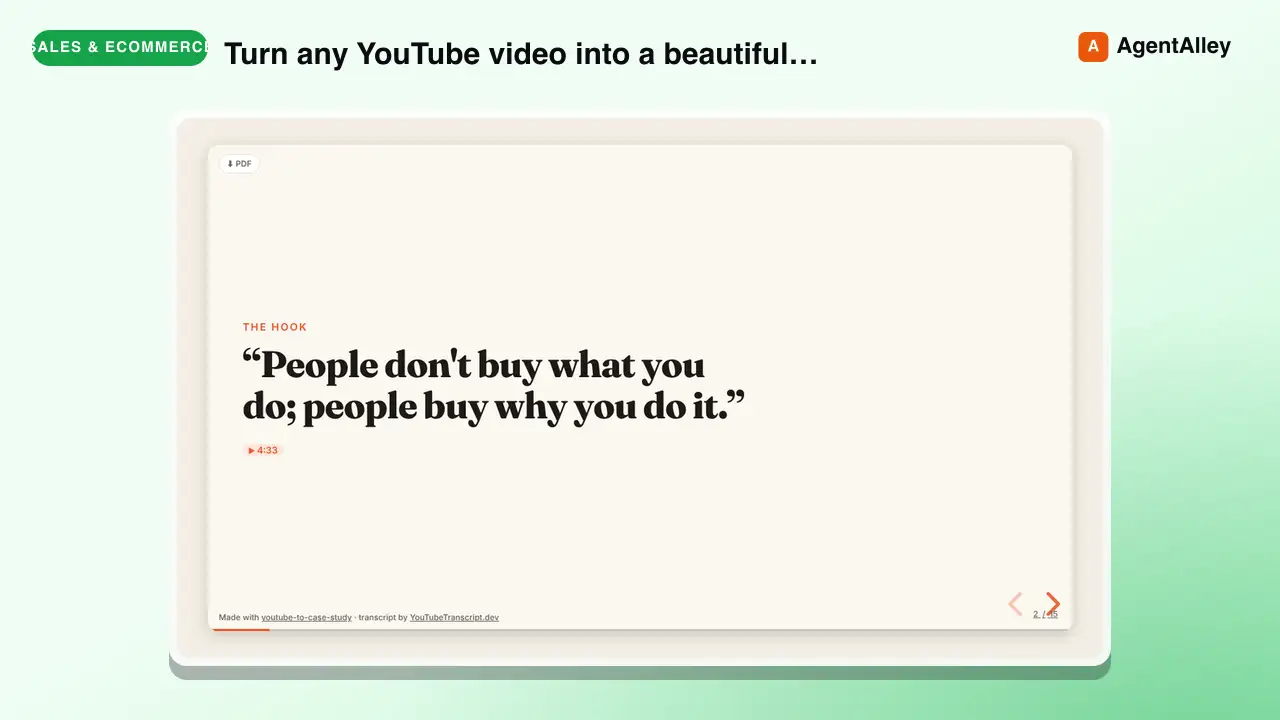 SkillYouTube to Case Study Converter
 tstfully/youtube-to-case-study · by tstfullyTurn any YouTube video (founder interview, product teardown, conference talk, marketing breakdown, UX walkthrough, podcast) into a beautiful case-study slideshow: one HTML file that opens in any browser, built on reveal.js, with speaker notes and every fact linked to the exact second in the video. Use this skill whenever someone wants a case study, business case study, marketing case study, UX case study, product teardown, growth teardown, competitor breakdown, swipe file, lesson deck, or presentation / slides / deck from a YouTube video or link. Also trigger on 'turn this video into a case study', 'make slides from this YouTube video', 'case study from this talk', 'teardown of this video', 'youtube to slides', 'youtube to presentation', or 'summarize this video as a deck'. Works for marketers, educators, product managers, students, and consultants; no coding needed.★ 3 GitHub stars
More from AgriciDaniel
 SkillAgent Browsing Auditor
 AgriciDaniel/claude-seo · by AgriciDanielAudit and fix agent readiness: the Lighthouse Agentic Browsing fraction, accessibility tree for agents, robots.txt and Content-Signal for AI agents, WAF treatment of agent traffic, llms.txt, Markdown delivery, ai-catalog.json, /.well-known discovery files, and WebMCP tools. Exclude AI citability and brand signals (seo-geo) and commerce protocol depth (seo-ecommerce).★ 17.4k GitHub stars
 SkillAI Search OptimizationAgriciDaniel/claude-seo · by AgriciDanielOptimize content for AI Overviews (formerly SGE), ChatGPT web search, Perplexity, and other AI-powered search experiences. Generative Engine Optimization (GEO) analysis including brand mention signals, AI crawler accessibility, llms.txt compliance, passage-level citability scoring, and platform-specific optimization. Use when user says "AI Overviews", "SGE", GEO", "AI search", "LLM optimization", "Perplexity", "AI citations", ChatGPT search", or "AI visibility".★ 17.4k GitHub stars
 SkillBacklink Profile AnalysisAgriciDaniel/claude-seo · by AgriciDanielBacklink profile analysis: referring domains, anchor text distribution, toxic link detection, competitor gap analysis. Works with free APIs (Moz, Bing Webmaster, Common Crawl) and DataForSEO extension. Use when user says backlinks, link profile, referring domains, anchor text, toxic links, link gap, link building, disavow, or backlink audit.★ 17.4k GitHub stars
 SkillAmazon Ads AuditorAgriciDaniel/claude-ads · by AgriciDanielYou share your Amazon advertising numbers and goals; you get back a plain-language review of what's draining your budget and what to change first.★ 9.5k GitHub stars
 SkillApple Search Ads AuditorAgriciDaniel/claude-ads · by AgriciDanielPaste what you're spending on Apple Search Ads and your recent numbers; get back a plain review of what's wasting money and what to fix first.★ 9.5k GitHub stars
 SkillAttribution AuditorAgriciDaniel/claude-ads · by AgriciDanielPaste the sales and spend numbers each ad platform claims, and get back a plain explanation of why they disagree and which figure to trust.★ 9.5k GitHub stars