Sales Forecast Builder
Sales Forecasting Model Skill
Build a structured sales forecast framework for any business or team. Use when asked to build a sales forecast, create a revenue model, project pipeline, or build a bottom-up forecast.
---
name: sales-forecasting-model
description: "Build a structured sales forecast framework for any business or team. Use when asked to build a sales forecast, create a revenue model, project pipeline, or build a bottom-up forecast. Produces a forecast methodology, pipeline model, scenario analysis, and assumption log."
---

# Sales Forecasting Model Skill

Produces a structured sales forecast framework — from pipeline conversion modelling to scenario analysis. Built for revenue and sales leaders who need a defensible forecast, not a spreadsheet guess.

## Required Inputs

Ask the user for these if not provided:
- **Business type** (SaaS / Transactional / Services / Marketplace)
- **Forecast period** (monthly / quarterly / annual)
- **Sales motion** (inbound / outbound / channel / PLG / mixed)
- **Current pipeline data** (number of deals, stages, values — rough is fine)
- **Historical conversion rates** (if available — otherwise model will flag as assumption)
- **Average deal size and sales cycle length**
Overview
Produces a structured sales forecast framework — from pipeline conversion modelling to scenario analysis. Built for revenue and sales leaders who need a defensible forecast, not a spreadsheet guess.
Manual install (npx, ZIP)
npx skills add mohitagw15856/pm-claude-skills --skill sales-forecasting-model -g -a claude-codemkdir -p ~/.claude/skills && curl -sL https://codeload.github.com/mohitagw15856/pm-claude-skills/tar.gz/f6ca79348c55 \
| tar -xz -C ~/.claude/skills --strip-components=2 pm-claude-skills-f6ca79348c55/skills/sales-forecasting-modelNew-Item -ItemType Directory -Force "$HOME\.claude\skills" | Out-Null; Invoke-WebRequest "https://m.agentalley.io/zip/855340d9f0f507df7be9/sales-forecasting-model.zip" -OutFile "$env:TEMP\sales-forecasting-model.zip"; Expand-Archive "$env:TEMP\sales-forecasting-model.zip" -DestinationPath "$HOME\.claude\skills" -ForceConnects with Agent Alley MCP · agentalley.io/mcp
Files included
SKILL.md5.2 KB
Read the files here
mohitagw15856/
Show the full text139 lines
Sales Forecasting Model Skill
Produces a structured sales forecast framework — from pipeline conversion modelling to scenario analysis. Built for revenue and sales leaders who need a defensible forecast, not a spreadsheet guess.
Required Inputs
Ask the user for these if not provided:
- Business type (SaaS / Transactional / Services / Marketplace)
- Forecast period (monthly / quarterly / annual)
- Sales motion (inbound / outbound / channel / PLG / mixed)
- Current pipeline data (number of deals, stages, values — rough is fine)
- Historical conversion rates (if available — otherwise model will flag as assumption)
- Average deal size and sales cycle length
Output Structure
Sales Forecast: [Team / Business] — [Period]
Forecast type: [Bottom-up pipeline / Top-down quota / Capacity-based / Hybrid] Period: [Month / Quarter / Year] Created: [Date] Forecast owner: [Name]
1. Forecast Methodology
Chosen approach: [Bottom-up / Top-down / Hybrid] — and why for this context.
Bottom-up (recommended when pipeline data exists):
Start from real deals in the pipeline. Apply stage-by-stage conversion rates. Sum to a revenue number.
Top-down (useful for planning, not for calling a number):
Start from market or quota. Work backwards to activity targets.
2. Pipeline Stage Model
Define the sales stages and the expected conversion rate between each:
| Stage | Description | % of deals that advance | Avg time in stage |
|---|---|---|---|
| Prospect | Identified, not contacted | — | — |
| Qualified | Discovery done, confirmed fit | [X%] | [N days] |
| Proposal | Proposal sent | [X%] | [N days] |
| Negotiation | Commercial terms being agreed | [X%] | [N days] |
| Closed Won | Contract signed | [X%] | — |
Overall pipeline conversion rate: [X%] (Qualified → Closed Won) Average sales cycle: [N days from Qualified to Close]
3. Current Pipeline Snapshot
| Stage | Number of deals | Total value | Expected close (weighted) |
|---|---|---|---|
| Qualified | [N] | £[X] | £[X × conversion %] |
| Proposal | [N] | £[X] | £[X × conversion %] |
| Negotiation | [N] | £[X] | £[X × conversion %] |
| Total | £[X] | £[weighted total] |
Coverage ratio: [Weighted pipeline ÷ target = X×] Rule of thumb: 3× pipeline coverage is needed for confident forecast; 2× is tight; below 1.5× is at risk.
4. Scenario Analysis
| Scenario | Assumption | Revenue | Probability |
|---|---|---|---|
| Upside | All Negotiation + top 50% of Proposal close | £[X] | [%] |
| Base | Weighted pipeline conversion at historical rates | £[X] | [%] |
| Downside | Conversion rates drop 20% from historical | £[X] | [%] |
Committed forecast: £[X] — [The number the forecast owner is willing to call. Between base and downside.]
5. Key Assumptions Log
Every forecast is a set of assumptions. Name them explicitly so they can be updated:
| Assumption | Value | Confidence | Source | Last updated |
|---|---|---|---|---|
| Avg deal size | £[X] | High/Med/Low | [Last N deals] | [Date] |
| Sales cycle | [N days] | |||
| Close rate from Proposal | [X%] | |||
| Seasonal factor | [e.g. Q4 +20%] | |||
| Churn/contraction | [X% of ARR at risk] |
6. Activity-Based Sanity Check
Work backwards from the forecast to check if the required activity is achievable:
To hit £[target]:
- Deals needed to close: [N] (target ÷ avg deal size)
- Qualified pipeline needed (at current conversion): [N deals or £value]
- Discovery calls needed per week to build that pipeline: [N]
- Outreach needed per week (at [X%] meeting rate): [N]
Does the team have capacity to generate this? [Yes / No — flag if not]
Quality Checks
- Forecast methodology is stated (not just a number)
- Stage conversion rates are based on historical data or flagged as assumptions
- Coverage ratio is calculated
- Three scenarios are modelled (not just one number)
- Assumption log is explicit and dated
- Activity sanity check confirms the forecast is achievable with current capacity
Example Trigger Phrases
- "Build a sales forecast for [period]"
- "Create a pipeline model for [team/business]"
- "Help me build a bottom-up revenue forecast"
- "What is our forecast for Q[N] based on current pipeline?"
Anti-Patterns
- Do not present a single forecast number without scenario analysis — a forecast without upside and downside cases hides risk
- Do not use 100% confidence on conversion rates that are not backed by historical data — flag them as assumptions
- Do not skip the activity sanity check — a forecast number that requires unreachable activity levels is not credible
- Do not use top-down quota as the only forecast method when pipeline data exists — bottom-up is more accurate and defensible
- Do not omit the coverage ratio — without it, stakeholders cannot assess whether the pipeline is sufficient to hit target
| 1 | |
| 2 | name sales-forecasting-model |
| 3 | description "Build a structured sales forecast framework for any business or team. Use when asked to build a sales forecast, create a revenue model, project pipeline, or build a bottom-up forecast. Produces a forecast methodology, pipeline model, scenario analysis, and assumption log." |
| 4 | |
| 5 | |
| 6 | # Sales Forecasting Model Skill |
| 7 | |
| 8 | Produces a structured sales forecast framework — from pipeline conversion modelling to scenario analysis. Built for revenue and sales leaders who need a defensible forecast, not a spreadsheet guess. |
| 9 | |
| 10 | ## Required Inputs |
| 11 | |
| 12 | Ask the user for these if not provided: |
| 13 | **Business type** (SaaS / Transactional / Services / Marketplace) |
| 14 | **Forecast period** (monthly / quarterly / annual) |
| 15 | **Sales motion** (inbound / outbound / channel / PLG / mixed) |
| 16 | **Current pipeline data** (number of deals, stages, values — rough is fine) |
| 17 | **Historical conversion rates** (if available — otherwise model will flag as assumption) |
| 18 | **Average deal size and sales cycle length** |
| 19 | |
| 20 | ## Output Structure |
| 21 | |
| 22 | |
| 23 | |
| 24 | # Sales Forecast: [Team / Business] — [Period] |
| 25 | |
| 26 | **Forecast type:** [Bottom-up pipeline / Top-down quota / Capacity-based / Hybrid] |
| 27 | **Period:** [Month / Quarter / Year] |
| 28 | **Created:** [Date] |
| 29 | **Forecast owner:** [Name] |
| 30 | |
| 31 | |
| 32 | |
| 33 | ## 1. Forecast Methodology |
| 34 | |
| 35 | **Chosen approach:** [Bottom-up / Top-down / Hybrid] — and why for this context. |
| 36 | |
| 37 | Bottom-up (recommended when pipeline data exists): |
| 38 | > Start from real deals in the pipeline. Apply stage-by-stage conversion rates. Sum to a revenue number. |
| 39 | |
| 40 | Top-down (useful for planning, not for calling a number): |
| 41 | > Start from market or quota. Work backwards to activity targets. |
| 42 | |
| 43 | |
| 44 | |
| 45 | ## 2. Pipeline Stage Model |
| 46 | |
| 47 | Define the sales stages and the expected conversion rate between each: |
| 48 | |
| 49 | | Stage | Description | % of deals that advance | Avg time in stage | |
| 50 | |---|---|---|---| |
| 51 | | Prospect | Identified, not contacted | — | — | |
| 52 | | Qualified | Discovery done, confirmed fit | [X%] | [N days] | |
| 53 | | Proposal | Proposal sent | [X%] | [N days] | |
| 54 | | Negotiation | Commercial terms being agreed | [X%] | [N days] | |
| 55 | | Closed Won | Contract signed | [X%] | — | |
| 56 | |
| 57 | **Overall pipeline conversion rate:** [X%] (Qualified → Closed Won) |
| 58 | **Average sales cycle:** [N days from Qualified to Close] |
| 59 | |
| 60 | |
| 61 | |
| 62 | ## 3. Current Pipeline Snapshot |
| 63 | |
| 64 | | Stage | Number of deals | Total value | Expected close (weighted) | |
| 65 | |---|---|---|---| |
| 66 | | Qualified | [N] | £[X] | £[X × conversion %] | |
| 67 | | Proposal | [N] | £[X] | £[X × conversion %] | |
| 68 | | Negotiation | [N] | £[X] | £[X × conversion %] | |
| 69 | | **Total** | | **£[X]** | **£[weighted total]** | |
| 70 | |
| 71 | **Coverage ratio:** [Weighted pipeline ÷ target = X×] |
| 72 | *Rule of thumb: 3× pipeline coverage is needed for confident forecast; 2× is tight; below 1.5× is at risk.* |
| 73 | |
| 74 | |
| 75 | |
| 76 | ## 4. Scenario Analysis |
| 77 | |
| 78 | | Scenario | Assumption | Revenue | Probability | |
| 79 | |---|---|---|---| |
| 80 | | Upside | All Negotiation + top 50% of Proposal close | £[X] | [%] | |
| 81 | | Base | Weighted pipeline conversion at historical rates | £[X] | [%] | |
| 82 | | Downside | Conversion rates drop 20% from historical | £[X] | [%] | |
| 83 | |
| 84 | **Committed forecast:** £[X] — [The number the forecast owner is willing to call. Between base and downside.] |
| 85 | |
| 86 | |
| 87 | |
| 88 | ## 5. Key Assumptions Log |
| 89 | |
| 90 | Every forecast is a set of assumptions. Name them explicitly so they can be updated: |
| 91 | |
| 92 | | Assumption | Value | Confidence | Source | Last updated | |
| 93 | |---|---|---|---|---| |
| 94 | | Avg deal size | £[X] | High/Med/Low | [Last N deals] | [Date] | |
| 95 | | Sales cycle | [N days] | | | | |
| 96 | | Close rate from Proposal | [X%] | | | | |
| 97 | | Seasonal factor | [e.g. Q4 +20%] | | | | |
| 98 | | Churn/contraction | [X% of ARR at risk] | | | | |
| 99 | |
| 100 | |
| 101 | |
| 102 | ## 6. Activity-Based Sanity Check |
| 103 | |
| 104 | Work backwards from the forecast to check if the required activity is achievable: |
| 105 | |
| 106 | To hit £[target]: |
| 107 | Deals needed to close: [N] (target ÷ avg deal size) |
| 108 | Qualified pipeline needed (at current conversion): [N deals or £value] |
| 109 | Discovery calls needed per week to build that pipeline: [N] |
| 110 | Outreach needed per week (at [X%] meeting rate): [N] |
| 111 | |
| 112 | **Does the team have capacity to generate this?** [Yes / No — flag if not] |
| 113 | |
| 114 | |
| 115 | |
| 116 | ## Quality Checks |
| 117 | |
| 118 | [ ] Forecast methodology is stated (not just a number) |
| 119 | [ ] Stage conversion rates are based on historical data or flagged as assumptions |
| 120 | [ ] Coverage ratio is calculated |
| 121 | [ ] Three scenarios are modelled (not just one number) |
| 122 | [ ] Assumption log is explicit and dated |
| 123 | [ ] Activity sanity check confirms the forecast is achievable with current capacity |
| 124 | |
| 125 | ## Example Trigger Phrases |
| 126 | |
| 127 | "Build a sales forecast for [period]" |
| 128 | "Create a pipeline model for [team/business]" |
| 129 | "Help me build a bottom-up revenue forecast" |
| 130 | "What is our forecast for Q[N] based on current pipeline?" |
| 131 | |
| 132 | ## Anti-Patterns |
| 133 | |
| 134 | [ ] Do not present a single forecast number without scenario analysis — a forecast without upside and downside cases hides risk |
| 135 | [ ] Do not use 100% confidence on conversion rates that are not backed by historical data — flag them as assumptions |
| 136 | [ ] Do not skip the activity sanity check — a forecast number that requires unreachable activity levels is not credible |
| 137 | [ ] Do not use top-down quota as the only forecast method when pipeline data exists — bottom-up is more accurate and defensible |
| 138 | [ ] Do not omit the coverage ratio — without it, stakeholders cannot assess whether the pipeline is sufficient to hit target |
| 139 |
Details
- Updated
- Sep 23, 2026
- License
- MIT
- Stars on the repo
- ★ 1,395
- Checked
- Source
- mohitagw15856/pm-claude-skills ↗
- Creator
- mohitagw15856 · 191 listings
Similar skills
See all → AgentNEXUS Quick-Start Guide
 msitarzewski/agency-agents · by msitarzewski> Get from zero to orchestrated multi-agent pipeline in 5 minutes.★ 154k GitHub stars
 SkillRaw Footage Cleanup
 hassancs91/claude-youtube-editor · by hassancs91Step 1 of the AI Video Editor pipeline — turn raw talking-head footage into a clean master cut. Use when the user wants to "clean cut", "cut the raw footage", "remove filler / dead air / bad takes", "tighten the pacing", produce cuts.json, run the cut editor, or render a cleaned preview/master for a video-N project in this repo. Covers audio extraction, AssemblyAI transcription, authoring cuts.json (keeps/cuts/fluff categorized), the cut policy (content-aggressive, pause-natural ~0.5s), QA + review docs, the local cut-editor UI, tight/natural previews, the final 4K60 render, and producing edited-transcript.json as the handoff to /make-tsx. Not for building TSX overlays (that is /make-tsx) or the raw TSX authoring rules (that is vidtsx-2d-generator).★ 330 GitHub stars
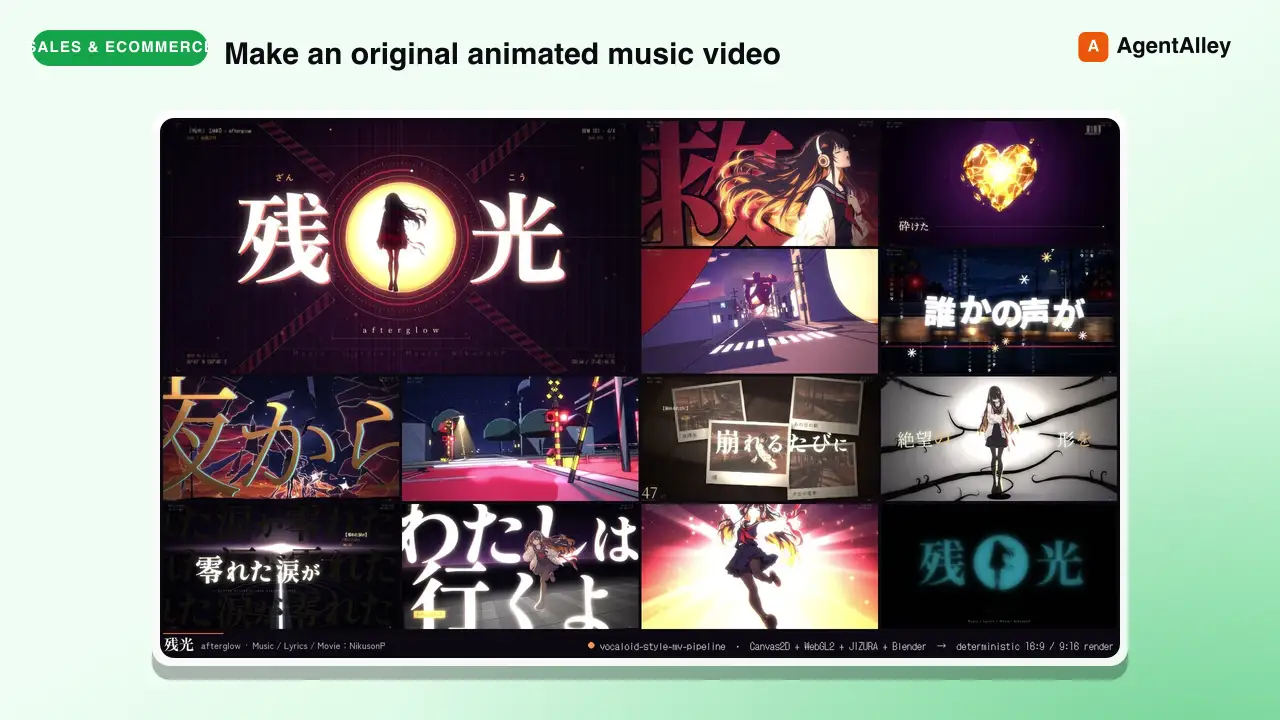 SkillVocaloid Music Video Builder
 EGSECDA/vocaloid-style-mv-pipeline · by EGSECDAMake an original animated music video (MV / PV) for a song from its audio file plus lyrics, in the Vocaloid / J-pop lyric-video tradition: 手書き/tegaki (V家手书, 手描きMV, ボカロPV), 文字PV and kinetic typography (リリックモーション, リリックビデオ, 歌詞動画, 歌词视频, 动态歌词), anime-illustration MVs with an original character — for any mood, from dark ballads to bright upbeat summer pop. Renders to MP4 with a deterministic Canvas2D/WebGL2 engine in a headless browser: JIZURA lyric motion, AI-generated art, optional Blender toon 3D, beat-locked editing, 9:16 vertical/Shorts version. Use it whenever the user wants a music video, MV, PV, lyric video or beat-synced animation for a song, e.g. make an MV for my song", "turn this track into a lyric video", "给这首歌做个MV/PV", "做个V家手书", "この曲のMVを作って", ボカロPV作って", "縦型ショートも" — even if they only give a .wav/.mp3 and say "make a cool video for it". Not for editing existing footage or clip compilations.★ 169 GitHub stars
 SkillConstruction Project Manager
 hewi333/Mom-n-Pop-Skills · by hewi333Construction company AI agent — orchestrates email (Google Workspace), project management (JobTread Pave API), and file routing for a construction business. Handles email triage, attachment routing to JobTread, project status, task management, and daily briefings via Telegram. Reference implementation for a construction/trades business with an existing email→Drive→PM pipeline.★ 122 GitHub stars
 SkillLightweight SQLite CRMhewi333/Mom-n-Pop-Skills · by hewi333Use when tracking customer interactions, managing leads, or building a lightweight CRM for small businesses without dedicated CRM software. Stores contacts, leads, activities, estimates, and communications in local SQLite.★ 122 GitHub stars
 SkillShort Video Pipeline
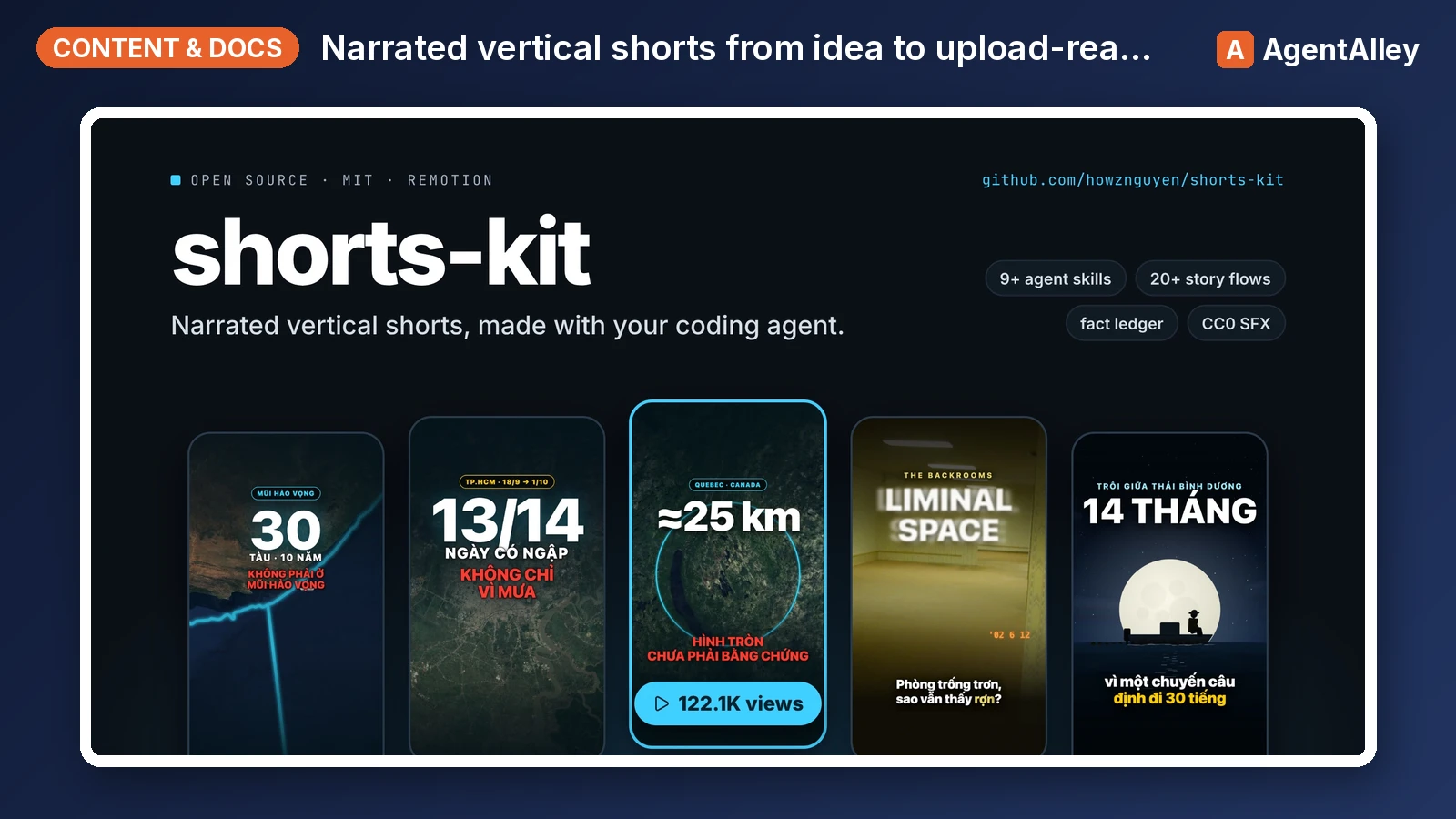
 howznguyen/shorts-kit · by howznguyenOrchestrates one narrated vertical short (TikTok, YouTube Shorts, Reels) from idea to upload-ready hand-off files, in the fixed order idea, facts, flow and visual choice, brief, narration, TTS, lint, scenes, still review, render, cover, normalize, encode, hand-off. Use when the user says "make a video about X", "start a new short", "take this idea to a finished video", "what's the next step", "where was I on this video", or asks how the whole pipeline fits together. Also when the user gives a video or audio file (or a folder of clips) to edit: "edit this video", "dựng video này", a .mov/.mp4 path. Points at the skill and the SOUL section that governs each step.★ 69 GitHub stars
More from mohitagw15856
 Skill360 Feedback Survey
 mohitagw15856/pm-claude-skills · by mohitagw15856Design a 360-degree feedback survey or write a structured 360 feedback report. Use when asked to build a 360 feedback process, write 360 feedback for a colleague, design a feedback survey, or produce a feedback report. Produces either a complete survey instrument with rating scales and open-ended questions, or a structured narrative feedback report with themes, strengths, and development areas.★ 1.4k GitHub stars
 SkillExperiment Design Plannermohitagw15856/pm-claude-skills · by mohitagw15856Design statistically rigorous A/B tests for product features, UI changes, onboarding flows, and pricing experiments. Use when asked to set up an experiment, design an A/B test, calculate sample size, or interpret test results. Produces a complete test plan with hypothesis, variant definitions, sample size, duration estimate, guardrail metrics, and a results interpretation guide.★ 1.4k GitHub stars
 SkillWeb Accessibility Auditormohitagw15856/pm-claude-skills · by mohitagw15856Generate a WCAG 2.2 accessibility audit checklist and remediation suggestions for any UI or design. Use when asked to audit for accessibility, check WCAG compliance, review a design for a11y issues, or create an accessibility remediation plan. Produces a prioritised checklist with pass/fail assessments and specific fixes.★ 1.4k GitHub stars
 SkillKey Account Plannermohitagw15856/pm-claude-skills · by mohitagw15856Build a structured account plan for any key customer or target account. Use when asked to create an account plan, key account strategy, strategic account review, or territory plan. Produces a complete account plan with relationship map, growth opportunities, risks, and 90-day action plan.★ 1.4k GitHub stars
 SkillAEO Optimizermohitagw15856/pm-claude-skills · by mohitagw15856Optimize an article for Answer Engine Optimization (AEO) so AI engines like ChatGPT, Perplexity, and Claude can extract, quote, and cite it. Use when asked to AEO-optimize, make content AI-readable, improve AI citation chances, or adapt an article for answer engines. Produces an AEO-optimised rewrite with question headings, 50–80 word answer capsules, a paragraph-length audit, and flagged trust signals.★ 1.4k GitHub stars
 SkillAI Ethics Review Conductormohitagw15856/pm-claude-skills · by mohitagw15856Conduct a structured ethical review of an AI or ML feature, model, or product. Use when preparing to deploy an AI system, assessing algorithmic risk, auditing a model for bias, or producing a responsible AI impact assessment. Produces a structured ethics review covering fairness, transparency, privacy, safety, accountability, and societal impact with a risk tier score, pre-deployment checklist, and prioritised mitigations.★ 1.4k GitHub stars