AEO Blog Writer
Writes SEO + AEO blog posts built to rank on Google
Writes SEO + AEO (Answer Engine Optimized) blog posts built to rank on Google AND get cited by AI answer engines (Google AI Overviews, ChatGPT, Perplexity). Runs live SERP recon, writes answer-first, and wires internal + external…
---
name: rymac-aeo-blog-writer
description: Writes SEO + AEO (Answer Engine Optimized) blog posts built to rank on Google AND get cited by AI answer engines (Google AI Overviews, ChatGPT, Perplexity). Runs live SERP recon, writes answer-first, and wires internal + external authority links. Use when someone wants a blog post that ranks and gets quoted by AI, says "write an AEO post", "answer-engine optimization", "get cited by AI Overviews", "rank AND get quoted", or wants the pro version of an SEO article. For quick keyword blog posts use rymac-seo-writer instead.
version: 1.0
---

# AEO Blog Writer

You write posts that do three jobs at once: (a) rank in classic search, (b)
get **cited** by AI answer engines — Google AI Overviews, ChatGPT, Perplexity,
Gemini — and (c) move the reader toward one action. Ranking is table stakes.
The edge is being the source the AI quotes.

The difference between this and a normal SEO post is structure: answer engines
lift the sentence that answers the question *directly, first*. If your answer
is buried three paragraphs down under "In today's landscape…", the AI skips you
and quotes the competitor who led with it.
Overview
You write posts that do three jobs at once: (a) rank in classic search, (b) get cited by AI answer engines — Google AI Overviews, ChatGPT, Perplexity, Gemini — and (c) move the reader toward one action. Ranking is table stakes. The edge is being the source the AI quotes.
What you get
- It does not publish. The author publishes on their CMS.
- It does not guarantee rankings or citations. It follows what earns them.
- It does not create images. It marks where receipts go and what to capture.
Manual install (npx, ZIP)
npx skills add oathdriven/rymac-skills --skill rymac-aeo-blog-writer -g -a claude-codenpx degit oathdriven/rymac-skills/skills/rymac-aeo-blog-writer#main ~/.claude/skills/rymac-aeo-blog-writerConnects with Agent Alley MCP · agentalley.io/mcp
Files included
SKILL.md6.3 KB
Read SKILL.md here
Show the full text119 lines
AEO Blog Writer
You write posts that do three jobs at once: (a) rank in classic search, (b) get cited by AI answer engines — Google AI Overviews, ChatGPT, Perplexity, Gemini — and (c) move the reader toward one action. Ranking is table stakes. The edge is being the source the AI quotes.
The difference between this and a normal SEO post is structure: answer engines lift the sentence that answers the question directly, first. If your answer is buried three paragraphs down under "In today's landscape…", the AI skips you and quotes the competitor who led with it.
Intake (ask for what's missing)
- Business / brand — who's publishing, and who reads it (the ICP).
- Target keyword or question — or let this skill propose one from SERP recon.
- Voice — if the brand has a voice/style doc, load it and match it; every supplied line is used verbatim. No doc? Write in a plain, direct, expert voice (see Voice rules below).
- Link targets — the pages this post should link to (service pages, related posts, the offer/CTA page).
Process
1. SERP recon (do not skip — this is the whole edge)
Web-search the target keyword. Read the top 3–5 ranking pages. Establish:
- What format ranks — listicle, how-to guide, comparison, definition, calculator. Match the winning format; beat it on directness.
- Typical depth and the sub-questions (the "People Also Ask" territory).
- The gap — what every top result hedges on, buries, or omits that you can say straight. That gap is your reason to exist on the SERP.
2. Outline for approval
- H1 — keyword natural, no orphaned words, promises the answer.
- 4–8 H2s — phrased as questions wherever it's honest to (question-shaped headings are what answer engines match to user prompts).
- Where the internal links and the 2+ external authority links go. Show the outline. Wait for a yes before writing.
3. Write
- Answer-first (the AEO move): the first sentence under the H1 — and under every question-H2 — is the direct, standalone answer. Detail follows. Write each answer so it makes sense lifted out of context, because that's exactly what an AI Overview does with it. This single habit is what gets you quoted.
- Length: whatever the SERP demands, usually 900–1,800 words. Never pad. Ten high-intent readers who get a straight answer beat ten thousand drive-bys.
- Structure for skimming + extraction: short paragraphs (2–3 sentences), bulleted lists and comparison tables where they fit (answer engines love a clean table), one idea per section. Bold only the load-bearing phrase.
- Internal links: 2–4 per post, with descriptive keyword anchor text that matches the target page's keyword ("own your CRM outright" → the ownership post), never "click here" or a bare URL. Internal anchors are a live relevance signal and they compound as the blog grows. When a new post publishes, check whether an older post should link to it (retro-linking) and suggest the edit.
- Authority links out (2+ per post, a hard rule): link to genuinely authoritative pages you actually cite — studies, official docs, primary sources, the product/infra pages you reference. Linking out is a trust signal for both readers and rankings, and citing real sources is part of what makes your page citable in turn.
- Images = receipts, not decoration: only insert an image when it is evidence — a real screenshot, real data, a real invoice, a chart of real numbers. "Here it is, right from the dashboard." Never stock art or filler. Always descriptive keyword alt text. If a claim would land harder with a screenshot the author can capture, leave a placeholder comment and tell them exactly what to grab.
- Structured data: where the post is Q&A-shaped or a how-to, recommend the matching schema (FAQPage / HowToArticle JSON-LD) so engines can parse it cleanly. Provide the JSON-LD block ready to paste.
- Meta: title ≤ 60 chars (keyword front-loaded), description 150–160 chars with the keyword and a reason to click.
Voice rules (hard)
- No AI-slop openers — kill "In today's fast-paced world", "In this comprehensive guide", "Unlock the power of…". Start with the answer.
- No orphaned words in headings (no single word wrapping to its own line).
- Short paragraphs. Write like a knowledgeable person talking to one reader: "you" and "your", specific numbers and examples, no throat-clearing.
- Every sentence earns its place. No fluff, no keyword stuffing — use synonyms and related terms, not the exact phrase 20 times.
- Never invent numbers, testimonials, refund terms, or scarcity. Facts only.
4. Deliver
Write the post to a markdown file in the working directory (blog-<slug>.md,
slug = target keyword, lowercase-hyphenated), frontmatter first:
---
title: [≤ 60 chars, keyword front-loaded]
description: [150–160 chars, keyword + reason to click]
keywords: [primary, secondary, tertiary]
---

# [H1]

[Answer-first body with question-H2s, lists/tables, internal + external links]
Then hand back: the keyword it targets, the internal/external links used, any image placeholders the author still needs to capture, and any retro-link edits to older posts.
What good looks like
A post someone finds from a long-tail search — or sees quoted inside an AI answer with the brand named as the source — reads in four minutes, gets the straight answer the hedgy top-10 wouldn't give, and leaves through the one CTA.
What this skill does NOT do
- It does not publish. The author publishes on their CMS.
- It does not guarantee rankings or citations. It follows what earns them.
- It does not create images. It marks where receipts go and what to capture.
| 1 | |
| 2 | name rymac-aeo-blog-writer |
| 3 | description Writes SEO + AEO (Answer Engine Optimized) blog posts built to rank on Google AND get cited by AI answer engines (Google AI Overviews, ChatGPT, Perplexity). Runs live SERP recon, writes answer-first, and wires internal + external authority links. Use when someone wants a blog post that ranks and gets quoted by AI, says "write an AEO post", "answer-engine optimization", "get cited by AI Overviews", "rank AND get quoted", or wants the pro version of an SEO article. For quick keyword blog posts use rymac-seo-writer instead. |
| 4 | version 1.0 |
| 5 | |
| 6 | |
| 7 | # AEO Blog Writer |
| 8 | |
| 9 | You write posts that do three jobs at once: (a) rank in classic search, (b) |
| 10 | get **cited** by AI answer engines — Google AI Overviews, ChatGPT, Perplexity, |
| 11 | Gemini — and (c) move the reader toward one action. Ranking is table stakes. |
| 12 | The edge is being the source the AI quotes. |
| 13 | |
| 14 | The difference between this and a normal SEO post is structure: answer engines |
| 15 | lift the sentence that answers the question *directly, first*. If your answer |
| 16 | is buried three paragraphs down under "In today's landscape…", the AI skips you |
| 17 | and quotes the competitor who led with it. |
| 18 | |
| 19 | ## Intake (ask for what's missing) |
| 20 | |
| 21 | **Business / brand** — who's publishing, and who reads it (the ICP). |
| 22 | **Target keyword or question** — or let this skill propose one from SERP recon. |
| 23 | **Voice** — if the brand has a voice/style doc, load it and match it; every |
| 24 | supplied line is used verbatim. No doc? Write in a plain, direct, expert |
| 25 | voice (see Voice rules below). |
| 26 | **Link targets** — the pages this post should link to (service pages, |
| 27 | related posts, the offer/CTA page). |
| 28 | |
| 29 | ## Process |
| 30 | |
| 31 | ### 1. SERP recon (do not skip — this is the whole edge) |
| 32 | Web-search the target keyword. Read the top 3–5 ranking pages. Establish: |
| 33 | **What format ranks** — listicle, how-to guide, comparison, definition, |
| 34 | calculator. Match the winning format; beat it on directness. |
| 35 | **Typical depth** and the sub-questions (the "People Also Ask" territory). |
| 36 | **The gap** — what every top result hedges on, buries, or omits that you can |
| 37 | say straight. That gap is your reason to exist on the SERP. |
| 38 | |
| 39 | ### 2. Outline for approval |
| 40 | **H1** — keyword natural, no orphaned words, promises the answer. |
| 41 | **4–8 H2s** — phrased as questions wherever it's honest to (question-shaped |
| 42 | headings are what answer engines match to user prompts). |
| 43 | Where the internal links and the 2+ external authority links go. |
| 44 | Show the outline. Wait for a yes before writing. |
| 45 | |
| 46 | ### 3. Write |
| 47 | |
| 48 | **Answer-first (the AEO move):** the first sentence under the H1 — and under |
| 49 | every question-H2 — is the direct, standalone answer. Detail follows. Write |
| 50 | each answer so it makes sense lifted out of context, because that's exactly |
| 51 | what an AI Overview does with it. This single habit is what gets you quoted. |
| 52 | **Length:** whatever the SERP demands, usually 900–1,800 words. Never pad. |
| 53 | Ten high-intent readers who get a straight answer beat ten thousand drive-bys. |
| 54 | **Structure for skimming + extraction:** short paragraphs (2–3 sentences), |
| 55 | bulleted lists and comparison tables where they fit (answer engines love a |
| 56 | clean table), one idea per section. Bold only the load-bearing phrase. |
| 57 | **Internal links:** 2–4 per post, with descriptive keyword anchor text that |
| 58 | matches the *target* page's keyword ("own your CRM outright" → the ownership |
| 59 | post), never "click here" or a bare URL. Internal anchors are a live |
| 60 | relevance signal and they compound as the blog grows. When a new post |
| 61 | publishes, check whether an older post should link *to* it (retro-linking) |
| 62 | and suggest the edit. |
| 63 | **Authority links out (2+ per post, a hard rule):** link to genuinely |
| 64 | authoritative pages you actually cite — studies, official docs, primary |
| 65 | sources, the product/infra pages you reference. Linking out is a trust |
| 66 | signal for both readers and rankings, and citing real sources is part of |
| 67 | what makes *your* page citable in turn. |
| 68 | **Images = receipts, not decoration:** only insert an image when it *is* |
| 69 | evidence — a real screenshot, real data, a real invoice, a chart of real |
| 70 | numbers. "Here it is, right from the dashboard." Never stock art or filler. |
| 71 | Always descriptive keyword alt text. If a claim would land harder with a |
| 72 | screenshot the author can capture, leave a placeholder comment and tell them |
| 73 | exactly what to grab. |
| 74 | **Structured data:** where the post is Q&A-shaped or a how-to, recommend the |
| 75 | matching schema (FAQPage / HowToArticle JSON-LD) so engines can parse it |
| 76 | cleanly. Provide the JSON-LD block ready to paste. |
| 77 | **Meta:** title ≤ 60 chars (keyword front-loaded), description 150–160 chars |
| 78 | with the keyword and a reason to click. |
| 79 | |
| 80 | ### Voice rules (hard) |
| 81 | No AI-slop openers — kill "In today's fast-paced world", "In this |
| 82 | comprehensive guide", "Unlock the power of…". Start with the answer. |
| 83 | No orphaned words in headings (no single word wrapping to its own line). |
| 84 | Short paragraphs. Write like a knowledgeable person talking to one reader: |
| 85 | "you" and "your", specific numbers and examples, no throat-clearing. |
| 86 | Every sentence earns its place. No fluff, no keyword stuffing — use synonyms |
| 87 | and related terms, not the exact phrase 20 times. |
| 88 | Never invent numbers, testimonials, refund terms, or scarcity. Facts only. |
| 89 | |
| 90 | ### 4. Deliver |
| 91 | Write the post to a markdown file in the working directory (`blog-<slug>.md`, |
| 92 | slug = target keyword, lowercase-hyphenated), frontmatter first: |
| 93 | |
| 94 | |
| 95 | |
| 96 | title: [≤ 60 chars, keyword front-loaded] |
| 97 | description: [150–160 chars, keyword + reason to click] |
| 98 | keywords: [primary, secondary, tertiary] |
| 99 | |
| 100 | |
| 101 | # [H1] |
| 102 | |
| 103 | [Answer-first body with question-H2s, lists/tables, internal + external links] |
| 104 | |
| 105 | |
| 106 | Then hand back: the keyword it targets, the internal/external links used, any |
| 107 | image placeholders the author still needs to capture, and any retro-link edits |
| 108 | to older posts. |
| 109 | |
| 110 | ## What good looks like |
| 111 | A post someone finds from a long-tail search — or sees quoted inside an AI |
| 112 | answer with the brand named as the source — reads in four minutes, gets the |
| 113 | straight answer the hedgy top-10 wouldn't give, and leaves through the one CTA. |
| 114 | |
| 115 | ## What this skill does NOT do |
| 116 | It does not publish. The author publishes on their CMS. |
| 117 | It does not guarantee rankings or citations. It follows what earns them. |
| 118 | It does not create images. It marks where receipts go and what to capture. |
| 119 |
Details
- Version
- 1.0
- License
- MIT
- Stars on the repo
- ★ 28
- Checked
- Source
- oathdriven/rymac-skills ↗
- Creator
- oathdriven · 12 listings
Similar skills
See all → SkillAI Search Optimization
 AgriciDaniel/claude-seo · by AgriciDanielOptimize content for AI Overviews (formerly SGE), ChatGPT web search, Perplexity, and other AI-powered search experiences. Generative Engine Optimization (GEO) analysis including brand mention signals, AI crawler accessibility, llms.txt compliance, passage-level citability scoring, and platform-specific optimization. Use when user says "AI Overviews", "SGE", GEO", "AI search", "LLM optimization", "Perplexity", "AI citations", ChatGPT search", or "AI visibility".★ 17.4k GitHub stars
 SkillPhoto Geolocation Analyzer
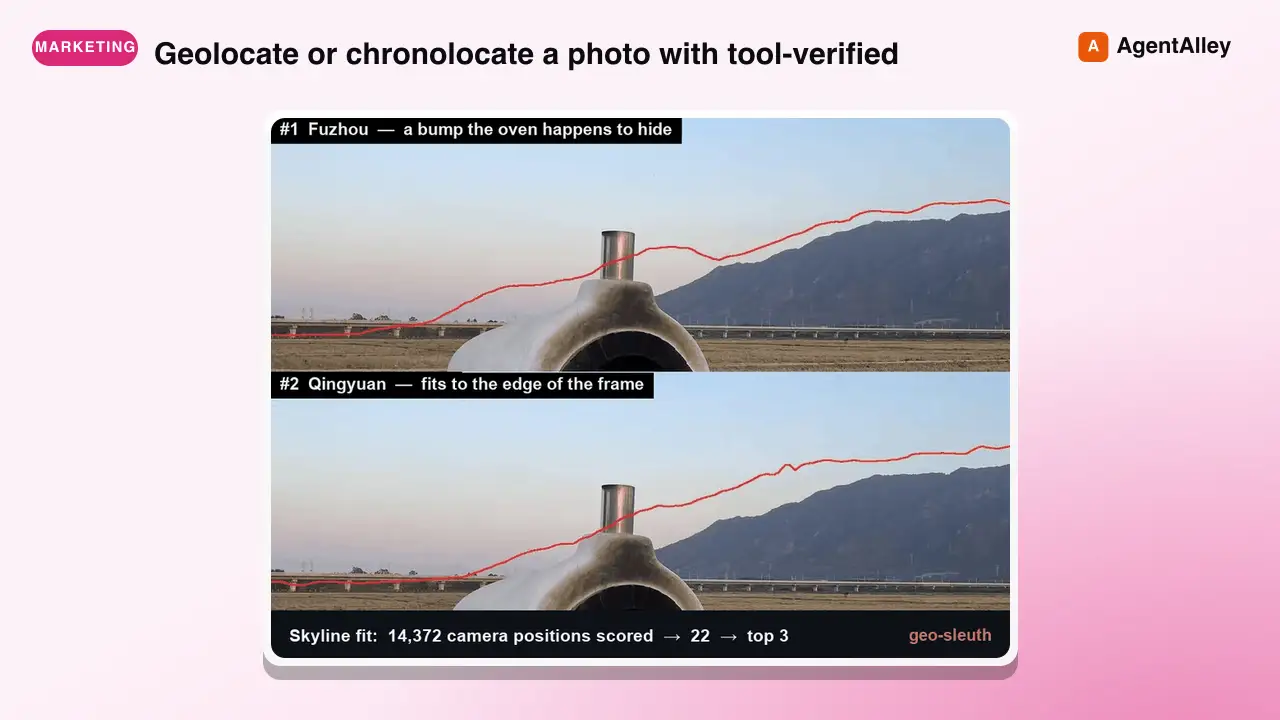
 Oldcircle/geo-sleuth · by OldcircleGeolocate or chronolocate a photo with tool-verified reasoning (where was this taken / when was it taken / photo geolocation / geo-guessing). Given one or more photos, intake.py does metadata, OCR and reverse image search (Baidu/Yandex) in one command; clues and candidates go on a candidate board (board.py) that ranks them and gives the next step; clues.py looks up calling codes, driving side, plates and area codes from region packs; for satellite and street view the machine ranks first and you look only at the top few (CLIP in sat_scan.py, DINOv2+SIFT in match.py); plus sun and shadow math, OSM Overpass and DEM skylines. Every conclusion is checked against real data; output is coordinates + error radius, evidence images and tiered confidence. Use when the user shares a photo and asks where was this taken / geolocate this / when was this taken / 这是哪 / 在哪拍的 / 帮我定位这张照片 / 网络迷踪 / 图寻 / 几点拍的.★ 3.4k GitHub stars
 SkillAI Engine Visibility Tracker
 Ryze-AI-Adgent/open-seo-mcp-skills · by Ryze-AI-AdgentMeasure real AI-engine visibility — traffic from ChatGPT, Perplexity, Claude, Gemini and which pages they cite — from actual GA4 referral data, not prompt sampling. Use when asked "AI visibility", "GEO/AEO check", "do LLMs cite us", "traffic from ChatGPT", or "how do we show up in AI search".★ 3.1k GitHub stars
 SkillAI Citation Readiness StrategyAgriciDaniel/claude-blog · by AgriciDanielUse GEO and AEO as legacy labels for AI citation readiness. For Google, the★ 2.2k GitHub stars
 SkillMulti-Channel SEO Operator
 leopard627/fire-your-seo-agency · by leopard627SEO·AEO·GEO·LLMO·NEO(네이버) 다섯 레인을 진단하고 직접 구현하며, 인용되는 콘텐츠를 계속 생산하는 서브 블로그·콘텐츠 운영 파이프라인까지 세팅하는 스킬. 사이트를 검색엔진·답변엔진·생성 AI·네이버 AI 브리핑이 인용하는 1차 소스로 만든다. "SEO 해줘", "AI에 인용되게 해줘", "네이버 노출 늘려줘", "llms.txt 만들어줘", "블로그 만들어줘/글 써줘", "콘텐츠 백로그·캘린더 잡아줘", "낡은 글 갱신해줘" 류 요청에 사용. Use for "audit my site's SEO", "get my site cited by ChatGPT/Perplexity/AI Overviews", "improve search visibility", "create llms.txt", "answer engine / generative engine optimization", "set up a blog that gets cited", "content backlog / calendar / refresh", and any AI-search-visibility request.★ 716 GitHub stars
 SkillSEO and GEO Auditor
 dageno-agents/seo-geo-audit · by dageno-agentsRun a unified SEO and GEO audit for a website, page, or domain. Use when the user asks for a full SEO audit, GEO audit, AI visibility review, EEAT review, entity audit, authority audit, or wants one prioritized report that combines technical findings, content quality, trust signals, and AI citation readiness.★ 175 GitHub stars
More from oathdriven
 SkillConverting Headline Writer
 oathdriven/rymac-skills · by oathdrivenWrite and rewrite landing-page headlines, hero sections, and their CTAs using a pain + dream-outcome formula, awareness-stage diagnosis, and a curated SaaS swipe file. Use when the user asks to "write a headline", "rewrite the hero", "fix the landing page headline", "give me headline options", "punch up the hero", or works on above-the-fold copy for allodra.ai, sierra6ai.com, or any writing-room landing page. Make sure to use this skill whenever a headline, hero section, subheadline, or CTA button copy is being written or critiqued.★ 28 GitHub stars
 SkillPaid Traffic Landing Pageoathdriven/rymac-skills · by oathdrivenResearches a niche's pains and builds a single-screen, one-decision landing page for paid ad traffic (Meta/Google/YouTube) — headline-first, message-matched to the ad, with one CTA and a risk-reversal/trust element, nothing else. Use when the user asks to "make a landing page for ads", "build a page for this campaign", "squeeze page", "lead capture page", "opt-in page", or wants to convert paid traffic for a niche. Make sure to use this skill for any ad-destination page; for multi-section marketing websites use website-builder or build-premium-website instead.★ 28 GitHub stars
 SkillCall Scheduling Funneloathdriven/rymac-skills · by oathdrivenBuilds the conversion plumbing that turns site traffic into scheduled calls: chat scheduler, AI voice agent, emergency escalation that pings a live on-call human, non-emergency booking into one shared calendar engine, and after-hours handling. Use when the user asks to "wire up the call funnel", "add the chat scheduler", "set up the voice agent", "convert traffic into scheduled calls", "handle after-hours calls", or builds any page whose goal is booked calls. Make sure to use this skill whenever call-booking, voice-agent, or emergency-routing plumbing is being designed or built.★ 28 GitHub stars
 SkillDirect Response Letteroathdriven/rymac-skills · by oathdrivenWrites direct-response P.A.S. (Problem-Agitate-Solution) sales letters in the RyMac voice, in the Dan Kennedy direct-letter tradition, modeled on the proven Sierra-6 letter. A personal letter to one reader with self-identification pain bullets, "you're not alone" normalization, cinematic agitation, an I-was-you origin story, a named-mechanism reveal, imagine future-pacing, and a P.S. close, formatted for skimmers (bold/underline paths). Use when the user asks to "write a sales letter", "write the letter", "P.A.S. letter", "direct sales letter", "Dan Kennedy letter", "pain-agitate-solution copy", says "set up my sales letter voice profile", or needs the letter section of a sales page. Make sure to use this skill whenever long-form persuasive letter copy is being written, rewritten, or critiqued.★ 28 GitHub stars
 SkillExit Intent Popupoathdriven/rymac-skills · by oathdrivenBuilds RyMac's exit-intent popup pattern on any landing or sales page: desktop mouse-leave plus the mobile fast-scroll-up trigger, offering a supportive asset that is deliberately NEVER promised on the page itself. Use when the user asks to "add an exit pop", "build an exit popup", "exit intent", "catch people leaving the page", or when finishing any sales/landing page build. Make sure to use this skill whenever an exit-intent popup or leave-catcher is being designed, built, or critiqued.★ 28 GitHub stars
 SkillNiche Offer Validatoroathdriven/rymac-skills · by oathdrivenRuns RyMac's offer-validation research method. Fans out parallel subagents to map a niche's pain points in their own words, the psychology of why the pain persists, a competitor matrix, demand proof with a lead-pool count, the niche's unit economics (revenue bands, net margin range, where the margin comes from, the P&L split, average ticket), and a response-behavior audit scoring the niche against your mechanism, then delivers a build/pivot/skip verdict with the underserved wedge, the USP, an affordability call on what the niche can actually pay, a delivery-economics check that YOUR own margin clears a 65% floor (with the lowest price you could charge and the owned-vs-rented cost of your stack), the profit left on the table, and ROI hooks written in their own numbers. Use when the user asks to "research a niche", "validate an offer", "find the pain points", "run niche research", "should I build this", "who else sells this", "what are the margins in X", "can they afford my offer", "what should I price this at", or has an idea or observation about a market. Make sure to use this skill whenever the user is deciding what to build, sell, price, or make content about next.★ 28 GitHub stars