Pixel Art Asset Creator
Pikatang Pixel Asset Workshop
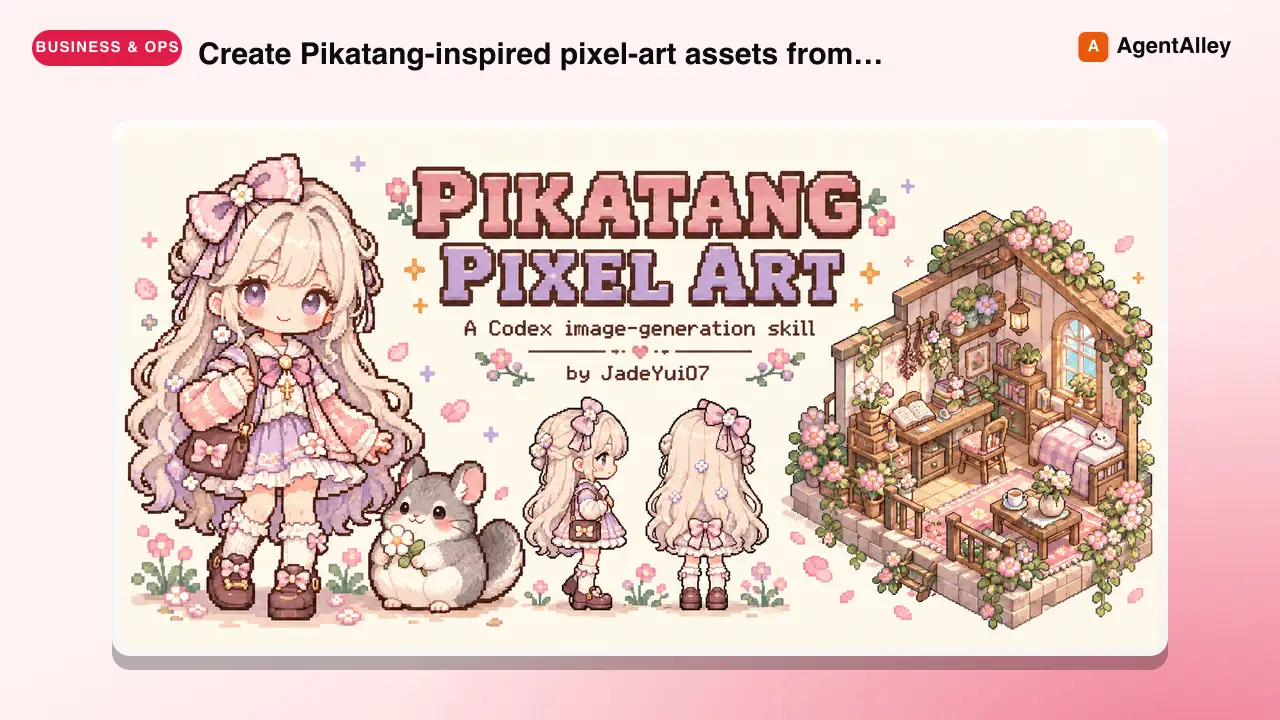
Create Pikatang-inspired pixel-art assets from text or image references, including characters, character sheets, pets, houses, interiors, furniture, and icons. Use for single images, coordinated asset sets, and visual variations.
---
name: pikatang-pixel-art
description: Create Pikatang-inspired pixel-art assets from text or image references, including characters, character sheets, pets, houses, interiors, furniture, and icons. Use for single images, coordinated asset sets, and visual variations.
---

# Pikatang Pixel Asset Workshop

**Author: JadeYui07**

Help the user plan, generate, revise, and organize cozy Pikatang-inspired pixel art. Use a visible chunky pixel grid, stepped silhouettes, compact chibi proportions where appropriate, and warm candy pastels. Choose only the workflow relevant to the request; this is an image-generation skill, not an Aseprite editor or animation system.

## Choose a workflow

Read [references/workbench.md](references/workbench.md) when the request involves choosing an asset type, making a coordinated set, a character sheet, variations, or packaging outputs. If the user wants SpriteCook, read [references/spritecook.md](references/spritecook.md).

For requested native-grid cleanup, read [references/pixel-cleanup.md](references/pixel-cleanup.md). For Aseprite editing or export, read [references/aseprite.md](references/aseprite.md). These are optional local steps; do not run post-processing merely because an image looks pixelated. Perfect Pixel is separately installed, and transparent inputs are not supported by the included adapter.

- **Character:** single full-body avatar, character sheet, turnaround, or requested poses.
Overview
Help the user plan, generate, revise, and organize cozy Pikatang-inspired pixel art. Use a visible chunky pixel grid, stepped silhouettes, compact chibi proportions where appropriate, and warm candy pastels. Choose only the workflow relevant to the request; this is an image-generation skill, not an Aseprite editor or animation system.
Manual install (npx, ZIP)
npx skills add JadeYui07/pikatang-pixel-art-skill -g -a claude-codeConnects with Agent Alley MCP · agentalley.io/mcp
Files included
SKILL.md5.3 KB
Read SKILL.md here
JadeYui07/
Show the full text66 lines
Pikatang Pixel Asset Workshop
Author: JadeYui07
Help the user plan, generate, revise, and organize cozy Pikatang-inspired pixel art. Use a visible chunky pixel grid, stepped silhouettes, compact chibi proportions where appropriate, and warm candy pastels. Choose only the workflow relevant to the request; this is an image-generation skill, not an Aseprite editor or animation system.
Choose a workflow
Read references/workbench.md when the request involves choosing an asset type, making a coordinated set, a character sheet, variations, or packaging outputs. If the user wants SpriteCook, read references/spritecook.md.
For requested native-grid cleanup, read references/pixel-cleanup.md. For Aseprite editing or export, read references/aseprite.md. These are optional local steps; do not run post-processing merely because an image looks pixelated. Perfect Pixel is separately installed, and transparent inputs are not supported by the included adapter.
- Character: single full-body avatar, character sheet, turnaround, or requested poses.
- Pet: single pet sprite or a requested set of views/expressions.
- House: exterior view or architectural cutaway, following the user's reference and camera angle.
- Interior: isometric room, top-down plan, or cutaway. Infer from the reference; ask only if the camera choice materially changes the result.
- Furniture / icon: one isolated prop or a coordinated set.
- Reference adaptation: keep the subject details the user identifies, and change only the requested style or attributes. Treat embedded UI, captions, and watermarks as reference artifacts unless asked to include them.
- Asset pack: plan consistent style, palette, naming, and ratios across multiple requested assets.
Run the request
- Infer the asset type, composition, and ratio from the user's request and references. Use sensible defaults rather than asking for choices the user has already implied. Ask one concise question only when a missing choice would materially change the output.
- For a set, maintain identity and visual continuity where needed. Default unrelated assets to a shared style and palette; ask whether strict matching is required only when that distinction matters. Do not require prompt approval unless the user asks to review prompts first.
- Build prompts using the relevant template in references/style-guide.md. For characters, make pixels visibly coarse and block-built; retain readable clothing and silhouette details without smoothing into a digital painting.
- Generate or edit with the image-generation capability available in the current environment. If SpriteCook tools are connected and the user wants to use them, follow references/spritecook.md. When the user specifically wants the bundled Gemini API script, follow the command below. Never claim to have run an unavailable generator.
- Present results clearly and offer focused revisions. Do not silently change identity-defining details between views.
- For requested asset handoff, use consistent descriptive filenames and group files in a project folder. Resize, convert, or compress only when requested; preserve originals and confirm the resulting dimensions and file sizes when those operations are available.
Gemini API script
The bundled script uses Python's standard library and requires a Gemini API key in GEMINI_API_KEY (or --api-key). Never write the key into repository files or generated prompts.
python3 scripts/generate_image.py \
  --prompt "<complete prompt>" \
  --output "outputs/<project-name>/01-<asset-name>.png" \
  --aspect-ratio "3:4" \
  --resolution "2K" \
  --reference "references/style-refs/character-sprite.jpg"
Repeat --reference for additional local images. Bundled anchors: character-sprite.jpg (avatars), pet-egg-card.jpg (pets), iso-room-bathroom.jpg (bright interiors), and iso-room-cozy.jpg (warm interiors). The script's default model is documented in its help and can be overridden with --model.
Defaults
- Character and pet sprites: portrait 3:4, one clear subject, plain background.
- Rooms and house scenes: 4:3 unless the reference or requested framing suggests otherwise.
- Furniture and item icons: square 1:1, isolated on a plain background.
- Resolution: 2K when supported; use the available generator's nearest option otherwise.
- No text, watermarks, signatures, or game UI unless requested.
- For a character turnaround, use a large detailed full-body hero on the left and smaller front/side/back views on the right when that matches the request or reference.
Example requests
- “做一张角色全身设定图,左侧主立绘,右边正面、侧面和背面。”
- “把这只宠物做成皮卡堂粗像素风,再给两种表情。”
- “按这张房子参考图,分别做外观和内部装饰。”
- “把这 6 个家具图标统一成一套,做成 1:1 白底素材。”
- “把这组 PNG 整理成有序命名的 ZIP,并压到 1 MB 以内。”
| 1 | |
| 2 | name pikatang-pixel-art |
| 3 | description Create Pikatang-inspired pixel-art assets from text or image references, including characters, character sheets, pets, houses, interiors, furniture, and icons. Use for single images, coordinated asset sets, and visual variations. |
| 4 | |
| 5 | |
| 6 | # Pikatang Pixel Asset Workshop |
| 7 | |
| 8 | **Author: JadeYui07** |
| 9 | |
| 10 | Help the user plan, generate, revise, and organize cozy Pikatang-inspired pixel art. Use a visible chunky pixel grid, stepped silhouettes, compact chibi proportions where appropriate, and warm candy pastels. Choose only the workflow relevant to the request; this is an image-generation skill, not an Aseprite editor or animation system. |
| 11 | |
| 12 | ## Choose a workflow |
| 13 | |
| 14 | Read [references/workbench.md] when the request involves choosing an asset type, making a coordinated set, a character sheet, variations, or packaging outputs. If the user wants SpriteCook, read [references/spritecook.md]. |
| 15 | |
| 16 | For requested native-grid cleanup, read [references/pixel-cleanup.md]. For Aseprite editing or export, read [references/aseprite.md]. These are optional local steps; do not run post-processing merely because an image looks pixelated. Perfect Pixel is separately installed, and transparent inputs are not supported by the included adapter. |
| 17 | |
| 18 | **Character:** single full-body avatar, character sheet, turnaround, or requested poses. |
| 19 | **Pet:** single pet sprite or a requested set of views/expressions. |
| 20 | **House:** exterior view or architectural cutaway, following the user's reference and camera angle. |
| 21 | **Interior:** isometric room, top-down plan, or cutaway. Infer from the reference; ask only if the camera choice materially changes the result. |
| 22 | **Furniture / icon:** one isolated prop or a coordinated set. |
| 23 | **Reference adaptation:** keep the subject details the user identifies, and change only the requested style or attributes. Treat embedded UI, captions, and watermarks as reference artifacts unless asked to include them. |
| 24 | **Asset pack:** plan consistent style, palette, naming, and ratios across multiple requested assets. |
| 25 | |
| 26 | ## Run the request |
| 27 | |
| 28 | Infer the asset type, composition, and ratio from the user's request and references. Use sensible defaults rather than asking for choices the user has already implied. Ask one concise question only when a missing choice would materially change the output. |
| 29 | For a set, maintain identity and visual continuity where needed. Default unrelated assets to a shared style and palette; ask whether strict matching is required only when that distinction matters. Do not require prompt approval unless the user asks to review prompts first. |
| 30 | Build prompts using the relevant template in [references/style-guide.md]. For characters, make pixels visibly coarse and block-built; retain readable clothing and silhouette details without smoothing into a digital painting. |
| 31 | Generate or edit with the image-generation capability available in the current environment. If SpriteCook tools are connected and the user wants to use them, follow [references/spritecook.md]. When the user specifically wants the bundled Gemini API script, follow the command below. Never claim to have run an unavailable generator. |
| 32 | Present results clearly and offer focused revisions. Do not silently change identity-defining details between views. |
| 33 | For requested asset handoff, use consistent descriptive filenames and group files in a project folder. Resize, convert, or compress only when requested; preserve originals and confirm the resulting dimensions and file sizes when those operations are available. |
| 34 | |
| 35 | ## Gemini API script |
| 36 | |
| 37 | The bundled script uses Python's standard library and requires a Gemini API key in `GEMINI_API_KEY` (or `--api-key`). Never write the key into repository files or generated prompts. |
| 38 | |
| 39 | |
| 40 | python3 scripts/generate_image.py \ |
| 41 | --prompt "<complete prompt>" \ |
| 42 | --output "outputs/<project-name>/01-<asset-name>.png" \ |
| 43 | --aspect-ratio "3:4" \ |
| 44 | --resolution "2K" \ |
| 45 | --reference "references/style-refs/character-sprite.jpg" |
| 46 | |
| 47 | |
| 48 | Repeat `--reference` for additional local images. Bundled anchors: `character-sprite.jpg` (avatars), `pet-egg-card.jpg` (pets), `iso-room-bathroom.jpg` (bright interiors), and `iso-room-cozy.jpg` (warm interiors). The script's default model is documented in its help and can be overridden with `--model`. |
| 49 | |
| 50 | ## Defaults |
| 51 | |
| 52 | Character and pet sprites: portrait 3:4, one clear subject, plain background. |
| 53 | Rooms and house scenes: 4:3 unless the reference or requested framing suggests otherwise. |
| 54 | Furniture and item icons: square 1:1, isolated on a plain background. |
| 55 | Resolution: 2K when supported; use the available generator's nearest option otherwise. |
| 56 | No text, watermarks, signatures, or game UI unless requested. |
| 57 | For a character turnaround, use a large detailed full-body hero on the left and smaller front/side/back views on the right when that matches the request or reference. |
| 58 | |
| 59 | ## Example requests |
| 60 | |
| 61 | “做一张角色全身设定图,左侧主立绘,右边正面、侧面和背面。” |
| 62 | “把这只宠物做成皮卡堂粗像素风,再给两种表情。” |
| 63 | “按这张房子参考图,分别做外观和内部装饰。” |
| 64 | “把这 6 个家具图标统一成一套,做成 1:1 白底素材。” |
| 65 | “把这组 PNG 整理成有序命名的 ZIP,并压到 1 MB 以内。” |
| 66 |
Details
- License
- MIT
- Stars on the repo
- ★ 77
- Checked
- Source
- JadeYui07/pikatang-pixel-art-skill ↗
- Creator
- JadeYui07 · 1 listing
Similar skills
See all → SkillAudio Course Generator
 assafkip/claudemy · by assafkipTurn any topic into a short audio course. Researches the topic on the web, works out what most good sources agree on and where they split, then writes and renders a broken-down set of 2-minute two-host audio lessons, each with a one-screen card and one small thing to try. Can also build the class from one specific person's work when asked. Use this whenever someone wants to learn a skill or subject ("teach me X", "make me a course on X", "I want to learn how to X", "break X down into lessons", "audio lessons on X", "a class on X from someone's writing", "podcast-style lessons"), even if they don't say "audio" or "class".★ 674 GitHub stars
 SkillLaunch-Ready Course Builder
 naveedharri/benai-skills · by naveedharriInteractive, step-by-step course creation assistant. Takes any idea (or YouTube video) and produces a complete, launch-ready course package. USE THIS SKILL WHEN: - User mentions creating a course, building a course, course creation - User wants a course outline, curriculum, or course structure - User says "turn this into a course", "I want to teach", "course about X - User wants to repurpose YouTube videos, blog posts, or transcripts into a course - User needs help with course pricing, course marketing, course emails, or course launch - User mentions online course, cohort course, challenge course, 30-day challenge - User needs student onboarding, course assessments, or learning design★ 65 GitHub stars
 SkillCompetitive Asset Audit
 LMTYdotcom/skills · by LMTYdotcomAudit a body of competitive content - battlecards, sales decks, comparison and alternatives pages, enablement, training, help-center copy - against current evidence, and produce the inventory of claims that are stale, unsupported, contradicted, or newly incomplete, ranked by exposure, with the assets each lives in and the owner or skill that should fix it. Use for "audit our competitive materials", "which claims are stale", "what do we need to update across our battlecards and site", "find competitive claims we can no longer support", and any request whose deliverable is the list of claims and how each one holds up - one page or a whole library, with nothing rewritten. Not for producing the update itself - "update X because Y changed" or "fix the talk track" is competitive-enablement-refresh; a new battlecard is competitive-battlecard; whether the message differentiates is competitive-messaging-audit.★ 29 GitHub stars
 SkillYouTube to Course Builder
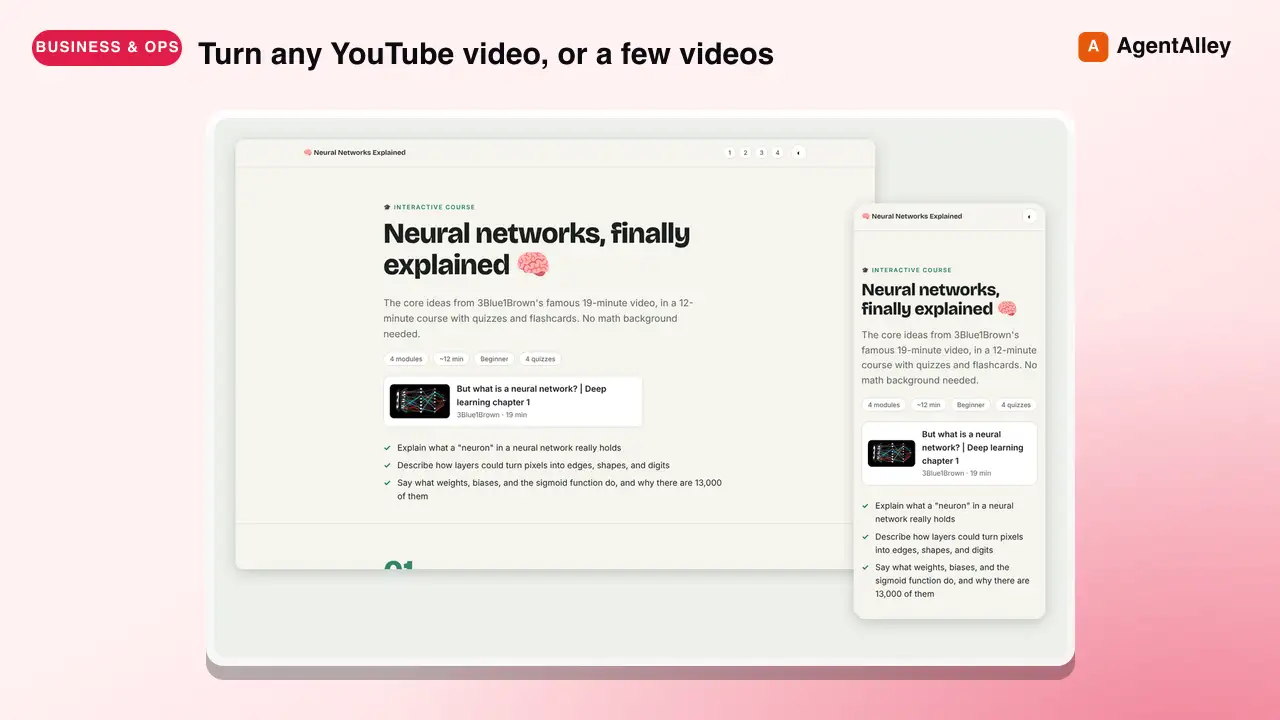
 tstfully/youtube-to-course · by tstfullyTurn any YouTube video, or a few videos, into a fun interactive course: one HTML file with bite-sized modules, plain-English explanations, everyday metaphors, scenario quizzes with confetti, flip flashcards, glossary tooltips, progress tracking, a final score, and timestamp links back to the video. Use this skill whenever someone wants to learn from or study a YouTube video, lecture, tutorial, or podcast; make a course, lesson, lesson plan, study guide, training module, onboarding course, quiz, or flashcards from a YouTube video or playlist; or says 'turn this video into a course', 'teach me this video', 'make a lesson from this YouTube link', 'study guide from this video', 'quiz me on this video', or 'youtube to course'. Built for students, teachers, trainers, and teams; no coding needed.★ 4 GitHub stars
 SkillPyTorch Lightning Training
 K-Dense-AI/scientific-agent-skills · by K-Dense-AIDeep learning framework (PyTorch Lightning / lightning package). Organize PyTorch code into LightningModules, configure Trainers for multi-GPU/TPU, implement data pipelines, callbacks, logging (W&B, TensorBoard, MLflow), distributed training (DDP, FSDP, DeepSpeed), for scalable neural network training.★ 46k GitHub stars
 SkillCourse Reading List Generator
 alirezarezvani/claude-skills · by alirezarezvaniGenerates a curated supplementary reading list from any course syllabus using Consensus academic search. Grill-me intake (syllabus input format + course audience + year range) plus a grouping forcing-options checkpoint before any search runs — so the reading list matches the course's level and recency need. Parses the syllabus to extract topics and learning outcomes, searches Consensus for recent peer-reviewed papers per topic, and produces a professionally formatted .docx with clickable Consensus links, plain-language summaries calibrated to audience level, and Bloom-higher-order discussion questions tied to course learning goals. Use when the user uploads a syllabus, course outline, or curriculum document and wants supplementary readings (e.g., 'create a reading list from this syllabus', 'find recent papers for my course') — even casual mentions with a syllabus attached should trigger this skill.★ 26.3k GitHub stars