Human Communication Handler
Messaging the human
Use when project policy calls for a human decision or update, a human delivery is pending or failed, or a reply must resume the right work.
---
name: messaging-the-human
description: "Use when project policy calls for a human decision or update, a human delivery is pending or failed, or a reply must resume the right work."
metadata:
  cli_surfaces_referenced:
    - gateway human list
    - gateway human show
    - queue create
    - queue transitions
    - queue block
    - send
  openrig:
    stage: provisional
    audience: all agents
    sibling_skills:
      - queue-handoff
      - openrig-user
---
Overview
Project World supplies when and why to contact a human. This skill supplies transport-neutral mechanics; installing it does not create an approval gate or choose a connector. If policy leaves a material decision ambiguous, identify the missing authority. Do not convert a solvable technical failure into a human gate.
Manual install (npx, ZIP)
npx skills add mvschwarz/openrig --skill messaging-the-human -g -a claude-codenpx degit mvschwarz/openrig/packages/daemon/assets/plugins/openrig-core/skills/messaging-the-human#main ~/.claude/skills/messaging-the-humanConnects with Agent Alley MCP · agentalley.io/mcp
Files included
SKILL.md7.2 KB
Read SKILL.md here
Show the full text145 lines
Messaging the Human
Project World supplies when and why to contact a human. This skill supplies transport-neutral mechanics; installing it does not create an approval gate or choose a connector. If policy leaves a material decision ambiguous, identify the missing authority. Do not convert a solvable technical failure into a human gate.
Discover, check, send, inspect
Discover the registered participants and inspect the chosen human:
rig gateway human list --json
rig gateway human show <entityId> --json
Use the returned address (<entityId>@external), not a username, remembered
seat, connector handle, or guessed kernel address. Where several humans exist,
use the decision ownership in Project World. An absent or ambiguous registration
needs a named registration correction, not a fallback address.
Check readiness: configured, enabled, active, ready, reason, and next action.
indeterminate is not ready. Follow the reported next inspection; do not enable
or reconfigure a connector merely to make the check pass.
Author for the person reading on a phone: a short subject in --summary, then
one complete brief in --body-file. State why it matters, your recommendation
and material tradeoff, the bounded action if approved, and the choice requested.
For an update, state the user-visible outcome and “No action needed.” Aim for
roughly 100–150 words; this is guidance, not a semantic validator. Keep technical
continuation, exact candidate/revision and evidence on the owning agent row and
in the durable artifact behind --evidence-ref. A local path is not a phone link
and Markdown evidence files are not automatically attached.
For example, a synthetic brief could say:
The repaired status view is ready. I recommend updating this instance; live status will briefly pause. Sessions will be preserved. Approve this instance update, or hold? Supporting test detail follows in this thread.
This example grants no authority. Choose --human-intent decision for a request
or --human-intent update for a quiet FYI. Omission retains legacy decision
behavior; words such as “FYI” and tags do not change intent.
The sole outbound human-message primitive is:
rig queue create --destination <entityId>@external \
  --human-intent decision --summary "<short subject>" --body-file <brief-file> \
  --evidence-ref <durable-evidence> --verify --json
An optional --human-detail-file <path> supplies one coherent supplemental
reply in the same thread. Announce its purpose in the brief; the product also
marks that a detail reply follows. The primary must already contain the complete
scope, options and action. Do not split an agent dump blindly or move the essential
choice into overflow. Rendering checks every part and its accessibility fallback
before posting; an oversized request is refused with a field-specific correction,
never silently clipped. Shorten the brief or related detail as directed. Inspect
the failed row, then deliberately cancel/replace the authored request if its
content needs correction; a timeout alone is never a reason to replace it.
A follow-up update about earlier work ("the change you approved is merged")
can post into that item's thread with --reply-to <earlier-qitem-id>. It is
accepted only with --human-intent update. Name the item whose thread the
human saw, such as the parked row, and create the update on the same host as
that item. Send the update from the seat that owns that thread: the seat that
parked the row, or the author of the earlier item. A human reply in a thread
reaches its owning seat, so an update from any other seat posts as a new
message. It also posts as a new message, rather than being refused, if the
earlier thread is missing or closed, or while the earlier item still waits on
the human (a pending human decision, or a row parked on the human), since a
reply in that thread would answer the decision. In every such case the
--verify result says threaded: false with the reason.
A decision with a few clear choices can carry --human-questions-file <path>:
a JSON array of 1–4 questions, each
{"id", "question", "options": [{"id", "label", "recommended"?}]} with 2–4
options (labels up to 75 characters, at most one recommended). Slack shows each
question as a row of buttons. Each click records that answer on the item, and
the decision resolves once every question has one. You then receive one reply
row listing the answers, and the item's humanAnswers holds the option ids. The
human may instead type a reply in the thread; that resolves the decision as
usual, so read the reply rather than assuming an option was picked. Keep the
brief complete: the questions add buttons, they do not replace the explanation.
If an existing agent-owned row must wait for a decision, block it on the new live qitem ID
(rig queue block <work-id> --on <human-qitem-id> ...), not on the human address.
Completion of the human qitem resumes its dependants. Blocking on the human as
well would issue another notification for the same decision.
The row persists before bounded delivery verification. Read its qitem ID and
verification result; posted proves connector posting, not human readership.
transport-failed, never-posted, or a pending/indeterminate result leaves the
row intact. Inspect that same row and its next action; never create a second row
or blindly resend because verification timed out.
rig queue transitions <qitem-id>
For update, confirmed complete delivery may close the delivery obligation.
It creates no approval obligation and cannot be used as a decision blocker.
Delivered updates remain queryable for Feed; a failure or ambiguous send stays
separate. A root message alone does not prove supplemental delivery. Retries
reconcile stable part identities and send only missing parts. An FYI reply is
not a human decision.
For a decision, a correlated reply binds to that exact human and qitem and records the resolution that resumes the owner. Check the recorded result before claiming the decision arrived; a delivery receipt alone is not acceptance.
Existing blockers and other channels
An existing agent-owned row may be blocked on <entityId>@host. That is an
internal custody label resolved through the human registry to the same external
participant; it is not a second delivery address. Keep the owner and continuation
on that row. Inspect its existing delivery receipt before considering another
request, so a legacy blocker does not produce a duplicate message. Never derive
@host from the current rig name.
rig send reaches an agent's terminal only. It is not a human transport or a
durable human obligation. Agent-to-agent work uses the queue handoff path.
Connector-specific configuration and handles belong to registry/readiness tools,
not to project-independent message instructions.
| 1 | |
| 2 | name messaging-the-human |
| 3 | description "Use when project policy calls for a human decision or update, a human delivery is pending or failed, or a reply must resume the right work." |
| 4 | metadata |
| 5 | cli_surfaces_referenced |
| 6 | - gateway human list |
| 7 | - gateway human show |
| 8 | - queue create |
| 9 | - queue transitions |
| 10 | - queue block |
| 11 | - send |
| 12 | openrig |
| 13 | stage provisional |
| 14 | audience all agents |
| 15 | sibling_skills |
| 16 | - queue-handoff |
| 17 | - openrig-user |
| 18 | |
| 19 | |
| 20 | # Messaging the Human |
| 21 | |
| 22 | Project World supplies **when and why** to contact a human. This skill supplies |
| 23 | transport-neutral mechanics; installing it does not create an approval gate or |
| 24 | choose a connector. If policy leaves a material decision ambiguous, identify the |
| 25 | missing authority. Do not convert a solvable technical failure into a human gate. |
| 26 | |
| 27 | ## Discover, check, send, inspect |
| 28 | |
| 29 | Discover the registered participants and inspect the chosen human: |
| 30 | |
| 31 | |
| 32 | rig gateway human list --json |
| 33 | rig gateway human show <entityId> --json |
| 34 | |
| 35 | |
| 36 | Use the returned `address` (`<entityId>@external`), not a username, remembered |
| 37 | seat, connector handle, or guessed kernel address. Where several humans exist, |
| 38 | use the decision ownership in Project World. An absent or ambiguous registration |
| 39 | needs a named registration correction, not a fallback address. |
| 40 | |
| 41 | Check readiness: configured, enabled, active, ready, reason, and next action. |
| 42 | `indeterminate` is not ready. Follow the reported next inspection; do not enable |
| 43 | or reconfigure a connector merely to make the check pass. |
| 44 | |
| 45 | Author for the person reading on a phone: a short subject in `--summary`, then |
| 46 | one complete brief in `--body-file`. State why it matters, your recommendation |
| 47 | and material tradeoff, the bounded action if approved, and the choice requested. |
| 48 | For an update, state the user-visible outcome and “No action needed.” Aim for |
| 49 | roughly 100–150 words; this is guidance, not a semantic validator. Keep technical |
| 50 | continuation, exact candidate/revision and evidence on the owning agent row and |
| 51 | in the durable artifact behind `--evidence-ref`. A local path is not a phone link |
| 52 | and Markdown evidence files are not automatically attached. |
| 53 | |
| 54 | For example, a synthetic brief could say: |
| 55 | |
| 56 | > The repaired status view is ready. I recommend updating this instance; live |
| 57 | > status will briefly pause. Sessions will be preserved. Approve this instance |
| 58 | > update, or hold? Supporting test detail follows in this thread. |
| 59 | |
| 60 | This example grants no authority. Choose `--human-intent decision` for a request |
| 61 | or `--human-intent update` for a quiet FYI. Omission retains legacy decision |
| 62 | behavior; words such as “FYI” and tags do not change intent. |
| 63 | |
| 64 | The sole outbound human-message primitive is: |
| 65 | |
| 66 | |
| 67 | rig queue create --destination <entityId>@external \ |
| 68 | --human-intent decision --summary "<short subject>" --body-file <brief-file> \ |
| 69 | --evidence-ref <durable-evidence> --verify --json |
| 70 | |
| 71 | |
| 72 | An optional `--human-detail-file <path>` supplies one coherent supplemental |
| 73 | reply in the same thread. Announce its purpose in the brief; the product also |
| 74 | marks that a detail reply follows. The primary must already contain the complete |
| 75 | scope, options and action. Do not split an agent dump blindly or move the essential |
| 76 | choice into overflow. Rendering checks every part and its accessibility fallback |
| 77 | before posting; an oversized request is refused with a field-specific correction, |
| 78 | never silently clipped. Shorten the brief or related detail as directed. Inspect |
| 79 | the failed row, then deliberately cancel/replace the authored request if its |
| 80 | content needs correction; a timeout alone is never a reason to replace it. |
| 81 | |
| 82 | A follow-up **update** about earlier work ("the change you approved is merged") |
| 83 | can post into that item's thread with `--reply-to <earlier-qitem-id>`. It is |
| 84 | accepted only with `--human-intent update`. Name the item whose thread the |
| 85 | human saw, such as the parked row, and create the update on the same host as |
| 86 | that item. Send the update from the seat that owns that thread: the seat that |
| 87 | parked the row, or the author of the earlier item. A human reply in a thread |
| 88 | reaches its owning seat, so an update from any other seat posts as a new |
| 89 | message. It also posts as a new message, rather than being refused, if the |
| 90 | earlier thread is missing or closed, or while the earlier item still waits on |
| 91 | the human (a pending human decision, or a row parked on the human), since a |
| 92 | reply in that thread would answer the decision. In every such case the |
| 93 | `--verify` result says `threaded: false` with the reason. |
| 94 | |
| 95 | A **decision** with a few clear choices can carry `--human-questions-file <path>`: |
| 96 | a JSON array of 1–4 questions, each |
| 97 | `{"id", "question", "options": [{"id", "label", "recommended"?}]}` with 2–4 |
| 98 | options (labels up to 75 characters, at most one recommended). Slack shows each |
| 99 | question as a row of buttons. Each click records that answer on the item, and |
| 100 | the decision resolves once every question has one. You then receive one reply |
| 101 | row listing the answers, and the item's `humanAnswers` holds the option ids. The |
| 102 | human may instead type a reply in the thread; that resolves the decision as |
| 103 | usual, so read the reply rather than assuming an option was picked. Keep the |
| 104 | brief complete: the questions add buttons, they do not replace the explanation. |
| 105 | |
| 106 | If an existing agent-owned row must wait for a **decision**, block it on the **new live qitem ID** |
| 107 | (`rig queue block <work-id> --on <human-qitem-id> ...`), not on the human address. |
| 108 | Completion of the human qitem resumes its dependants. Blocking on the human as |
| 109 | well would issue another notification for the same decision. |
| 110 | |
| 111 | The row persists before bounded delivery verification. Read its qitem ID and |
| 112 | verification result; `posted` proves connector posting, **not human readership**. |
| 113 | `transport-failed`, `never-posted`, or a pending/indeterminate result leaves the |
| 114 | row intact. Inspect that same row and its next action; never create a second row |
| 115 | or blindly resend because verification timed out. |
| 116 | |
| 117 | |
| 118 | rig queue transitions <qitem-id> |
| 119 | |
| 120 | |
| 121 | For `update`, confirmed complete delivery may close the delivery obligation. |
| 122 | It creates no approval obligation and cannot be used as a decision blocker. |
| 123 | Delivered updates remain queryable for Feed; a failure or ambiguous send stays |
| 124 | separate. A root message alone does not prove supplemental delivery. Retries |
| 125 | reconcile stable part identities and send only missing parts. An FYI reply is |
| 126 | not a human decision. |
| 127 | |
| 128 | For a decision, a correlated reply binds to that exact human and qitem and records the resolution |
| 129 | that resumes the owner. Check the recorded result before claiming the decision |
| 130 | arrived; a delivery receipt alone is not acceptance. |
| 131 | |
| 132 | ## Existing blockers and other channels |
| 133 | |
| 134 | An existing agent-owned row may be blocked on `<entityId>@host`. That is an |
| 135 | internal custody label resolved through the human registry to the same external |
| 136 | participant; it is not a second delivery address. Keep the owner and continuation |
| 137 | on that row. Inspect its existing delivery receipt before considering another |
| 138 | request, so a legacy blocker does not produce a duplicate message. Never derive |
| 139 | `@host` from the current rig name. |
| 140 | |
| 141 | `rig send` reaches an agent's terminal only. It is not a human transport or a |
| 142 | durable human obligation. Agent-to-agent work uses the queue handoff path. |
| 143 | Connector-specific configuration and handles belong to registry/readiness tools, |
| 144 | not to project-independent message instructions. |
| 145 |
Details
- License
- Apache-2.0
- Stars on the repo
- ★ 4,707
- Checked
- Source
- mvschwarz/openrig ↗
- Creator
- mvschwarz · 13 listings
Similar skills
See all → SkillCompetitor Ad Analyzer
 ScrapeCreators/social-media-research-skills · by ScrapeCreatorsUse when the user wants to analyze active ads from Meta/Facebook, Google, or LinkedIn ad libraries; tear down a competitor's messaging; extract hooks, offers, CTAs, video transcripts, landing page claims, and test ideas from public ads.★ 2.6k GitHub stars
 SkillProduct Listing Visual Creator
 feichanggege/ecommerce-visual-copywriting-skill · by feichanggegeTurn product materials into listing visuals for Taobao, JD, Douyin, Amazon, Shopify and TikTok Shop: main-image and detail-page storyboards, in-image copy, image prompts, plus an evidence and ad-compliance check.★ 985 GitHub stars
 SkillPricing Page Builder
 boraoztunc/skills · by Meng ToTell us about your plans and prices, and get back a ready-to-build pricing page: plan layout, what each tier includes, buttons, and answers to common buyer questions.★ 361 GitHub stars
 SkillArticle Opening Hooks
 samber/cc-skills · by samberWrites opening hooks and post titles for long-form articles in EN or FR — blog posts, Substack/Medium/dev.to, LinkedIn long-form, newsletters, essays. Trigger whenever the user asks for a hook, opening, lede, intro, first sentence/paragraph, opener, accroche, attaque, phrase d'accroche, or première phrase — including punching up a flat intro or draft opening — or for a post title, titre d'article, or headline. Do NOT trigger for social posts (LinkedIn feed, Twitter/X, TikTok, Bluesky), READMEs, taglines, email subjects, ad copy, landing-page headlines, press releases, SEO meta, or body rewrites. Do NOT use for end-of-article CTAs — use samber/cc-skills@copywriting-cta instead.★ 222 GitHub stars
 SkillEcommerce Landing Page Designer
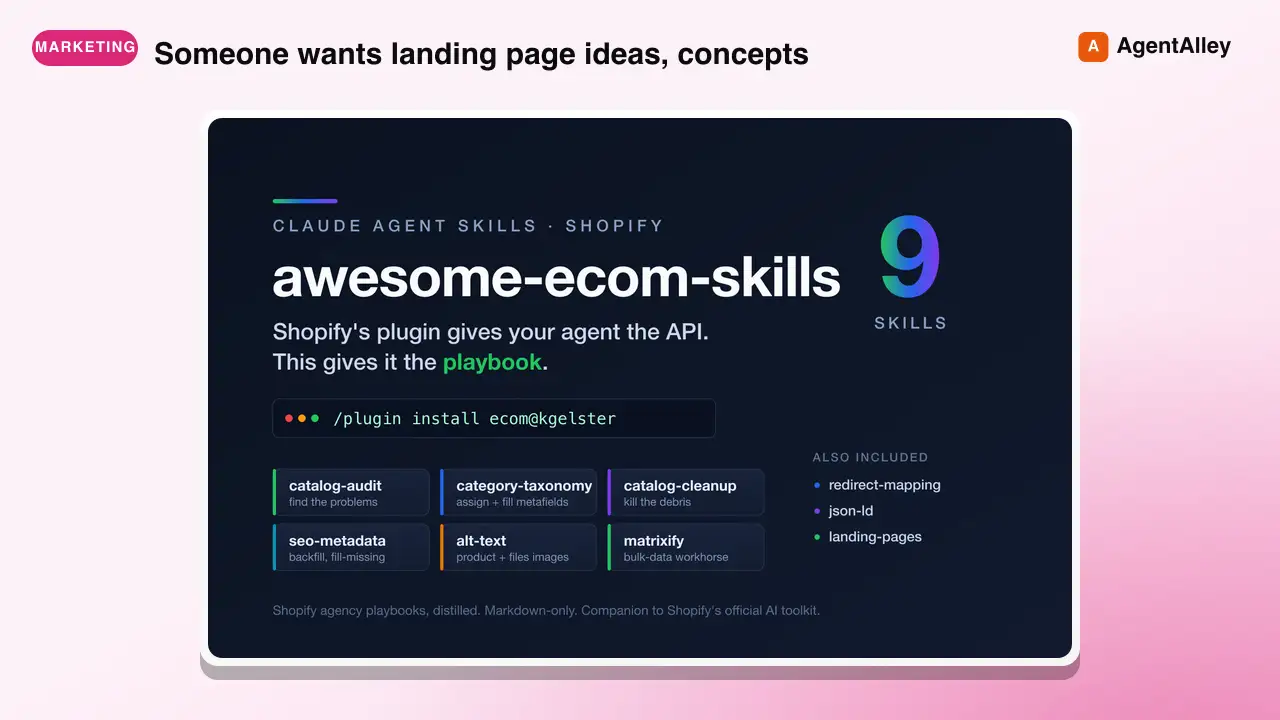
 kgelster/awesome-ecom-skills · by kgelsterUse when someone wants landing page ideas, concepts, or angles for a store: give me landing page concepts", "LP ideas", "landing page angles", a campaign or ad landing page, pages for a new audience/segment, a seasonal/event/promo page, or a geo/local page. Also use when a chosen concept gets picked and needs building out into an actual page (section-by-section blueprint), or when auditing an existing landing page against best practice. The core insight: one product becomes dozens of pages by varying the ANGLE, not the product. Not for full-site information architecture, product detail pages, collection pages, or blog/SEO content (a landing page has ONE goal, no site chrome). Use an SEO/content skill. Not for the ad or email creative itself, though message match with the page matters.★ 49 GitHub stars
 SkillDirect Response Copywriter
 Deupaxx/EveryDay-Writer · by DeupaxxWrite sales pages, email sequences, and direct-response copy that converts through clarity and specificity rather than manipulation. Use for launches, offers, and conversion-focused email. Enforces the EW anti-AI rules, proof standards, and the writer's voice profile.★ 32 GitHub stars
More from mvschwarz
 SkillSession Compaction Restore
 mvschwarz/openrig · by mvschwarzUse when a Claude Code session is about to compact, has just compacted, reached its context limit, resumed after /compact, or must rebuild its working picture of a long-running seat from its own restore map, its JSONL transcript and the files it touched.★ 4.7k GitHub stars
 SkillTask Delegation Advisormvschwarz/openrig · by mvschwarzUse when you have a task and must decide WHO does it — yourself, a spawned subagent, or another agent in the topology that already holds the context. The rule: how much would a blank slate have to read in to do this correctly? A lot → route to a context-holding agent; a little → subagent; unsure → a real agent or yourself. NOT the mechanics of fanning out (that's dispatching-parallel-agents / subagent-driven-development) — this is the who/whether decision, and the failure mode that makes teams abandon subagents.★ 4.7k GitHub stars
 SkillOpenRig Development Guidemvschwarz/openrig · by mvschwarzUse when changing OpenRig's own source in a clone of the openrig repository: finding which package or file owns a behaviour, choosing which tests to run, testing a change without disturbing the OpenRig daemon your own session runs on, judging whether a diff touches a high-risk area, or preparing a pull request. Not for operating rigs (openrig-skills) or designing rig topologies.★ 4.7k GitHub stars
 SkillSystem Architecture Primermvschwarz/openrig · by mvschwarzUse when the system around you does not make sense yet: you just booted into a seat and do not know how the pieces fit; someone said rig, pod, seat, fleet, topology, or slice and you are not certain what they mean here; you are unsure what kind of rig you are in or what it is for; you do not know how skills reach you or where context comes from; or you are about to act on a guess about how OpenRig works. Gives the runtime mental model fast, so you stop guessing.★ 4.7k GitHub stars
 SkillMission Lifecycle Frameworkmvschwarz/openrig · by mvschwarzUse when starting, building, handing off, restoring, or closing a mission or slice under the default lightweight SDLC.★ 4.7k GitHub stars
 SkillOpenRig Skills Indexmvschwarz/openrig · by mvschwarzUse when you're operating OpenRig and need the right skill or context for fleet recovery, seat handover, new-seat orientation, a watchdog wake, cross-host reach to an agent on another machine, rig packaging, an OpenRig upgrade, systematic debugging, queue triage, or implementation planning; also use when you don't know what applies or nothing is projected on cold boot.★ 4.7k GitHub stars