Target Architecture Designer
System Design Proposal Builder
Designs target system boundaries, contracts and tradeoffs from requirements; does not plan tasks or implement.
---
name: ln-23-system-design-proposal-builder
description: "Designs target system boundaries, contracts and tradeoffs from requirements; does not plan tasks or implement."
---

# System Design Proposal Builder

**Goal:** Create a proportionate, evidence-backed target system design that turns requirements into explicit boundaries, contracts, data flow, failure behavior, operations, and tradeoffs. Change only the approved design document; do not implement, audit, or approve the delivery.

**Execution contract:** The checklist defines completion. Track each item internally as `PENDING`, `PROVEN` with evidence, `CLEARED` with evidence its condition is absent, or `UNPROVEN` with a gap; reading, delegation, tool failure, a zero exit status, or a self-reported success is not proof; only the observed outcome is. Reconcile after each section. Before returning, resolve all `PENDING`, count only `PROVEN` and `CLEARED`, and apply verdict and approval rules to every gap.
Preserve intent, scope, and existing authorization. Continue authorized work; ask only for consequential unresolved choices or required external approval. When no one can answer during the run, state the exact question and apply the skill's verdict for the remaining gap instead of waiting or guessing. Scale depth to material risk without skipping checks. Preserve dependency and safety order; otherwise choose an appropriate verification method.
Accept equivalent user or repository evidence; no other skill, named artifact, or complete lifecycle is required. Preserve source requirement and decision IDs. Bind reused evidence to relevant source versions, dirty changes, configuration, and environment; invalidate only affected claims.
On continuation, reconcile task, authorization, current state, and unresolved evidence. For long work, return a compact continuation record or update an already authorized artifact; read-only skills do not persist it. Distinguish artifact readiness, verified behavior, and external-action authority.
Prepare authorized work before required approval. If blocked by an instruction, cite its exact source and unresolved boundary; do not invent approval gates from caution.


## Tool Routing
Overview
Goal: Create a proportionate, evidence-backed target system design that turns requirements into explicit boundaries, contracts, data flow, failure behavior, operations, and tradeoffs. Change only the approved design document; do not implement, audit, or approve the delivery.
What you get
- ResultThe exact skill-specific verdict token first, then the supported outcome.
- ScopeReviewed/changed scope, exclusions, baseline, and material assumptions.
- EvidenceSkill-specific fields below; distinguish facts, inferences, and unverified claims. Link artifacts; use tables when useful.
- VerificationChecks/results, unavailable evidence, and applicable cleanup/external state.
- CompletionChecklist: X/Y complete; Incomplete: None or each UNPROVEN item's reason, outcome impact, and exact next action; residual risks and required decisions.
Manual install (npx, ZIP)
npx skills add levnikolaevich/claude-code-skills --skill ln-23-system-design-proposal-builder -g -a claude-codenpx degit levnikolaevich/claude-code-skills/plugins/architecture-suite/skills/ln-23-system-design-proposal-builder#master ~/.claude/skills/ln-23-system-design-proposal-builderConnects with Agent Alley MCP · agentalley.io/mcp
Files included
SKILL.md10.1 KB
Read SKILL.md here
Show the full text103 lines
System Design Proposal Builder
Goal: Create a proportionate, evidence-backed target system design that turns requirements into explicit boundaries, contracts, data flow, failure behavior, operations, and tradeoffs. Change only the approved design document; do not implement, audit, or approve the delivery.
Execution contract: The checklist defines completion. Track each item internally as PENDING, PROVEN with evidence, CLEARED with evidence its condition is absent, or UNPROVEN with a gap; reading, delegation, tool failure, a zero exit status, or a self-reported success is not proof; only the observed outcome is. Reconcile after each section. Before returning, resolve all PENDING, count only PROVEN and CLEARED, and apply verdict and approval rules to every gap.
Preserve intent, scope, and existing authorization. Continue authorized work; ask only for consequential unresolved choices or required external approval. When no one can answer during the run, state the exact question and apply the skill's verdict for the remaining gap instead of waiting or guessing. Scale depth to material risk without skipping checks. Preserve dependency and safety order; otherwise choose an appropriate verification method.
Accept equivalent user or repository evidence; no other skill, named artifact, or complete lifecycle is required. Preserve source requirement and decision IDs. Bind reused evidence to relevant source versions, dirty changes, configuration, and environment; invalidate only affected claims.
On continuation, reconcile task, authorization, current state, and unresolved evidence. For long work, return a compact continuation record or update an already authorized artifact; read-only skills do not persist it. Distinguish artifact readiness, verified behavior, and external-action authority.
Prepare authorized work before required approval. If blocked by an instruction, cite its exact source and unresolved boundary; do not invent approval gates from caution.
Tool Routing
| Need | Preferred capability | Fallback |
|---|---|---|
| Requirements and constraints | Approved requirements, baseline, decisions, and direct stakeholder input | Mark material gaps and ask the smallest decision question |
| Current implementation and conventions | Repository search, manifests, entrypoints, and architecture artifacts | Treat as greenfield only when the user or repository establishes that fact; otherwise mark current state UNKNOWN and return INCOMPLETE or BLOCKED when the gap can change boundaries, compatibility, or migration |
| External capabilities and limits | Current official documentation and specifications | Mark claims UNVERIFIED; avoid vendor-dependent commitment |
| Estimates | Reproducible arithmetic from sourced workload assumptions | Use ranges and sensitivity; never present estimates as measurements |
| Document mutation | Minimal patch to the approved target-design artifact | Return BLOCKED if scope or path is unsafe |
Use patterns as candidate solutions, not goals. Introduce infrastructure only when a requirement, failure mode, ownership boundary, or measured horizon pays for its lifecycle cost.
Artifact Rules
- Reuse a clear target-design document; otherwise use
docs/architecture/target-design.md. - Read available baseline, current-state, decision, interface, diagram, and migration artifacts by path; none is mandatory.
- Label facts, assumptions, estimates, proposed decisions, and unresolved choices separately.
- Compare credible alternatives for consequential decisions, including the simplest feasible option; when constraints permit only one, document why rather than inventing another.
- Prefer reversible choices and the simplest topology fitting the system. For a new application, consider a modular monolith before independent services; do not force that shape onto libraries, plugins, or an established topology.
- Do not silently change an accepted decision; record the conflict and required governance action.
Checklist
1. Frame the Design
- Resolve business outcome, actors, journeys, scope, non-goals, horizon, readers, language, and the approved canonical destination before editing.
- Read repository instructions and inspect relevant architecture artifacts and current implementation.
- Extract functional requirements and measurable quality drivers, preserving their source and status.
- Identify architecture-critical unknowns and ask only questions whose answers change the target shape.
- Return
BLOCKEDwhen a required business boundary or safety constraint cannot be responsibly assumed.
2. Estimate Before Choosing Components
- Estimate average and peak request or event rates, concurrency, payload and bandwidth, storage growth, retention, and recovery volume where relevant.
- Show formulas, ranges, growth horizon, and assumptions; identify the variables that can reverse a choice.
- Identify likely first bottlenecks and explicit thresholds for deferred scaling mechanisms.
- Separate availability, latency, durability, consistency, security, cost, and operability requirements from implementation preferences.
- Reject speculative scale and list complex mechanisms intentionally deferred.
3. Define Domains, Data, and Contracts
- Map business capabilities, domains or modules, ownership, invariants, and allowed dependency direction.
- Define systems of record, data models at architecture depth, lifecycle, retention, consistency, and transaction boundaries.
- Define public APIs, events, commands, schemas, errors, idempotency, ordering, versioning, and compatibility expectations.
- Define trust boundaries, identities, authorization, sensitive data, secrets, abuse controls, and audit needs proportionate to risk.
- Keep framework and vendor details outside the core model unless they are genuine constraints.
4. Build HLD and Critical LLD
- Describe system context, deployable units, stores, queues, external systems, responsibilities, and labeled data flows.
- Trace success, overload, dependency failure, partial failure, retry, timeout, degradation, recovery, and cancellation for critical journeys.
- Deep-dive only components whose correctness, scale, security, or reversibility risk warrants implementation-level detail.
- Define observability, SLI measurement points, health, deployment strategy, rollback, backup, and operator actions.
- Define ownership, team impact, cost drivers, and operational burden for the proposed topology.
5. Decide and Validate
- Compare credible alternatives against requirements, estimates, failure behavior, complexity, cost, migration, and future triggers.
- State selected and rejected options with consequences, sensitivity points, and assumptions that would reopen the decision.
- Identify significant decisions that deserve their own compact decision records without requiring another workflow.
- Define architecture acceptance evidence appropriate to each material driver: contract checks, load/failure experiments, security validation, recovery proof, or observability signals. Specify prerequisites and pass criteria; do not execute them during design.
- Outline current-to-target implications and compatibility needs without expanding into a full implementation plan.
6. Write and Report
- Write context, drivers, estimates, domains, contracts, HLD, critical LLD, failure and operations model, security, alternatives, decisions, validation, open questions, and evolution triggers.
- Preserve existing content outside the approved scope and link shared artifacts only by document path or title.
- Re-read the proposal for unsupported facts, hidden decisions, mixed abstraction, and unjustified machinery.
- Demonstrate that each material design boundary is implementable: link source requirements to contracts, data, failure behavior, unresolved choices, and acceptance evidence; distinguish a ready proposal from an accepted decision.
- Use
READYonly when the design is decision-complete enough for implementation planning; useINCOMPLETEfor material but solvable gaps; useBLOCKEDwhen required intent, evidence, authority, or destination is unavailable.
Self-Check
- Reconcile before returning. Check item-level evidence, requirement coverage, contradictions, scope, verdict, and applicable cleanup. Correct the report or authorized artifacts. Reuse valid evidence; do not automatically rescan the repository or rerun successful commands. Repeat checks only for relevant changes, failures, or unresolved evidence. Disclose remaining gaps.
Output Contract
Report in the user's language, in this order; label all five fields and state each fact once. Use controlled plain language: one fact per sentence, usually under 20 words, active voice, and one term per concept, with no synonyms for verdicts, IDs, or states. Small results may use one line per field; omit empty tables and do not copy linked artifacts:
- Result: The exact skill-specific verdict token first, then the supported outcome.
- Scope: Reviewed/changed scope, exclusions, baseline, and material assumptions.
- Evidence: Skill-specific fields below; distinguish facts, inferences, and unverified claims. Link artifacts; use tables when useful.
- Verification: Checks/results, unavailable evidence, and applicable cleanup/external state.
- Completion:
Checklist: X/Y complete;Incomplete: Noneor eachUNPROVENitem's reason, outcome impact, and exact next action; residual risks and required decisions.
Skill-specific evidence: Artifact path; requirements, estimates, boundaries, contracts, HLD/critical LLD, selected decisions, alternatives, evidence, and reopen triggers. Summarize validation/transition needs, compatibility, rollout, rollback, observability, and only unresolved choices that affect implementation planning. When the design has more than a few components and the host renders Markdown diagrams, add one Mermaid boundary diagram; keep the text complete without it.
| 1 | |
| 2 | name ln-23-system-design-proposal-builder |
| 3 | description "Designs target system boundaries, contracts and tradeoffs from requirements; does not plan tasks or implement." |
| 4 | |
| 5 | |
| 6 | # System Design Proposal Builder |
| 7 | |
| 8 | **Goal:** Create a proportionate, evidence-backed target system design that turns requirements into explicit boundaries, contracts, data flow, failure behavior, operations, and tradeoffs. Change only the approved design document; do not implement, audit, or approve the delivery. |
| 9 | |
| 10 | **Execution contract:** The checklist defines completion. Track each item internally as `PENDING`, `PROVEN` with evidence, `CLEARED` with evidence its condition is absent, or `UNPROVEN` with a gap; reading, delegation, tool failure, a zero exit status, or a self-reported success is not proof; only the observed outcome is. Reconcile after each section. Before returning, resolve all `PENDING`, count only `PROVEN` and `CLEARED`, and apply verdict and approval rules to every gap. |
| 11 | Preserve intent, scope, and existing authorization. Continue authorized work; ask only for consequential unresolved choices or required external approval. When no one can answer during the run, state the exact question and apply the skill's verdict for the remaining gap instead of waiting or guessing. Scale depth to material risk without skipping checks. Preserve dependency and safety order; otherwise choose an appropriate verification method. |
| 12 | Accept equivalent user or repository evidence; no other skill, named artifact, or complete lifecycle is required. Preserve source requirement and decision IDs. Bind reused evidence to relevant source versions, dirty changes, configuration, and environment; invalidate only affected claims. |
| 13 | On continuation, reconcile task, authorization, current state, and unresolved evidence. For long work, return a compact continuation record or update an already authorized artifact; read-only skills do not persist it. Distinguish artifact readiness, verified behavior, and external-action authority. |
| 14 | Prepare authorized work before required approval. If blocked by an instruction, cite its exact source and unresolved boundary; do not invent approval gates from caution. |
| 15 | |
| 16 | |
| 17 | ## Tool Routing |
| 18 | |
| 19 | | Need | Preferred capability | Fallback | |
| 20 | |---|---|---| |
| 21 | | Requirements and constraints | Approved requirements, baseline, decisions, and direct stakeholder input | Mark material gaps and ask the smallest decision question | |
| 22 | | Current implementation and conventions | Repository search, manifests, entrypoints, and architecture artifacts | Treat as greenfield only when the user or repository establishes that fact; otherwise mark current state `UNKNOWN` and return `INCOMPLETE` or `BLOCKED` when the gap can change boundaries, compatibility, or migration | |
| 23 | | External capabilities and limits | Current official documentation and specifications | Mark claims `UNVERIFIED`; avoid vendor-dependent commitment | |
| 24 | | Estimates | Reproducible arithmetic from sourced workload assumptions | Use ranges and sensitivity; never present estimates as measurements | |
| 25 | | Document mutation | Minimal patch to the approved target-design artifact | Return `BLOCKED` if scope or path is unsafe | |
| 26 | |
| 27 | Use patterns as candidate solutions, not goals. Introduce infrastructure only when a requirement, failure mode, ownership boundary, or measured horizon pays for its lifecycle cost. |
| 28 | |
| 29 | ## Artifact Rules |
| 30 | |
| 31 | Reuse a clear target-design document; otherwise use `docs/architecture/target-design.md`. |
| 32 | Read available baseline, current-state, decision, interface, diagram, and migration artifacts by path; none is mandatory. |
| 33 | Label facts, assumptions, estimates, proposed decisions, and unresolved choices separately. |
| 34 | Compare credible alternatives for consequential decisions, including the simplest feasible option; when constraints permit only one, document why rather than inventing another. |
| 35 | Prefer reversible choices and the simplest topology fitting the system. For a new application, consider a modular monolith before independent services; do not force that shape onto libraries, plugins, or an established topology. |
| 36 | Do not silently change an accepted decision; record the conflict and required governance action. |
| 37 | |
| 38 | ## Checklist |
| 39 | |
| 40 | ### 1. Frame the Design |
| 41 | |
| 42 | [ ] Resolve business outcome, actors, journeys, scope, non-goals, horizon, readers, language, and the approved canonical destination before editing. |
| 43 | [ ] Read repository instructions and inspect relevant architecture artifacts and current implementation. |
| 44 | [ ] Extract functional requirements and measurable quality drivers, preserving their source and status. |
| 45 | [ ] Identify architecture-critical unknowns and ask only questions whose answers change the target shape. |
| 46 | [ ] Return `BLOCKED` when a required business boundary or safety constraint cannot be responsibly assumed. |
| 47 | |
| 48 | ### 2. Estimate Before Choosing Components |
| 49 | |
| 50 | [ ] Estimate average and peak request or event rates, concurrency, payload and bandwidth, storage growth, retention, and recovery volume where relevant. |
| 51 | [ ] Show formulas, ranges, growth horizon, and assumptions; identify the variables that can reverse a choice. |
| 52 | [ ] Identify likely first bottlenecks and explicit thresholds for deferred scaling mechanisms. |
| 53 | [ ] Separate availability, latency, durability, consistency, security, cost, and operability requirements from implementation preferences. |
| 54 | [ ] Reject speculative scale and list complex mechanisms intentionally deferred. |
| 55 | |
| 56 | ### 3. Define Domains, Data, and Contracts |
| 57 | |
| 58 | [ ] Map business capabilities, domains or modules, ownership, invariants, and allowed dependency direction. |
| 59 | [ ] Define systems of record, data models at architecture depth, lifecycle, retention, consistency, and transaction boundaries. |
| 60 | [ ] Define public APIs, events, commands, schemas, errors, idempotency, ordering, versioning, and compatibility expectations. |
| 61 | [ ] Define trust boundaries, identities, authorization, sensitive data, secrets, abuse controls, and audit needs proportionate to risk. |
| 62 | [ ] Keep framework and vendor details outside the core model unless they are genuine constraints. |
| 63 | |
| 64 | ### 4. Build HLD and Critical LLD |
| 65 | |
| 66 | [ ] Describe system context, deployable units, stores, queues, external systems, responsibilities, and labeled data flows. |
| 67 | [ ] Trace success, overload, dependency failure, partial failure, retry, timeout, degradation, recovery, and cancellation for critical journeys. |
| 68 | [ ] Deep-dive only components whose correctness, scale, security, or reversibility risk warrants implementation-level detail. |
| 69 | [ ] Define observability, SLI measurement points, health, deployment strategy, rollback, backup, and operator actions. |
| 70 | [ ] Define ownership, team impact, cost drivers, and operational burden for the proposed topology. |
| 71 | |
| 72 | ### 5. Decide and Validate |
| 73 | |
| 74 | [ ] Compare credible alternatives against requirements, estimates, failure behavior, complexity, cost, migration, and future triggers. |
| 75 | [ ] State selected and rejected options with consequences, sensitivity points, and assumptions that would reopen the decision. |
| 76 | [ ] Identify significant decisions that deserve their own compact decision records without requiring another workflow. |
| 77 | [ ] Define architecture acceptance evidence appropriate to each material driver: contract checks, load/failure experiments, security validation, recovery proof, or observability signals. Specify prerequisites and pass criteria; do not execute them during design. |
| 78 | [ ] Outline current-to-target implications and compatibility needs without expanding into a full implementation plan. |
| 79 | |
| 80 | ### 6. Write and Report |
| 81 | |
| 82 | [ ] Write context, drivers, estimates, domains, contracts, HLD, critical LLD, failure and operations model, security, alternatives, decisions, validation, open questions, and evolution triggers. |
| 83 | [ ] Preserve existing content outside the approved scope and link shared artifacts only by document path or title. |
| 84 | [ ] Re-read the proposal for unsupported facts, hidden decisions, mixed abstraction, and unjustified machinery. |
| 85 | [ ] Demonstrate that each material design boundary is implementable: link source requirements to contracts, data, failure behavior, unresolved choices, and acceptance evidence; distinguish a ready proposal from an accepted decision. |
| 86 | [ ] Use `READY` only when the design is decision-complete enough for implementation planning; use `INCOMPLETE` for material but solvable gaps; use `BLOCKED` when required intent, evidence, authority, or destination is unavailable. |
| 87 | |
| 88 | ## Self-Check |
| 89 | |
| 90 | [ ] **Reconcile before returning.** Check item-level evidence, requirement coverage, contradictions, scope, verdict, and applicable cleanup. Correct the report or authorized artifacts. Reuse valid evidence; do not automatically rescan the repository or rerun successful commands. Repeat checks only for relevant changes, failures, or unresolved evidence. Disclose remaining gaps. |
| 91 | |
| 92 | ## Output Contract |
| 93 | |
| 94 | Report in the user's language, in this order; label all five fields and state each fact once. Use controlled plain language: one fact per sentence, usually under 20 words, active voice, and one term per concept, with no synonyms for verdicts, IDs, or states. Small results may use one line per field; omit empty tables and do not copy linked artifacts: |
| 95 | |
| 96 | **Result:** The exact skill-specific verdict token first, then the supported outcome. |
| 97 | **Scope:** Reviewed/changed scope, exclusions, baseline, and material assumptions. |
| 98 | **Evidence:** Skill-specific fields below; distinguish facts, inferences, and unverified claims. Link artifacts; use tables when useful. |
| 99 | **Verification:** Checks/results, unavailable evidence, and applicable cleanup/external state. |
| 100 | **Completion:** `Checklist: X/Y complete`; `Incomplete: None` or each `UNPROVEN` item's reason, outcome impact, and exact next action; residual risks and required decisions. |
| 101 | |
| 102 | **Skill-specific evidence:** Artifact path; requirements, estimates, boundaries, contracts, HLD/critical LLD, selected decisions, alternatives, evidence, and reopen triggers. Summarize validation/transition needs, compatibility, rollout, rollback, observability, and only unresolved choices that affect implementation planning. When the design has more than a few components and the host renders Markdown diagrams, add one Mermaid boundary diagram; keep the text complete without it. |
| 103 |
Details
- License
- MIT
- Stars on the repo
- ★ 568
- Checked
- Source
- levnikolaevich/claude-code-skills ↗
- Creator
- levnikolaevich · 18 listings
Similar skills
See all → SkillAphorism Library Manager
 danielmiessler/LifeOS · by danielmiesslerCurated aphorism collection with CRUD — content-based matching, themed search, thinker research, DB maintenance. Quotes organized by author/theme/context/usage to prevent repetition. Four workflows: FindAphorism, AddAphorism, ResearchThinker, SearchAphorisms. Themes: Stoicism, Wisdom, Truth-seeking, Excellence, Resilience, Curiosity. USE WHEN aphorism, quote, find a quote, research thinker, add aphorism, quote for newsletter, what did X say about, quote bank. NOT FOR creative writing or social posts.★ 19.3k GitHub stars
 SkillCommercial Deal Negotiator
 cbrock84/headcount · by cbrock84Negotiates a commercial deal without giving away the terms that matter — preparing your walk-away and theirs, trading concessions rather than conceding them, recognizing the tactics that create false urgency, protecting price by moving other variables, and closing on terms someone can actually deliver. Use this to prepare for a negotiation, respond to a demand mid-deal, work out why discounts keep landing at quarter end, or review terms before they are signed.★ 2k GitHub stars
 SkillNegotiation & Influence
 samber/cc-skills · by samberInfluence and negotiation toolkit for any interaction needing another person's agreement, even when the user never says 'negotiation'. Covers B2B sales, salary reviews and raise asks, collective bargaining and unions, hard 1:1s, recruitment closes, cross-cultural deals, mediation, and diplomatic messages — declining, pushing back on scope, justifying a delay, raising a concern, getting alignment. Use when the user says 'they just said X, what do I say' or 'draft a reply', or mentions a buyer, champion, procurement, RFP, sponsor, HR, union, or candidate, or a pushback, refusal, ghosting, no-decision, escalation, fixed budget, counter-offer, comp band, strike, BATNA, anchor, or concession.★ 222 GitHub stars
 SkillProfessional Case Study Builder
 realjaymes/marketingagentskills · by realjaymesCreates professional case studies, engagement summaries, and project summaries. Use when the user wants to create a 'case study,' 'client success story,' 'engagement summary,' 'project summary,' or 'portfolio piece.'★ 65 GitHub stars
 SkillUnslop Design Review
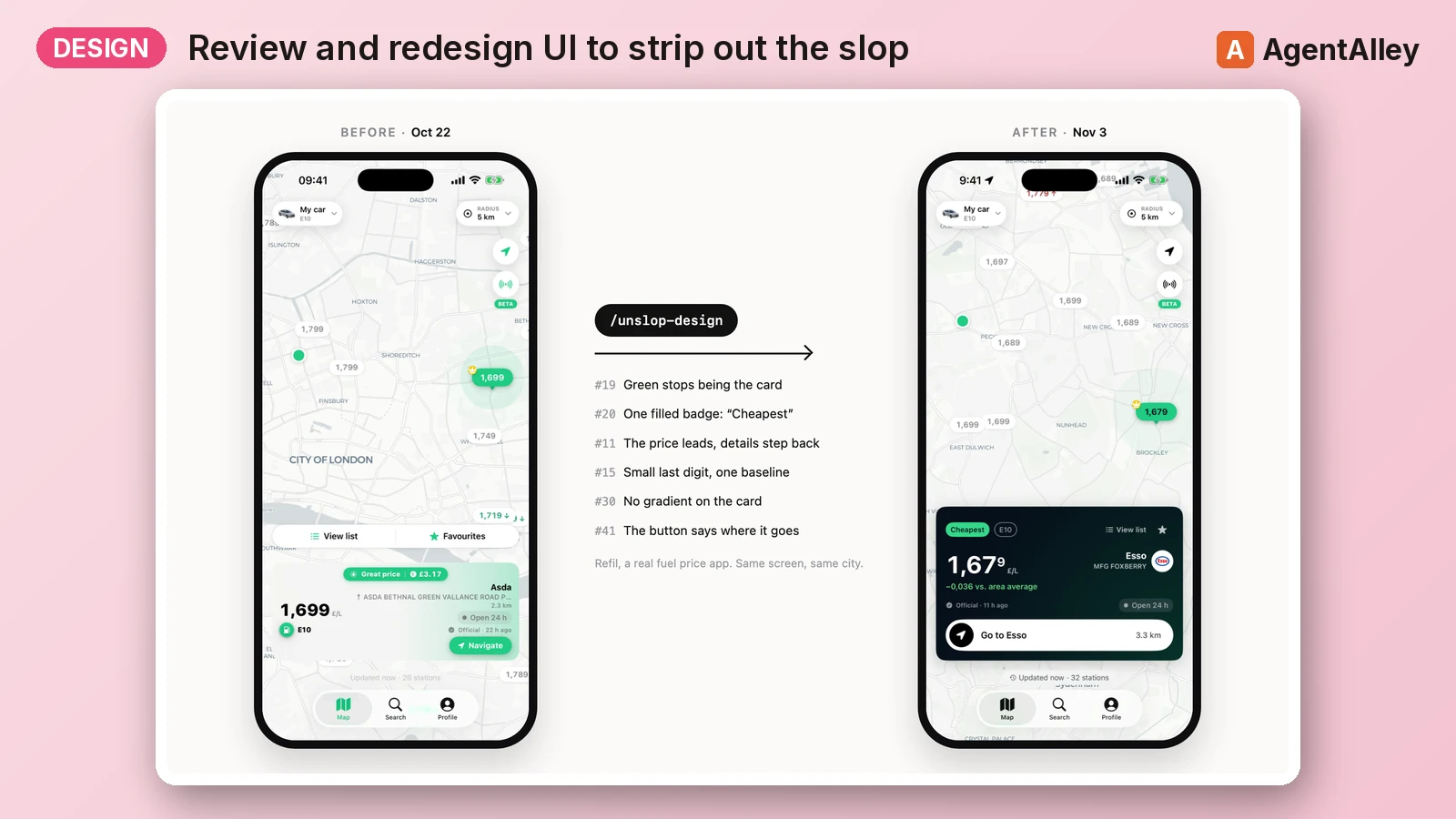
 marcosnovo/unslop-design · by marcosnovoReview and redesign an app or website UI to strip out the "slop" (decorative accent color, gradients, glows, noisy badges, emoji as icons, eyeballed spacing, greetings as titles, Title Case, flat hierarchy, repeated numbers) with a system (spacing, type, color roles, elevation) and two modes: a quick five-fix pass for one screen, or an orchestrated process for a whole app (parallel reviewers, a published winning proposal, devs per area, audits, PR). Covers SwiftUI, Compose and web (dashboards, landing pages, Tailwind), with scripts that scan the code, measure the rendered page and score it from 0 to 100. Use it when asked to "review the design", "make it look less AI", "unslop", "polish this screen", "design review", "winning proposal", "audit this dashboard", or when given videos or screenshots of an app or site asking for feedback or a redesign. Also use it to start a design system (spacing, type, palette, shadow scales) or to audit tokens, contrast or consistency across screens.★ 14 GitHub stars
 SkillYouTube to Case Study Converter
 tstfully/youtube-to-case-study · by tstfullyTurn any YouTube video (founder interview, product teardown, conference talk, marketing breakdown, UX walkthrough, podcast) into a beautiful case-study slideshow: one HTML file that opens in any browser, built on reveal.js, with speaker notes and every fact linked to the exact second in the video. Use this skill whenever someone wants a case study, business case study, marketing case study, UX case study, product teardown, growth teardown, competitor breakdown, swipe file, lesson deck, or presentation / slides / deck from a YouTube video or link. Also trigger on 'turn this video into a case study', 'make slides from this YouTube video', 'case study from this talk', 'teardown of this video', 'youtube to slides', 'youtube to presentation', or 'summarize this video as a deck'. Works for marketers, educators, product managers, students, and consultants; no coding needed.★ 3 GitHub stars
More from levnikolaevich
 SkillArchitecture Decision Recorder
 levnikolaevich/claude-code-skills · by levnikolaevichRecords one architecture decision with alternatives, consequences and status; does not design the whole system.★ 568 GitHub stars
 SkillArchitecture Diagram Builderlevnikolaevich/claude-code-skills · by levnikolaevichCreates evidence-backed current or target architecture diagrams; not UI design.★ 568 GitHub stars
 SkillArchitecture Migration Plannerlevnikolaevich/claude-code-skills · by levnikolaevichPlans architecture migrations with compatibility, data safety, rollout and recovery; does not execute them.★ 568 GitHub stars
 SkillImplementation Benchmarkerlevnikolaevich/claude-code-skills · by levnikolaevichCompares tools or implementations through controlled benchmarks and independent correctness checks.★ 568 GitHub stars
 SkillCode Modernizerlevnikolaevich/claude-code-skills · by levnikolaevichModernizes a bounded capability to reduce demonstrated maintenance cost; not routine upgrades or performance tuning.★ 568 GitHub stars
 SkillCommunity Announcerlevnikolaevich/claude-code-skills · by levnikolaevichDrafts or publishes authorized, fact-checked GitHub Discussions announcements; does not create releases.★ 568 GitHub stars