Launch Retrospective
Launch retrospective
Use after a social launch, campaign, creator collaboration, or distribution test has enough evidence to decide what should be repeated, changed, or stopped. Trigger phrases include "run a launch retro", "what did we learn from this…
---
name: launch-retrospective
description: Use after a social launch, campaign, creator collaboration, or distribution test has enough evidence to decide what should be repeated, changed, or stopped. Trigger phrases include "run a launch retro", "what did we learn from this campaign?", "postmortem this launch", "should we repeat this?", and "turn these results into next steps". Do not use this to assign blame, invent missing data, or write a live performance dashboard; use social-analytics-report for the in-flight metric read and campaign-brief to plan the next campaign.
---

# Launch Retrospective

Turn a completed campaign into durable operational learning: what happened, why it may have happened, and the next smallest decision.

## 1. Reconstruct the intended plan

Bring together the original objective, audience, approved message, channel roles, budget or partner scope where supplied, timing, measurement plan, and decisions made during execution. Compare what actually shipped with what was planned. Separate a deliberate change from an accidental deviation.

## 2. Gather the evidence with limits attached

Use available performance data, qualitative feedback, partner notes, approvals, and execution records. State dates, metric definitions, missing data, and material confounders. Keep a timeline so the team does not attribute an outcome to a change that happened after it.

## 3. Distinguish facts from explanations
Overview
Turn a completed campaign into durable operational learning: what happened, why it may have happened, and the next smallest decision.
Manual install (npx, ZIP)
npx skills add Ootto-AI/claude-content-skills --skill launch-retrospective -g -a claude-codenpx degit Ootto-AI/claude-content-skills/skills/launch-retrospective#main ~/.claude/skills/launch-retrospectiveConnects with Agent Alley MCP · agentalley.io/mcp
Files included
SKILL.md3.2 KB
Read SKILL.md here
Show the full text46 lines
Launch Retrospective
Turn a completed campaign into durable operational learning: what happened, why it may have happened, and the next smallest decision.
1. Reconstruct the intended plan
Bring together the original objective, audience, approved message, channel roles, budget or partner scope where supplied, timing, measurement plan, and decisions made during execution. Compare what actually shipped with what was planned. Separate a deliberate change from an accidental deviation.
2. Gather the evidence with limits attached
Use available performance data, qualitative feedback, partner notes, approvals, and execution records. State dates, metric definitions, missing data, and material confounders. Keep a timeline so the team does not attribute an outcome to a change that happened after it.
3. Distinguish facts from explanations
List observations first: what was published, what audiences did, and what tracking shows. Then list hypotheses about message, format, distribution, timing, destination, or process. Give each hypothesis a confidence level and the evidence that would strengthen or weaken it.
4. Commit to operational changes
Return a short set of keep, change, test, and stop decisions with owners and due dates. Update reusable inputs such as the campaign brief template, proof library, UTM vocabulary, or creator brief. Leave a clear record of unresolved questions so they are not rewritten as facts next time.
Hard rules
- Do not use a retrospective to blame individuals, creators, or customers for an outcome.
- Never claim causation where the evidence only shows correlation.
- Include negative and inconclusive results; they are part of the learning.
- Do not compare campaigns with different objectives or measurement conditions as if they were identical.
- Separate process failure from message failure before prescribing a fix.
Failure modes
| Failure | Do this instead |
|---|---|
| The retro is a victory lap or blame document | Use a factual timeline, uncertainty, and future-oriented decisions. |
| A single metric explains the whole launch | Combine the original job, data boundary, qualitative evidence, and process record. |
| Lessons stay as vague observations | Turn each learning into a named change, test, or stop decision. |
| The same tracking issue returns next launch | Update the UTM or measurement workflow with a clear owner. |
Where it sits
Use social-analytics-report for structured performance evidence during the launch. Use campaign-brief, paid-social-brief, influencer-partnerships, and utm-campaign-plan as source records. Feed confirmed lessons into the next campaign-brief rather than treating the retro as a standalone document.
| 1 | |
| 2 | name launch-retrospective |
| 3 | description Use after a social launch, campaign, creator collaboration, or distribution test has enough evidence to decide what should be repeated, changed, or stopped. Trigger phrases include "run a launch retro", "what did we learn from this campaign?", "postmortem this launch", "should we repeat this?", and "turn these results into next steps". Do not use this to assign blame, invent missing data, or write a live performance dashboard; use social-analytics-report for the in-flight metric read and campaign-brief to plan the next campaign. |
| 4 | |
| 5 | |
| 6 | # Launch Retrospective |
| 7 | |
| 8 | Turn a completed campaign into durable operational learning: what happened, why it may have happened, and the next smallest decision. |
| 9 | |
| 10 | ## 1. Reconstruct the intended plan |
| 11 | |
| 12 | Bring together the original objective, audience, approved message, channel roles, budget or partner scope where supplied, timing, measurement plan, and decisions made during execution. Compare what actually shipped with what was planned. Separate a deliberate change from an accidental deviation. |
| 13 | |
| 14 | ## 2. Gather the evidence with limits attached |
| 15 | |
| 16 | Use available performance data, qualitative feedback, partner notes, approvals, and execution records. State dates, metric definitions, missing data, and material confounders. Keep a timeline so the team does not attribute an outcome to a change that happened after it. |
| 17 | |
| 18 | ## 3. Distinguish facts from explanations |
| 19 | |
| 20 | List observations first: what was published, what audiences did, and what tracking shows. Then list hypotheses about message, format, distribution, timing, destination, or process. Give each hypothesis a confidence level and the evidence that would strengthen or weaken it. |
| 21 | |
| 22 | ## 4. Commit to operational changes |
| 23 | |
| 24 | Return a short set of keep, change, test, and stop decisions with owners and due dates. Update reusable inputs such as the campaign brief template, proof library, UTM vocabulary, or creator brief. Leave a clear record of unresolved questions so they are not rewritten as facts next time. |
| 25 | |
| 26 | ## Hard rules |
| 27 | |
| 28 | Do not use a retrospective to blame individuals, creators, or customers for an outcome. |
| 29 | Never claim causation where the evidence only shows correlation. |
| 30 | Include negative and inconclusive results; they are part of the learning. |
| 31 | Do not compare campaigns with different objectives or measurement conditions as if they were identical. |
| 32 | Separate process failure from message failure before prescribing a fix. |
| 33 | |
| 34 | ## Failure modes |
| 35 | |
| 36 | | Failure | Do this instead | |
| 37 | | --- | --- | |
| 38 | | The retro is a victory lap or blame document | Use a factual timeline, uncertainty, and future-oriented decisions. | |
| 39 | | A single metric explains the whole launch | Combine the original job, data boundary, qualitative evidence, and process record. | |
| 40 | | Lessons stay as vague observations | Turn each learning into a named change, test, or stop decision. | |
| 41 | | The same tracking issue returns next launch | Update the UTM or measurement workflow with a clear owner. | |
| 42 | |
| 43 | ## Where it sits |
| 44 | |
| 45 | Use social-analytics-report for structured performance evidence during the launch. Use campaign-brief, paid-social-brief, influencer-partnerships, and utm-campaign-plan as source records. Feed confirmed lessons into the next campaign-brief rather than treating the retro as a standalone document. |
| 46 |
Details
- License
- MIT
- Stars on the repo
- ★ 139
- Checked
- Source
- Ootto-AI/claude-content-skills ↗
- Creator
- Ootto-AI · 36 listings
Similar skills
See all →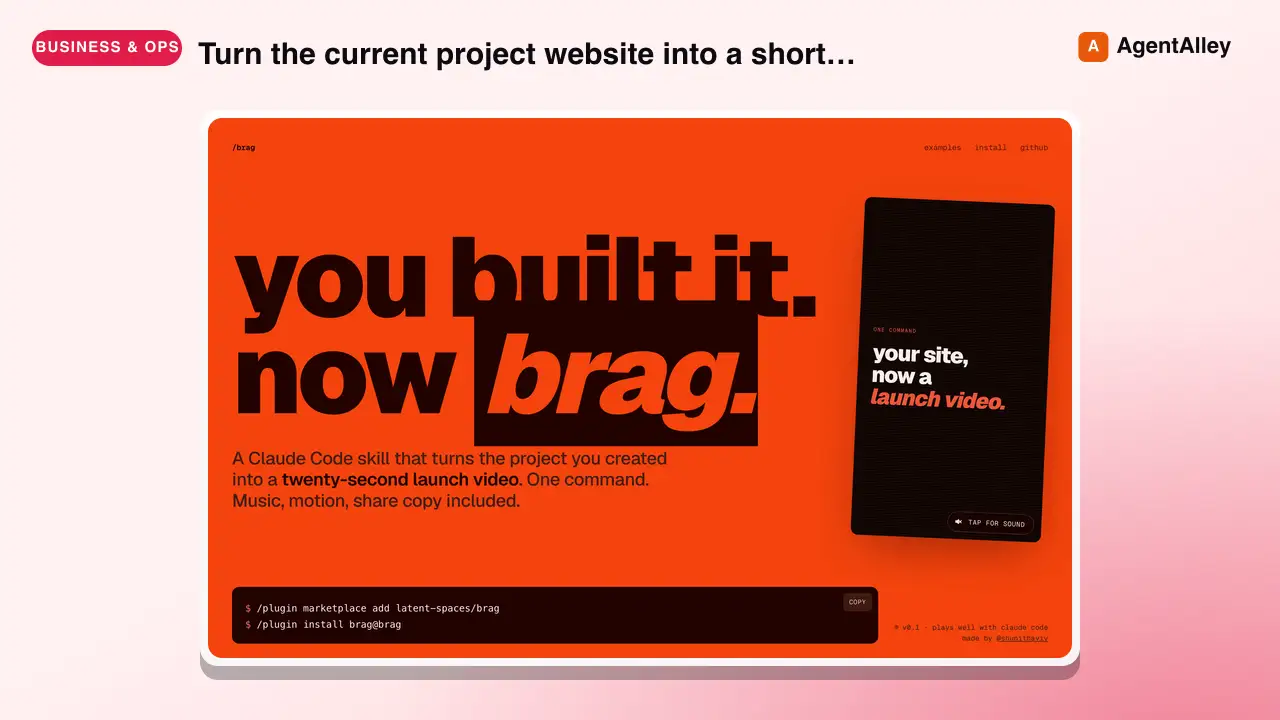 SkillLaunch Video Composer
 latent-spaces/brag · by latent-spacesTurn the current project website into a short, polished, shareable launch video using Hyperframes. Use when someone says "/brag", "let's brag about this", "make a launch video", "turn this into a video", or wants to share what they built. Reads the project code directly — no live URL or screenshots needed.★ 12.5k GitHub stars
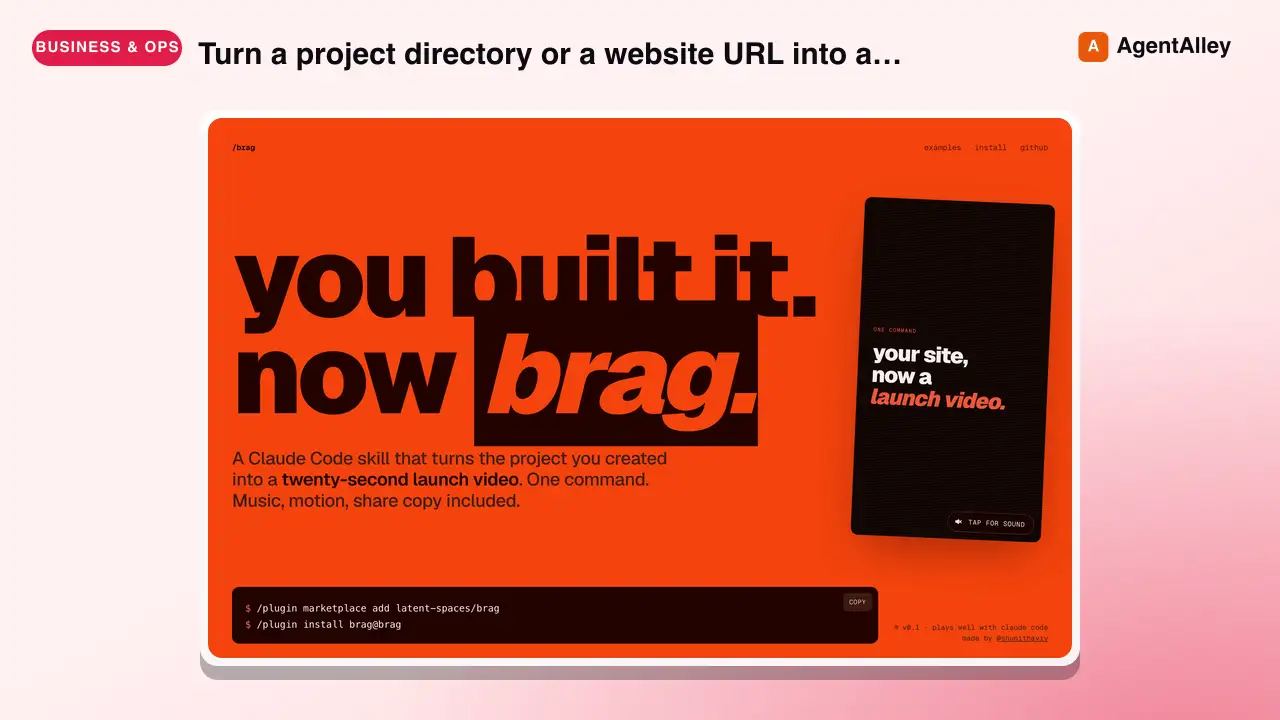 SkillQuick Launch Videolatent-spaces/brag · by latent-spacesTurn a project directory or a website URL into a short, shareable launch video with music, motion, and share copy. One file, no bundled assets — built entirely by the model with the tools already on the machine. Use when someone says "/brag-slim", "let's /brag about this", "brag about <url>", "make a launch video", or wants to show off what they built. If the /brag skill is also installed, let /brag handle those phrases; it hands off here on Opus 5.5.★ 12.5k GitHub stars
 SkillCommercial Motion Film
 echris6/motion-video-kit · by echris6Plan, build and quality-check a premium short commercial for a real business (roofing, property, ecommerce, B2B software) using AI-generated footage, code-built motion (HTML/GSAP), selective Three.js and an independent-critic "Gauntlet" loop. Use when asked to make a launch-style / SaaS-style video, business ad, explainer, sample reel or pitch video, or to review and improve one. Encodes motion principles distilled from 28 professional launch films, a quality bar, audio rules and a business-offer playbook.★ 665 GitHub stars
 SkillAI Product Launch Playbook
 Gingiris-1031/gingiris-skills · by Gingiris-1031Launch your AI product to global attention — the playbook behind Manus, Devin, and AFFiNE's breakout launches. Covers AI-specific GTM strategy, hype cycle management, waitlist tactics, and multi-market rollout for maximum day-one impact.★ 82 GitHub stars
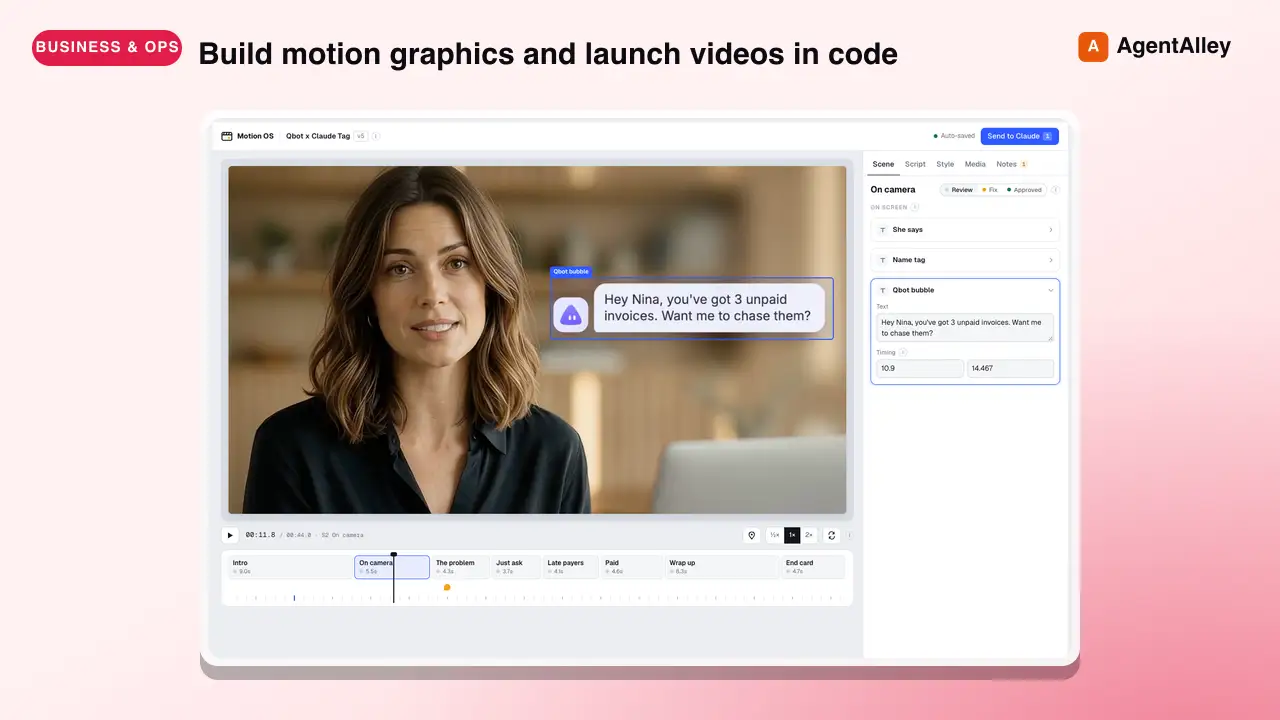 SkillMotion OS Studio
 jasonlee-breadcrumb/motion-os · by jasonlee-breadcrumbBuild motion graphics and launch videos in code, then open them in Motion OS, a local scene-by-scene review player where the user edits copy, pins notes on the frame, and sends one prompt back. Use when the user asks for a motion graphic, launch video, explainer, product video or animated ad, says "motion os", or pastes feedback that starts with "Motion OS feedback for".★ 61 GitHub stars
 SkillLaunch Video Creator
 timscheuerai/content-vault · by timscheueraiBuild a 30-60s motion-graphics launch video for a <YOUR_BRAND> product or feature. Remotion 4 React composition + ElevenLabs AI narration + sound effects + background music, beat-anchored timing, brand-aligned design system. Use when asked to "create a launch video", "make a product video", "video for X feature", "launch a new feature", or "/launch-video".★ 37 GitHub stars
More from Ootto-AI
 SkillHook Variant A/B Generator
 Ootto-AI/claude-content-skills · by Ootto-AIGenerates two genuinely distinct hook variants for the same reel so you can post-test which opening actually wins. Use when the user says "give me two hooks to test", "A/B this hook", "which opening should I use", "hook variants".★ 139 GitHub stars
 SkillInternet Research RouterOotto-AI/claude-content-skills · by Ootto-AIMUST USE when user wants to 调研/research/搜索/search/查/找/look up anything on the internet — e.g. 全网调研 X / 帮我调研一下 X / 查一下 X / 搜搜 X / 看看大家怎么评价 X / X 上有什么讨论 / research this topic。 Also MUST USE when user mentions any platform or shares any URL/链接: 小红书/xiaohongshu/xhs, Twitter/推特/X, B站/bilibili, Reddit, V2EX, LinkedIn/领英/招聘/求职/jobs, YouTube, GitHub code search, 小宇宙播客, 雪球/股票行情, RSS feeds, or any web URL. 13 platforms, multi-backend routing (OpenCLI / per-platform CLIs / APIs). Zero config for 6 channels. Run `agent-reach doctor --json` to see which backend serves each platform right now. NOT for: 写报告/数据分析/翻译等内容加工(本 skill 只负责从互联网获取内容); 发帖/评论/点赞等写操作;已有专门 skill 的平台(先用专门 skill)。 【路由方式】SKILL.md 包含路由表和常用命令,复杂场景需按需阅读对应分类的 references/*.md。 分类:search / social (小红书/推特/B站/V2EX/Reddit) / career(LinkedIn) / dev(github) / web(网页/文章/RSS) / video(YouTube/B站/播客)。★ 139 GitHub stars
 SkillObsidian Long-Term MemoryOotto-AI/claude-content-skills · by Ootto-AIGive Claude a permanent, searchable long-term memory using an Obsidian vault as the store. At the end of a session, summarize what mattered and save it as a Markdown note in your "AI Brain" vault; at the start of a session (or on demand), read back only the relevant past notes. Local markdown you own — connected via the Filesystem MCP. Trigger with "wrap up", "save this session", or "remember this".★ 139 GitHub stars
 SkillAnalytics Readout TranslatorOotto-AI/claude-content-skills · by Ootto-AIReads your reel insights and explains in plain English what to make more of and what to stop — no jargon. Use when the user says "explain my analytics", "what do my numbers mean", "read my insights", "how did this reel do".★ 139 GitHub stars
 SkillSocial Audience PersonasOotto-AI/claude-content-skills · by Ootto-AIBuild evidence-led social audience personas from customer interviews, comments, reviews, or CRM notes.★ 139 GitHub stars
 SkillSocial Profile ConverterOotto-AI/claude-content-skills · by Ootto-AIRewrites your bio, name field and pinned-reel order to convert profile visits into follows and clicks. Use when the user says "rewrite my bio", "optimize my profile", "what should my bio say", "which reels should I pin".★ 139 GitHub stars