Risk Reversal Guarantees
Guarantees: Reversing Risk to Close the Deal
The guarantee is one of the most powerful yet underutilized elements of a Grand Slam Offer.
# Guarantees: Reversing Risk to Close the Deal

The guarantee is one of the most powerful yet underutilized elements of a Grand Slam Offer. Most businesses either offer no guarantee (forcing the customer to bear all the risk) or offer a weak, generic money-back guarantee that does little to differentiate. A well-designed guarantee does more than reduce risk -- it demonstrates confidence, attracts better customers, and counterintuitively reduces refund rates. This reference covers the five guarantee types, naming strategies, stacking approaches, the psychology of guarantees, and legal considerations.

## The Psychology of Risk in Buying Decisions

### Why Prospects Don't Buy

When a prospect decides not to buy, it is almost never because the price is too high in absolute terms. It is because the perceived risk exceeds the perceived value. Every purchase carries multiple types of risk:

| Risk Type | What the Prospect Fears | Example Internal Monologue |
|-----------|------------------------|---------------------------|
| **Financial risk** | Losing money | "What if it doesn't work and I'm out $5,000?" |
| **Time risk** | Wasting time | "What if I spend 3 months on this and it fails?" |
| **Reputation risk** | Looking foolish | "What will my team/spouse/friends think if this doesn't work?" |
| **Effort risk** | Investing energy for nothing | "What if I put in all the work and nothing changes?" |
| **Opportunity cost** | Missing a better option | "What if something better comes along next month?" |
| **Identity risk** | Being "that person" | "Am I the kind of person who buys things like this?" |
Overview
The guarantee is one of the most powerful yet underutilized elements of a Grand Slam Offer. Most businesses either offer no guarantee (forcing the customer to bear all the risk) or offer a weak, generic money-back guarantee that does little to differentiate. A well-designed guarantee does more than reduce risk -- it demonstrates confidence, attracts better customers, and counterintuitively reduces refund rates. This reference covers the five guarantee types, naming strategies, stacking approaches, the psychology of guarantees, and legal considerations.
Manual install (npx, ZIP)
npx skills add wondelai/skills --skill guarantees-reversing-risk-to-close-the-deal -g -a claude-codeConnects with Agent Alley MCP · agentalley.io/mcp
Files included
guarantees.md13.7 KB
Read guarantees.md here
wondelai/
Show the full text253 lines
Guarantees: Reversing Risk to Close the Deal
The guarantee is one of the most powerful yet underutilized elements of a Grand Slam Offer. Most businesses either offer no guarantee (forcing the customer to bear all the risk) or offer a weak, generic money-back guarantee that does little to differentiate. A well-designed guarantee does more than reduce risk -- it demonstrates confidence, attracts better customers, and counterintuitively reduces refund rates. This reference covers the five guarantee types, naming strategies, stacking approaches, the psychology of guarantees, and legal considerations.
The Psychology of Risk in Buying Decisions
Why Prospects Don't Buy
When a prospect decides not to buy, it is almost never because the price is too high in absolute terms. It is because the perceived risk exceeds the perceived value. Every purchase carries multiple types of risk:
| Risk Type | What the Prospect Fears | Example Internal Monologue |
|---|---|---|
| Financial risk | Losing money | "What if it doesn't work and I'm out $5,000?" |
| Time risk | Wasting time | "What if I spend 3 months on this and it fails?" |
| Reputation risk | Looking foolish | "What will my team/spouse/friends think if this doesn't work?" |
| Effort risk | Investing energy for nothing | "What if I put in all the work and nothing changes?" |
| Opportunity cost | Missing a better option | "What if something better comes along next month?" |
| Identity risk | Being "that person" | "Am I the kind of person who buys things like this?" |
A guarantee systematically addresses these risks by saying: "You cannot lose. The worst case scenario is that you end up exactly where you are now."
The Guarantee Paradox
Stronger guarantees lead to fewer refund requests, not more. This seems counterintuitive, but there are three reasons:
- Confidence signal: A strong guarantee signals that the seller is confident in their product. This makes the buyer more confident too, which leads to better effort and better results.
- Customer quality: Strong guarantees attract decisive, committed buyers who are confident they will succeed. Weak guarantees (or no guarantees) attract tentative, risk-averse buyers who are more likely to quit.
- Cognitive dissonance: Once someone buys, they want to believe they made a good decision. A guarantee removes the anxiety that would cause them to second-guess, so they invest more fully in the process.
The Five Guarantee Types
Type 1: Unconditional Guarantee
What it is: Full refund, no questions asked, within a specified time period.
How it works: The customer can request a refund for any reason during the guarantee period and receive their money back with no friction.
Best for: Low to mid-ticket products and services ($50-$2,000), first-time buyers, markets with high skepticism, e-commerce products.
Strengths:
- Eliminates financial risk completely
- Simplest to communicate
- Highest conversion lift (reduces barrier to yes)
- Legally straightforward
Weaknesses:
- Attracts some "tire kickers" who never intended to keep the product
- Does not filter for commitment or effort
- Higher refund rates than conditional guarantees (but still typically 5-15%)
Examples:
- "30-Day Money-Back Guarantee. If you're not satisfied for any reason, email us for a full refund."
- "Try it for 60 days. Love it or get every penny back."
- "100% Satisfaction Guarantee. No hoops. No fine print."
Type 2: Conditional Guarantee
What it is: Full refund, but only if the customer meets specific conditions (usually completing the program or taking specific actions).
How it works: The customer must demonstrate that they did the work (completed the modules, attended the calls, implemented the steps). If they did the work and did not get results, they receive a refund.
Best for: High-ticket offers ($2,000+), coaching programs, courses, services where customer effort affects outcomes.
Strengths:
- Filters for committed buyers (people who will not do the work self-select out)
- Much lower refund rates than unconditional (typically 2-5%)
- Customers who meet the conditions almost always get results (making refunds rare)
- Demonstrates that the offer works when the customer engages
Weaknesses:
- Slightly more complex to communicate
- Requires tracking customer completion
- Some prospects perceive conditions as "fine print" (address this head-on)
Examples:
- "Complete all 8 modules and implement the strategies. If you don't see at least a 2x return within 90 days, we'll refund 100%."
- "Attend all 12 coaching calls and do the homework. If you're not satisfied with your progress, full refund."
- "Use the system for 90 days. If you follow the steps and don't land 3 new clients, we'll give you your money back."
How to present conditions ethically:
- Frame conditions as the customer's roadmap to success, not as escape-prevention
- "We know this works when you engage. That's why we guarantee: complete the program and get results, or get your money back."
- Make conditions reasonable and achievable (if 95% of customers can meet them, they're fair)
Type 3: Anti-Guarantee
What it is: Explicitly stating that there is no refund. All sales are final.
How it works: By removing the safety net, you create a "burned bridges" effect. The customer is fully committed, which paradoxically leads to better effort and better results.
Best for: High-demand offers with limited availability, luxury and prestige products, situations where brand strength is sufficient, experienced customers who know what they want.
Strengths:
- Maximum customer commitment (no escape hatch = full effort)
- Signals exclusivity and confidence
- Zero refund management costs
- Works when demand exceeds supply
Weaknesses:
- Only works when your brand, social proof, or demand is strong enough
- Reduces conversion rate (some fence-sitters will not buy)
- Requires more upfront trust-building
Examples:
- "This is a serious investment. All sales are final. We work with people who are committed to results."
- "Due to the personalized nature of this service, we do not offer refunds. We are confident in our process, and we only accept clients we are confident we can help."
- "No refunds. No exceptions. This is for people who are ready."
Type 4: Implied Guarantee
What it is: No explicitly stated guarantee, but the offer structure implies safety through social proof, track record, and reputation.
How it works: Instead of a formal guarantee, you stack so much proof and credibility that the prospect feels safe without one.
Best for: Established brands with strong reputations, subscription products with monthly cancel options, free trial offers (the trial itself is the guarantee).
Strengths:
- No formal refund obligations
- Works naturally when trust is already high
- Avoids the "refund conversation" entirely
Weaknesses:
- Does not actively overcome risk objections
- Weaker conversion lift than explicit guarantees
- Relies on existing trust
Examples:
- "Join 50,000+ marketers who trust [Product] every day. Cancel anytime."
- "Free for 14 days. No credit card required. See why 97% of trial users become paying customers."
- "Rated 4.9/5 by 2,000+ customers. See their stories below."
Type 5: Performance-Based Guarantee
What it is: You guarantee a specific, measurable outcome. If the outcome is not achieved, the customer receives a refund, credit, or continued service at no charge.
How it works: You tie your compensation directly to results. This is the ultimate risk reversal because the customer literally cannot lose money unless they also get results.
Best for: Agency services, consulting, any offer where you control or heavily influence the outcome, high-ticket B2B services.
Strengths:
- Strongest possible risk reversal
- Massive differentiation (very few competitors offer this)
- Highest trust-building power
- Attracts the most committed and qualified buyers
Weaknesses:
- Requires confidence in your ability to deliver
- Need clear, measurable outcome metrics
- Must be financially sustainable (model the worst case)
- Higher operational complexity
Examples:
- "We guarantee 50 qualified leads in 90 days. If we fall short, we work for free until we deliver."
- "Our SEO program guarantees page-one rankings for 5 target keywords within 6 months, or we continue working at no charge until we get there."
- "If our sales training doesn't increase your team's close rate by at least 20% within 60 days, you pay nothing."
Naming Your Guarantee
A named guarantee feels proprietary and memorable. It becomes part of your brand.
Naming Examples
| Generic | Named Version | Why It's Better |
|---|---|---|
| "Money-back guarantee" | "The Results-or-Free Guarantee" | Focuses on the outcome, not the refund |
| "Satisfaction guarantee" | "The 'Love It or Leave It' Promise" | Sounds confident and conversational |
| "30-day guarantee" | "The 30-Day Test Drive" | Reframes it as an experience, not a risk |
| "Performance guarantee" | "The Triple-Your-Pipeline Guarantee" | Names the specific result |
| "Risk-free trial" | "The Zero-Risk Launchpad" | Sounds like an opportunity, not a safety net |
Naming Formula
[Emotion/Action] + [Specific Result or Timeframe] + [Guarantee/Promise/Pledge]
Examples:
- "The No-Questions 90-Day Money-Back Promise"
- "The Double-Your-Revenue Guarantee"
- "The Risk-Free Launch Pledge"
- "The 'You'll Love It' 60-Day Promise"
Stacking Guarantees
You can stack multiple guarantees to address multiple risk types simultaneously.
Example: Three-Layer Guarantee Stack
| Layer | Guarantee | Risk Addressed |
|---|---|---|
| Layer 1 | "30-Day Unconditional Money-Back Guarantee" | Financial risk ("What if I don't like it?") |
| Layer 2 | "90-Day Results Guarantee: Complete the program, if no results, full refund" | Performance risk ("What if it doesn't work?") |
| Layer 3 | "Lifetime Access Guarantee: Your access never expires" | Time risk ("What if I fall behind?") |
Stacking Presentation
Present stacked guarantees as layers of protection:
"You're protected three ways:
- Try risk-free for 30 days. Not happy for any reason? Full refund, no questions.
- Get results or don't pay. Complete the program. If you don't see [specific result], we refund every penny.
- Never lose access. Life gets busy. Your access is forever. Come back whenever you're ready."
Legal Considerations
Important Disclaimers
- Consult a lawyer. Guarantee terms should be reviewed by legal counsel in your jurisdiction.
- FTC compliance (US): Guarantees are considered advertising claims. You must honor them as stated. Failure to honor guarantees can result in FTC enforcement action.
- Document everything. Keep records of guarantee terms, conditions, and all refund requests and resolutions.
- Clear terms. The conditions of the guarantee must be clearly stated before purchase, not buried in fine print.
- Reasonable conditions. Conditional guarantee requirements must be reasonable and achievable. Requiring someone to "complete all 47 modules, attend all 52 calls, and submit weekly reports for 12 months" is not reasonable.
Structuring Guarantee Terms
| Element | What to Include | Example |
|---|---|---|
| Duration | How long the guarantee lasts | "Within 90 days of purchase" |
| Conditions | What the customer must do (if conditional) | "Complete all 8 modules and attend 4 of 6 live calls" |
| Outcome metric | The specific result guaranteed (if performance-based) | "At least 20 qualified leads" |
| Refund process | How to claim the guarantee | "Email support@company.com with your completion certificate" |
| Refund method | How the refund is delivered | "Full refund to original payment method within 10 business days" |
| Exclusions | What is not covered (if any) | "Does not cover third-party costs (ad spend, software subscriptions)" |
Guarantee Design Checklist
- Have you identified the primary risk type your prospect fears?
- Have you selected the guarantee type that best addresses that risk?
- Is the guarantee clearly and prominently communicated (not buried)?
- Have you named the guarantee?
- Are the conditions (if any) reasonable and clearly stated?
- Have you modeled the financial impact of the worst-case refund scenario?
- Is the refund process simple and frictionless?
- Have you consulted legal counsel on the guarantee terms?
- Does the guarantee strengthen your confidence positioning?
- Would you feel comfortable being held to this guarantee personally?
Exercises
Exercise 1: Risk Mapping
List every type of risk your prospect faces when considering your offer (financial, time, reputation, effort, opportunity cost, identity). For each, design a guarantee element that neutralizes it.
Exercise 2: Guarantee Comparison
Write out five versions of your guarantee -- one for each type (unconditional, conditional, anti-guarantee, implied, performance-based). Evaluate which one best fits your business model, customer profile, and risk tolerance.
Exercise 3: Name Your Guarantee
Using the naming formula, create 5 candidate names for your guarantee. Test them with 10 people in your target market. Which one resonates most? Which one makes them feel the safest?
Exercise 4: Financial Modeling
Assume a 10% refund rate under your proposed guarantee. Model the revenue impact over 12 months. Now model the conversion increase from adding the guarantee (typically 15-30% lift). Compare the two. In almost every case, the conversion lift dramatically exceeds the refund cost.
| 1 | # Guarantees: Reversing Risk to Close the Deal |
| 2 | |
| 3 | The guarantee is one of the most powerful yet underutilized elements of a Grand Slam Offer. Most businesses either offer no guarantee (forcing the customer to bear all the risk) or offer a weak, generic money-back guarantee that does little to differentiate. A well-designed guarantee does more than reduce risk -- it demonstrates confidence, attracts better customers, and counterintuitively reduces refund rates. This reference covers the five guarantee types, naming strategies, stacking approaches, the psychology of guarantees, and legal considerations. |
| 4 | |
| 5 | ## The Psychology of Risk in Buying Decisions |
| 6 | |
| 7 | ### Why Prospects Don't Buy |
| 8 | |
| 9 | When a prospect decides not to buy, it is almost never because the price is too high in absolute terms. It is because the perceived risk exceeds the perceived value. Every purchase carries multiple types of risk: |
| 10 | |
| 11 | | Risk Type | What the Prospect Fears | Example Internal Monologue | |
| 12 | |-----------|------------------------|---------------------------| |
| 13 | | **Financial risk** | Losing money | "What if it doesn't work and I'm out $5,000?" | |
| 14 | | **Time risk** | Wasting time | "What if I spend 3 months on this and it fails?" | |
| 15 | | **Reputation risk** | Looking foolish | "What will my team/spouse/friends think if this doesn't work?" | |
| 16 | | **Effort risk** | Investing energy for nothing | "What if I put in all the work and nothing changes?" | |
| 17 | | **Opportunity cost** | Missing a better option | "What if something better comes along next month?" | |
| 18 | | **Identity risk** | Being "that person" | "Am I the kind of person who buys things like this?" | |
| 19 | |
| 20 | A guarantee systematically addresses these risks by saying: "You cannot lose. The worst case scenario is that you end up exactly where you are now." |
| 21 | |
| 22 | ### The Guarantee Paradox |
| 23 | |
| 24 | Stronger guarantees lead to fewer refund requests, not more. This seems counterintuitive, but there are three reasons: |
| 25 | |
| 26 | **Confidence signal:** A strong guarantee signals that the seller is confident in their product. This makes the buyer more confident too, which leads to better effort and better results. |
| 27 | **Customer quality:** Strong guarantees attract decisive, committed buyers who are confident they will succeed. Weak guarantees (or no guarantees) attract tentative, risk-averse buyers who are more likely to quit. |
| 28 | **Cognitive dissonance:** Once someone buys, they want to believe they made a good decision. A guarantee removes the anxiety that would cause them to second-guess, so they invest more fully in the process. |
| 29 | |
| 30 | ## The Five Guarantee Types |
| 31 | |
| 32 | ### Type 1: Unconditional Guarantee |
| 33 | |
| 34 | **What it is:** Full refund, no questions asked, within a specified time period. |
| 35 | |
| 36 | **How it works:** The customer can request a refund for any reason during the guarantee period and receive their money back with no friction. |
| 37 | |
| 38 | **Best for:** Low to mid-ticket products and services ($50-$2,000), first-time buyers, markets with high skepticism, e-commerce products. |
| 39 | |
| 40 | **Strengths:** |
| 41 | Eliminates financial risk completely |
| 42 | Simplest to communicate |
| 43 | Highest conversion lift (reduces barrier to yes) |
| 44 | Legally straightforward |
| 45 | |
| 46 | **Weaknesses:** |
| 47 | Attracts some "tire kickers" who never intended to keep the product |
| 48 | Does not filter for commitment or effort |
| 49 | Higher refund rates than conditional guarantees (but still typically 5-15%) |
| 50 | |
| 51 | **Examples:** |
| 52 | "30-Day Money-Back Guarantee. If you're not satisfied for any reason, email us for a full refund." |
| 53 | "Try it for 60 days. Love it or get every penny back." |
| 54 | "100% Satisfaction Guarantee. No hoops. No fine print." |
| 55 | |
| 56 | ### Type 2: Conditional Guarantee |
| 57 | |
| 58 | **What it is:** Full refund, but only if the customer meets specific conditions (usually completing the program or taking specific actions). |
| 59 | |
| 60 | **How it works:** The customer must demonstrate that they did the work (completed the modules, attended the calls, implemented the steps). If they did the work and did not get results, they receive a refund. |
| 61 | |
| 62 | **Best for:** High-ticket offers ($2,000+), coaching programs, courses, services where customer effort affects outcomes. |
| 63 | |
| 64 | **Strengths:** |
| 65 | Filters for committed buyers (people who will not do the work self-select out) |
| 66 | Much lower refund rates than unconditional (typically 2-5%) |
| 67 | Customers who meet the conditions almost always get results (making refunds rare) |
| 68 | Demonstrates that the offer works when the customer engages |
| 69 | |
| 70 | **Weaknesses:** |
| 71 | Slightly more complex to communicate |
| 72 | Requires tracking customer completion |
| 73 | Some prospects perceive conditions as "fine print" (address this head-on) |
| 74 | |
| 75 | **Examples:** |
| 76 | "Complete all 8 modules and implement the strategies. If you don't see at least a 2x return within 90 days, we'll refund 100%." |
| 77 | "Attend all 12 coaching calls and do the homework. If you're not satisfied with your progress, full refund." |
| 78 | "Use the system for 90 days. If you follow the steps and don't land 3 new clients, we'll give you your money back." |
| 79 | |
| 80 | **How to present conditions ethically:** |
| 81 | Frame conditions as the customer's roadmap to success, not as escape-prevention |
| 82 | "We know this works when you engage. That's why we guarantee: complete the program and get results, or get your money back." |
| 83 | Make conditions reasonable and achievable (if 95% of customers can meet them, they're fair) |
| 84 | |
| 85 | ### Type 3: Anti-Guarantee |
| 86 | |
| 87 | **What it is:** Explicitly stating that there is no refund. All sales are final. |
| 88 | |
| 89 | **How it works:** By removing the safety net, you create a "burned bridges" effect. The customer is fully committed, which paradoxically leads to better effort and better results. |
| 90 | |
| 91 | **Best for:** High-demand offers with limited availability, luxury and prestige products, situations where brand strength is sufficient, experienced customers who know what they want. |
| 92 | |
| 93 | **Strengths:** |
| 94 | Maximum customer commitment (no escape hatch = full effort) |
| 95 | Signals exclusivity and confidence |
| 96 | Zero refund management costs |
| 97 | Works when demand exceeds supply |
| 98 | |
| 99 | **Weaknesses:** |
| 100 | Only works when your brand, social proof, or demand is strong enough |
| 101 | Reduces conversion rate (some fence-sitters will not buy) |
| 102 | Requires more upfront trust-building |
| 103 | |
| 104 | **Examples:** |
| 105 | "This is a serious investment. All sales are final. We work with people who are committed to results." |
| 106 | "Due to the personalized nature of this service, we do not offer refunds. We are confident in our process, and we only accept clients we are confident we can help." |
| 107 | "No refunds. No exceptions. This is for people who are ready." |
| 108 | |
| 109 | ### Type 4: Implied Guarantee |
| 110 | |
| 111 | **What it is:** No explicitly stated guarantee, but the offer structure implies safety through social proof, track record, and reputation. |
| 112 | |
| 113 | **How it works:** Instead of a formal guarantee, you stack so much proof and credibility that the prospect feels safe without one. |
| 114 | |
| 115 | **Best for:** Established brands with strong reputations, subscription products with monthly cancel options, free trial offers (the trial itself is the guarantee). |
| 116 | |
| 117 | **Strengths:** |
| 118 | No formal refund obligations |
| 119 | Works naturally when trust is already high |
| 120 | Avoids the "refund conversation" entirely |
| 121 | |
| 122 | **Weaknesses:** |
| 123 | Does not actively overcome risk objections |
| 124 | Weaker conversion lift than explicit guarantees |
| 125 | Relies on existing trust |
| 126 | |
| 127 | **Examples:** |
| 128 | "Join 50,000+ marketers who trust [Product] every day. Cancel anytime." |
| 129 | "Free for 14 days. No credit card required. See why 97% of trial users become paying customers." |
| 130 | "Rated 4.9/5 by 2,000+ customers. See their stories below." |
| 131 | |
| 132 | ### Type 5: Performance-Based Guarantee |
| 133 | |
| 134 | **What it is:** You guarantee a specific, measurable outcome. If the outcome is not achieved, the customer receives a refund, credit, or continued service at no charge. |
| 135 | |
| 136 | **How it works:** You tie your compensation directly to results. This is the ultimate risk reversal because the customer literally cannot lose money unless they also get results. |
| 137 | |
| 138 | **Best for:** Agency services, consulting, any offer where you control or heavily influence the outcome, high-ticket B2B services. |
| 139 | |
| 140 | **Strengths:** |
| 141 | Strongest possible risk reversal |
| 142 | Massive differentiation (very few competitors offer this) |
| 143 | Highest trust-building power |
| 144 | Attracts the most committed and qualified buyers |
| 145 | |
| 146 | **Weaknesses:** |
| 147 | Requires confidence in your ability to deliver |
| 148 | Need clear, measurable outcome metrics |
| 149 | Must be financially sustainable (model the worst case) |
| 150 | Higher operational complexity |
| 151 | |
| 152 | **Examples:** |
| 153 | "We guarantee 50 qualified leads in 90 days. If we fall short, we work for free until we deliver." |
| 154 | "Our SEO program guarantees page-one rankings for 5 target keywords within 6 months, or we continue working at no charge until we get there." |
| 155 | "If our sales training doesn't increase your team's close rate by at least 20% within 60 days, you pay nothing." |
| 156 | |
| 157 | ## Naming Your Guarantee |
| 158 | |
| 159 | A named guarantee feels proprietary and memorable. It becomes part of your brand. |
| 160 | |
| 161 | ### Naming Examples |
| 162 | |
| 163 | | Generic | Named Version | Why It's Better | |
| 164 | |---------|--------------|-----------------| |
| 165 | | "Money-back guarantee" | "The Results-or-Free Guarantee" | Focuses on the outcome, not the refund | |
| 166 | | "Satisfaction guarantee" | "The 'Love It or Leave It' Promise" | Sounds confident and conversational | |
| 167 | | "30-day guarantee" | "The 30-Day Test Drive" | Reframes it as an experience, not a risk | |
| 168 | | "Performance guarantee" | "The Triple-Your-Pipeline Guarantee" | Names the specific result | |
| 169 | | "Risk-free trial" | "The Zero-Risk Launchpad" | Sounds like an opportunity, not a safety net | |
| 170 | |
| 171 | ### Naming Formula |
| 172 | |
| 173 | **[Emotion/Action] + [Specific Result or Timeframe] + [Guarantee/Promise/Pledge]** |
| 174 | |
| 175 | Examples: |
| 176 | "The No-Questions 90-Day Money-Back Promise" |
| 177 | "The Double-Your-Revenue Guarantee" |
| 178 | "The Risk-Free Launch Pledge" |
| 179 | "The 'You'll Love It' 60-Day Promise" |
| 180 | |
| 181 | ## Stacking Guarantees |
| 182 | |
| 183 | You can stack multiple guarantees to address multiple risk types simultaneously. |
| 184 | |
| 185 | ### Example: Three-Layer Guarantee Stack |
| 186 | |
| 187 | | Layer | Guarantee | Risk Addressed | |
| 188 | |-------|-----------|---------------| |
| 189 | | **Layer 1** | "30-Day Unconditional Money-Back Guarantee" | Financial risk ("What if I don't like it?") | |
| 190 | | **Layer 2** | "90-Day Results Guarantee: Complete the program, if no results, full refund" | Performance risk ("What if it doesn't work?") | |
| 191 | | **Layer 3** | "Lifetime Access Guarantee: Your access never expires" | Time risk ("What if I fall behind?") | |
| 192 | |
| 193 | ### Stacking Presentation |
| 194 | |
| 195 | Present stacked guarantees as layers of protection: |
| 196 | |
| 197 | "You're protected three ways: |
| 198 | **Try risk-free for 30 days.** Not happy for any reason? Full refund, no questions. |
| 199 | **Get results or don't pay.** Complete the program. If you don't see [specific result], we refund every penny. |
| 200 | **Never lose access.** Life gets busy. Your access is forever. Come back whenever you're ready." |
| 201 | |
| 202 | ## Legal Considerations |
| 203 | |
| 204 | ### Important Disclaimers |
| 205 | |
| 206 | **Consult a lawyer.** Guarantee terms should be reviewed by legal counsel in your jurisdiction. |
| 207 | **FTC compliance (US):** Guarantees are considered advertising claims. You must honor them as stated. Failure to honor guarantees can result in FTC enforcement action. |
| 208 | **Document everything.** Keep records of guarantee terms, conditions, and all refund requests and resolutions. |
| 209 | **Clear terms.** The conditions of the guarantee must be clearly stated before purchase, not buried in fine print. |
| 210 | **Reasonable conditions.** Conditional guarantee requirements must be reasonable and achievable. Requiring someone to "complete all 47 modules, attend all 52 calls, and submit weekly reports for 12 months" is not reasonable. |
| 211 | |
| 212 | ### Structuring Guarantee Terms |
| 213 | |
| 214 | | Element | What to Include | Example | |
| 215 | |---------|----------------|---------| |
| 216 | | **Duration** | How long the guarantee lasts | "Within 90 days of purchase" | |
| 217 | | **Conditions** | What the customer must do (if conditional) | "Complete all 8 modules and attend 4 of 6 live calls" | |
| 218 | | **Outcome metric** | The specific result guaranteed (if performance-based) | "At least 20 qualified leads" | |
| 219 | | **Refund process** | How to claim the guarantee | "Email support@company.com with your completion certificate" | |
| 220 | | **Refund method** | How the refund is delivered | "Full refund to original payment method within 10 business days" | |
| 221 | | **Exclusions** | What is not covered (if any) | "Does not cover third-party costs (ad spend, software subscriptions)" | |
| 222 | |
| 223 | ## Guarantee Design Checklist |
| 224 | |
| 225 | [ ] Have you identified the primary risk type your prospect fears? |
| 226 | [ ] Have you selected the guarantee type that best addresses that risk? |
| 227 | [ ] Is the guarantee clearly and prominently communicated (not buried)? |
| 228 | [ ] Have you named the guarantee? |
| 229 | [ ] Are the conditions (if any) reasonable and clearly stated? |
| 230 | [ ] Have you modeled the financial impact of the worst-case refund scenario? |
| 231 | [ ] Is the refund process simple and frictionless? |
| 232 | [ ] Have you consulted legal counsel on the guarantee terms? |
| 233 | [ ] Does the guarantee strengthen your confidence positioning? |
| 234 | [ ] Would you feel comfortable being held to this guarantee personally? |
| 235 | |
| 236 | ## Exercises |
| 237 | |
| 238 | ### Exercise 1: Risk Mapping |
| 239 | |
| 240 | List every type of risk your prospect faces when considering your offer (financial, time, reputation, effort, opportunity cost, identity). For each, design a guarantee element that neutralizes it. |
| 241 | |
| 242 | ### Exercise 2: Guarantee Comparison |
| 243 | |
| 244 | Write out five versions of your guarantee -- one for each type (unconditional, conditional, anti-guarantee, implied, performance-based). Evaluate which one best fits your business model, customer profile, and risk tolerance. |
| 245 | |
| 246 | ### Exercise 3: Name Your Guarantee |
| 247 | |
| 248 | Using the naming formula, create 5 candidate names for your guarantee. Test them with 10 people in your target market. Which one resonates most? Which one makes them feel the safest? |
| 249 | |
| 250 | ### Exercise 4: Financial Modeling |
| 251 | |
| 252 | Assume a 10% refund rate under your proposed guarantee. Model the revenue impact over 12 months. Now model the conversion increase from adding the guarantee (typically 15-30% lift). Compare the two. In almost every case, the conversion lift dramatically exceeds the refund cost. |
| 253 |
Details
- Updated
- Sep 10, 2026
- License
- MIT
- Stars on the repo
- ★ 2,235
- Checked
- Source
- wondelai/skills ↗
- Creator
- wondelai · 319 listings
Similar skills
See all → SkillAphorism Library Manager
 danielmiessler/LifeOS · by danielmiesslerCurated aphorism collection with CRUD — content-based matching, themed search, thinker research, DB maintenance. Quotes organized by author/theme/context/usage to prevent repetition. Four workflows: FindAphorism, AddAphorism, ResearchThinker, SearchAphorisms. Themes: Stoicism, Wisdom, Truth-seeking, Excellence, Resilience, Curiosity. USE WHEN aphorism, quote, find a quote, research thinker, add aphorism, quote for newsletter, what did X say about, quote bank. NOT FOR creative writing or social posts.★ 19.3k GitHub stars
 SkillCommercial Deal Negotiator
 cbrock84/headcount · by cbrock84Negotiates a commercial deal without giving away the terms that matter — preparing your walk-away and theirs, trading concessions rather than conceding them, recognizing the tactics that create false urgency, protecting price by moving other variables, and closing on terms someone can actually deliver. Use this to prepare for a negotiation, respond to a demand mid-deal, work out why discounts keep landing at quarter end, or review terms before they are signed.★ 2k GitHub stars
 SkillNegotiation & Influence
 samber/cc-skills · by samberInfluence and negotiation toolkit for any interaction needing another person's agreement, even when the user never says 'negotiation'. Covers B2B sales, salary reviews and raise asks, collective bargaining and unions, hard 1:1s, recruitment closes, cross-cultural deals, mediation, and diplomatic messages — declining, pushing back on scope, justifying a delay, raising a concern, getting alignment. Use when the user says 'they just said X, what do I say' or 'draft a reply', or mentions a buyer, champion, procurement, RFP, sponsor, HR, union, or candidate, or a pushback, refusal, ghosting, no-decision, escalation, fixed budget, counter-offer, comp band, strike, BATNA, anchor, or concession.★ 222 GitHub stars
 SkillProfessional Case Study Builder
 realjaymes/marketingagentskills · by realjaymesCreates professional case studies, engagement summaries, and project summaries. Use when the user wants to create a 'case study,' 'client success story,' 'engagement summary,' 'project summary,' or 'portfolio piece.'★ 65 GitHub stars
 SkillUnslop Design Review
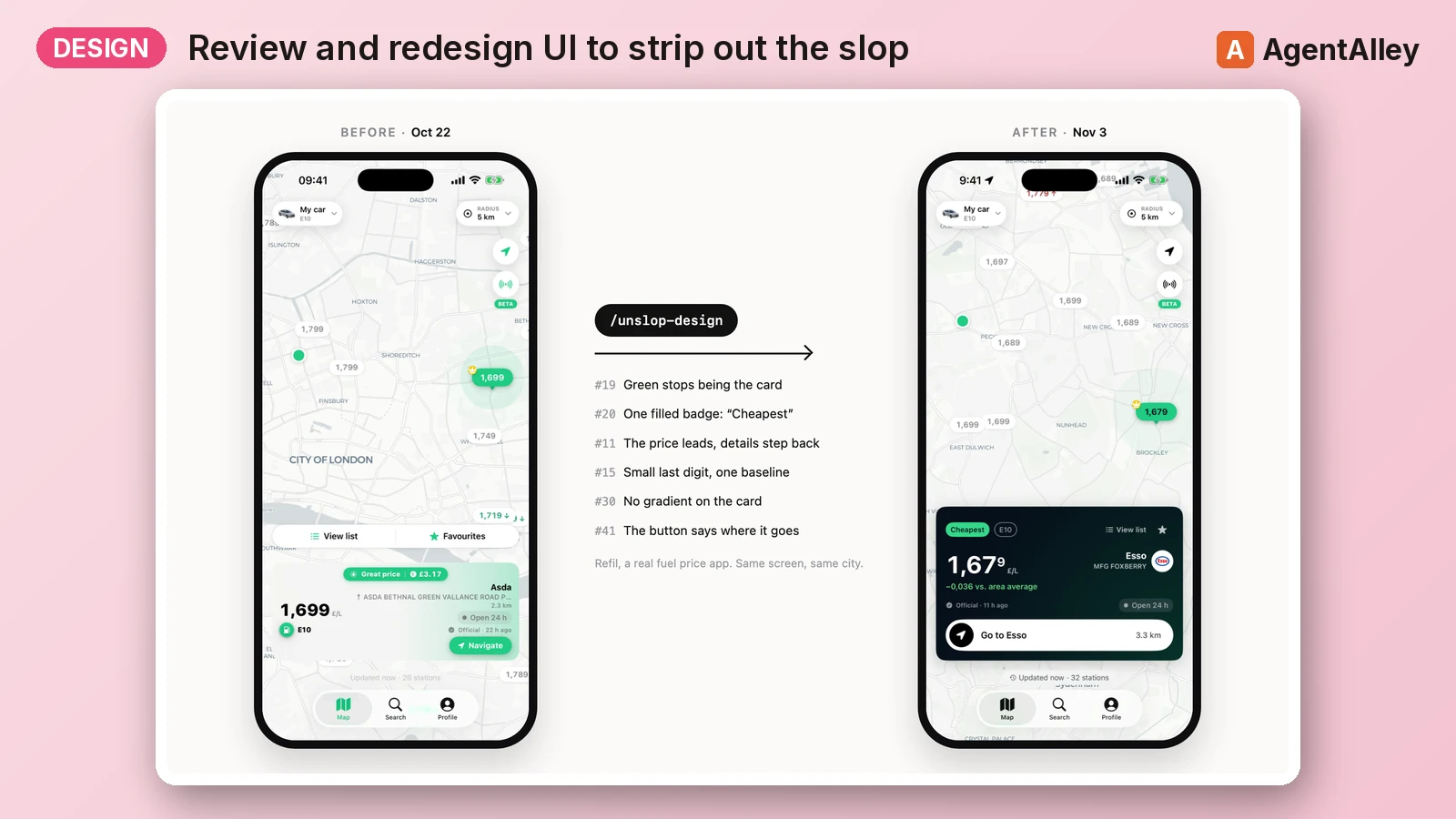
 marcosnovo/unslop-design · by marcosnovoReview and redesign an app or website UI to strip out the "slop" (decorative accent color, gradients, glows, noisy badges, emoji as icons, eyeballed spacing, greetings as titles, Title Case, flat hierarchy, repeated numbers) with a system (spacing, type, color roles, elevation) and two modes: a quick five-fix pass for one screen, or an orchestrated process for a whole app (parallel reviewers, a published winning proposal, devs per area, audits, PR). Covers SwiftUI, Compose and web (dashboards, landing pages, Tailwind), with scripts that scan the code, measure the rendered page and score it from 0 to 100. Use it when asked to "review the design", "make it look less AI", "unslop", "polish this screen", "design review", "winning proposal", "audit this dashboard", or when given videos or screenshots of an app or site asking for feedback or a redesign. Also use it to start a design system (spacing, type, palette, shadow scales) or to audit tokens, contrast or consistency across screens.★ 14 GitHub stars
 SkillYouTube to Case Study Converter
 tstfully/youtube-to-case-study · by tstfullyTurn any YouTube video (founder interview, product teardown, conference talk, marketing breakdown, UX walkthrough, podcast) into a beautiful case-study slideshow: one HTML file that opens in any browser, built on reveal.js, with speaker notes and every fact linked to the exact second in the video. Use this skill whenever someone wants a case study, business case study, marketing case study, UX case study, product teardown, growth teardown, competitor breakdown, swipe file, lesson deck, or presentation / slides / deck from a YouTube video or link. Also trigger on 'turn this video into a case study', 'make slides from this YouTube video', 'case study from this talk', 'teardown of this video', 'youtube to slides', 'youtube to presentation', or 'summarize this video as a deck'. Works for marketers, educators, product managers, students, and consultants; no coding needed.★ 3 GitHub stars
More from wondelai
 SkillSoftware Design Philosophy
 wondelai/skills · by wondelaiManage software complexity through deep modules, information hiding, and strategic programming. Use when the user mentions "module design", "API too complex", "shallow class", "complexity budget", "strategic vs tactical", "deep module", "information leakage", "pass-through method", "this code is over-engineered", or "simplify this design". Also trigger when reviewing an interface for simplicity, evaluating whether an abstraction is pulling its weight, deciding whether a comment is worth writing, or choosing between general-purpose and special-purpose approaches. Covers deep vs shallow modules, red flags for complexity, and comments as design documentation. For code quality, see clean-code. For architecture boundaries, see clean-architecture.★ 2.2k GitHub stars
 SkillActionable Metrics Guidewondelai/skills · by wondelaiMetrics are the language of validated learning. The wrong metrics create the illusion of progress while the startup drifts toward failure.…★ 2.2k GitHub stars
 SkillAdvertising Mediawondelai/skills · by wondelaiAdvertising media is the vehicle that carries your message to your target market. Choosing the right media is not about what is trendy — it…★ 2.2k GitHub stars
 SkillAffordance Designwondelai/skills · by wondelaiAn affordance is a relationship between an object and a person that determines how the object could possibly be used. A chair affords…★ 2.2k GitHub stars
 SkillLean UX in Agile Teamswondelai/skills · by wondelaiLean UX was designed to work inside Agile development teams, not alongside them. The central mechanism is dual-track agile, where a…★ 2.2k GitHub stars
 SkillAMP Framework Practitionerwondelai/skills · by wondelaiThis reference translates the AMP framework from theory into practice across six domains: product gamification, team management,…★ 2.2k GitHub stars