AI Writing Detector
Detectai
Detects AI-generated writing four ways — a heuristic audit against a catalog of known AI patterns, deterministic statistical signals (n-gram entropy, burstiness, repetition, stylometry — features never verdicts), an empirical Pangram…
---
name: DetectAI
version: 1.1.2
description: "Detects AI-generated writing four ways — a heuristic audit against a catalog of known AI patterns, deterministic statistical signals (n-gram entropy, burstiness, repetition, stylometry — features never verdicts), an empirical Pangram score calibrated against known-human baselines, and a keyless scan for watermark and steganography signatures (invisible characters, homoglyphs, bidi, odd whitespace) in the bytes. USE WHEN detect AI writing, is this AI, AI detection, AI detector, did an AI write this, does this sound like AI, AI writing score, pangram, scan for AI tells, flag AI patterns, AI-isms, statistical AI signals, burstiness, text entropy, is this watermarked, detect watermark, steganography, zero-width chars, hidden characters, invisible unicode, compare drafts for AI-ness. NOT FOR rewriting prose to strip AI patterns (use a voice/authoring skill), plagiarism detection, detecting AI-generated images/video/code, or judging whether writing is any good."
---

# DetectAI

## What It Does

Answers two questions — *how much does this read as machine-generated?* and *does it carry an embedded mark?* — with four independent measures:

- **Heuristic audit.** Flags known AI tells (inflated vocabulary, the "not X, it's Y" tic, recycled transitions, uniform rhythm) against a severity-tiered pattern catalog. Free, instant, and it explains *why* each flag fired.
- **Statistical signals.** A deterministic pass (`LIFEOS/TOOLS/StatSignals.ts`) measuring the keyless distributional tells the research literature rates real: n-gram entropy, type-token ratio, repetition structure — plus the weak-alone folklore tier (burstiness, paragraph uniformity, function-word stylometry), each labeled with its reliability. Features, never verdicts (arXiv:2310.15264: paraphrase degrades every keyless statistic). Free, no key.
- **Empirical score.** Runs the text through the Pangram detection model and returns a real probability — AI% / AI-assisted% / human% — plus per-segment counts. Costs money, needs an API key, and doesn't care what your word list says.
- **Watermark scan.** A keyless, deterministic pass for character-level covert channels — invisible chars, variation-selector/Tags-block steganography, homoglyphs, bidi, odd whitespace. Catches embedded marks that live in the bytes; by design it *cannot* read sampling-time statistical watermarks (SynthID, Kirchenbauer, Anthropic's announced mark), which are key-gated. Free, no key.

The measures disagree often, and that disagreement is the useful part. Text can clear every pattern on the list and still score 100% AI, which tells you the tells are structural, not lexical — and a watermark hit is bytes-level proof regardless of what the other two say.
Overview
Answers two questions — how much does this read as machine-generated? and does it carry an embedded mark? — with four independent measures:
What you get
- Heuristic auditFlags known AI tells (inflated vocabulary, the "not X, it's Y" tic, recycled transitions, uniform rhythm) against a severity-tiered pattern catalog. Free, instant, and it explains why each flag fired.
- Statistical signalsA deterministic pass (LIFEOS/TOOLS/StatSignals.ts) measuring the keyless distributional tells the research literature rates real: n-gram entropy, type-token ratio, repetition structure — plus the weak-alone folklore tier (burstiness, paragraph uniformity, function-word stylometry), each labeled with its reliability. Features, never verdicts (arXiv:2310.15264: paraphrase degrades every keyless statistic). Free, no key.
- Empirical scoreRuns the text through the Pangram detection model and returns a real probability — AI% / AI-assisted% / human% — plus per-segment counts. Costs money, needs an API key, and doesn't care what your word list says.
- Watermark scanA keyless, deterministic pass for character-level covert channels — invisible chars, variation-selector/Tags-block steganography, homoglyphs, bidi, odd whitespace. Catches embedded marks that live in the bytes; by design it cannot read sampling-time statistical watermarks (SynthID, Kirchenbauer, Anthropic's announced mark), which are key-gated. Free, no key.
Manual install (npx, ZIP)
npx skills add danielmiessler/LifeOS --skill DetectAI -g -a claude-codenpx degit danielmiessler/LifeOS/LifeOS/install/skills/DetectAI#main ~/.claude/skills/detectaiConnects with Agent Alley MCP · agentalley.io/mcp
Files included
SKILL.md7.2 KB
Read SKILL.md here
Show the full text75 lines
DetectAI
What It Does
Answers two questions — how much does this read as machine-generated? and does it carry an embedded mark? — with four independent measures:
- Heuristic audit. Flags known AI tells (inflated vocabulary, the "not X, it's Y" tic, recycled transitions, uniform rhythm) against a severity-tiered pattern catalog. Free, instant, and it explains why each flag fired.
- Statistical signals. A deterministic pass (
LIFEOS/TOOLS/StatSignals.ts) measuring the keyless distributional tells the research literature rates real: n-gram entropy, type-token ratio, repetition structure — plus the weak-alone folklore tier (burstiness, paragraph uniformity, function-word stylometry), each labeled with its reliability. Features, never verdicts (arXiv:2310.15264: paraphrase degrades every keyless statistic). Free, no key. - Empirical score. Runs the text through the Pangram detection model and returns a real probability — AI% / AI-assisted% / human% — plus per-segment counts. Costs money, needs an API key, and doesn't care what your word list says.
- Watermark scan. A keyless, deterministic pass for character-level covert channels — invisible chars, variation-selector/Tags-block steganography, homoglyphs, bidi, odd whitespace. Catches embedded marks that live in the bytes; by design it cannot read sampling-time statistical watermarks (SynthID, Kirchenbauer, Anthropic's announced mark), which are key-gated. Free, no key.
The measures disagree often, and that disagreement is the useful part. Text can clear every pattern on the list and still score 100% AI, which tells you the tells are structural, not lexical — and a watermark hit is bytes-level proof regardless of what the other two say.
The Problem
"Does this sound like AI?" gets answered by vibes, and vibes are wrong in both directions. Heuristic word-lists flag legitimate writing and miss AI text that avoided the obvious words. Detector scores look authoritative but saturate — Pangram will confidently call a short human paragraph 100% AI. Neither measure alone is trustworthy, and a raw number with no baseline is close to meaningless.
This skill runs both, and anchors the empirical score against known-human writing so the number has something to be read against.
Setup — Pangram API key (required for scoring)
The heuristic audit works with no setup. The empirical score needs a key.
- Create an account or log in at pangram.com, open the API tab, and generate a key.
- Add prepaid credits (from $5, or enable auto-refill). Realtime checks bill about $0.05 per 1,000 words.
- Put the key in
~/.claude/.env:PANGRAM_API_KEY=your-key-here - Verify:
bun ~/.claude/LIFEOS/TOOLS/PangramScore.ts --file <a-file-you-wrote.md>
Full setup, alternatives, and troubleshooting (402/429 handling, endpoint override, key precedence): Setup.md.
Workflow Routing
| Workflow | Trigger | File |
|---|---|---|
| Detect | "scan for AI tells", "flag AI patterns", "does this sound like AI", "audit this for AI-isms", "statistical signals", "burstiness", "entropy" — heuristic + deterministic statistical pass, no key needed | Workflows/Detect.md |
| Score | "score this for AI", "is this AI generated", "AI detection score", "pangram", "compare these drafts" — empirical, needs key | Workflows/Score.md |
| Watermark | "is this watermarked", "detect a watermark", "scan for hidden/invisible characters", "steganography", "zero-width chars" — keyless byte-level signature scan, no key needed | Workflows/Watermark.md |
Asked simply "is this AI?" with a key configured, run both and report them side by side — the heuristic explains, the score measures. "Is this watermarked?" routes to Watermark, which answers a different question: whether a covert channel is embedded in the bytes, not whether the prose reads as AI.
Gotchas
- Short samples are unreliable. Detectors are weakest under ~5 sentences. Pangram leans toward decisive 100/0 calls and will flag a short human paragraph as 100% AI. Verified in testing: a plain-voice human paragraph and deliberate AI slop both scored 100% at roughly four sentences each. Score passages of a few hundred words or don't bother.
- An absolute score without a baseline says little. Score known-human writing in the same batch. If the human baseline also maxes out, the detector is saturating on the genre and length, not on the text. The A-vs-B comparison is the trustworthy part.
- It measures detectability, not quality. A low AI% means "reads human," not "reads well."
- One detector is not ground truth. Pangram is among the strongest available and still has real false-positive rates. Report it as a strong signal, never a verdict — and never accuse a person of AI authorship on one score.
- Every call bills and polls. The API is async (submit, then poll to
STAGE_SUCCESS). Don't loop it on trivial snippets; batch comparisons run sequentially, one call each. - HTTP 402 means out of credits, not a bad key. 429 means rate limited — realtime checks cap at 5 QPS. Neither is an auth failure; don't rotate the key over them.
- Never degrade writing to beat a detector. Injected typos, broken sentences, and "humanizer" laundering damage the prose and don't fix the underlying problem. If text must read human, the fix is a human in the loop.
Examples
- "Scan this post for AI tells, don't change it" → Detect: tiered P0/P1/P2 flag report, each marked clear-problem vs judgment-call, no edits.
- "Is this AI generated?" → Score: single Pangram run, headline verdict plus AI/AI-assisted/human percentages, with the length caveat stated if the sample is short.
- "Which of these three drafts reads most human?" → Score in batch-compare mode: one call per draft, ranked table, relative comparison foregrounded over absolute numbers.
- "Did my rewrite actually help?" → Score before and after, with two known-human passages scored in the same batch as calibration.
Execution Log
echo '{"ts":"'$(date -u +%Y-%m-%dT%H:%M:%SZ)'","skill":"DetectAI","workflow":"WORKFLOW_USED","input":"8_WORD_SUMMARY","status":"ok|error","duration_s":SECONDS}' >> ~/.claude/LIFEOS/MEMORY/SKILLS/execution.jsonl
| 1 | |
| 2 | name DetectAI |
| 3 | version 1.1.2 |
| 4 | description "Detects AI-generated writing four ways — a heuristic audit against a catalog of known AI patterns, deterministic statistical signals (n-gram entropy, burstiness, repetition, stylometry — features never verdicts), an empirical Pangram score calibrated against known-human baselines, and a keyless scan for watermark and steganography signatures (invisible characters, homoglyphs, bidi, odd whitespace) in the bytes. USE WHEN detect AI writing, is this AI, AI detection, AI detector, did an AI write this, does this sound like AI, AI writing score, pangram, scan for AI tells, flag AI patterns, AI-isms, statistical AI signals, burstiness, text entropy, is this watermarked, detect watermark, steganography, zero-width chars, hidden characters, invisible unicode, compare drafts for AI-ness. NOT FOR rewriting prose to strip AI patterns (use a voice/authoring skill), plagiarism detection, detecting AI-generated images/video/code, or judging whether writing is any good." |
| 5 | |
| 6 | |
| 7 | # DetectAI |
| 8 | |
| 9 | ## What It Does |
| 10 | |
| 11 | Answers two questions — *how much does this read as machine-generated?* and *does it carry an embedded mark?* — with four independent measures: |
| 12 | |
| 13 | **Heuristic audit.** Flags known AI tells (inflated vocabulary, the "not X, it's Y" tic, recycled transitions, uniform rhythm) against a severity-tiered pattern catalog. Free, instant, and it explains *why* each flag fired. |
| 14 | **Statistical signals.** A deterministic pass (`LIFEOS/TOOLS/StatSignals.ts`) measuring the keyless distributional tells the research literature rates real: n-gram entropy, type-token ratio, repetition structure — plus the weak-alone folklore tier (burstiness, paragraph uniformity, function-word stylometry), each labeled with its reliability. Features, never verdicts (arXiv:2310.15264: paraphrase degrades every keyless statistic). Free, no key. |
| 15 | **Empirical score.** Runs the text through the Pangram detection model and returns a real probability — AI% / AI-assisted% / human% — plus per-segment counts. Costs money, needs an API key, and doesn't care what your word list says. |
| 16 | **Watermark scan.** A keyless, deterministic pass for character-level covert channels — invisible chars, variation-selector/Tags-block steganography, homoglyphs, bidi, odd whitespace. Catches embedded marks that live in the bytes; by design it *cannot* read sampling-time statistical watermarks (SynthID, Kirchenbauer, Anthropic's announced mark), which are key-gated. Free, no key. |
| 17 | |
| 18 | The measures disagree often, and that disagreement is the useful part. Text can clear every pattern on the list and still score 100% AI, which tells you the tells are structural, not lexical — and a watermark hit is bytes-level proof regardless of what the other two say. |
| 19 | |
| 20 | ## The Problem |
| 21 | |
| 22 | "Does this sound like AI?" gets answered by vibes, and vibes are wrong in both directions. Heuristic word-lists flag legitimate writing and miss AI text that avoided the obvious words. Detector scores look authoritative but saturate — Pangram will confidently call a short *human* paragraph 100% AI. Neither measure alone is trustworthy, and a raw number with no baseline is close to meaningless. |
| 23 | |
| 24 | This skill runs both, and anchors the empirical score against known-human writing so the number has something to be read against. |
| 25 | |
| 26 | ## Setup — Pangram API key (required for scoring) |
| 27 | |
| 28 | The heuristic audit works with no setup. The empirical score needs a key. |
| 29 | |
| 30 | Create an account or log in at [pangram.com], open the **API** tab, and generate a key. |
| 31 | Add prepaid credits (from $5, or enable auto-refill). Realtime checks bill about **$0.05 per 1,000 words**. |
| 32 | Put the key in `~/.claude/.env`: |
| 33 | |
| 34 | PANGRAM_API_KEY=your-key-here |
| 35 | |
| 36 | Verify: |
| 37 | |
| 38 | bun ~/.claude/LIFEOS/TOOLS/PangramScore.ts --file <a-file-you-wrote.md> |
| 39 | |
| 40 | |
| 41 | Full setup, alternatives, and troubleshooting (402/429 handling, endpoint override, key precedence): `Setup.md`. |
| 42 | |
| 43 | ## Workflow Routing |
| 44 | |
| 45 | | Workflow | Trigger | File | |
| 46 | |----------|---------|------| |
| 47 | | **Detect** | "scan for AI tells", "flag AI patterns", "does this sound like AI", "audit this for AI-isms", "statistical signals", "burstiness", "entropy" — heuristic + deterministic statistical pass, no key needed | `Workflows/Detect.md` | |
| 48 | | **Score** | "score this for AI", "is this AI generated", "AI detection score", "pangram", "compare these drafts" — empirical, needs key | `Workflows/Score.md` | |
| 49 | | **Watermark** | "is this watermarked", "detect a watermark", "scan for hidden/invisible characters", "steganography", "zero-width chars" — keyless byte-level signature scan, no key needed | `Workflows/Watermark.md` | |
| 50 | |
| 51 | Asked simply "is this AI?" with a key configured, run both and report them side by side — the heuristic explains, the score measures. "Is this watermarked?" routes to Watermark, which answers a different question: whether a covert channel is embedded in the bytes, not whether the prose reads as AI. |
| 52 | |
| 53 | ## Gotchas |
| 54 | |
| 55 | **Short samples are unreliable.** Detectors are weakest under ~5 sentences. Pangram leans toward decisive 100/0 calls and will flag a short human paragraph as 100% AI. Verified in testing: a plain-voice human paragraph and deliberate AI slop both scored 100% at roughly four sentences each. Score passages of a few hundred words or don't bother. |
| 56 | **An absolute score without a baseline says little.** Score known-human writing in the same batch. If the human baseline also maxes out, the detector is saturating on the genre and length, not on the text. The A-vs-B comparison is the trustworthy part. |
| 57 | **It measures detectability, not quality.** A low AI% means "reads human," not "reads well." |
| 58 | **One detector is not ground truth.** Pangram is among the strongest available and still has real false-positive rates. Report it as a strong signal, never a verdict — and never accuse a person of AI authorship on one score. |
| 59 | **Every call bills and polls.** The API is async (submit, then poll to `STAGE_SUCCESS`). Don't loop it on trivial snippets; batch comparisons run sequentially, one call each. |
| 60 | **HTTP 402 means out of credits, not a bad key.** 429 means rate limited — realtime checks cap at 5 QPS. Neither is an auth failure; don't rotate the key over them. |
| 61 | **Never degrade writing to beat a detector.** Injected typos, broken sentences, and "humanizer" laundering damage the prose and don't fix the underlying problem. If text must read human, the fix is a human in the loop. |
| 62 | |
| 63 | ## Examples |
| 64 | |
| 65 | "Scan this post for AI tells, don't change it" → **Detect**: tiered P0/P1/P2 flag report, each marked clear-problem vs judgment-call, no edits. |
| 66 | "Is this AI generated?" → **Score**: single Pangram run, headline verdict plus AI/AI-assisted/human percentages, with the length caveat stated if the sample is short. |
| 67 | "Which of these three drafts reads most human?" → **Score** in batch-compare mode: one call per draft, ranked table, relative comparison foregrounded over absolute numbers. |
| 68 | "Did my rewrite actually help?" → **Score** before and after, with two known-human passages scored in the same batch as calibration. |
| 69 | |
| 70 | ## Execution Log |
| 71 | |
| 72 | |
| 73 | echo '{"ts":"'$(date -u +%Y-%m-%dT%H:%M:%SZ)'","skill":"DetectAI","workflow":"WORKFLOW_USED","input":"8_WORD_SUMMARY","status":"ok|error","duration_s":SECONDS}' >> ~/.claude/LIFEOS/MEMORY/SKILLS/execution.jsonl |
| 74 | |
| 75 |
Details
- Version
- 1.1.2
- License
- MIT
- Stars on the repo
- ★ 19,269
- Checked
- Source
- danielmiessler/LifeOS ↗
- Creator
- danielmiessler · 63 listings
Similar skills
See all →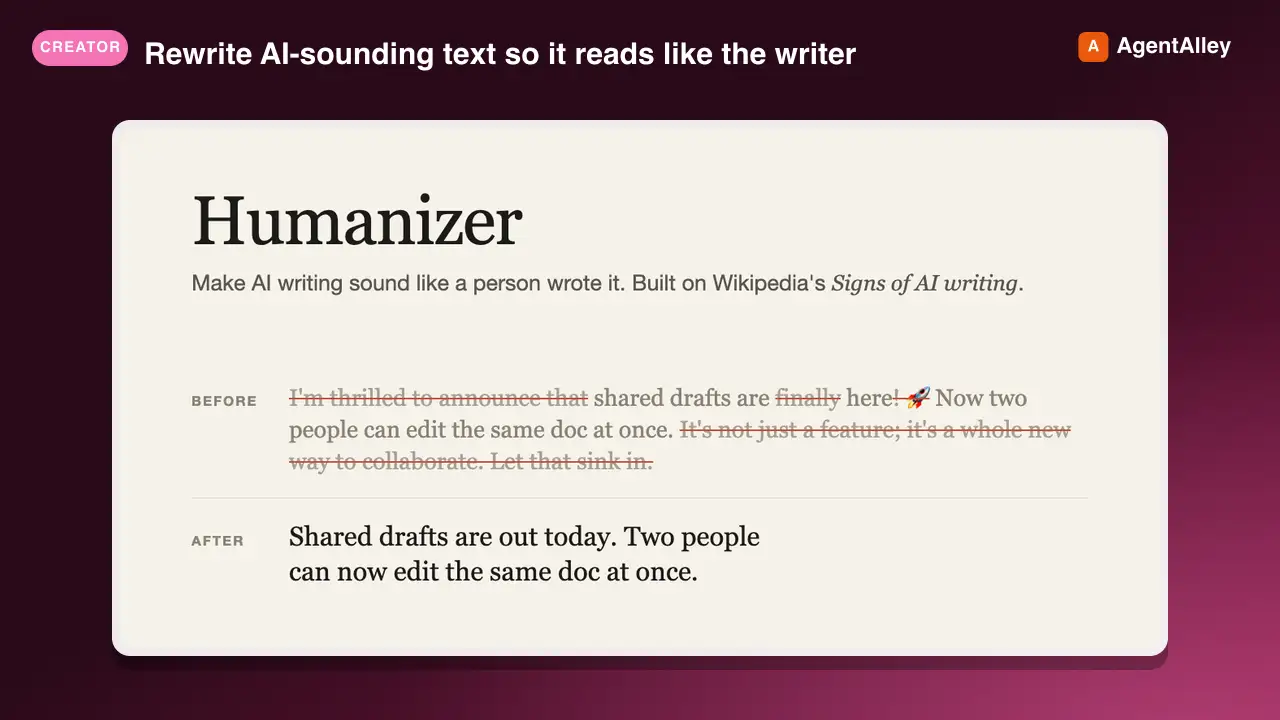 SkillProse Naturalizer
 blader/humanizer · by bladerRewrite AI-sounding text so it reads like the writer without changing what it says. Use when editing or reviewing prose for AI tells: not-X-but-Y contrasts, one-line closers, staged openers, forced triads, dashes everywhere, inflated claims, sales language, stock AI words, bold labels, or filler. Based on Wikipedia's "Signs of AI writing.★ 53.6k GitHub stars
 SkillAI Pattern Remover
 hardikpandya/stop-slop · by hardikpandyaRemove AI writing patterns from prose. Use when drafting, editing, or reviewing text to eliminate predictable AI tells.★ 17.8k GitHub stars
 SkillAI Slop Editor
 petergyang/no-ai-slop · by petergyangEdit drafts into sharper, more human writing while preserving the writer's personal voice, or detect AI-slop patterns without rewriting. Use when the user wants a draft clearer, more direct, more opinionated, or less AI-sounding, or asks whether writing reads as AI.★ 12k GitHub stars
 SkillAI Writing Pattern Detector
 conorbronsdon/avoid-ai-writing · by conorbronsdonUse when the user asks to detect, scan, audit, score, or flag AI-writing patterns without rewriting the text, including requests for a deterministic local detector result when the host can execute Node.★ 4.7k GitHub stars
 SkillAI Writing Auditorconorbronsdon/avoid-ai-writing · by conorbronsdonAudit and rewrite content to remove AI writing patterns ("AI-isms"). Use this skill when asked to "remove AI-isms," "clean up AI writing," "edit writing for AI patterns," "audit writing for AI tells," or "make this sound less like AI." Supports a detect-only mode, an edit-in-place mode for files, an optional voice profile (casual / professional / technical / warm / blunt), and an iterate-to-convergence pass.★ 4.7k GitHub stars
 SkillDe-AI Writing
 Nanako0129/sepia · by Nanako0129Make AI-generated writing read as human-written, in fiction and in professional prose. Repairs the narrative architecture of fiction and stories (based on StoryScope, arXiv:2604.03136); routes professional text through domain rules for release notes, announcements, PR and issue replies, code-review comments, incident postmortems, tickets, work orders, technical articles, blog posts, and long-form journalism. Four operations - write, review (diagnose AI tells without editing), refactor (minimal in-place edits), recreate (full rewrite). Use when asked to humanize, de-AI, unslop, or strip AI flavor from any text; when writing or revising any of these document types; or whenever output must not read as machine-written.★ 3.1k GitHub stars
More from danielmiessler
 SkillScope Oscillation Analyzer
 danielmiessler/LifeOS · by danielmiessler3-pass scope oscillation that holds a question constant while shifting zoom — narrow/tactical, wide/strategic, then synthesis — to surface design tensions, scope recommendations, and coherence assessments invisible at any single zoom level. USE WHEN aperture oscillation, oscillate scope, zoom in and out, tactical vs strategic, scope framing, design tension, system coherence check, local vs global design, wrong scope, scope negotiation. NOT FOR lens rotation across angles (use IterativeDepth).★ 19.3k GitHub stars
 SkillAphorism Library Managerdanielmiessler/LifeOS · by danielmiesslerCurated aphorism collection with CRUD — content-based matching, themed search, thinker research, DB maintenance. Quotes organized by author/theme/context/usage to prevent repetition. Four workflows: FindAphorism, AddAphorism, ResearchThinker, SearchAphorisms. Themes: Stoicism, Wisdom, Truth-seeking, Excellence, Resilience, Curiosity. USE WHEN aphorism, quote, find a quote, research thinker, add aphorism, quote for newsletter, what did X say about, quote bank. NOT FOR creative writing or social posts.★ 19.3k GitHub stars
 SkillSocial Platform Scraperdanielmiessler/LifeOS · by danielmiesslerScrapes social platforms, business data, and e-commerce via Apify actors — Instagram, LinkedIn, TikTok, YouTube, Facebook, Google Maps, Amazon, and web crawls — filtering in code. USE WHEN scrape Instagram, scrape LinkedIn, scrape TikTok, scrape YouTube, scrape Facebook, Google Maps leads, Amazon reviews, business intelligence, multi-platform social listening, competitive analysis, lead generation, social monitoring, Apify actors, web crawl, extract contacts. NOT FOR X/Twitter account operations like posting, threads, or bookmarks (those need a dedicated X API client), 4-tier progressive scraping with proxy escalation (use BrightData), or real-Chrome bot bypass and computer use (use Interceptor).★ 19.3k GitHub stars
 SkillVisual Content Generatordanielmiessler/LifeOS · by danielmiesslerStatic visual content across 20+ formats — diagrams, mermaid, infographics, D3 dashboards, comics, icons, wallpaper — via Nano Banana Pro (default), Nano Banana, and Flux. USE WHEN art, illustration, diagram, flowchart, infographic, header image, blog social thumbnail, visualize, generate image, mermaid, architecture diagram, comic, icon, blog art, framework diagram, D3 chart, remove background, wallpaper. NOT FOR locked house-style YouTube/channel/video thumbnails, video or animation (use Remotion), or web UI design and integrated frontend layout (use Webdesign).★ 19.3k GitHub stars
 SkillArXiv Paper Finderdanielmiessler/LifeOS · by danielmiesslerSearch and retrieve arXiv academic papers by topic, category, or paper ID — with AlphaXiv-enriched AI-generated overviews. Uses arXiv Atom API across cs.AI/cs.LG/cs.CL/cs.CR/cs.MA/cs.SE/cs.IR. Three workflows: Latest, Search, Paper. USE WHEN arxiv, papers, latest papers, research papers, recent ML papers, paper lookup, summarize paper, latest LLM papers, AI safety papers, cs.AI latest. NOT FOR general research (Research), URL parsing, or annual reports.★ 19.3k GitHub stars
 SkillFiller Removal Audio Editordanielmiessler/LifeOS · by danielmiesslerAI audio editing pipeline: Whisper word-level transcription → Claude segment classification (KEEP/CUT_FILLER/CUT_FALSE_START/CUT_STUTTER/CUT_DEAD_AIR) → ffmpeg with 40ms qsin crossfades and room-tone fill → optional Cleanvoice cloud polish; plus GateScan/GateRepair for noise-gate ticking artifacts. Modes: --preview, --aggressive, --polish. Workflow: Clean. USE WHEN clean audio, edit audio, remove filler words, clean podcast, remove ums, cut dead air, polish audio, trim recording, cut stutters, ticking audio, clicking audio, audio clicks, gate artifacts, popping audio. NOT FOR video composition (use Remotion).★ 19.3k GitHub stars