Agency Proposal Builder
/digital-marketing-pro:client-proposal
Draft a professional agency proposal or pitch document for a prospective client — executive summary, situation analysis, scope of services with a deliverables matrix, KPI targets with baselines and stretch goals, 2-3 pricing options,…
---
name: client-proposal
description: "Draft a professional agency proposal or pitch document for a prospective client — executive summary, situation analysis, scope of services with a deliverables matrix, KPI targets with baselines and stretch goals, 2-3 pricing options, team bio structure, case-study placeholders, terms outline, and next steps, written from the agency's perspective. Triggers on \"/digital-marketing-pro:client-proposal\", \"write a proposal for this prospect\", \"scope of work for a 6-month retainer\", \"respond to this RFP\", \"pitch deck outline with pricing tiers\". Loads the agency's own brand profile (not the client's), plus custom templates and agency SOPs; industry benchmarks inform the KPI and pricing sections."
---

# /digital-marketing-pro:client-proposal

## Purpose

Generate a professional marketing agency proposal or pitch document for a prospective client. Covers strategic analysis, service scope, deliverables, pricing, and team positioning to win new business or formalize an existing engagement with a polished, ready-to-customize document.

## Input Required

The user must provide (or will be prompted for):

- **Client business name and industry**: Who the proposal is for and their vertical/market segment
- **Services requested**: Which marketing services are in scope (SEO, PPC, social, content, email, strategy, creative, analytics, etc.)
- **Estimated budget range**: Client's stated or expected budget for marketing services (monthly or annual)
Overview
Generate a professional marketing agency proposal or pitch document for a prospective client. Covers strategic analysis, service scope, deliverables, pricing, and team positioning to win new business or formalize an existing engagement with a polished, ready-to-customize document.
What you get
- Executive summaryClient challenges, proposed approach, and expected outcomes in a compelling 1-page overview
- Situation analysisClient's current state, competitive landscape, market opportunity, and key assumptions
- Proposed strategyHigh-level strategic approach connecting services to business goals with a clear theory of change
- Scope of servicesDetailed service descriptions with deliverables, frequency, ownership matrix, and exclusions
- Deliverables timelineMonth-by-month or phase-by-phase deliverable schedule with milestones and review gates
- KPI targetsMeasurable success metrics per service line with baseline, target, and stretch goals
Manual install (npx, ZIP)
npx skills add indranilbanerjee/digital-marketing-pro --skill client-proposal -g -a claude-codenpx degit indranilbanerjee/digital-marketing-pro/skills/client-proposal#main ~/.claude/skills/client-proposalConnects with Agent Alley MCP · agentalley.io/mcp
Files included
SKILL.md6.6 KB
Read SKILL.md here
Show the full text62 lines
/digital-marketing-pro:client-proposal
Purpose
Generate a professional marketing agency proposal or pitch document for a prospective client. Covers strategic analysis, service scope, deliverables, pricing, and team positioning to win new business or formalize an existing engagement with a polished, ready-to-customize document.
Input Required
The user must provide (or will be prompted for):
- Client business name and industry: Who the proposal is for and their vertical/market segment
- Services requested: Which marketing services are in scope (SEO, PPC, social, content, email, strategy, creative, analytics, etc.)
- Estimated budget range: Client's stated or expected budget for marketing services (monthly or annual)
- Timeline: Engagement duration — 3-month pilot, 6-month contract, 12-month retainer, or project-based with defined milestones
- Key challenges/goals: What the client is trying to achieve, problems they need solved, or opportunities they want to capture
- Competitive context: Key competitors, market pressures, or differentiation challenges the client faces
- Decision criteria: What matters most to the client — price, expertise, speed, industry experience, team size, or technology
- Proposal format: Full written proposal, pitch deck outline, or scope-of-work document
- Existing relationship: New prospect, referral, existing client expansion, or RFP response
- Internal team available: Agency team members who would staff the account (for team bio section)
Process
- Load brand context: Read
~/.claude-marketing/brands/_active-brand.jsonfor the active slug, then load~/.claude-marketing/brands/{slug}/profile.json. Apply brand voice, compliance rules for target markets (skills/context-engine/compliance-rules.md), and industry context. The loaded brand should be the agency brand — the proposal will be written from the agency's perspective. Also check for guidelines at~/.claude-marketing/brands/{slug}/guidelines/_manifest.json— if present, load restrictions and relevant category files. Check for custom templates at~/.claude-marketing/brands/{slug}/templates/. Check for agency SOPs at~/.claude-marketing/sops/. If no brand exists, ask: "Set up a brand first (/digital-marketing-pro:brand-setup)?" — or proceed with defaults. - Research client industry benchmarks: Pull relevant industry performance data, typical marketing spend ratios, competitive landscape patterns, and common pain points for the client's vertical
- Define proposed scope of services: Map requested services to specific deliverables, ownership (agency vs. client), frequency, and dependencies between service lines
- Build deliverables matrix with timelines: Create a detailed breakdown of every deliverable, its cadence (weekly, monthly, quarterly), responsible party, and approval workflow
- Create KPI framework with realistic targets: Set measurable goals for each service line — baseline assumptions, 90-day targets, 6-month targets, and stretch goals tied to business outcomes
- Design pricing structure: Develop 2-3 pricing options — retainer-based, project-based, or performance-based models with clear scope boundaries, overage terms, and upgrade paths
- Include case study references: Frame placeholders for relevant case studies or past results that demonstrate capability in the client's industry, service area, or challenge type
- Draft executive summary: Write a compelling 1-page overview that connects the client's specific challenges to the proposed solution and expected outcomes
- Build team and process overview: Outline the account team structure, communication cadence (weekly calls, monthly reports, quarterly reviews), reporting rhythm, and escalation process
- Include terms and conditions framework: Draft standard engagement terms covering scope change process, payment terms, IP ownership, confidentiality, data handling, performance guarantees, and termination clauses
- Add competitive differentiation: Articulate why the agency is the right choice based on the client's stated decision criteria — without naming competitors directly
Output
A structured client proposal document containing:
- Executive summary: Client challenges, proposed approach, and expected outcomes in a compelling 1-page overview
- Situation analysis: Client's current state, competitive landscape, market opportunity, and key assumptions
- Proposed strategy: High-level strategic approach connecting services to business goals with a clear theory of change
- Scope of services: Detailed service descriptions with deliverables, frequency, ownership matrix, and exclusions
- Deliverables timeline: Month-by-month or phase-by-phase deliverable schedule with milestones and review gates
- KPI targets: Measurable success metrics per service line with baseline, target, and stretch goals
- Pricing options: 2-3 pricing tiers or models with clear scope definitions, add-on options, and payment schedule
- Team bios section: Account team structure with role descriptions and placeholder bios to be filled with actual team members
- Case study framework: Structured placeholders for 2-3 relevant past engagements showing challenge, approach, and results
- Terms outline: Standard engagement terms covering scope, payment, IP, confidentiality, data, and termination
- Next steps: Clear action items with dates for moving from proposal to signed engagement
- Investment justification: ROI framework showing how the proposed services connect to measurable business outcomes
- Risk and assumptions: Key assumptions underpinning projections and risks that could affect delivery or results
Agents Used
- marketing-strategist — Strategic positioning, service scoping, KPI framework, competitive analysis, proposal narrative, industry benchmarking
| 1 | |
| 2 | name client-proposal |
| 3 | description "Draft a professional agency proposal or pitch document for a prospective client — executive summary, situation analysis, scope of services with a deliverables matrix, KPI targets with baselines and stretch goals, 2-3 pricing options, team bio structure, case-study placeholders, terms outline, and next steps, written from the agency's perspective. Triggers on \"/digital-marketing-pro:client-proposal\", \"write a proposal for this prospect\", \"scope of work for a 6-month retainer\", \"respond to this RFP\", \"pitch deck outline with pricing tiers\". Loads the agency's own brand profile (not the client's), plus custom templates and agency SOPs; industry benchmarks inform the KPI and pricing sections." |
| 4 | |
| 5 | |
| 6 | # /digital-marketing-pro:client-proposal |
| 7 | |
| 8 | ## Purpose |
| 9 | |
| 10 | Generate a professional marketing agency proposal or pitch document for a prospective client. Covers strategic analysis, service scope, deliverables, pricing, and team positioning to win new business or formalize an existing engagement with a polished, ready-to-customize document. |
| 11 | |
| 12 | ## Input Required |
| 13 | |
| 14 | The user must provide (or will be prompted for): |
| 15 | |
| 16 | **Client business name and industry**: Who the proposal is for and their vertical/market segment |
| 17 | **Services requested**: Which marketing services are in scope (SEO, PPC, social, content, email, strategy, creative, analytics, etc.) |
| 18 | **Estimated budget range**: Client's stated or expected budget for marketing services (monthly or annual) |
| 19 | **Timeline**: Engagement duration — 3-month pilot, 6-month contract, 12-month retainer, or project-based with defined milestones |
| 20 | **Key challenges/goals**: What the client is trying to achieve, problems they need solved, or opportunities they want to capture |
| 21 | **Competitive context**: Key competitors, market pressures, or differentiation challenges the client faces |
| 22 | **Decision criteria**: What matters most to the client — price, expertise, speed, industry experience, team size, or technology |
| 23 | **Proposal format**: Full written proposal, pitch deck outline, or scope-of-work document |
| 24 | **Existing relationship**: New prospect, referral, existing client expansion, or RFP response |
| 25 | **Internal team available**: Agency team members who would staff the account (for team bio section) |
| 26 | |
| 27 | ## Process |
| 28 | |
| 29 | **Load brand context**: Read `~/.claude-marketing/brands/_active-brand.json` for the active slug, then load `~/.claude-marketing/brands/{slug}/profile.json`. Apply brand voice, compliance rules for target markets (`skills/context-engine/compliance-rules.md`), and industry context. The loaded brand should be the **agency brand** — the proposal will be written from the agency's perspective. **Also check for guidelines** at `~/.claude-marketing/brands/{slug}/guidelines/_manifest.json` — if present, load restrictions and relevant category files. Check for custom templates at `~/.claude-marketing/brands/{slug}/templates/`. Check for agency SOPs at `~/.claude-marketing/sops/`. If no brand exists, ask: "Set up a brand first (/digital-marketing-pro:brand-setup)?" — or proceed with defaults. |
| 30 | **Research client industry benchmarks**: Pull relevant industry performance data, typical marketing spend ratios, competitive landscape patterns, and common pain points for the client's vertical |
| 31 | **Define proposed scope of services**: Map requested services to specific deliverables, ownership (agency vs. client), frequency, and dependencies between service lines |
| 32 | **Build deliverables matrix with timelines**: Create a detailed breakdown of every deliverable, its cadence (weekly, monthly, quarterly), responsible party, and approval workflow |
| 33 | **Create KPI framework with realistic targets**: Set measurable goals for each service line — baseline assumptions, 90-day targets, 6-month targets, and stretch goals tied to business outcomes |
| 34 | **Design pricing structure**: Develop 2-3 pricing options — retainer-based, project-based, or performance-based models with clear scope boundaries, overage terms, and upgrade paths |
| 35 | **Include case study references**: Frame placeholders for relevant case studies or past results that demonstrate capability in the client's industry, service area, or challenge type |
| 36 | **Draft executive summary**: Write a compelling 1-page overview that connects the client's specific challenges to the proposed solution and expected outcomes |
| 37 | **Build team and process overview**: Outline the account team structure, communication cadence (weekly calls, monthly reports, quarterly reviews), reporting rhythm, and escalation process |
| 38 | **Include terms and conditions framework**: Draft standard engagement terms covering scope change process, payment terms, IP ownership, confidentiality, data handling, performance guarantees, and termination clauses |
| 39 | **Add competitive differentiation**: Articulate why the agency is the right choice based on the client's stated decision criteria — without naming competitors directly |
| 40 | |
| 41 | ## Output |
| 42 | |
| 43 | A structured client proposal document containing: |
| 44 | |
| 45 | **Executive summary**: Client challenges, proposed approach, and expected outcomes in a compelling 1-page overview |
| 46 | **Situation analysis**: Client's current state, competitive landscape, market opportunity, and key assumptions |
| 47 | **Proposed strategy**: High-level strategic approach connecting services to business goals with a clear theory of change |
| 48 | **Scope of services**: Detailed service descriptions with deliverables, frequency, ownership matrix, and exclusions |
| 49 | **Deliverables timeline**: Month-by-month or phase-by-phase deliverable schedule with milestones and review gates |
| 50 | **KPI targets**: Measurable success metrics per service line with baseline, target, and stretch goals |
| 51 | **Pricing options**: 2-3 pricing tiers or models with clear scope definitions, add-on options, and payment schedule |
| 52 | **Team bios section**: Account team structure with role descriptions and placeholder bios to be filled with actual team members |
| 53 | **Case study framework**: Structured placeholders for 2-3 relevant past engagements showing challenge, approach, and results |
| 54 | **Terms outline**: Standard engagement terms covering scope, payment, IP, confidentiality, data, and termination |
| 55 | **Next steps**: Clear action items with dates for moving from proposal to signed engagement |
| 56 | **Investment justification**: ROI framework showing how the proposed services connect to measurable business outcomes |
| 57 | **Risk and assumptions**: Key assumptions underpinning projections and risks that could affect delivery or results |
| 58 | |
| 59 | ## Agents Used |
| 60 | |
| 61 | **marketing-strategist** — Strategic positioning, service scoping, KPI framework, competitive analysis, proposal narrative, industry benchmarking |
| 62 |
Details
- License
- MIT
- Stars on the repo
- ★ 834
- Checked
- Source
- indranilbanerjee/digital-marketing-pro ↗
- Creator
- indranilbanerjee · 114 listings
Similar skills
See all → SkillAphorism Library Manager
 danielmiessler/LifeOS · by danielmiesslerCurated aphorism collection with CRUD — content-based matching, themed search, thinker research, DB maintenance. Quotes organized by author/theme/context/usage to prevent repetition. Four workflows: FindAphorism, AddAphorism, ResearchThinker, SearchAphorisms. Themes: Stoicism, Wisdom, Truth-seeking, Excellence, Resilience, Curiosity. USE WHEN aphorism, quote, find a quote, research thinker, add aphorism, quote for newsletter, what did X say about, quote bank. NOT FOR creative writing or social posts.★ 19.3k GitHub stars
 SkillCommercial Deal Negotiator
 cbrock84/headcount · by cbrock84Negotiates a commercial deal without giving away the terms that matter — preparing your walk-away and theirs, trading concessions rather than conceding them, recognizing the tactics that create false urgency, protecting price by moving other variables, and closing on terms someone can actually deliver. Use this to prepare for a negotiation, respond to a demand mid-deal, work out why discounts keep landing at quarter end, or review terms before they are signed.★ 2k GitHub stars
 SkillNegotiation & Influence
 samber/cc-skills · by samberInfluence and negotiation toolkit for any interaction needing another person's agreement, even when the user never says 'negotiation'. Covers B2B sales, salary reviews and raise asks, collective bargaining and unions, hard 1:1s, recruitment closes, cross-cultural deals, mediation, and diplomatic messages — declining, pushing back on scope, justifying a delay, raising a concern, getting alignment. Use when the user says 'they just said X, what do I say' or 'draft a reply', or mentions a buyer, champion, procurement, RFP, sponsor, HR, union, or candidate, or a pushback, refusal, ghosting, no-decision, escalation, fixed budget, counter-offer, comp band, strike, BATNA, anchor, or concession.★ 222 GitHub stars
 SkillProfessional Case Study Builder
 realjaymes/marketingagentskills · by realjaymesCreates professional case studies, engagement summaries, and project summaries. Use when the user wants to create a 'case study,' 'client success story,' 'engagement summary,' 'project summary,' or 'portfolio piece.'★ 65 GitHub stars
 SkillUnslop Design Review
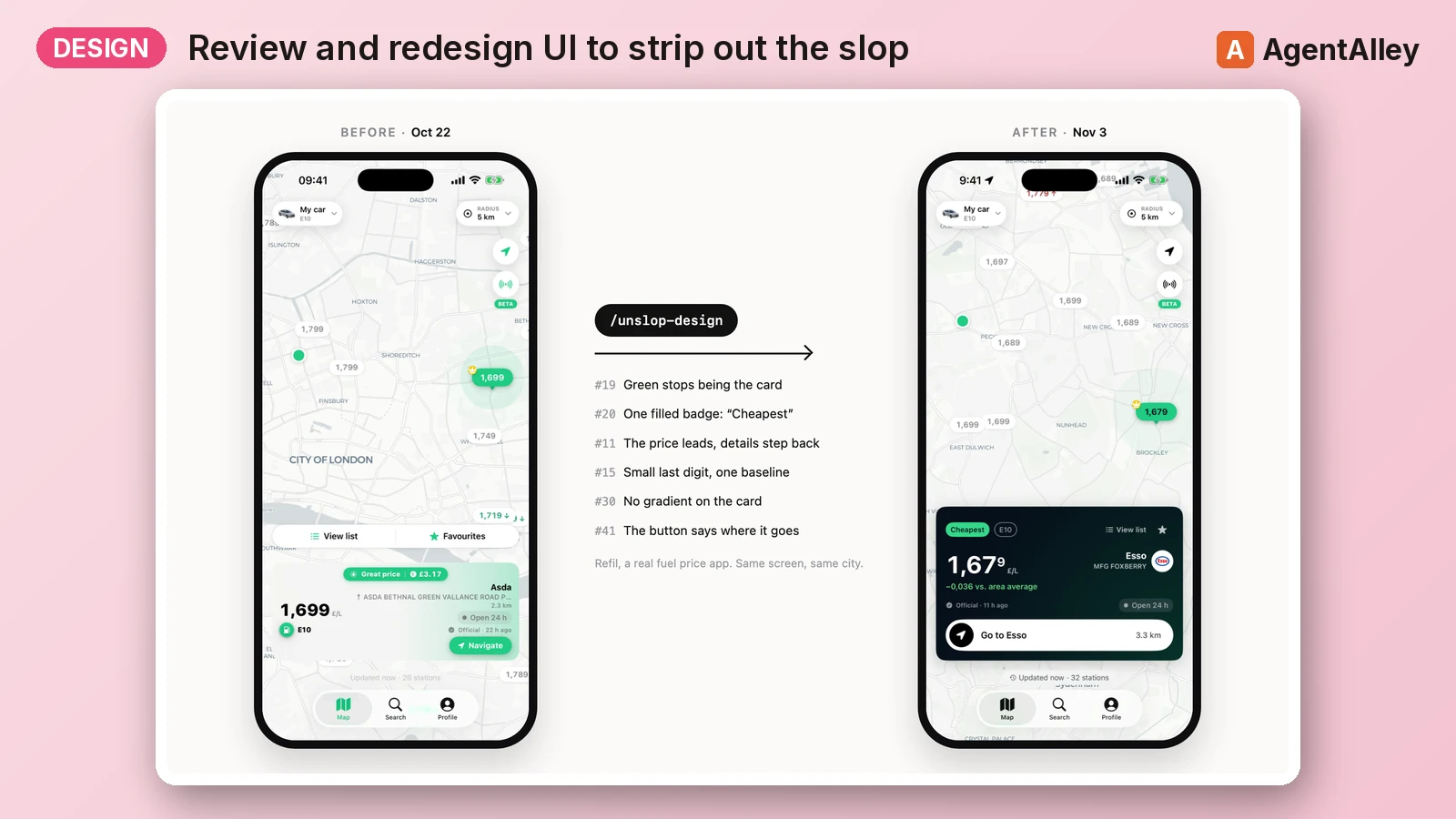
 marcosnovo/unslop-design · by marcosnovoReview and redesign an app or website UI to strip out the "slop" (decorative accent color, gradients, glows, noisy badges, emoji as icons, eyeballed spacing, greetings as titles, Title Case, flat hierarchy, repeated numbers) with a system (spacing, type, color roles, elevation) and two modes: a quick five-fix pass for one screen, or an orchestrated process for a whole app (parallel reviewers, a published winning proposal, devs per area, audits, PR). Covers SwiftUI, Compose and web (dashboards, landing pages, Tailwind), with scripts that scan the code, measure the rendered page and score it from 0 to 100. Use it when asked to "review the design", "make it look less AI", "unslop", "polish this screen", "design review", "winning proposal", "audit this dashboard", or when given videos or screenshots of an app or site asking for feedback or a redesign. Also use it to start a design system (spacing, type, palette, shadow scales) or to audit tokens, contrast or consistency across screens.★ 14 GitHub stars
 SkillYouTube to Case Study Converter
 tstfully/youtube-to-case-study · by tstfullyTurn any YouTube video (founder interview, product teardown, conference talk, marketing breakdown, UX walkthrough, podcast) into a beautiful case-study slideshow: one HTML file that opens in any browser, built on reveal.js, with speaker notes and every fact linked to the exact second in the video. Use this skill whenever someone wants a case study, business case study, marketing case study, UX case study, product teardown, growth teardown, competitor breakdown, swipe file, lesson deck, or presentation / slides / deck from a YouTube video or link. Also trigger on 'turn this video into a case study', 'make slides from this YouTube video', 'case study from this talk', 'teardown of this video', 'youtube to slides', 'youtube to presentation', or 'summarize this video as a deck'. Works for marketers, educators, product managers, students, and consultants; no coding needed.★ 3 GitHub stars
More from indranilbanerjee
 SkillA/B Test Planner
 indranilbanerjee/digital-marketing-pro · by indranilbanerjeePlan an A/B test by script: sample size per variant, days to run, stopping rules. "how many visitors per variant"★ 866 GitHub stars
 SkillAgency Client Dashboardindranilbanerjee/digital-marketing-pro · by indranilbanerjeeBuild the agency dashboard across all client brands: health, pacing, risk. "how are all our clients doing"★ 866 GitHub stars
 SkillAgent Readiness Auditindranilbanerjee/digital-marketing-pro · by indranilbanerjeeAudit agent readiness by script: AI-crawler rules, product schema, no-JS HTML, feeds. "can AI agents use our site"★ 866 GitHub stars
 SkillMarketing Anomaly Detectorindranilbanerjee/digital-marketing-pro · by indranilbanerjeeScan connected platforms for anomalies against stored baselines, with likely causes. "why did our CPA spike"★ 866 GitHub stars
 SkillAttribution Model Designerindranilbanerjee/digital-marketing-pro · by indranilbanerjeeDesign an attribution model and credit rules. Real path data → attribution-report. "set up multi-touch attribution"★ 866 GitHub stars
 SkillAttribution Model Comparisonindranilbanerjee/digital-marketing-pro · by indranilbanerjeeRun attribution on real conversion paths, comparing models. "which channels actually drive revenue"★ 866 GitHub stars