Multilingual Blog Publisher
Blog Multilingual, One-Command International Publishing
One-command multilingual blog creation. Writes a blog post, translates it into user-specified languages, applies cultural adaptation, and emits hreflang tags, sitemap entries, and a CMS-ready language map.
---
name: blog-multilingual
description: >
  One-command multilingual blog creation. Writes a blog post, translates it
  into user-specified languages, applies cultural adaptation, and emits
  hreflang tags, sitemap entries, and a CMS-ready language map. The complete
  write-to-publish pipeline for international content. Orchestrates blog-write,
  blog-translate, blog-localize, and (optionally) seo-hreflang.
  Use when user says "multilingual blog", "blog multilingual", "write in
  multiple languages", "international blog", "mehrsprachiger Blog", "blog
  multilingue", "blog multilingue", "create blog in German and French".
user-invokable: true
argument-hint: "<topic> --languages <comma-separated-codes>"
license: MIT
compatibility: Requires claude-blog (blog-write). Optional integration with claude-seo (seo-hreflang) for richer hreflang validation.
metadata:
  author: AgriciDaniel
  version: "2.2.0"
Overview
The flagship multilingual orchestrator. Combines blog writing, translation, cultural adaptation, and full international SEO into a single command. Produces publication-ready blog posts in every target language with hreflang tags, localized JSON-LD schema, and CMS-integration metadata.
Manual install (npx, ZIP)
npx skills add AgriciDaniel/claude-blog --skill blog-multilingual -g -a claude-codemkdir -p ~/.claude/skills && curl -sL https://codeload.github.com/AgriciDaniel/claude-blog/tar.gz/2500d4c76503 \
| tar -xz -C ~/.claude/skills --strip-components=2 claude-blog-2500d4c76503/skills/blog-multilingualNew-Item -ItemType Directory -Force "$HOME\.claude\skills" | Out-Null; Invoke-WebRequest "https://m.agentalley.io/zip/79b1616d106352b71ff6/blog-multilingual.zip" -OutFile "$env:TEMP\blog-multilingual.zip"; Expand-Archive "$env:TEMP\blog-multilingual.zip" -DestinationPath "$HOME\.claude\skills" -ForceConnects with Agent Alley MCP · agentalley.io/mcp
Files included
SKILL.md13.2 KB
Read the files here
AgriciDaniel/
Show the full text343 lines
Blog Multilingual, One-Command International Publishing
The flagship multilingual orchestrator. Combines blog writing, translation, cultural adaptation, and full international SEO into a single command. Produces publication-ready blog posts in every target language with hreflang tags, localized JSON-LD schema, and CMS-integration metadata.
Adapted from
claude-blog-multilingualby Chris Mueller (AI Marketing Hub Pro Hub Challenge submission, March 2026, scored 85/100 Proficient). Original: https://github.com/Chriss54/multilingual-int This port removes the originalcurl | bashinstaller and credential handling flagged in the audit, integrates as core skills, and uses the shared cultural-adaptation reference underblog-translate/references/.
Dependencies
Invoked internally by this orchestrator:
| Component | Source | Required |
|---|---|---|
blog-write |
claude-blog (this plugin) | Yes |
blog-translate |
claude-blog (this plugin) | Yes |
blog-localize |
claude-blog (this plugin) | Yes (when --localize is on, default) |
seo-hreflang |
claude-seo (sibling plugin) | No, falls back to a self-contained generator |
If seo-hreflang is not installed, the orchestrator emits hreflang tags using
its own minimal generator (Phase 5 below) and notes the limitation in the
delivery summary. Hreflang validation in that case is structural only, not the
deeper validation seo-hreflang provides.
Command Syntax
/blog multilingual <topic> --languages <lang1,lang2,...> [--source <lang>] [--no-localize] [--format <md|mdx|html>]
| Argument | Required | Default | Description |
|---|---|---|---|
<topic> |
Yes | required | Blog topic or working title |
--languages |
Yes | required | Comma-separated Google-compatible hreflang tags (e.g. de,fr,es-MX,ja,pt-BR) |
--source |
No | en |
Source language to write the original in |
--no-localize |
No | off | Skip cultural adaptation (translation only) |
--format |
No | auto | Output format: md, mdx, or html |
If --languages is missing, ask the user once before running anything:
"Which languages should the blog be published in? Provide hreflang tags
separated by commas (e.g., de,fr,es-MX,ja,pt-BR). The post will be written
in <source> first, then translated."
Workflow
Phase 1: Configuration
- Parse arguments. Extract topic, target languages, source, format.
- Validate each language code with the shared multilingual locale rules used
by
blog-translate,blog-localize, andblog-locale-audit: ISO 639-1 language in lowercase, optional ISO 15924 script in title case, optional ISO 3166-1 Alpha-2 region in uppercase. Require a region or explicit neutral mode for ambiguous language-only targets such ases,pt, andzh. - Detect output format from the project (frontmatter convention, file
extensions, framework hints) or use
--format. - Resolve source language. If a target language equals
--source, drop it from the translation list with a notice. - Create the output directory inside the current working directory:
Keep all output inside the project root; do not write outside the cwd.multilingual/ {source-lang}/ {lang-1}/ {lang-2}/ ...
Progress: Phase 1: Configuration complete, [N] languages selected ([codes])
Phase 2: Write Original Blog
Invoke the blog-write sub-skill (route through /blog write so all
existing rules apply: template auto-selection, sourced statistics, citation
capsules, Article schema priority, FAQPage only as an entity signal when
visible FAQ content exists, internal-link zones, charts, image embedding). Pass the
topic and any blog-write parameters surfaced by the user.
Save the original to multilingual/{source-lang}/{slug}.{ext}.
Progress: Phase 2: Original written, multilingual/{source-lang}/{slug}.{ext}
Phase 3: Translate to All Target Languages
For each target language, invoke blog-translate:
- Input: the original blog post produced in Phase 2.
- Target: the specific language code.
- Run targets in parallel where the runtime supports it (one Task per language) to reduce wall-clock time.
Save translations to multilingual/{lang}/{localized-slug}.{ext}.
Progress: Phase 3: Translating to [lang] ([X]/[N]) per language, then
Phase 3: All translations complete.
Phase 4: Cultural Adaptation
If --no-localize is NOT set, invoke blog-localize for every translated
post:
- Input: the translated blog post.
- Locale: the target language or region code.
- Run in parallel.
Apply the localized output only after resolving the generated path inside
multilingual/, rejecting symlinks, and creating a backup when overwriting.
The localizer swaps brand examples, adapts CTAs, substitutes legal
references, and adjusts formality. See
../blog-localize/SKILL.md for the full adaptation pass.
Progress: Phase 4: Cultural adaptation complete for [N] languages.
Phase 5: International SEO Generation
Generate three artifacts plus localized schema. If the seo-hreflang skill
from claude-seo is installed, delegate validation to it. Otherwise use the
self-contained generator below.
5a. Hreflang Tags (HTML)
Copy-paste ready tags for <head>:
<!-- Hreflang tags. Paste into <head> of each language version. -->
<link rel="alternate" hreflang="{source}" href="https://example.com/{source-url}" />
<link rel="alternate" hreflang="{lang-1}" href="https://example.com/{lang-1-url}" />
<link rel="alternate" hreflang="{lang-2}" href="https://example.com/{lang-2-url}" />
<link rel="alternate" hreflang="x-default" href="https://example.com/{fallback-url}" />
Rules (mirrored from seo-hreflang):
- Every page references all alternates including itself (self-referencing).
- Every
href, includingx-default, is a fully qualified absolutehttps://...URL. x-defaultpoints to the unmatched-language fallback, such as a global language selector or default market page. It does not have to be the source language version.- All URLs use the same protocol (HTTPS) and trailing-slash convention.
- Bidirectional: every relationship is reciprocal.
Save to multilingual/hreflang-tags.html.
5b. Hreflang Sitemap Fragment
<?xml version="1.0" encoding="UTF-8"?>
<urlset xmlns="http://www.sitemaps.org/schemas/sitemap/0.9"
        xmlns:xhtml="http://www.w3.org/1999/xhtml">
  <url>
    <loc>https://example.com/{source-url}</loc>
    <xhtml:link rel="alternate" hreflang="{source}" href="https://example.com/{source-url}" />
    <xhtml:link rel="alternate" hreflang="{lang-1}" href="https://example.com/{lang-1-url}" />
    <xhtml:link rel="alternate" hreflang="{lang-2}" href="https://example.com/{lang-2-url}" />
    <xhtml:link rel="alternate" hreflang="x-default" href="https://example.com/{fallback-url}" />
  </url>
  <url>
    <loc>https://example.com/{lang-1-url}</loc>
    <xhtml:link rel="alternate" hreflang="{source}" href="https://example.com/{source-url}" />
    <xhtml:link rel="alternate" hreflang="{lang-1}" href="https://example.com/{lang-1-url}" />
    <xhtml:link rel="alternate" hreflang="{lang-2}" href="https://example.com/{lang-2-url}" />
    <xhtml:link rel="alternate" hreflang="x-default" href="https://example.com/{fallback-url}" />
  </url>
  <url>
    <loc>https://example.com/{lang-2-url}</loc>
    <xhtml:link rel="alternate" hreflang="{source}" href="https://example.com/{source-url}" />
    <xhtml:link rel="alternate" hreflang="{lang-1}" href="https://example.com/{lang-1-url}" />
    <xhtml:link rel="alternate" hreflang="{lang-2}" href="https://example.com/{lang-2-url}" />
    <xhtml:link rel="alternate" hreflang="x-default" href="https://example.com/{fallback-url}" />
  </url>
</urlset>
Generate one <url> block per locale. Every block must contain the identical
complete set of <xhtml:link> alternates for every locale, plus self and
optional x-default, using fully qualified https://... URLs.
Save to multilingual/hreflang-sitemap.xml.
5c. Hreflang Map (JSON)
Machine-readable mapping for CMS integration:
{
  "sourceSlug": "how-to-avoid-ai-slop",
  "sourceLanguage": "en",
  "generatedDate": "YYYY-MM-DD",
  "versions": [
    {
      "lang": "en",
      "locale": "en",
      "hreflang": "en",
      "slug": "how-to-avoid-ai-slop",
      "file": "en/how-to-avoid-ai-slop.md",
      "url": "https://example.com/en/how-to-avoid-ai-slop/",
      "canonical": "https://example.com/en/how-to-avoid-ai-slop/",
      "xDefault": true,
      "title": "How to Avoid AI Slop in 2026",
      "description": "..."
    },
    {
      "lang": "de",
      "locale": "de-DE",
      "hreflang": "de-DE",
      "slug": "wie-man-ki-slop-vermeidet",
      "file": "de/wie-man-ki-slop-vermeidet.md",
      "url": "https://example.com/de/wie-man-ki-slop-vermeidet/",
      "canonical": "https://example.com/de/wie-man-ki-slop-vermeidet/",
      "xDefault": false,
      "title": "KI-Slop vermeiden in 2026",
      "description": "..."
    }
  ],
  "hreflang": {
    "method": "html",
    "x-default": "https://example.com/"
  }
}
Save to multilingual/hreflang-map.json.
5d. Localized Article Schema (Required)
Attach or update Article/BlogPosting JSON-LD on every language version with
inLanguage and translationOfWork fields:
{
  "@context": "https://schema.org",
  "@type": "BlogPosting",
  "headline": "[Localized title]",
  "description": "[Localized description]",
  "inLanguage": "[lang-code]",
  "isPartOf": { "@type": "Blog", "inLanguage": "[lang-code]" },
  "translationOfWork": {
    "@type": "BlogPosting",
    "inLanguage": "[source-lang]",
    "url": "[source-url]"
  }
}
Use the existing /blog schema sub-skill for richer schema on each version.
Keep Article/BlogPosting, Person, Organization, and BreadcrumbList as the
priority stack. FAQPage is optional and only for visible FAQ content as an
entity and AI-citation signal, not a Google rich result target.
Phase 6: Delivery Summary
## Multilingual blog complete: [Title]

### Original
- Language: [source]
- File: multilingual/{source}/{slug}.{ext}

### Translations
| Language | File | Localized | Keywords adapted |
|----------|------|-----------|------------------|
| de | multilingual/de/{slug}.md | yes | [N] |
| fr | multilingual/fr/{slug}.md | yes | [N] |
| es | multilingual/es/{slug}.md | yes | [N] |

### International SEO assets
- multilingual/hreflang-tags.html
- multilingual/hreflang-sitemap.xml
- multilingual/hreflang-map.json
- Localized Article schema embedded per version

### Total
- [N] posts in [N] languages
- [N] SEO assets generated

### Next steps
- Replace `{source-url}`, `{lang-1-url}`, `{lang-2-url}`, and
  `{fallback-url}` placeholders in hreflang tags with real absolute HTTPS
  URLs.
- Merge `hreflang-sitemap.xml` into your existing sitemap.
- Run `/blog locale-audit multilingual/` to verify completeness.
- Resolve `[INTERNAL-LINK]` placeholders with locale-specific URLs.
- If claude-seo is installed, run `/seo hreflang multilingual/` for
  deeper validation.
Cross-References
| When | Run |
|---|---|
| To regenerate or reword the source | /blog write <topic> |
| To translate one existing file only | /blog translate <file> --to <codes> |
| To deepen cultural fit on one file | /blog localize <file> --locale <code> |
| To audit a multilingual directory | /blog locale-audit <directory> |
| For deeper hreflang validation | /seo hreflang <directory> (claude-seo, optional) |
Error Handling
| Scenario | Action |
|---|---|
blog-write missing |
Error: "This skill requires blog-write. Reinstall claude-blog." |
| One translation fails | Complete the rest, report partial results, suggest a retry command |
| Source language equals a target | Skip that target, log a notice |
| 10 or more target languages | Stop before writing. Explain scaled-content-abuse risk and require reviewed batches of at most 9 target languages |
seo-hreflang not installed |
Use the self-contained generator, note it in the summary |
Commands Recap
| Command | Purpose |
|---|---|
/blog multilingual <topic> --languages de,fr,es |
Write source, translate, localize, emit hreflang assets |
/blog translate <file> --to de,fr,es |
Translate one file into target languages |
/blog localize <file> --locale de-DE |
Cultural deep-adaptation of one translated file |
/blog locale-audit <directory> |
Multilingual QA across a directory |
| 1 | |
| 2 | name blog-multilingual |
| 3 | description > |
| 4 | One-command multilingual blog creation. Writes a blog post, translates it |
| 5 | into user-specified languages, applies cultural adaptation, and emits |
| 6 | hreflang tags, sitemap entries, and a CMS-ready language map. The complete |
| 7 | write-to-publish pipeline for international content. Orchestrates blog-write, |
| 8 | blog-translate, blog-localize, and (optionally) seo-hreflang. |
| 9 | Use when user says "multilingual blog", "blog multilingual", "write in |
| 10 | multiple languages", "international blog", "mehrsprachiger Blog", "blog |
| 11 | multilingue", "blog multilingue", "create blog in German and French". |
| 12 | user-invokable true |
| 13 | argument-hint "<topic> --languages <comma-separated-codes>" |
| 14 | license MIT |
| 15 | compatibility Requires claude-blog (blog-write). Optional integration with claude-seo (seo-hreflang) for richer hreflang validation. |
| 16 | metadata |
| 17 | author AgriciDaniel |
| 18 | version "2.2.0" |
| 19 | category blog |
| 20 | |
| 21 | |
| 22 | # Blog Multilingual, One-Command International Publishing |
| 23 | |
| 24 | The flagship multilingual orchestrator. Combines blog writing, translation, |
| 25 | cultural adaptation, and full international SEO into a single command. |
| 26 | Produces publication-ready blog posts in every target language with hreflang |
| 27 | tags, localized JSON-LD schema, and CMS-integration metadata. |
| 28 | |
| 29 | > Adapted from `claude-blog-multilingual` by Chris Mueller (AI Marketing Hub |
| 30 | > Pro Hub Challenge submission, March 2026, scored 85/100 Proficient). |
| 31 | > Original: https://github.com/Chriss54/multilingual-int |
| 32 | > This port removes the original `curl | bash` installer and credential |
| 33 | > handling flagged in the audit, integrates as core skills, and uses the |
| 34 | > shared cultural-adaptation reference under `blog-translate/references/`. |
| 35 | |
| 36 | ## Dependencies |
| 37 | |
| 38 | Invoked internally by this orchestrator: |
| 39 | |
| 40 | | Component | Source | Required | |
| 41 | |-----------|--------|----------| |
| 42 | | `blog-write` | claude-blog (this plugin) | Yes | |
| 43 | | `blog-translate` | claude-blog (this plugin) | Yes | |
| 44 | | `blog-localize` | claude-blog (this plugin) | Yes (when `--localize` is on, default) | |
| 45 | | `seo-hreflang` | claude-seo (sibling plugin) | No, falls back to a self-contained generator | |
| 46 | |
| 47 | If `seo-hreflang` is not installed, the orchestrator emits hreflang tags using |
| 48 | its own minimal generator (Phase 5 below) and notes the limitation in the |
| 49 | delivery summary. Hreflang validation in that case is structural only, not the |
| 50 | deeper validation `seo-hreflang` provides. |
| 51 | |
| 52 | ## Command Syntax |
| 53 | |
| 54 | |
| 55 | /blog multilingual <topic> --languages <lang1,lang2,...> [--source <lang>] [--no-localize] [--format <md|mdx|html>] |
| 56 | |
| 57 | |
| 58 | | Argument | Required | Default | Description | |
| 59 | |----------|----------|---------|-------------| |
| 60 | | `<topic>` | Yes | required | Blog topic or working title | |
| 61 | | `--languages` | Yes | required | Comma-separated Google-compatible hreflang tags (e.g. `de,fr,es-MX,ja,pt-BR`) | |
| 62 | | `--source` | No | `en` | Source language to write the original in | |
| 63 | | `--no-localize` | No | off | Skip cultural adaptation (translation only) | |
| 64 | | `--format` | No | auto | Output format: `md`, `mdx`, or `html` | |
| 65 | |
| 66 | If `--languages` is missing, ask the user once before running anything: |
| 67 | "Which languages should the blog be published in? Provide hreflang tags |
| 68 | separated by commas (e.g., `de,fr,es-MX,ja,pt-BR`). The post will be written |
| 69 | in `<source>` first, then translated." |
| 70 | |
| 71 | ## Workflow |
| 72 | |
| 73 | ### Phase 1: Configuration |
| 74 | |
| 75 | Parse arguments. Extract topic, target languages, source, format. |
| 76 | Validate each language code with the shared multilingual locale rules used |
| 77 | by `blog-translate`, `blog-localize`, and `blog-locale-audit`: ISO 639-1 |
| 78 | language in lowercase, optional ISO 15924 script in title case, optional |
| 79 | ISO 3166-1 Alpha-2 region in uppercase. Require a region or explicit |
| 80 | neutral mode for ambiguous language-only targets such as `es`, `pt`, and |
| 81 | `zh`. |
| 82 | Detect output format from the project (frontmatter convention, file |
| 83 | extensions, framework hints) or use `--format`. |
| 84 | Resolve source language. If a target language equals `--source`, drop it |
| 85 | from the translation list with a notice. |
| 86 | Create the output directory inside the current working directory: |
| 87 | |
| 88 | multilingual/ |
| 89 | {source-lang}/ |
| 90 | {lang-1}/ |
| 91 | {lang-2}/ |
| 92 | ... |
| 93 | |
| 94 | Keep all output inside the project root; do not write outside the cwd. |
| 95 | |
| 96 | Progress: `Phase 1: Configuration complete, [N] languages selected ([codes])` |
| 97 | |
| 98 | ### Phase 2: Write Original Blog |
| 99 | |
| 100 | Invoke the `blog-write` sub-skill (route through `/blog write` so all |
| 101 | existing rules apply: template auto-selection, sourced statistics, citation |
| 102 | capsules, Article schema priority, FAQPage only as an entity signal when |
| 103 | visible FAQ content exists, internal-link zones, charts, image embedding). Pass the |
| 104 | topic and any blog-write parameters surfaced by the user. |
| 105 | |
| 106 | Save the original to `multilingual/{source-lang}/{slug}.{ext}`. |
| 107 | |
| 108 | Progress: `Phase 2: Original written, multilingual/{source-lang}/{slug}.{ext}` |
| 109 | |
| 110 | ### Phase 3: Translate to All Target Languages |
| 111 | |
| 112 | For each target language, invoke `blog-translate`: |
| 113 | |
| 114 | Input: the original blog post produced in Phase 2. |
| 115 | Target: the specific language code. |
| 116 | Run targets in parallel where the runtime supports it (one Task per |
| 117 | language) to reduce wall-clock time. |
| 118 | |
| 119 | Save translations to `multilingual/{lang}/{localized-slug}.{ext}`. |
| 120 | |
| 121 | Progress: `Phase 3: Translating to [lang] ([X]/[N])` per language, then |
| 122 | `Phase 3: All translations complete`. |
| 123 | |
| 124 | ### Phase 4: Cultural Adaptation |
| 125 | |
| 126 | If `--no-localize` is NOT set, invoke `blog-localize` for every translated |
| 127 | post: |
| 128 | |
| 129 | Input: the translated blog post. |
| 130 | Locale: the target language or region code. |
| 131 | Run in parallel. |
| 132 | |
| 133 | Apply the localized output only after resolving the generated path inside |
| 134 | `multilingual/`, rejecting symlinks, and creating a backup when overwriting. |
| 135 | The localizer swaps brand examples, adapts CTAs, substitutes legal |
| 136 | references, and adjusts formality. See |
| 137 | `../blog-localize/SKILL.md` for the full adaptation pass. |
| 138 | |
| 139 | Progress: `Phase 4: Cultural adaptation complete for [N] languages`. |
| 140 | |
| 141 | ### Phase 5: International SEO Generation |
| 142 | |
| 143 | Generate three artifacts plus localized schema. If the `seo-hreflang` skill |
| 144 | from claude-seo is installed, delegate validation to it. Otherwise use the |
| 145 | self-contained generator below. |
| 146 | |
| 147 | #### 5a. Hreflang Tags (HTML) |
| 148 | |
| 149 | Copy-paste ready tags for `<head>`: |
| 150 | |
| 151 | |
| 152 | <!-- Hreflang tags. Paste into <head> of each language version. --> |
| 153 | <link rel="alternate" hreflang="{source}" href="https://example.com/{source-url}" /> |
| 154 | <link rel="alternate" hreflang="{lang-1}" href="https://example.com/{lang-1-url}" /> |
| 155 | <link rel="alternate" hreflang="{lang-2}" href="https://example.com/{lang-2-url}" /> |
| 156 | <link rel="alternate" hreflang="x-default" href="https://example.com/{fallback-url}" /> |
| 157 | |
| 158 | |
| 159 | Rules (mirrored from `seo-hreflang`): |
| 160 | |
| 161 | Every page references all alternates including itself (self-referencing). |
| 162 | Every `href`, including `x-default`, is a fully qualified absolute |
| 163 | `https://...` URL. |
| 164 | `x-default` points to the unmatched-language fallback, such as a global |
| 165 | language selector or default market page. It does not have to be the source |
| 166 | language version. |
| 167 | All URLs use the same protocol (HTTPS) and trailing-slash convention. |
| 168 | Bidirectional: every relationship is reciprocal. |
| 169 | |
| 170 | Save to `multilingual/hreflang-tags.html`. |
| 171 | |
| 172 | #### 5b. Hreflang Sitemap Fragment |
| 173 | |
| 174 | |
| 175 | <?xml version="1.0" encoding="UTF-8"?> |
| 176 | <urlset xmlns="http://www.sitemaps.org/schemas/sitemap/0.9" |
| 177 | xmlns:xhtml="http://www.w3.org/1999/xhtml"> |
| 178 | <url> |
| 179 | <loc>https://example.com/{source-url}</loc> |
| 180 | <xhtml:link rel="alternate" hreflang="{source}" href="https://example.com/{source-url}" /> |
| 181 | <xhtml:link rel="alternate" hreflang="{lang-1}" href="https://example.com/{lang-1-url}" /> |
| 182 | <xhtml:link rel="alternate" hreflang="{lang-2}" href="https://example.com/{lang-2-url}" /> |
| 183 | <xhtml:link rel="alternate" hreflang="x-default" href="https://example.com/{fallback-url}" /> |
| 184 | </url> |
| 185 | <url> |
| 186 | <loc>https://example.com/{lang-1-url}</loc> |
| 187 | <xhtml:link rel="alternate" hreflang="{source}" href="https://example.com/{source-url}" /> |
| 188 | <xhtml:link rel="alternate" hreflang="{lang-1}" href="https://example.com/{lang-1-url}" /> |
| 189 | <xhtml:link rel="alternate" hreflang="{lang-2}" href="https://example.com/{lang-2-url}" /> |
| 190 | <xhtml:link rel="alternate" hreflang="x-default" href="https://example.com/{fallback-url}" /> |
| 191 | </url> |
| 192 | <url> |
| 193 | <loc>https://example.com/{lang-2-url}</loc> |
| 194 | <xhtml:link rel="alternate" hreflang="{source}" href="https://example.com/{source-url}" /> |
| 195 | <xhtml:link rel="alternate" hreflang="{lang-1}" href="https://example.com/{lang-1-url}" /> |
| 196 | <xhtml:link rel="alternate" hreflang="{lang-2}" href="https://example.com/{lang-2-url}" /> |
| 197 | <xhtml:link rel="alternate" hreflang="x-default" href="https://example.com/{fallback-url}" /> |
| 198 | </url> |
| 199 | </urlset> |
| 200 | |
| 201 | |
| 202 | Generate one `<url>` block per locale. Every block must contain the identical |
| 203 | complete set of `<xhtml:link>` alternates for every locale, plus self and |
| 204 | optional `x-default`, using fully qualified `https://...` URLs. |
| 205 | |
| 206 | Save to `multilingual/hreflang-sitemap.xml`. |
| 207 | |
| 208 | #### 5c. Hreflang Map (JSON) |
| 209 | |
| 210 | Machine-readable mapping for CMS integration: |
| 211 | |
| 212 | |
| 213 | { |
| 214 | "sourceSlug": "how-to-avoid-ai-slop", |
| 215 | "sourceLanguage": "en", |
| 216 | "generatedDate": "YYYY-MM-DD", |
| 217 | "versions": [ |
| 218 | { |
| 219 | "lang": "en", |
| 220 | "locale": "en", |
| 221 | "hreflang": "en", |
| 222 | "slug": "how-to-avoid-ai-slop", |
| 223 | "file": "en/how-to-avoid-ai-slop.md", |
| 224 | "url": "https://example.com/en/how-to-avoid-ai-slop/", |
| 225 | "canonical": "https://example.com/en/how-to-avoid-ai-slop/", |
| 226 | "xDefault": true, |
| 227 | "title": "How to Avoid AI Slop in 2026", |
| 228 | "description": "..." |
| 229 | }, |
| 230 | { |
| 231 | "lang": "de", |
| 232 | "locale": "de-DE", |
| 233 | "hreflang": "de-DE", |
| 234 | "slug": "wie-man-ki-slop-vermeidet", |
| 235 | "file": "de/wie-man-ki-slop-vermeidet.md", |
| 236 | "url": "https://example.com/de/wie-man-ki-slop-vermeidet/", |
| 237 | "canonical": "https://example.com/de/wie-man-ki-slop-vermeidet/", |
| 238 | "xDefault": false, |
| 239 | "title": "KI-Slop vermeiden in 2026", |
| 240 | "description": "..." |
| 241 | } |
| 242 | ], |
| 243 | "hreflang": { |
| 244 | "method": "html", |
| 245 | "x-default": "https://example.com/" |
| 246 | } |
| 247 | } |
| 248 | |
| 249 | |
| 250 | Save to `multilingual/hreflang-map.json`. |
| 251 | |
| 252 | #### 5d. Localized Article Schema (Required) |
| 253 | |
| 254 | Attach or update Article/BlogPosting JSON-LD on every language version with |
| 255 | `inLanguage` and `translationOfWork` fields: |
| 256 | |
| 257 | |
| 258 | { |
| 259 | "@context": "https://schema.org", |
| 260 | "@type": "BlogPosting", |
| 261 | "headline": "[Localized title]", |
| 262 | "description": "[Localized description]", |
| 263 | "inLanguage": "[lang-code]", |
| 264 | "isPartOf": { "@type": "Blog", "inLanguage": "[lang-code]" }, |
| 265 | "translationOfWork": { |
| 266 | "@type": "BlogPosting", |
| 267 | "inLanguage": "[source-lang]", |
| 268 | "url": "[source-url]" |
| 269 | } |
| 270 | } |
| 271 | |
| 272 | |
| 273 | Use the existing `/blog schema` sub-skill for richer schema on each version. |
| 274 | Keep Article/BlogPosting, Person, Organization, and BreadcrumbList as the |
| 275 | priority stack. FAQPage is optional and only for visible FAQ content as an |
| 276 | entity and AI-citation signal, not a Google rich result target. |
| 277 | |
| 278 | ### Phase 6: Delivery Summary |
| 279 | |
| 280 | |
| 281 | ## Multilingual blog complete: [Title] |
| 282 | |
| 283 | ### Original |
| 284 | - Language: [source] |
| 285 | - File: multilingual/{source}/{slug}.{ext} |
| 286 | |
| 287 | ### Translations |
| 288 | | Language | File | Localized | Keywords adapted | |
| 289 | |----------|------|-----------|------------------| |
| 290 | | de | multilingual/de/{slug}.md | yes | [N] | |
| 291 | | fr | multilingual/fr/{slug}.md | yes | [N] | |
| 292 | | es | multilingual/es/{slug}.md | yes | [N] | |
| 293 | |
| 294 | ### International SEO assets |
| 295 | - multilingual/hreflang-tags.html |
| 296 | - multilingual/hreflang-sitemap.xml |
| 297 | - multilingual/hreflang-map.json |
| 298 | - Localized Article schema embedded per version |
| 299 | |
| 300 | ### Total |
| 301 | - [N] posts in [N] languages |
| 302 | - [N] SEO assets generated |
| 303 | |
| 304 | ### Next steps |
| 305 | - Replace `{source-url}`, `{lang-1-url}`, `{lang-2-url}`, and |
| 306 | `{fallback-url}` placeholders in hreflang tags with real absolute HTTPS |
| 307 | URLs. |
| 308 | - Merge `hreflang-sitemap.xml` into your existing sitemap. |
| 309 | - Run `/blog locale-audit multilingual/` to verify completeness. |
| 310 | - Resolve `[INTERNAL-LINK]` placeholders with locale-specific URLs. |
| 311 | - If claude-seo is installed, run `/seo hreflang multilingual/` for |
| 312 | deeper validation. |
| 313 | |
| 314 | |
| 315 | ## Cross-References |
| 316 | |
| 317 | | When | Run | |
| 318 | |------|-----| |
| 319 | | To regenerate or reword the source | `/blog write <topic>` | |
| 320 | | To translate one existing file only | `/blog translate <file> --to <codes>` | |
| 321 | | To deepen cultural fit on one file | `/blog localize <file> --locale <code>` | |
| 322 | | To audit a multilingual directory | `/blog locale-audit <directory>` | |
| 323 | | For deeper hreflang validation | `/seo hreflang <directory>` (claude-seo, optional) | |
| 324 | |
| 325 | ## Error Handling |
| 326 | |
| 327 | | Scenario | Action | |
| 328 | |----------|--------| |
| 329 | | `blog-write` missing | Error: "This skill requires `blog-write`. Reinstall claude-blog." | |
| 330 | | One translation fails | Complete the rest, report partial results, suggest a retry command | |
| 331 | | Source language equals a target | Skip that target, log a notice | |
| 332 | | 10 or more target languages | Stop before writing. Explain scaled-content-abuse risk and require reviewed batches of at most 9 target languages | |
| 333 | | `seo-hreflang` not installed | Use the self-contained generator, note it in the summary | |
| 334 | |
| 335 | ## Commands Recap |
| 336 | |
| 337 | | Command | Purpose | |
| 338 | |---------|---------| |
| 339 | | `/blog multilingual <topic> --languages de,fr,es` | Write source, translate, localize, emit hreflang assets | |
| 340 | | `/blog translate <file> --to de,fr,es` | Translate one file into target languages | |
| 341 | | `/blog localize <file> --locale de-DE` | Cultural deep-adaptation of one translated file | |
| 342 | | `/blog locale-audit <directory>` | Multilingual QA across a directory | |
| 343 |
Details
- Updated
- Sep 18, 2026
- License
- MIT
- Stars on the repo
- ★ 2,219
- Checked
- Source
- AgriciDaniel/claude-blog ↗
- Creator
- AgriciDaniel · 129 listings
Similar skills
See all →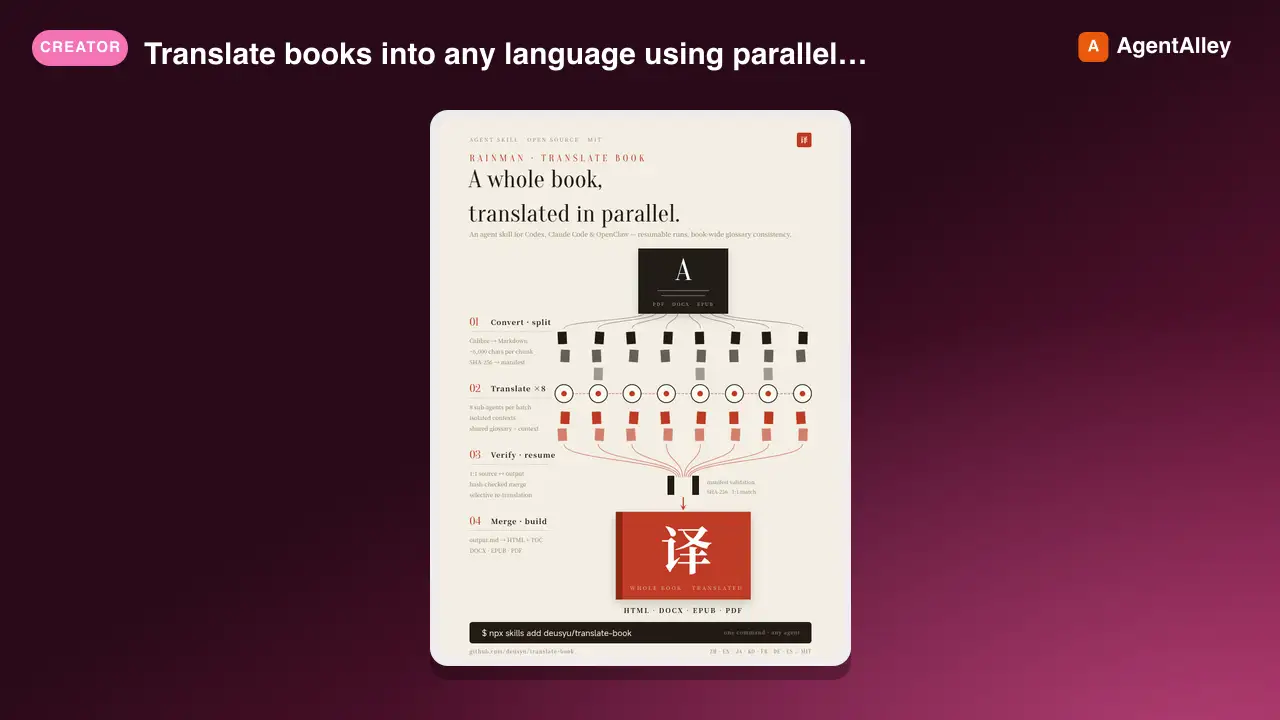 SkillBook Translator
 deusyu/translate-book · by deusyuTranslate books (PDF/DOCX/EPUB) into any language using parallel sub-agents. Converts input -> Markdown chunks -> translated chunks -> HTML/DOCX/EPUB/PDF.★ 2.1k GitHub stars
 SkillArabic Marketing Copy Localizer
 growthack88/growth-marketing-os · by growthack88Marketing copy localization skill that converts English marketing copy (ads, landing pages, emails, CTAs) into native Egyptian Arabic عامية — or GCC dialect on request — with natural English code-switching for business terms. Use whenever marketing copy needs an Arabic version, an Arabic draft "sounds translated", or a bilingual campaign is being built. Rebuilds meaning per line instead of translating words; never outputs فصحى for performance marketing contexts.★ 117 GitHub stars
 SkillMulti-Language Translator
 JimLiu/baoyu-skills · by JimLiuThis skill should be used when the user asks to "translate", "翻译", "精翻", "translate article", translate to Chinese", "translate to English", "改成中文", "改成英文", "convert to Chinese", localize", "本地化", "refined translation", "精细翻译", "proofread translation", "快速翻译", "快翻", 这篇文章翻译一下", or provides a URL/file with translation intent. Supports three modes (quick/normal/refined) with custom glossary support.★ 26.6k GitHub stars
 AgentDesign Implementation Bridge
 VoltAgent/awesome-claude-code-subagents · by VoltAgentUse this agent when you need to translate a DESIGN.md from the VoltAgent/awesome-design-md repository into polished Claude Code instructions for building user interfaces that faithfully match the chosen brand. Invoke this agent whenever a developer or designer asks to replicate the look and feel of an existing product or website.★ 25.2k GitHub stars
 SkillMultilingual Blog Auditor
 AgriciDaniel/claude-blog · by AgriciDanielAudit a directory of multilingual blog content for completeness, consistency, hreflang correctness, meta-tag parity, and freshness. Builds a translation coverage matrix, flags stale translations, validates hreflang and schema, and emits a prioritized report with runnable fix commands. Use when user says "locale audit", "blog locale-audit", "check translations", multilingual audit", "translation check", "hreflang check", Uebersetzungen pruefen".★ 2.2k GitHub stars
 SkillBlog Localization AdapterAgriciDaniel/claude-blog · by AgriciDanielDeep cultural adaptation of translated blog posts. Run after blog-translate completes. Goes beyond translation to swap brand examples, adapt CTAs, substitute legal references, localize statistic sources where possible, and adjust formality (Sie/du, tu/vous, formal/informal). Built-in profiles for DACH, Francophone, Hispanic, and Japanese markets. Use when user says "localize blog", "blog localize", "cultural adaptation", adapt for Germany", "lokalisieren", "localiser", "adaptar".★ 2.2k GitHub stars
More from AgriciDaniel
 SkillAgent Browsing AuditorAgriciDaniel/claude-seo · by AgriciDanielAudit and fix agent readiness: the Lighthouse Agentic Browsing fraction, accessibility tree for agents, robots.txt and Content-Signal for AI agents, WAF treatment of agent traffic, llms.txt, Markdown delivery, ai-catalog.json, /.well-known discovery files, and WebMCP tools. Exclude AI citability and brand signals (seo-geo) and commerce protocol depth (seo-ecommerce).★ 17.4k GitHub stars
 SkillAI Search OptimizationAgriciDaniel/claude-seo · by AgriciDanielOptimize content for AI Overviews (formerly SGE), ChatGPT web search, Perplexity, and other AI-powered search experiences. Generative Engine Optimization (GEO) analysis including brand mention signals, AI crawler accessibility, llms.txt compliance, passage-level citability scoring, and platform-specific optimization. Use when user says "AI Overviews", "SGE", GEO", "AI search", "LLM optimization", "Perplexity", "AI citations", ChatGPT search", or "AI visibility".★ 17.4k GitHub stars
 SkillBacklink Profile AnalysisAgriciDaniel/claude-seo · by AgriciDanielBacklink profile analysis: referring domains, anchor text distribution, toxic link detection, competitor gap analysis. Works with free APIs (Moz, Bing Webmaster, Common Crawl) and DataForSEO extension. Use when user says backlinks, link profile, referring domains, anchor text, toxic links, link gap, link building, disavow, or backlink audit.★ 17.4k GitHub stars
 SkillAmazon Ads AuditorAgriciDaniel/claude-ads · by AgriciDanielYou share your Amazon advertising numbers and goals; you get back a plain-language review of what's draining your budget and what to change first.★ 9.5k GitHub stars
 SkillApple Search Ads AuditorAgriciDaniel/claude-ads · by AgriciDanielPaste what you're spending on Apple Search Ads and your recent numbers; get back a plain review of what's wasting money and what to fix first.★ 9.5k GitHub stars
 SkillAttribution AuditorAgriciDaniel/claude-ads · by AgriciDanielPaste the sales and spend numbers each ad platform claims, and get back a plain explanation of why they disagree and which figure to trust.★ 9.5k GitHub stars