Ahrefs API Manager
Ahrefs python
Manages Ahrefs API usage in Python using `ahrefs-python` library. Use when working with SEO / marketing related tasks or with data including backlinks, keywords, domain ratings, organic traffic, site audits, rank tracking, and brand…
---
name: ahrefs-python
description: Manages Ahrefs API usage in Python using `ahrefs-python` library. Use when working with SEO / marketing related tasks or with data including backlinks, keywords, domain ratings, organic traffic, site audits, rank tracking, and brand monitoring. Covers `ahrefs-python` usage including AhrefsClient / AsyncAhrefsClient, typed request/response models, error handling, and all API sections.
---

# Ahrefs Python SDK Skill

## Overview

The Ahrefs API provides programmatic access to Ahrefs SEO data. The official Python SDK (`ahrefs-python`) provides typed request and response models for all endpoints, auto-generated from the OpenAPI spec.

Key capabilities:
- **Site Explorer** - Backlinks, organic keywords, domain rating, traffic, referring domains
- **Keywords Explorer** - Keyword research, volumes, difficulty, related terms
- **Rank Tracker** - SERP monitoring, competitor tracking
- **Site Audit** - Technical SEO issues, page content, page explorer
- **Brand Radar** - AI brand mentions, share of voice, impressions
- **SERP Overview** - Search result analysis
Overview
The Ahrefs API provides programmatic access to Ahrefs SEO data. The official Python SDK (ahrefs-python) provides typed request and response models for all endpoints, auto-generated from the OpenAPI spec.
Manual install (npx, ZIP)
npx skills add OpenClaudia/openclaudia-skills --skill ahrefs-python -g -a claude-codenpx degit OpenClaudia/openclaudia-skills/skills/ahrefs-research#main ~/.claude/skills/ahrefs-pythonConnects with Agent Alley MCP · agentalley.io/mcp
Files included
SKILL.md7.4 KB
Read SKILL.md here
Show the full text212 lines
Ahrefs Python SDK Skill
Overview
The Ahrefs API provides programmatic access to Ahrefs SEO data. The official Python SDK (ahrefs-python) provides typed request and response models for all endpoints, auto-generated from the OpenAPI spec.
Key capabilities:
- Site Explorer - Backlinks, organic keywords, domain rating, traffic, referring domains
- Keywords Explorer - Keyword research, volumes, difficulty, related terms
- Rank Tracker - SERP monitoring, competitor tracking
- Site Audit - Technical SEO issues, page content, page explorer
- Brand Radar - AI brand mentions, share of voice, impressions
- SERP Overview - Search result analysis
- Batch Analysis - Bulk domain/URL metrics via POST
Installation
pip3 install git+https://github.com/ahrefs/ahrefs-python.git
Requires Python 3.11+. Dependencies: httpx, pydantic.
API Method Discovery
The SDK has 52 methods across 7 API sections. The built-in search tool is the fastest way to find the right method — it returns matching method signatures, parameters, and return types directly, so there's no need to scan through a large reference.
Python (preferred when already in a Python context):
from ahrefs.search import search_api_methods

# Returns formatted text with method signatures, parameters, and return types
print(search_api_methods("domain rating"))

# Filter by API section and limit results
print(search_api_methods("backlinks", section="site-explorer", limit=3))
CLI (preferred when exploring from the terminal):
# Ensure python3 points to the interpreter where ahrefs-python is installed:
#   which python3
#   python3 -c "import ahrefs"
python3 -m ahrefs.api_search "domain rating"
python3 -m ahrefs.api_search "backlinks" --section site-explorer --limit 3
python3 -m ahrefs.api_search "batch" --json
python3 -m ahrefs.api_search --sections  # list all API sections
IMPORTANT RULES
- ALWAYS use the
ahrefs-pythonSDK. DO NOT make rawhttpx/requestscalls to the Ahrefs API. - ALWAYS pass dates as strings in
YYYY-MM-DDformat (e.g."2025-01-15"). - ALWAYS use
selecton list endpoints to request only the columns you need. List endpoints return all columns by default, which wastes API units and increases response size. - USE context managers (
with/async with) for client lifecycle management. - NEVER hardcode API keys in source code. Use the
AHREFS_API_KEYenvironment variable or your preferred secrets mechanism. - The client handles retries (429, 5xx, connection errors) automatically. DO NOT implement your own retry logic on top of the SDK.
Quick Start
import os
from ahrefs import AhrefsClient

with AhrefsClient(api_key=os.environ["AHREFS_API_KEY"]) as client:
    data = client.site_explorer_domain_rating(target="ahrefs.com", date="2025-01-15")
    print(data.domain_rating)  # 91.0
    print(data.ahrefs_rank)    # 3
SDK Patterns
Client Setup
import os
import ahrefs

with ahrefs.AhrefsClient(
    api_key=os.environ["AHREFS_API_KEY"],  # or any secrets source
    base_url="...",          # override API base URL (default: https://api.ahrefs.com/v3)
    timeout=30.0,            # request timeout in seconds (default: 60)
    max_retries=3,           # retries on transient errors (default: 2)
) as client:
    ...
Async client:
import os
from ahrefs import AsyncAhrefsClient

async with AsyncAhrefsClient(api_key=os.environ["AHREFS_API_KEY"]) as client:
    data = await client.site_explorer_domain_rating(target="ahrefs.com", date="2025-01-15")
For parallel calls, use asyncio.gather:
import asyncio

async with AsyncAhrefsClient(api_key=os.environ["AHREFS_API_KEY"]) as client:
    dr_ahrefs, dr_moz = await asyncio.gather(
        client.site_explorer_domain_rating(target="ahrefs.com", date="2025-01-15"),
        client.site_explorer_domain_rating(target="moz.com", date="2025-01-15"),
    )
Calling Methods
Two calling styles -- both are equivalent:
# Keyword arguments (recommended)
data = client.site_explorer_domain_rating(target="ahrefs.com", date="2025-01-15")

# Request objects (full type safety)
from ahrefs.types import SiteExplorerDomainRatingRequest
request = SiteExplorerDomainRatingRequest(target="ahrefs.com", date="2025-01-15")
data = client.site_explorer_domain_rating(request)
Method names follow {api_section}_{endpoint}, e.g. site_explorer_organic_keywords, keywords_explorer_overview.
Responses
Methods return typed Data objects directly.
Scalar endpoints return a single data object (or None):
data = client.site_explorer_domain_rating(target="ahrefs.com", date="2025-01-15")
print(data.domain_rating)
List endpoints return a list of data objects. There is no pagination — set limit to the number of results you need. Use select to request only the columns you need:
items = client.site_explorer_organic_keywords(
    target="ahrefs.com",
    date="2025-01-15",
    select="keyword,volume,best_position",
    order_by="volume:desc",
    limit=10,
)
for item in items:
    print(item.keyword, item.volume, item.best_position)
Error Handling
import ahrefs

try:
    data = client.site_explorer_domain_rating(target="example.com", date="2025-01-15")
except ahrefs.AuthenticationError:    # 401
    ...
except ahrefs.RateLimitError as e:    # 429 -- e.retry_after has the delay
    ...
except ahrefs.NotFoundError:          # 404
    ...
except ahrefs.APIError as e:          # other 4xx/5xx -- e.status_code, e.response_body
    ...
except ahrefs.APIConnectionError:     # network / timeout
    ...
All exceptions inherit from ahrefs.AhrefsError.
Common Parameters
Most list endpoints share these parameters:
| Parameter | Type | Description |
|---|---|---|
target |
str |
Domain, URL, or path to analyze |
date |
str |
Date in YYYY-MM-DD format |
date_from / date_to |
str |
Date range for history endpoints |
country |
str |
Two-letter country code (ISO 3166-1 alpha-2) |
select |
str |
Comma-separated columns to return |
where |
str |
Filter expression |
order_by |
str |
Column and direction, e.g. "volume:desc" |
limit |
int |
Max results to return |
Parameters typed as enums in the API reference (CountryEnum, VolumeModeEnum, etc.) accept plain strings — pass country="us" not CountryEnum("us").
The where parameter takes a JSON string. Use json.dumps() to build it:
import json
where = json.dumps({"field": "volume", "is": ["gte", 1000]})
items = client.site_explorer_organic_keywords(
    target="ahrefs.com", date="2025-01-15",
    select="keyword,volume", where=where,
)
For full filter syntax (boolean combinators, operators, nested fields), see references/filter-syntax.md.
API Methods
Use search_api_methods("query") or python3 -m ahrefs.api_search "query" to find methods by keyword. Search covers all 52 methods across 7 API sections and returns complete signatures, parameters, and response fields.
| 1 | |
| 2 | name ahrefs-python |
| 3 | description Manages Ahrefs API usage in Python using `ahrefs-python` library. Use when working with SEO / marketing related tasks or with data including backlinks, keywords, domain ratings, organic traffic, site audits, rank tracking, and brand monitoring. Covers `ahrefs-python` usage including AhrefsClient / AsyncAhrefsClient, typed request/response models, error handling, and all API sections. |
| 4 | |
| 5 | |
| 6 | # Ahrefs Python SDK Skill |
| 7 | |
| 8 | ## Overview |
| 9 | |
| 10 | The Ahrefs API provides programmatic access to Ahrefs SEO data. The official Python SDK (`ahrefs-python`) provides typed request and response models for all endpoints, auto-generated from the OpenAPI spec. |
| 11 | |
| 12 | Key capabilities: |
| 13 | **Site Explorer** - Backlinks, organic keywords, domain rating, traffic, referring domains |
| 14 | **Keywords Explorer** - Keyword research, volumes, difficulty, related terms |
| 15 | **Rank Tracker** - SERP monitoring, competitor tracking |
| 16 | **Site Audit** - Technical SEO issues, page content, page explorer |
| 17 | **Brand Radar** - AI brand mentions, share of voice, impressions |
| 18 | **SERP Overview** - Search result analysis |
| 19 | **Batch Analysis** - Bulk domain/URL metrics via POST |
| 20 | |
| 21 | ## Installation |
| 22 | |
| 23 | |
| 24 | pip3 install git+https://github.com/ahrefs/ahrefs-python.git |
| 25 | |
| 26 | |
| 27 | Requires Python 3.11+. Dependencies: `httpx`, `pydantic`. |
| 28 | |
| 29 | ## API Method Discovery |
| 30 | |
| 31 | The SDK has 52 methods across 7 API sections. The built-in search tool is the fastest way to find the right method — it returns matching method signatures, parameters, and return types directly, so there's no need to scan through a large reference. |
| 32 | |
| 33 | **Python** (preferred when already in a Python context): |
| 34 | |
| 35 | |
| 36 | from ahrefs.search import search_api_methods |
| 37 | |
| 38 | # Returns formatted text with method signatures, parameters, and return types |
| 39 | print(search_api_methods("domain rating")) |
| 40 | |
| 41 | # Filter by API section and limit results |
| 42 | print(search_api_methods("backlinks", section="site-explorer", limit=3)) |
| 43 | |
| 44 | |
| 45 | **CLI** (preferred when exploring from the terminal): |
| 46 | |
| 47 | |
| 48 | # Ensure python3 points to the interpreter where ahrefs-python is installed: |
| 49 | # which python3 |
| 50 | # python3 -c "import ahrefs" |
| 51 | python3 -m ahrefs.api_search "domain rating" |
| 52 | python3 -m ahrefs.api_search "backlinks" --section site-explorer --limit 3 |
| 53 | python3 -m ahrefs.api_search "batch" --json |
| 54 | python3 -m ahrefs.api_search --sections # list all API sections |
| 55 | |
| 56 | |
| 57 | ## IMPORTANT RULES |
| 58 | |
| 59 | ALWAYS use the `ahrefs-python` SDK. DO NOT make raw `httpx`/`requests` calls to the Ahrefs API. |
| 60 | ALWAYS pass dates as strings in `YYYY-MM-DD` format (e.g. `"2025-01-15"`). |
| 61 | ALWAYS use `select` on list endpoints to request only the columns you need. List endpoints return all columns by default, which wastes API units and increases response size. |
| 62 | USE context managers (`with` / `async with`) for client lifecycle management. |
| 63 | NEVER hardcode API keys in source code. Use the `AHREFS_API_KEY` environment variable or your preferred secrets mechanism. |
| 64 | The client handles retries (429, 5xx, connection errors) automatically. DO NOT implement your own retry logic on top of the SDK. |
| 65 | |
| 66 | ## Quick Start |
| 67 | |
| 68 | |
| 69 | import os |
| 70 | from ahrefs import AhrefsClient |
| 71 | |
| 72 | with AhrefsClient(api_key=os.environ["AHREFS_API_KEY"]) as client: |
| 73 | data = client.site_explorer_domain_rating(target="ahrefs.com", date="2025-01-15") |
| 74 | print(data.domain_rating) # 91.0 |
| 75 | print(data.ahrefs_rank) # 3 |
| 76 | |
| 77 | |
| 78 | ## SDK Patterns |
| 79 | |
| 80 | ### Client Setup |
| 81 | |
| 82 | |
| 83 | import os |
| 84 | import ahrefs |
| 85 | |
| 86 | with ahrefs.AhrefsClient( |
| 87 | api_key=os.environ["AHREFS_API_KEY"], # or any secrets source |
| 88 | base_url="...", # override API base URL (default: https://api.ahrefs.com/v3) |
| 89 | timeout=30.0, # request timeout in seconds (default: 60) |
| 90 | max_retries=3, # retries on transient errors (default: 2) |
| 91 | ) as client: |
| 92 | ... |
| 93 | |
| 94 | |
| 95 | Async client: |
| 96 | |
| 97 | |
| 98 | import os |
| 99 | from ahrefs import AsyncAhrefsClient |
| 100 | |
| 101 | async with AsyncAhrefsClient(api_key=os.environ["AHREFS_API_KEY"]) as client: |
| 102 | data = await client.site_explorer_domain_rating(target="ahrefs.com", date="2025-01-15") |
| 103 | |
| 104 | |
| 105 | For parallel calls, use `asyncio.gather`: |
| 106 | |
| 107 | |
| 108 | import asyncio |
| 109 | |
| 110 | async with AsyncAhrefsClient(api_key=os.environ["AHREFS_API_KEY"]) as client: |
| 111 | dr_ahrefs, dr_moz = await asyncio.gather( |
| 112 | client.site_explorer_domain_rating(target="ahrefs.com", date="2025-01-15"), |
| 113 | client.site_explorer_domain_rating(target="moz.com", date="2025-01-15"), |
| 114 | ) |
| 115 | |
| 116 | |
| 117 | ### Calling Methods |
| 118 | |
| 119 | Two calling styles -- both are equivalent: |
| 120 | |
| 121 | |
| 122 | # Keyword arguments (recommended) |
| 123 | data = client.site_explorer_domain_rating(target="ahrefs.com", date="2025-01-15") |
| 124 | |
| 125 | # Request objects (full type safety) |
| 126 | from ahrefs.types import SiteExplorerDomainRatingRequest |
| 127 | request = SiteExplorerDomainRatingRequest(target="ahrefs.com", date="2025-01-15") |
| 128 | data = client.site_explorer_domain_rating(request) |
| 129 | |
| 130 | |
| 131 | Method names follow `{api_section}_{endpoint}`, e.g. `site_explorer_organic_keywords`, `keywords_explorer_overview`. |
| 132 | |
| 133 | ### Responses |
| 134 | |
| 135 | Methods return typed Data objects directly. |
| 136 | |
| 137 | **Scalar endpoints** return a single data object (or `None`): |
| 138 | |
| 139 | |
| 140 | data = client.site_explorer_domain_rating(target="ahrefs.com", date="2025-01-15") |
| 141 | print(data.domain_rating) |
| 142 | |
| 143 | |
| 144 | **List endpoints** return a list of data objects. There is no pagination — set `limit` to the number of results you need. Use `select` to request only the columns you need: |
| 145 | |
| 146 | |
| 147 | items = client.site_explorer_organic_keywords( |
| 148 | target="ahrefs.com", |
| 149 | date="2025-01-15", |
| 150 | select="keyword,volume,best_position", |
| 151 | order_by="volume:desc", |
| 152 | limit=10, |
| 153 | ) |
| 154 | for item in items: |
| 155 | print(item.keyword, item.volume, item.best_position) |
| 156 | |
| 157 | |
| 158 | ### Error Handling |
| 159 | |
| 160 | |
| 161 | import ahrefs |
| 162 | |
| 163 | try: |
| 164 | data = client.site_explorer_domain_rating(target="example.com", date="2025-01-15") |
| 165 | except ahrefs.AuthenticationError: # 401 |
| 166 | ... |
| 167 | except ahrefs.RateLimitError as e: # 429 -- e.retry_after has the delay |
| 168 | ... |
| 169 | except ahrefs.NotFoundError: # 404 |
| 170 | ... |
| 171 | except ahrefs.APIError as e: # other 4xx/5xx -- e.status_code, e.response_body |
| 172 | ... |
| 173 | except ahrefs.APIConnectionError: # network / timeout |
| 174 | ... |
| 175 | |
| 176 | |
| 177 | All exceptions inherit from `ahrefs.AhrefsError`. |
| 178 | |
| 179 | ### Common Parameters |
| 180 | |
| 181 | Most list endpoints share these parameters: |
| 182 | |
| 183 | | Parameter | Type | Description | |
| 184 | |-----------|------|-------------| |
| 185 | | `target` | `str` | Domain, URL, or path to analyze | |
| 186 | | `date` | `str` | Date in YYYY-MM-DD format | |
| 187 | | `date_from` / `date_to` | `str` | Date range for history endpoints | |
| 188 | | `country` | `str` | Two-letter country code (ISO 3166-1 alpha-2) | |
| 189 | | `select` | `str` | Comma-separated columns to return | |
| 190 | | `where` | `str` | Filter expression | |
| 191 | | `order_by` | `str` | Column and direction, e.g. `"volume:desc"` | |
| 192 | | `limit` | `int` | Max results to return | |
| 193 | |
| 194 | Parameters typed as enums in the API reference (`CountryEnum`, `VolumeModeEnum`, etc.) accept plain strings — pass `country="us"` not `CountryEnum("us")`. |
| 195 | |
| 196 | The `where` parameter takes a JSON string. Use `json.dumps()` to build it: |
| 197 | |
| 198 | |
| 199 | import json |
| 200 | where = json.dumps({"field": "volume", "is": ["gte", 1000]}) |
| 201 | items = client.site_explorer_organic_keywords( |
| 202 | target="ahrefs.com", date="2025-01-15", |
| 203 | select="keyword,volume", where=where, |
| 204 | ) |
| 205 | |
| 206 | |
| 207 | For full filter syntax (boolean combinators, operators, nested fields), see `references/filter-syntax.md`. |
| 208 | |
| 209 | ## API Methods |
| 210 | |
| 211 | Use `search_api_methods("query")` or `python3 -m ahrefs.api_search "query"` to find methods by keyword. Search covers all 52 methods across 7 API sections and returns complete signatures, parameters, and response fields. |
| 212 |
Details
- License
- MIT
- Stars on the repo
- ★ 705
- Checked
- Source
- OpenClaudia/openclaudia-skills ↗
- Creator
- OpenClaudia · 78 listings
Similar skills
See all → SkillXberg Document Extractor
 xberg-io/xberg · by xberg-ioExtract text, tables, metadata, and images from 107 document formats (PDF, Office, images, HTML, email, archives, academic) using Xberg. Use when writing code that calls Xberg APIs in Python, Node.js/TypeScript, Rust, or CLI. Covers installation, extraction (sync/async), configuration (OCR, chunking, output format), batch processing, error handling, and plugins.★ 9.4k GitHub stars
 SkillCode Migration Validator
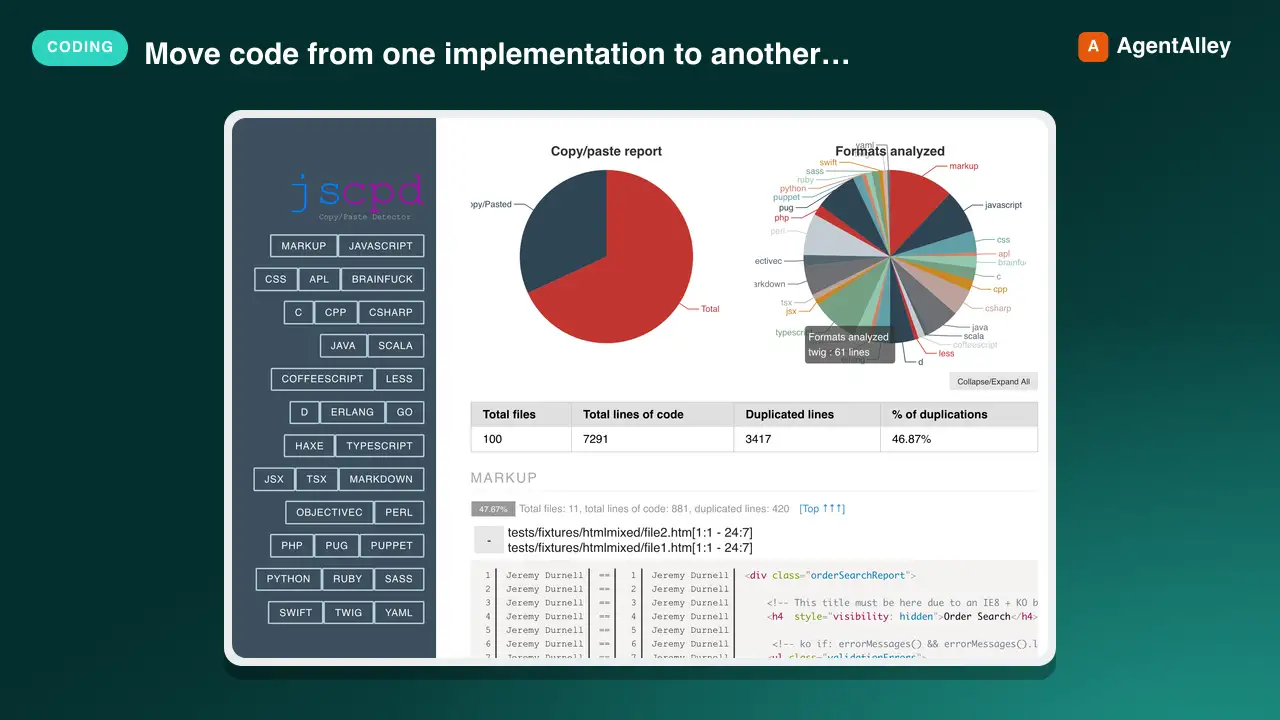
 kucherenko/jscpd · by kucherenkoMove code from one implementation to another function by function, tests first and code second, and check two implementations of one app for parity, with jscpd --compare as the progress measure and a coverage map binding each function to its tests. Use when porting a library or app to another language or framework (Java to Kotlin, JavaScript to Rust, a Python library to TypeScript, an iOS app to Android), when asked what is left to port, or when comparing the Android and iOS versions of an app.★ 6.3k GitHub stars
 AgentDocx to Markdown Translator
 dealfluence/adeu · by dealfluenceDocx ↔ LLM translator. Projects .docx office files to Markdown for editing. Projects edits back to OOXML as tracked changes (redlines). Python and Node.js implementations.★ 165 GitHub stars
 SkillAmazon White-Background Creator
 xianyu110/ecommerce-image-skills · by xianyu110Create an Amazon-compliant white-background main image (pure #FFFFFF background, product fills ≥85% of the frame, no text, props or watermark) from a product photo with GPT Image 2.5, then verify it with a Python check script. Use for Amazon/Walmart/eBay main images, 白底图, 白底主图, hero image, listing main photo.★ 92 GitHub stars
 AgentSendmux SDK
 Sendmux/sendmux-sdk · by SendmuxOfficial monorepo of SDKs, CLI, and MCP servers for Sendmux email APIs across TypeScript, Python, Go, PHP, Rust, and Ruby.★ 65 GitHub stars
 SkillSource-Driven Development
 addyosmani/agent-skills · by addyosmaniGrounds every implementation decision in official documentation. Use when you want to verify an approach against the official docs before implementing it, or when you want authoritative, source-cited code free from outdated patterns. Use when building with any framework or library where correctness matters.★ 98.7k GitHub stars
More from OpenClaudia
 SkillA/B Testing Framework
 OpenClaudia/openclaudia-skills · by OpenClaudiaDesign, plan, and analyze A/B tests with statistical rigor. Use when the user asks about A/B testing, split testing, experiment design, statistical significance, sample size calculation, test duration, multivariate testing, or conversion experiments. Trigger phrases include "A/B test", "split test", "experiment", "statistical significance", "sample size", "test duration", "which version wins", "conversion experiment", "hypothesis test", "variant testing".★ 705 GitHub stars
 SkillAffiliate Marketing ProgramOpenClaudia/openclaudia-skills · by OpenClaudiaBuild and manage an affiliate marketing program. Use when the user says "affiliate program", "affiliate marketing", "affiliate partners", "referral commissions", "affiliate network", "partner program", "affiliate tracking", or asks about creating, managing, or growing an affiliate or partner program.★ 705 GitHub stars
 SkillAI Citations Report GeneratorOpenClaudia/openclaudia-skills · by OpenClaudiaGenerate an AI Citations Report (GEO) for a domain — which AI-search prompts cite the site across Google AI Overview and ChatGPT, plus organic-traffic context and per-article citation coverage. Use when the user asks for an 'AI citations report', 'GEO citations report', or 'which AI prompts cite <domain>'.★ 705 GitHub stars
 SkillB2B Lead EnricherOpenClaudia/openclaudia-skills · by OpenClaudiaResearch and enrich B2B leads using the Apollo.io API. Use when the user says "find leads", "prospect research", "company enrichment", "find decision makers", "B2B leads", "lead research", "enrich contacts", "find VP of marketing at", or asks about finding people at specific companies or in specific roles.★ 705 GitHub stars
 SkillBacklink Health CheckerOpenClaudia/openclaudia-skills · by OpenClaudiaAudit a domain's backlink profile using the SemRush API. Use when the user says "audit backlinks", "check my backlinks", "backlink analysis", "link profile", "toxic links", "disavow", "link building opportunities", "referring domains", "anchor text", or asks about a site's link authority.★ 705 GitHub stars
 SkillBluesky Content CreatorOpenClaudia/openclaudia-skills · by OpenClaudiaCreate and manage content for Bluesky social network. Use when the user says "Bluesky post", "post to Bluesky", "Bluesky content", "Bluesky strategy", "AT Protocol", or asks about creating content for or engaging on Bluesky.★ 705 GitHub stars